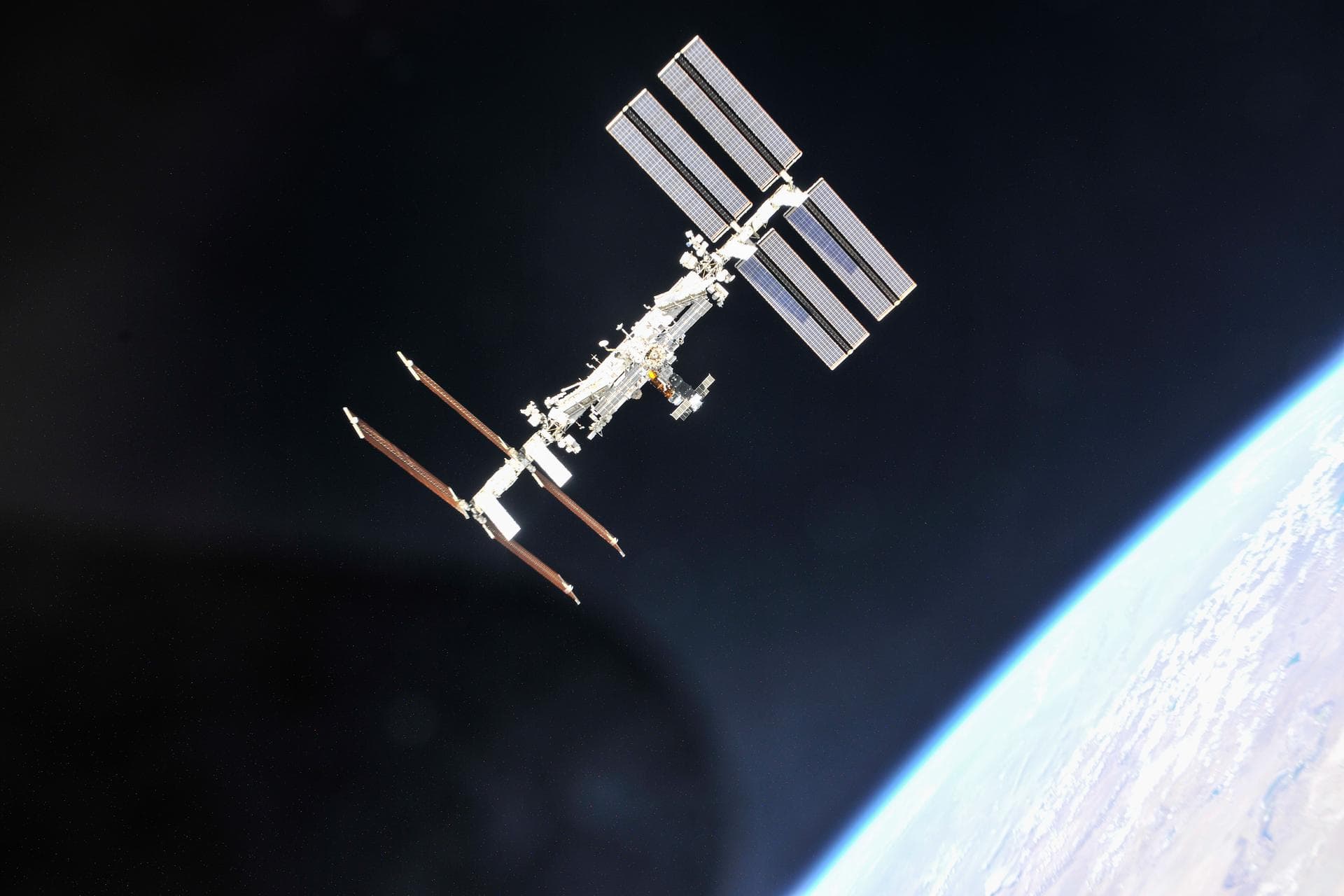
Tiangong ("heavenly palace") is China's space station, a three-module complex in low Earth orbit that has been staffed without interruption since the Shenzhou 14 crew arrived on June 5, 2022.[3][32] The station flies between 340 and 450 kilometers up,[1] in an orbit inclined about 41.5 degrees,[10] and its Tianhe, Wentian, and Mengtian modules give crews roughly 110 cubic meters of usable space.[1][9] The China Manned Space Agency (CMSA) operates it with rotating three-person crews that stay about six months, with six people aboard for a few days during handovers.[1][12] China assembled the station on its own: United States opposition excluded it from the International Space Station (ISS) partnership, and since 2011 the Wolf Amendment has barred NASA from spending federal funds on direct bilateral cooperation with the Chinese government.[4]
Three Long March 5B launches between April 2021 and October 2022 delivered the modules.[2][10] Station chief designer Yang Hong puts the complex at about 90 tonnes with spacecraft attached, roughly a fifth of the ISS's 420 tonnes, and plans to grow it to about 180 tonnes.[5][6] Chinese officials counted 267 science projects running aboard by mid-2026,[5] and the station's design life is more than 10 years, with China stating it intends to keep Tiangong permanently occupied at least that long.[1][12]
Status as of August 2026
The Shenzhou 23 crew of commander Zhu Yangzhu, Zhang Zhiyuan, and Li Jiaying, the first astronaut from Hong Kong, has been aboard Tiangong since May 24, 2026, and passed 80 days in orbit in mid-August, running brain-imaging experiments and emergency evacuation drills, according to Chinese state media.[19][20][21] One of the three is slated to stay a full year, which would be a national duration record.[19][20] The Tianzhou 10 freighter has been docked since May 11, 2026, carrying about 6.2 tonnes of supplies that included spacesuits rated for 20 uses over four years.[22] The spacecraft rotation returned to normal on May 29, when the Shenzhou 21 crew landed in the Shenzhou 22 capsule that had been launched uncrewed after debris damage grounded Shenzhou 20 in late 2025.[11] In June, officials announced a 20-tonne expansion module that will turn the T-shaped station into a cross,[5] and two Pakistani pilots were in training for a short visiting mission expected around late 2026.[29][31]
History
Tiangong-1 and Tiangong-2
China laid out its space station ambition in 1992 and worked toward it through two small orbital laboratories.[7] Tiangong-1, an experimental laboratory launched in 2011, came first; ground controllers lost contact with it in 2016, and it reentered the atmosphere uncontrolled in April 2018.[7] Tiangong-2, an 8.6-tonne, 10.4-meter laboratory launched in September 2016, hosted astronauts Jing Haipeng and Chen Dong for most of the 33-day Shenzhou 11 mission and received the first Tianzhou cargo spacecraft in April 2017, which demonstrated the in-orbit refueling a permanent station would need.[7] China deliberately deorbited the laboratory over the South Pacific on July 19, 2019.[7]
Both laboratories were steppingstones toward 20-tonne-class modules for a full station.[7] The parallel political fact was exclusion: the Wolf Amendment, added to a US appropriations law in 2011 by then representative Frank Wolf, prohibits NASA from spending federal funds on direct bilateral cooperation with the Chinese government, and China was excluded from the ISS project.[4] Responsibility for the resulting national program sits with CMSA, China's human spaceflight agency (also rendered as the China Manned Space Engineering Office), while the civil agency CNSA runs robotic exploration such as the Chang'e 7 lunar mission.[7][12]
Assembly, 2021-2022
The Tianhe core module launched on a Long March 5B on April 29, 2021.[2][26] The first resident crew, Shenzhou 12, lived aboard from June 17 to September 17, 2021, after the Tianzhou 2 cargo craft stocked the module that May.[2] The Wentian laboratory followed on July 24, 2022,[8] and Mengtian launched on October 31, 2022, docking with Tianhe's forward port less than 13 hours later.[10] Ground teams then moved Mengtian to a lateral port, mirroring Wentian's September repositioning, which completed the station's T shape.[9][10] Continuous occupation had already begun with Shenzhou 14's arrival on June 5 of that year,[3][32] and direct in-orbit handovers between arriving and departing crews began in December 2022 with the Shenzhou 14 to Shenzhou 15 rotation.[11]
Structure and orbit
Tiangong's three modules meet at a docking hub on Tianhe, which carries the station's flight control systems and the crew's main living quarters; Wentian duplicates key station-management functions as a backup.[1][8] The complex offers about 110 cubic meters of usable volume, sleeping quarters for six across Tianhe and Wentian, and docking ports for Shenzhou crew ferries and Tianzhou freighters at either end.[1][9][12]
| Module | Launched | Size and mass | Role |
|---|---|---|---|
| Tianhe (core) | April 29, 2021[2] | 16.6 m long, 4.2 m maximum diameter, 22.5 t[1] | Life support, propulsion, flight control, crew quarters, docking hub[1][2] |
| Wentian | July 24, 2022[8] | 17.9 m long, about 23 t[9] | Life science laboratory with 8 experiment cabinets, main spacewalk airlock, small robotic arm, backup station control, 22 external payload adapters[8][9] |
| Mengtian | October 31, 2022[10] | 17.9 m long, 4.2 m diameter, about 22 t[10] | Fluid physics, combustion, and materials laboratory; payload airlock and a release mechanism that can deploy small satellites of up to 100 kg[10] |
The station's operating band is 340 to 450 kilometers in altitude, and in practice it has flown near 380 to 390 kilometers, in an orbit inclined about 41.5 degrees.[1][10] The three modules alone come to about 66 tonnes,[1] and the complex masses around 90 tonnes once crew and cargo spacecraft are attached,[5] against roughly 420 tonnes for the ISS.[6]
Crew and cargo operations
Crew transport runs on one route: Shenzhou spacecraft launched on Long March 2F rockets from the Jiuquan Satellite Launch Center in the Gobi Desert.[12][14] Standard missions last about six months, and CMSA keeps a backup Long March 2F and Shenzhou at Jiuquan that can be readied in roughly 8.5 days in the best case, a rolling-lifeboat arrangement that was exercised for real in late 2025.[12] Cargo flies separately: Tianzhou freighters launch on Long March 7 rockets from Wenchang, deliver several tonnes of supplies and propellant per flight, and burn up on reentry when discarded.[22][23] Tianzhou 10, launched May 11, 2026, carried about 6.2 tonnes across more than 220 items, from crew consumables and propellant to mouse and zebrafish embryos and a new extravehicular suit.[22] Because Tianzhou is destroyed on reentry, the station's only way to bring experiments home is the small cargo allowance on returning Shenzhou capsules, a downmass gap the planned Haolong spaceplane is meant to close.[23]
Spacewalks stage from Wentian's airlock with support from the station's robotic arm; recent crews have used them to bolt debris shielding onto exposed sections and inspect external equipment.[18]
Recent Shenzhou missions
| Mission | Launched | Crew | Outcome |
|---|---|---|---|
| Shenzhou 19 | October 30, 2024 | Cai Xuzhe, Song Lingdong, Wang Haoze | Returned April 30, 2025, after 183 days; Wang Haoze was China's first female spaceflight engineer aboard the station[13] |
| Shenzhou 20 | April 24, 2025 | Chen Dong, Chen Zhongrui, Wang Jie | Crew returned November 14, 2025, aboard the Shenzhou 21 spacecraft after debris cracked their own capsule's window; the repaired capsule landed empty on January 19, 2026[12][14][17] |
| Shenzhou 21 | October 31, 2025 | Zhang Lu, Wu Fei, Zhang Hongzhang | Crew returned May 29, 2026, aboard the Shenzhou 22 spacecraft after 210 days, a mission extended about a month by the debris episode[11][15][18] |
| Shenzhou 22 | November 25, 2025 (uncrewed) | None | Emergency replacement spacecraft launched to restore the station's lifeboat; brought the Shenzhou 21 crew home on May 29, 2026[11][16] |
| Shenzhou 23 | May 24, 2026 | Zhu Yangzhu, Zhang Zhiyuan, Li Jiaying | Aboard as of August 22, 2026; one crew member is slated for a yearlong stay[19][20][21] |
The Shenzhou 20 debris strike
The station's first major emergency came from space debris. Hours before the Shenzhou 20 crew was due to undock on November 5, 2025, engineers found damage to their docked spacecraft, and CMSA later concluded from photographs, design review, simulation, and wind tunnel testing that the return capsule's window glass had a small crack, most likely from a debris impact, and did not meet the requirements for a safe crewed return.[12] The crew came home on November 14 in the newer Shenzhou 21 spacecraft instead, leaving the Shenzhou 21 crew temporarily without a return vehicle.[12] China answered with the backup it keeps at Jiuquan: the uncrewed Shenzhou 22 launched on November 25, 2025, about six months ahead of its planned crewed slot, carrying supplies and a specially designed window treatment.[16][17] Astronauts inspected and repaired the damaged capsule during a December spacewalk, and the empty Shenzhou 20 was landed, carrying only cargo, on January 19, 2026.[17][18] The episode made the Shenzhou 20 crew the first Chinese astronauts to spend more than 200 days in space, stretched Shenzhou 21's mission by about a month, and gave the rescue posture, one spare rocket and spacecraft in near readiness at all times, its first operational test.[12][18]
Science
Research aboard Tiangong divides between the two laboratory modules. Wentian's eight experiment cabinets concentrate on biology and life science, from plant and microbe growth to animal studies, and its 22 external adapters hold payloads that need direct exposure to space.[9] Mengtian covers fluid physics, combustion, materials science, and space technology tests, and its payload airlock lets the station's small robotic arm move experiments outside without a spacewalk.[9][10] By June 2026, officials said 267 science projects were operating aboard, 86 of them added in the preceding year, and the station had returned more than 150 terabytes of data.[5]
Recent crews have widened the biological work. Shenzhou 21 carried four mice, the station's first rodent research subjects, for behavioral studies in microgravity,[15] and Shenzhou 23's program spans more than 100 new projects in space life science, materials, microgravity fluid physics, and aerospace medicine, including a record-length crewed stay.[19] International experiments have a formal route aboard: a 2019 selection run with the United Nations Office for Outer Space Affairs accepted nine projects, six outright and three conditionally, from institutions in 17 countries.[25]
Expansion and future plans
More modules
Tiangong's next phase is growth. Officials confirmed in 2025 that the Long March 5B will launch additional modules,[26] and in June 2026 Chinese state media detailed the first step: a roughly 20-tonne multifunctional module that will dock with Tianhe and turn the T shape into a cross, adding docking ports so more spacecraft can berth at once, a second spacewalk hatch, and more storage and experiment space.[5][27] Chief designer Yang Hong has described an eventual six-module configuration that would double the station's mass to about 180 tonnes and allow specialized research modules.[5] No launch dates for the new modules had been announced as of August 2026.[5][26]
Xuntian and new spacecraft
The Xuntian space telescope is designed to share Tiangong's orbit rather than attach to it. The 2-meter-aperture observatory carries a 2.5-gigapixel survey camera with a field of view about 300 times larger than the Hubble Space Telescope's, and it will dock with the station periodically for servicing.[26][28] Its launch has slipped repeatedly, from initial plans for around 2023-2024 to a target of 2027.[10][28]
Cargo transport is opening to new suppliers. CMSA selected two low-cost resupply vehicles to complement Tianzhou: the Qingzhou spacecraft from the Chinese Academy of Sciences' Innovation Academy for Microsatellites, a single-module freighter with 27 cubic meters of volume for up to about 1.8 to 2 tonnes of cargo, and the Haolong reusable spaceplane from the AVIC Chengdu Aircraft Design Institute, a roughly 10-meter, 7-tonne vehicle that would land on a runway and return experiments to Earth.[23] A 4.2-tonne Qingzhou prototype reached orbit on the debut of the Kinetica 2 rocket on March 30, 2026, with the first full cargo flight to the station expected within about a year of that test.[24] Haolong is slated to launch on LandSpace's reusable Zhuque-3 rocket.[23] China is also developing a partially reusable new-generation crew spacecraft whose low Earth orbit version could carry as many as six or seven astronauts to Tiangong; its lunar variant, Mengzhou, anchors the separate crewed Moon program targeting a landing before 2030.[26]
International crews
Tiangong has yet to host a foreign astronaut, but the first is in training. Under a February 2025 agreement between CMSA and Pakistan's space agency SUPARCO, China is preparing a Pakistani astronaut for a short-duration station mission as a payload specialist.[29] Two Pakistan Air Force pilots, Muhammad Zeeshan Ali and Khurram Daud, were named for training in 2026,[30] and one of them is expected to fly around late 2026, conducting Pakistani experiments alongside routine crew duties.[29][31] CMSA has said it is discussing astronaut flights with other countries as well.[26] The expansion push comes as the ISS approaches the end of its planned operating life around 2030.[27]
References
- More details of China's space station unveiled - China National Space Administration, May 27, 2020.
- Tiangong, China's space station - The Planetary Society.
- Veteran taikonaut, 2 rookies launched on long-duration Chinese space station flight - CBS News, April 25, 2024.
- Can the U.S. and China Cooperate in Space? - Scientific American, August 2, 2021.
- China's space station to be expanded to unlock broader future - Xinhua, June 23, 2026.
- International Space Station Facts and Figures - NASA.
- China's Tiangong-2 space lab reenters over South Pacific - SpaceNews, July 19, 2019.
- Wentian Lab Module - China Manned Space Agency.
- Tiangong space station marks key step in assembly - China National Space Administration, September 30, 2022.
- Final module docks at China's Tiangong space station - SpaceNews, October 31, 2022.
- China's Shenzhou-21 Crew Returns to Earth - SpacePolicyOnline, May 29, 2026.
- Shenzhou-20 astronauts safely return to Earth on Shenzhou-21 spacecraft after space debris damage concerns - SpaceNews, November 14, 2025.
- China's Shenzhou-19 astronauts return to Earth after six-month mission - SpaceNews, April 30, 2025.
- Shenzhou-20 crewed spacecraft arrives at Tiangong space station - SpaceNews, April 24, 2025.
- China launches Shenzhou 21 mission, carrying 3 taikonauts, and 4 mice, to replace space station crew - CBS News, October 31, 2025.
- China launches Shenzhou 22 spacecraft to assist in return of 3 astronauts stranded on Tiangong space station - PBS News, November 25, 2025.
- Repaired Shenzhou-20 Returns to Earth Empty - SpacePolicyOnline, January 19, 2026.
- Shenzhou-21 astronauts complete third spacewalk, mission extended by a month - SpaceNews, April 17, 2026.
- Xinhua Headlines: China launches Shenzhou-23 spaceship, for new in-orbit stay record, cutting-edge space science - Xinhua, May 25, 2026.
- China launches Shenzhou 23 spacecraft with 1 of 3 astronauts set for yearlong stay - NPR, May 25, 2026.
- Over 80 days aboard Tiangong: Shenzhou-23 crew presses ahead with space experiments - People's Daily Online, August 18, 2026.
- China Focus: China launches Tianzhou-10 cargo craft to send space station supplies - Xinhua, May 11, 2026.
- China to launch 2 new space station cargo spacecraft on commercial rockets in 2025 - SpaceNews, February 2025.
- China's Kinetica-2 rocket debuts successfully, sending prototype cargo spacecraft to orbit - SpaceNews, March 30, 2026.
- UNOOSA and CMSA announce winners of opportunity to fly experiments on board China Space Station - United Nations Office for Outer Space Affairs, June 12, 2019.
- China to launch new modules to Tiangong space station - SpaceNews, May 9, 2025.
- China plans to double the size of its Tiangong space station while the ISS nears its end - Space.com, June 2026.
- China previews how powerful its new Xuntian space telescope will be ahead of 2027 launch - Space.com, 2026.
- China to train Pakistani astronaut for Tiangong space station mission - SpaceNews, February 2025.
- China names 2 Pakistani astronauts chosen to train for Tiangong space station mission - South China Morning Post, April 2026.
- Two Pakistani candidates shortlisted to train for China space station mission - Dawn.
- Shenzhou-14 crewed spaceship mission launched successfully - China Manned Space Agency, June 5, 2022.