The International Space Station (ISS) is a modular research complex about 400 kilometers above Earth, the largest structure humans have assembled in space, and it has been staffed without interruption since November 2, 2000.[2] Five agencies operate it together: NASA, Russia's Roscosmos, the European Space Agency (ESA), Japan's JAXA, and the Canadian Space Agency (CSA), which together represent the 15 nations that signed the partnership agreements.[1][2]
Assembly began in 1998, and each partner controls the hardware it supplied.[1] By August 2026, 295 people from 26 countries had visited the station.[2][3] NASA counted more than 4,000 investigations involving more than 5,000 researchers over the station's life, spanning biology, human physiology, combustion, fluid physics, materials, astronomy, and Earth observation.[4] The partners' published plan is to operate through 2030 and then conduct a controlled deorbit over an unpopulated ocean area.[1]
Status as of August 2026
The International Space Station was fully staffed and operating normally in mid-August 2026. Expedition 75 began on July 26 under NASA commander Jessica Meir, with four of its seven crew members launched on SpaceX Crew-12 and three on Soyuz MS-29.[36][37][39] Meir and Anil Menon completed a 6-hour, 27-minute spacewalk on August 6 to prepare a power channel for a future roll-out solar array,[40] and NASA set September 12, 2026, as the earliest launch date for Crew-13.[41] The partner governments' commitment to operate the station through 2030 stood unchanged, and Russia was planning Russian-segment operations through the same year.[1] A Senate bill directing an extension through 2032 cleared committee in March 2026 but had not become law.[46] SpaceX continued development of the US Deorbit Vehicle under its 2024 contract, valued at up to $843 million,[43] and NASA's commercial-successor procurement schedule called for a final Phase 2 solicitation in August 2026, with no replacement station yet in orbit.[47]
Origins and assembly
The ISS grew from NASA's Space Station Freedom project, approved in 1984. Canada, Japan, and European nations joined during the 1980s. Russia was invited into the redesigned program in 1993, bringing experience and hardware developed for Mir-2. The 1995-1998 Shuttle-Mir missions then gave US and Russian teams practical experience with joint flights, crew exchanges, docking, and long-duration operations before ISS assembly began.[5]
Fifteen governments signed the International Space Station Intergovernmental Agreement on January 29, 1998. It established the government-level framework, while memoranda of understanding between NASA and the other four agencies set out the agencies' responsibilities.[6][7]
The Russian-built, US-funded Zarya Functional Cargo Block launched on a Proton rocket on November 20, 1998. Space Shuttle Endeavour delivered the US Unity connecting node in December. Russia's Zvezda service module docked in July 2000, adding living quarters, life support, flight control, communications, and propulsion needed for permanent habitation.[8] Expedition 1 commander William Shepherd and flight engineers Yuri Gidzenko and Sergei Krikalev arrived on November 2, 2000.[9]
NASA counts 42 flights that delivered the station's large assembly elements: 37 Space Shuttle missions and five Russian Proton or Soyuz launches.[2] Later cargo flights also installed upgrades and externally carried equipment.[8] The table groups the principal pieces by function rather than listing every truss spacer, adapter, airlock, and logistics carrier.
| Assembly group | Main elements and arrival | What they added |
|---|---|---|
| Initial core | Zarya and Unity, 1998; Zvezda, 2000 | Zarya supplied early power, propulsion, and storage; Unity connected US and Russian elements; Zvezda made continuous habitation possible.[8] |
| US laboratories and habitation | Destiny, 2001; Quest airlock, 2001; Harmony, 2007; Tranquility and Cupola, 2010; Permanent Multipurpose Module, 2011 | Research racks, US-based spacewalk support, docking and laboratory connections, life-support equipment, observation, storage, and additional living space.[8] |
| International laboratories | ESA's Columbus, 2008; JAXA's Kibo complex, assembled 2008-2009 | Columbus added a European pressurized laboratory and external experiment sites. Kibo added a laboratory, logistics module, exposed facility, airlock, and robotic arm.[8] |
| Truss, power, and thermal control | Main truss segments and original solar arrays, 2000-2009; six ISS Roll-Out Solar Arrays, 2021-2023 | The truss carries power channels, batteries, radiators, communications equipment, the mobile transporter, and solar arrays. The roll-out arrays supplement the older wings.[8] |
| Robotics and external logistics | Canadarm2, 2001; Mobile Base System, 2002; Dextre, 2008; Bishop commercial airlock, 2020 | The Canadian Mobile Servicing System moves equipment and captures uncrewed vehicles. Bishop transfers larger commercial payloads between the cabin and space.[8] |
| Later Russian expansion | Poisk, 2009; Rassvet, 2010; Nauka, 2021; Prichal, 2021 | These elements added docking ports, storage, research and habitation space, another European robotic arm base, and fuel-transfer connections. Prichal was the most recent pressurized module added as of August 2026.[8] |
Structure and orbit
The International Space Station has two operationally distinct but physically and functionally connected regions. The Russian Orbital Segment includes Zarya, Zvezda, Poisk, Rassvet, Nauka, and Prichal. The United States Orbital Segment includes the US elements and the European, Japanese, and Canadian contributions. It is not practical to separate the two segments into self-sufficient stations because their power, propulsion, attitude control, life support, data, software, and structural connections were designed to work together.[1]
The complex spans 109 meters across its solar-array wings and has a 94-meter main truss. Its mass is about 419,725 kilograms, although the value changes as vehicles, propellant, cargo, and waste arrive or depart. NASA lists 1,005 cubic meters of pressurized volume, of which about 388 cubic meters is habitable. Eight original solar-array wings provide roughly 75 to 90 kilowatts of power, augmented by the six roll-out arrays installed from 2021 through 2023.[2][8]
The ISS travels at about 28,000 kilometers per hour and completes an orbit in roughly 90 minutes, or about 16 orbits per day. Its altitude is maintained near 400 kilometers but changes with atmospheric drag and reboost maneuvers.[2] The 51.6-degree inclination lets vehicles launched from Baikonur reach the station without the large payload penalty that a lower-inclination orbit would impose. It also carries the station's ground track between 51.6 degrees north and south latitude.[1][10]
Governance and partner responsibilities
The ISS partnership's legal structure has three levels. The 1998 Intergovernmental Agreement is a treaty among the partner governments. Four memoranda of understanding link NASA with Roscosmos, ESA, JAXA, and CSA. More detailed bilateral arrangements cover matters such as hardware, crew time, transport, operations, and use of research facilities.[7] Each partner retains jurisdiction and control over the elements it registers and over its nationals aboard. Partners also exchange hardware, services, transport, and operating resources through barter arrangements rather than billing one another for every contribution.[7][11]
Partner roles
| Partner | Principal responsibilities and facilities |
|---|---|
| NASA | Leads integrated US-segment operations, manages the Destiny laboratory and US nodes, provides most station electrical power and Tracking and Data Relay Satellite communications, and coordinates overall operations from Mission Control Center Houston. Payload Operations Integration Center at Marshall Space Flight Center manages US research operations.[1][8][12] |
| Roscosmos | Manages the Russian segment from Mission Control Center Moscow. Russian modules and Progress vehicles provide the station's main propulsion for reboost, major attitude maneuvers, and debris-avoidance burns.[1][8][12] |
| ESA | Operates Columbus from the Columbus Control Centre in Germany and supplies research facilities, crew, and services. ESA previously provided Automated Transfer Vehicle cargo and reboost flights and continues to settle part of its operating share through barter with NASA.[8][11][12] |
| CSA | Supplied Canadarm2, Dextre, and the Mobile Base System. Canadian controllers and engineering teams support robotics used for station assembly, maintenance, payload handling, and the capture of visiting cargo vehicles.[8][12][13] |
| JAXA | Owns and operates Kibo, including its exposed facility and robotic arm, with teams at Tsukuba Space Center and Mission Control Center Houston. JAXA also developed the HTV and current HTV-X cargo systems.[8][12][14] |
Mission control is distributed, not centralized in one room. Houston and Moscow command their respective segments while coordinating integrated flight rules. Controllers in Germany and Japan operate Columbus and Kibo, and payload controllers at Marshall coordinate experiment timelines with investigators. Crew members are trained deeply on their own segment's emergency and maintenance procedures; NASA states that US and Russian crew are not interchangeable for every failure response.[1][12]
Life support and daily operation
The ISS Environmental Control and Life Support System maintains cabin pressure, oxygen, water, temperature, humidity, ventilation, and waste processing. On the US segment, the Water Recovery System processes humidity condensate and urine. The Air Revitalization System removes carbon dioxide and trace contaminants. The Oxygen Generation System splits water by electrolysis, while a Sabatier reactor combines waste hydrogen with carbon dioxide to make water that can re-enter the recovery loop.[15]
NASA's often-cited 98 percent water-recovery figure is a demonstrated system milestone, not a simple statement that every water stream is always recycled at that rate. In 2023, operation of the Brine Processor Assembly raised the station's overall water recovery to 98 percent during the demonstration by extracting additional water from urine-processing brine.[16] The Russian segment has separate oxygen generation and carbon-dioxide removal systems, giving the crew dissimilar equipment and added redundancy.[1]
Microgravity shifts fluids and causes bone and muscle loss, so crew members normally exercise for at least two hours a day using a treadmill, cycle ergometer, and resistance device.[2] The rest of a working day is divided among research, equipment servicing, cargo transfers, medical checks, vehicle operations, and housekeeping.[2][12] Continuous maintenance becomes more demanding as station hardware ages, particularly where replacement parts are obsolete or upgrades have been deferred.[17]
Power, orientation, and reboost
Four US control-moment gyroscopes normally orient the ISS without consuming propellant. Russian thrusters take over during dockings, major maneuvers, and gyroscope saturation. Russian modules and Progress cargo craft supply the main capability for raising the orbit and avoiding debris. Northrop Grumman's Cygnus can perform limited reboosts, but NASA says it cannot replace the Russian segment's attitude control or sustained propulsion functions. US solar arrays also transfer power to the Russian segment, while NASA's relay satellites carry communications for the whole complex.[1]
Atmospheric drag steadily lowers the orbit, so reboost is a recurring requirement. Controllers also track conjunction warnings and can command a debris-avoidance maneuver when the calculated risk warrants one. These dependencies are why simply detaching either main segment is not a workable retirement plan.[1]
Aging and known risks
NASA's Office of Inspector General identified micrometeoroid and orbital-debris impacts and cracks in the Russian service-module transfer tunnel as leading safety risks to ISS operations through 2030. The audit also found that aging hardware and deferred upgrades could increase maintenance demands as the oldest structures pass their original 30-year design horizon.[17]
The transfer tunnel, called PrK, has developed cracks and small atmospheric leaks since 2019. During cargo work in early June 2026, Roscosmos measured a rise in leakage to about two pounds of air per day and found new suspected areas. A proposed repair involving a structural bracket was judged to carry elevated risk, so five crew members temporarily sheltered in their docked Dragon. Roscosmos paused the procedure for further measurements, after which the crew left safe haven and normal operations resumed.[18] The episode did not close the station, but it illustrates why leak rate, structural condition, and repair methods are monitored jointly.
How can you see the ISS from the ground?
Seeing the ISS from the ground requires no equipment. The station reflects enough sunlight to reach about magnitude -4 on a high overhead pass, at times outshining Venus, and it crosses the sky in a few minutes as a steady, unblinking point of light moving from west to east.[19][20] Sightings cluster within an hour or two of local sunrise or sunset: the observer stands in twilight or darkness while the station, 400 kilometers up, still catches the Sun. Passes that stay low on the horizon look more like an ordinary bright star.[20]
NASA's Spot the Station website and mobile app list upcoming passes for any location, send alerts shortly before a flyover, and include an augmented reality view that shows where to look.[19]
Research
Long-duration microgravity, a crew that can tend instruments, and exposure sites outside the station let ISS experiments use conditions not available to short uncrewed satellites.[21][22] By March 2026, NASA reported more than 4,000 investigations involving more than 5,000 researchers.[4] Congress designated the US portion as a national laboratory in 2005. NASA selected the nonprofit Center for the Advancement of Science in Space to manage non-NASA use of that laboratory, and in 2022 extended the management agreement through September 2027.[21]
Removing gravity-driven convection, buoyancy, and sedimentation changes how flames, liquids, colloids, cells, tissues, and crystals behave. Station investigations have therefore included macromolecular crystal growth, combustion safety, fluid physics, plant and microbial biology, human health, materials exposure, technology demonstrations, Earth imaging, and astronomy.[22] Results range from exploratory studies with small samples to mature instruments collecting billions of events, so their evidentiary weight is not uniform.
Selected peer-reviewed results
| Investigation | Result supported by the published study | Important limit or interpretation |
|---|---|---|
| NASA Twins Study | A multidimensional comparison of Scott Kelly's 340-day flight with his identical twin Mark found changes in telomere length, gene expression, DNA damage, metabolism, immune response, microbiome, and cognition. Many measures returned near preflight values after landing, while some short telomeres and gene-expression changes persisted.[23] | It was an intensive study of one twin pair, useful for generating hypotheses and measuring one long flight but not for estimating population-wide risks by itself.[23] |
| Cold Atom Laboratory | Researchers produced rubidium Bose-Einstein condensates in an orbiting laboratory, including subnanokelvin gases with free-expansion times longer than one second. The work demonstrated quantum-gas experiments that are difficult to sustain against gravity on Earth.[24] | It established an experimental capability; it was not a test of a single new fundamental theory.[24] |
| Alpha Magnetic Spectrometer | The AMS collaboration measured the cosmic-ray positron fraction from 0.5 to 350 gigaelectronvolts using 6.8 million positron and electron events. The fraction rose above 10 GeV and its slope decreased at higher energy.[25] | The spectrum constrains proposed sources, including pulsars and dark-matter models, but the measurement did not identify one source or constitute a dark-matter detection.[25] |
| NICER neutron-star timing | Pulse-profile modeling of PSR J0030+0451 produced simultaneous mass and radius constraints, providing information about the equation of state of ultradense neutron-star matter.[26] | The inference depends on models of the star's hot regions and relativistic pulse shapes, and this result concerns one pulsar.[26] |
| Skeletal muscle-on-a-chip | Engineered human muscle exposed to station microgravity for seven days showed shifts toward lipid and fatty-acid metabolism and increased apoptotic gene expression. IGF-1 and a 15-PGDH inhibitor partially reduced some microgravity-associated effects.[27] | The study used cells from two donors per group. It demonstrated a screening platform and biological response, not an approved treatment for muscle loss.[27] |
Protein-crystal, combustion, and fluid experiments are often incremental rather than single headline discoveries. Their value is in controlled data that improve molecular structures, fire-safety models, multiphase-flow models, and the design of spacecraft systems where buoyancy cannot be assumed.[22]
Crew and cargo transportation
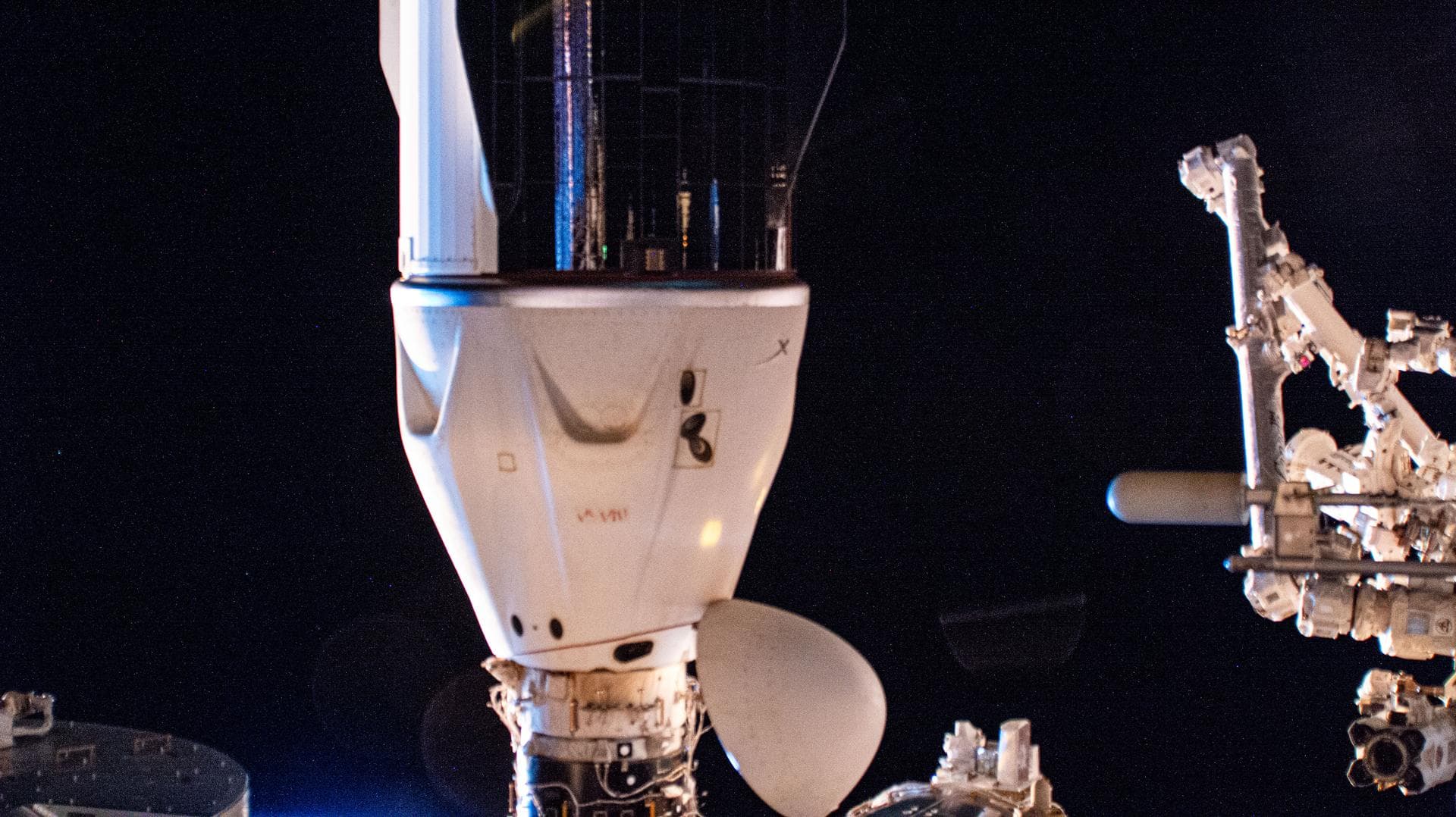
The ISS depends on overlapping transport systems. Crewed vehicles remain docked as emergency return craft, while cargo vehicles replenish food, water, gases, experiments, maintenance hardware, and propellant. Vehicles that burn up on reentry also remove waste; return-capable Dragons bring research samples and failed hardware back to Earth.[28]
| Vehicle | Station role | Operational status on August 12, 2026 |
|---|---|---|
| SpaceX Crew Dragon | NASA Commercial Crew Program rotations; remains docked as an emergency return vehicle | Operational. Crew-1 began regular NASA rotation flights in 2020.[28][29] |
| Soyuz | Russian-led crew rotations; remains docked as an emergency return vehicle and lands in Kazakhstan | Operational. It shares routine crew transport with Dragon.[28] |
| SpaceX Cargo Dragon | Pressurized and external cargo delivery; returns samples and hardware by ocean splashdown | Operational. It is the station's principal intact cargo-return system.[28] |
| Progress | Russian cargo, water, gases, and propellant; reboost and debris-avoidance support; destructive disposal of waste | Operational and central to the station's propulsion plan.[1][28] |
| Cygnus | Pressurized cargo delivered to a berthing port with Canadarm2; limited reboost capability; destructive disposal of waste | Operational, but its reboost function does not replace Russian propulsion.[1][28] |
| HTV-X | JAXA pressurized and external cargo vehicle captured by Canadarm2 and berthed to the station | The first HTV-X reached and was berthed to the ISS in October 2025.[30] |
The Space Shuttle and Soyuz originally carried the crews. Soyuz became the only crew route after the Shuttle retired in 2011, until SpaceX's Crew Dragon restored a US launch system in 2020.[28][29]
Starliner status
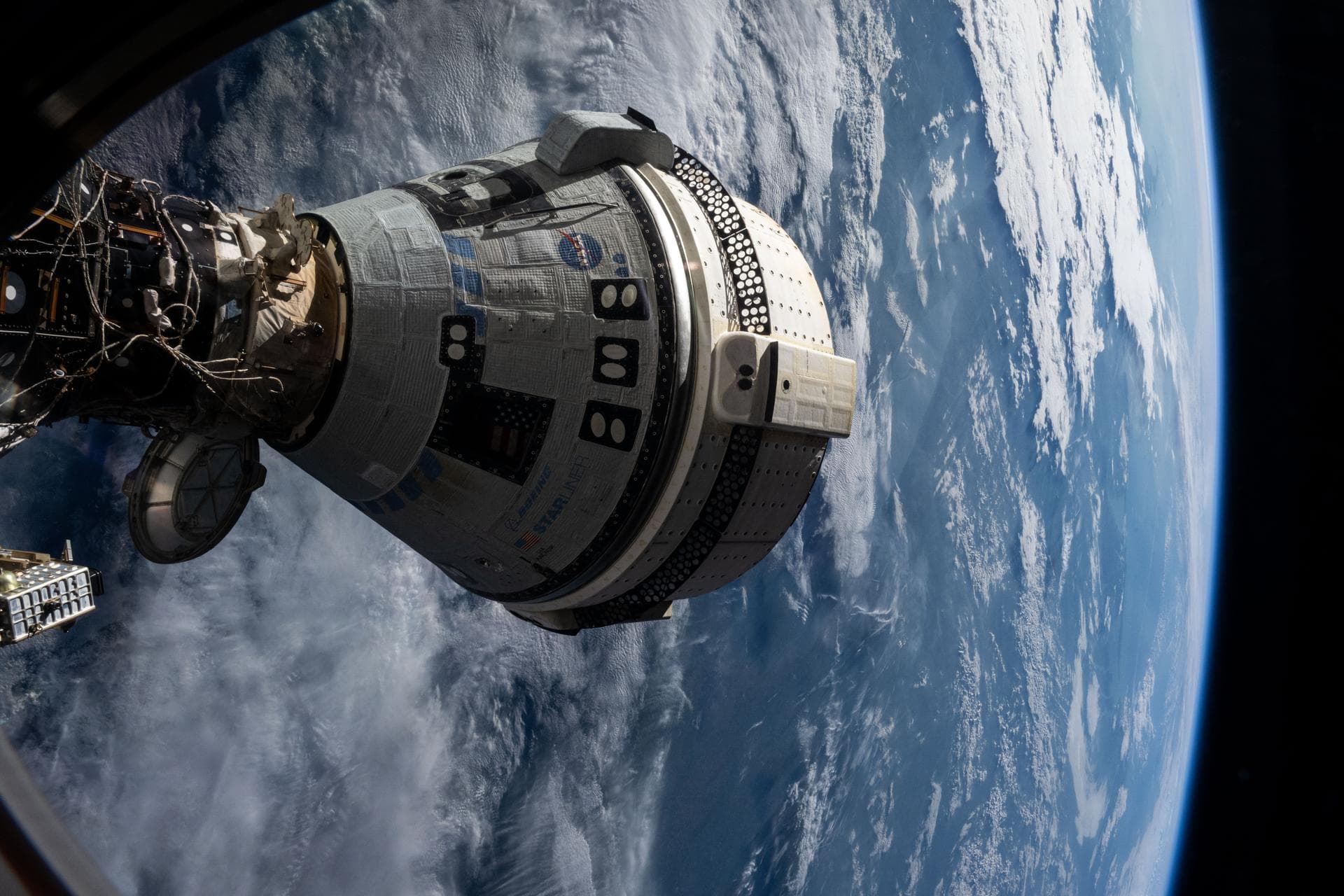
Boeing's Starliner was not an operational crew-rotation system as of August 12, 2026. Its June 2024 crewed test, planned for 8 to 14 days, lasted 93 days after propulsion anomalies. NASA returned the capsule without astronauts Butch Wilmore and Suni Williams. A NASA investigation later cited interacting hardware failures, qualification gaps, leadership errors, and cultural breakdowns, and classified the flight as a Type A mishap because of the temporary loss of maneuverability and associated risk.[31]
NASA and Boeing modified the Commercial Crew Transportation Capability contract in November 2025. Starliner-1 was changed from a four-person rotation to an uncrewed cargo and in-flight validation flight. The modified order covers that validation flight and up to three later crew rotations; two additional missions remain contract options.[32] NASA said in May 2026 that the launch opportunity was still under review while technical work continued.[33] Boeing said in late July that it did not expect a flight before the fourth quarter of 2026, but that was a company planning statement, not an assigned NASA launch date.[34]
Crew rotation and maintenance events in 2026
The main ISS crew and maintenance events of 2026, through mid-August, were:
| Date | Event |
|---|---|
| January 15 | Crew-11 returned after 167 days, about a month earlier than planned because of a medical concern involving one stable crew member. NASA did not identify the person or condition. The four-person departure left a reduced three-person crew until Crew-12 arrived.[35] |
| February 13-14 | Crew-12 launched on a Falcon 9 and docked the next day, restoring the usual seven-person staffing.[36] |
| June 5 | Crew-12 and NASA astronaut Chris Williams briefly sheltered in Dragon while Roscosmos assessed higher-risk work near the leaking PrK tunnel. The proposed cutting procedure was paused and normal operations resumed.[18] |
| July 14 | Soyuz MS-29 docked at Prichal with Anil Menon, Pyotr Dubrov, and Anna Kikina for an approximately eight-month mission.[37] |
| July 26 | Soyuz MS-28 returned Sergey Kud-Sverchkov, Sergei Mikaev, and Christopher Williams after 241 days. Expedition 75 began with Jessica Meir in command.[38][39] |
| August 6 | Meir and Menon completed a 6-hour, 27-minute spacewalk to prepare a power channel for a future roll-out solar array. It was the 281st spacewalk supporting station assembly, maintenance, or upgrades, and Menon's first.[40] |
Expedition 75 began on July 26, 2026, and NASA lists its end as spring 2027. Its seven-person crew combined four Crew-12 members with three Soyuz MS-29 members.[36][37][39]
| Crew member | Agency | Arrived aboard |
|---|---|---|
| Jessica Meir (commander) | NASA | SpaceX Crew-12[36][39] |
| Jack Hathaway | NASA | SpaceX Crew-12[36][39] |
| Sophie Adenot | ESA | SpaceX Crew-12[36][39] |
| Andrey Fedyaev | Roscosmos | SpaceX Crew-12[36][39] |
| Anil Menon | NASA | Soyuz MS-29[37][39] |
| Pyotr Dubrov | Roscosmos | Soyuz MS-29[37][39] |
| Anna Kikina | Roscosmos | Soyuz MS-29[37][39] |
NASA identified Jessica Watkins, Luke Delaney, Joshua Kutryk, and Sergey Teteryatnikov for Crew-13, with a launch target no earlier than September 12, 2026.[41] That date was a planning target as of this article's verification date, not a completed mission.
Retirement and controlled deorbit
The United States, Canada, Japan, and ESA partner governments have committed to ISS operations through 2030. NASA's August 2026 station FAQ says Russia is also planning Russian-segment operations through 2030.[1] NASA's current transition documents therefore use 2030 for the end of operations, with controlled reentry expected in 2031 after the orbit has been lowered.[17][42]
US Deorbit Vehicle
NASA selected SpaceX in June 2024 to develop and deliver the US Deorbit Vehicle (USDV) under a contract with a maximum value of $843 million. NASA will take ownership after development and operate the vehicle; launch service is excluded from that award and will be procured separately.[43] NASA officials estimated the full deorbit effort, including launch, at about $1.5 billion in 2024.[44]
The USDV is needed because a safe final maneuver requires more thrust, propellant, and fault tolerance than the current station and several Progress vehicles can provide with adequate margin. NASA plans for the vehicle to dock before the crew leaves, remain attached during gradual orbital lowering, and perform the final controlled burn toward an unpopulated ocean area.[42][45]
How the reentry would work
- Controllers would use natural atmospheric drag and smaller propulsive maneuvers to lower the ISS orbit while keeping the station controlled. The USDV would be docked and checked out before the final crew departs.[42]
- After crew departure, controllers would continue lowering the perigee while monitoring vehicle and station systems. The final burn would be timed so the breakup corridor lies over a remote ocean region.[42][45]
- Aerodynamic heating and loads would first remove solar arrays and radiators, then break apart the truss and pressurized modules. Much of the structure would melt or ablate, but dense items such as structural pieces and pressure vessels could survive to the ocean.[42]
The station is too massive for uncontrolled reentry. NASA applies a public-casualty risk threshold of less than 1 in 10,000 for the reentry operation, making a targeted ocean corridor necessary.[42] The deorbit plan must also account for propulsion failures, communications loss, micrometeoroid or debris damage, structural leaks, and the decreasing time available to respond as the orbit falls.[17][45]
Why the ISS is not simply moved or reused
NASA compared controlled deorbit with several alternatives and rejected them in the published transition analysis.[45]
| Alternative | Principal problem |
|---|---|
| Leave the ISS to decay | The time and footprint of an uncontrolled reentry could not be predicted well enough to meet public-safety requirements.[42][45] |
| Boost it into a long-lived orbit | A roughly 100-year orbit would require about 120 to 140 meters per second of velocity change, compared with about 57 meters per second for controlled deorbit, and it would leave a huge, aging object exposed to debris without eliminating eventual disposal.[42] |
| Disassemble and return it | The modules, truss, utilities, and software were not designed for reversal of the assembly sequence, and no current transport fleet can return most of the structure intact.[1][45] |
| Separate modules for other stations | The US and Russian segments cannot operate independently without major new propulsion, power, life-support, thermal, data, and structural systems.[1][45] |
| Break it into smaller pieces first | Fragmenting the station would multiply objects and reentry corridors without ensuring that surviving debris avoided populated areas.[45] |
The oldest elements, Zarya and Unity, will have spent about 32 years in orbit by the end of 2030, beyond the 30-year design life used for the primary structure. Continuing beyond that point is not automatically impossible, but it demands ongoing structural analysis, inspection, spares, and risk acceptance.[17][45]
That schedule is policy, not an immutable physical deadline. The Senate Commerce Committee approved a NASA authorization bill in March 2026 that would direct an extension through 2032, but committee approval did not make the proposal law.[46] Any extension would also require partner agreement, funding, transport, and a safety finding that the aging station can continue to operate.[17]
Commercial successors to the ISS
NASA's Commercial Low Earth Orbit Destinations program is intended to replace government ownership of a station with purchases of crew time, research volume, and other services from privately owned destinations. As of August 12, 2026, NASA had issued a draft request for proposals for the second phase. The procurement schedule called for a final solicitation in August 2026, proposals in October, and contract award in spring 2027. Those were planned milestones, and no Phase 2 service contract had yet been awarded.[47]
The development portfolio has changed since NASA's 2021 selections. NASA originally awarded funded Space Act Agreements to Blue Origin, Nanoracks, and Northrop Grumman.[48] Northrop Grumman later ended its standalone concept, and NASA redistributed funds, bringing the Starlab agreement total to $217.5 million and the Orbital Reef total to $172 million.[49] Axiom Space follows a separate path through a contract for modules that first attach to the ISS.[50]
ISS successor comparison as of August 12, 2026
| Project | NASA relationship and public funding | Provider architecture or target | Verified development status and caveat |
|---|---|---|---|
| Axiom Station | Separate 2020 firm-fixed-price, indefinite-delivery contract with a $140 million ceiling for at least one commercial module attached to the ISS.[50] | A revised sequence starts with a Payload Power Thermal Module, followed by Habitat 1, an airlock, Habitat 2, and a research and manufacturing facility. NASA said the initial elements could detach as early as 2028.[51] | NASA and Axiom approved the assembly-order change, but "as early as 2028" is a planning possibility, not a guaranteed free-flying-service date.[51] |
| Starlab | Began as Nanoracks' $160 million funded Space Act Agreement; NASA later added $57.5 million, for a $217.5 million total.[48][49] | Starlab Space, led by Voyager Technologies with Airbus and other partners, proposes a free-flying commercial station. | The company reported completing NASA's commercial critical design review in February 2026 and moving into fabrication, testing, and assembly. That report did not establish a NASA-certified operational date.[52] |
| Orbital Reef | Blue Origin received a $130 million funded Space Act Agreement in 2021; later additions brought the total to $172 million.[48][49] | Blue Origin leads a multi-company free-flying station concept intended for mixed government, research, and commercial use. | NASA reported human-in-the-loop testing in full-scale mockups in 2025. The work remained development under a Space Act Agreement, not an operational service contract.[53] |
| Vast Haven-1 and proposed Haven-2 | Vast has an unfunded NASA Collaborations for Commercial Space Capabilities-2 agreement, which provides technical collaboration but no CLD development award.[54] | Haven-1 is a single-module, short-duration private station and technology pathfinder. Vast presents the larger, multi-module Haven-2 as its ISS-successor concept. | Vast reported Haven-1 entering integration and set a provider target of flight readiness in the first quarter of 2027.[55] Its Haven Demo satellite flew from November 2025 to February 2026 and tested selected systems, but it was not a habitable station.[56] Haven-1 would not by itself replace the ISS's laboratory volume, continuous crew, or partner functions. |
NASA introduced an additional option in March 2026: a government-owned core module could attach to the ISS, accept commercially owned modules, and later separate from the old station. The agency described this as an initiative for industry feedback alongside existing approaches, not as an awarded replacement station or a decision to keep the full ISS flying into the mid-2030s.[4]
No commercial successor was operational or certified to replace the ISS on August 12, 2026. Funding agreements support development and milestones, while company launch targets remain distinct from NASA service certification and from the later Phase 2 procurement.[47][51][52][53][55]
References
- International Space Station Frequently Asked Questions - NASA, updated August 5, 2026.
- International Space Station Facts and Figures - NASA.
- International Space Station Visitors by Country - NASA.
- NASA Unveils Initiatives to Achieve America's National Space Policy - NASA, March 24, 2026.
- International Space Station - NASA.
- 20 Years Ago: Station Partners Sign Intergovernmental Agreement - NASA, January 29, 2018.
- International Space Station Legal Framework - European Space Agency.
- International Space Station Assembly Elements - NASA.
- NASA to Mark 10th Anniversary of Life on Space Station - NASA, October 21, 2010.
- International Space Station Systems Engineering Case Study - NASA.
- ESA's International Space Station Barter Agreements - European Space Agency.
- International Space Station Ground Facilities - NASA.
- Canada and the International Space Station - Canadian Space Agency, January 8, 2016.
- Kibo Operations and Control System - JAXA.
- Environmental Control and Life Support Systems - NASA.
- NASA Achieves Water Recovery Milestone on International Space Station - NASA, June 20, 2023.
- NASA's Management of Risks to Sustaining ISS Operations Through 2030 - NASA Office of Inspector General, September 26, 2024.
- NASA Provides Update on Space Station Leak - NASA, June 5, 2026.
- Spot the Station - NASA.
- How to Spot the ISS - The Planetary Society.
- NASA Extends International Space Station National Lab Management - NASA, July 22, 2022.
- 15 Ways the International Space Station Benefits Humanity Back on Earth - NASA.
- The NASA Twins Study: A Multidimensional Analysis of a Year-Long Human Spaceflight - Garrett-Bakelman et al., Science, 2019, doi:10.1126/science.aau8650.
- Observation of Bose-Einstein Condensates in an Earth-Orbiting Research Lab - Aveline et al., Nature, 2020, doi:10.1038/s41586-020-2346-1.
- First Result from the Alpha Magnetic Spectrometer on the International Space Station - Aguilar et al., Physical Review Letters, 2013, doi:10.1103/PhysRevLett.110.141102.
- PSR J0030+0451 Mass and Radius from NICER Data and Implications for the Properties of Neutron Star Matter - Miller et al., The Astrophysical Journal Letters, 2019, doi:10.3847/2041-8213/ab50c5.
- Skeletal Muscle-on-a-Chip in Microgravity as a Platform for Regeneration Modeling and Drug Screening - Kim et al., Stem Cell Reports, 2024, doi:10.1016/j.stemcr.2024.06.010.
- International Space Station Visiting Vehicles - NASA.
- Commercial Crew Program Press Kit - NASA.
- Successful Berthing of HTV-X1 to the International Space Station - JAXA, October 30, 2025.
- NASA Releases Report on Starliner Crewed Flight Test Investigation - NASA, February 19, 2026.
- NASA, Boeing Modify Commercial Crew Contract - NASA, November 24, 2025.
- NASA, Partners Update International Space Station 2026 Flight Plan - NASA, May 1, 2026.
- Boeing Still Working with NASA to Schedule Next Starliner Flight - SpaceNews, July 28, 2026.
- NASA's SpaceX Crew-11 Mission Returns, Splashes Down off California - NASA, January 15, 2026.
- NASA's SpaceX Crew-12 Launches to International Space Station - NASA, February 13, 2026.
- Soyuz Docks to Station, Hatches Open Soon for Crew Greeting - NASA, July 14, 2026.
- NASA Astronaut Chris Williams, Crewmates Return from Space Station - NASA, July 26, 2026.
- Expedition 75 - NASA, accessed August 12, 2026.
- Astronauts Complete Spacewalk for Solar Array Modifications - NASA, August 6, 2026.
- Spacewalk Preps, Health Research on Station as NASA Introduces SpaceX Crew-13 - NASA, August 3, 2026.
- FAQs: The International Space Station Transition Plan - NASA.
- NASA Selects International Space Station US Deorbit Vehicle - NASA, June 26, 2024.
- NASA: ISS Deorbit Vehicle Will Cost $1.5 Billion, but It's Essential - SpacePolicyOnline, July 18, 2024.
- International Space Station Deorbit Analysis Summary - NASA, 2024.
- Commerce Committee Passes NASA Authorization Act - US Senate Committee on Commerce, Science, and Transportation, March 4, 2026.
- Commercial Low Earth Orbit Destination Contract Procurement - NASA, updated July 20, 2026.
- NASA Selects Companies to Develop Commercial Destinations in Space - NASA, December 2, 2021.
- NASA Adjusts Agreements to Benefit Commercial Station Development - NASA, January 5, 2024.
- NASA Selects First Commercial Destination Module for International Space Station - NASA, January 27, 2020.
- NASA, Axiom Space Change Assembly Order of Commercial Space Station - NASA, December 18, 2024.
- Starlab Completes NASA Commercial Critical Design Review - Starlab Space, February 23, 2026.
- NASA Sees Progress on Blue Origin's Orbital Reef Design, Development - NASA, April 16, 2025.
- Seven US Companies Collaborate with NASA to Advance Space Capabilities - NASA, June 15, 2023.
- Vast Advances Haven-1 into Integration Phase - Vast, January 20, 2026.
- Haven Demo Mission Complete - Vast, March 19, 2026.