Curiosity is a NASA rover that has explored Gale Crater on Mars since August 6, 2012. Flown under the Mars Science Laboratory (MSL) mission and operated by the Jet Propulsion Laboratory (JPL), the car-sized, 899-kilogram rover was sent to answer one overarching question, whether Mars ever offered environmental conditions able to support microbial life, and within its first year it answered yes.[1][6]
The evidence was an ancient freshwater lake with mild chemistry and the key elements needed by life. Since 2014 Curiosity has been climbing Mount Sharp, the sedimentary mound at the crater's center, reading layers that record Mars's transition from a wet climate to a dry one. Along the way it has detected organic molecules of increasing size and complexity, measured seasonal methane in the atmosphere, found the carbonate minerals that earlier surveys of Mars had failed to locate, and, across 2025 and 2026, surveyed a network of mineral ridges called boxwork formations.[1][6]
The rover passed 14 years on Mars in August 2026, far beyond its two-year prime mission.[2] By the end of July 2026 it had logged 4,967 Martian days, or sols, and NASA put its totals that month at more than 37 kilometers driven and more than 1.35 kilometers of elevation gained since landing.[7][8]
The sky-crane landing
Curiosity launched on November 26, 2011, on an Atlas V 541 from Cape Canaveral. At five times the mass of earlier Mars rovers, it was too heavy for airbag landings, so JPL devised a new sequence: a guided atmospheric entry, the largest supersonic parachute then flown, and a rocket-powered descent stage that hovered while lowering the rover on nylon tethers, then flew away to crash at a safe distance. Engineers called the seven-minute automated sequence the "seven minutes of terror".[2]
The hypersonic guidance borrowed the technique Apollo crews used returning to Earth, and it shrank the landing footprint to an ellipse roughly 7 by 20 kilometers, about seven percent the area of the ellipse flown for Phoenix four years earlier.[3][4]
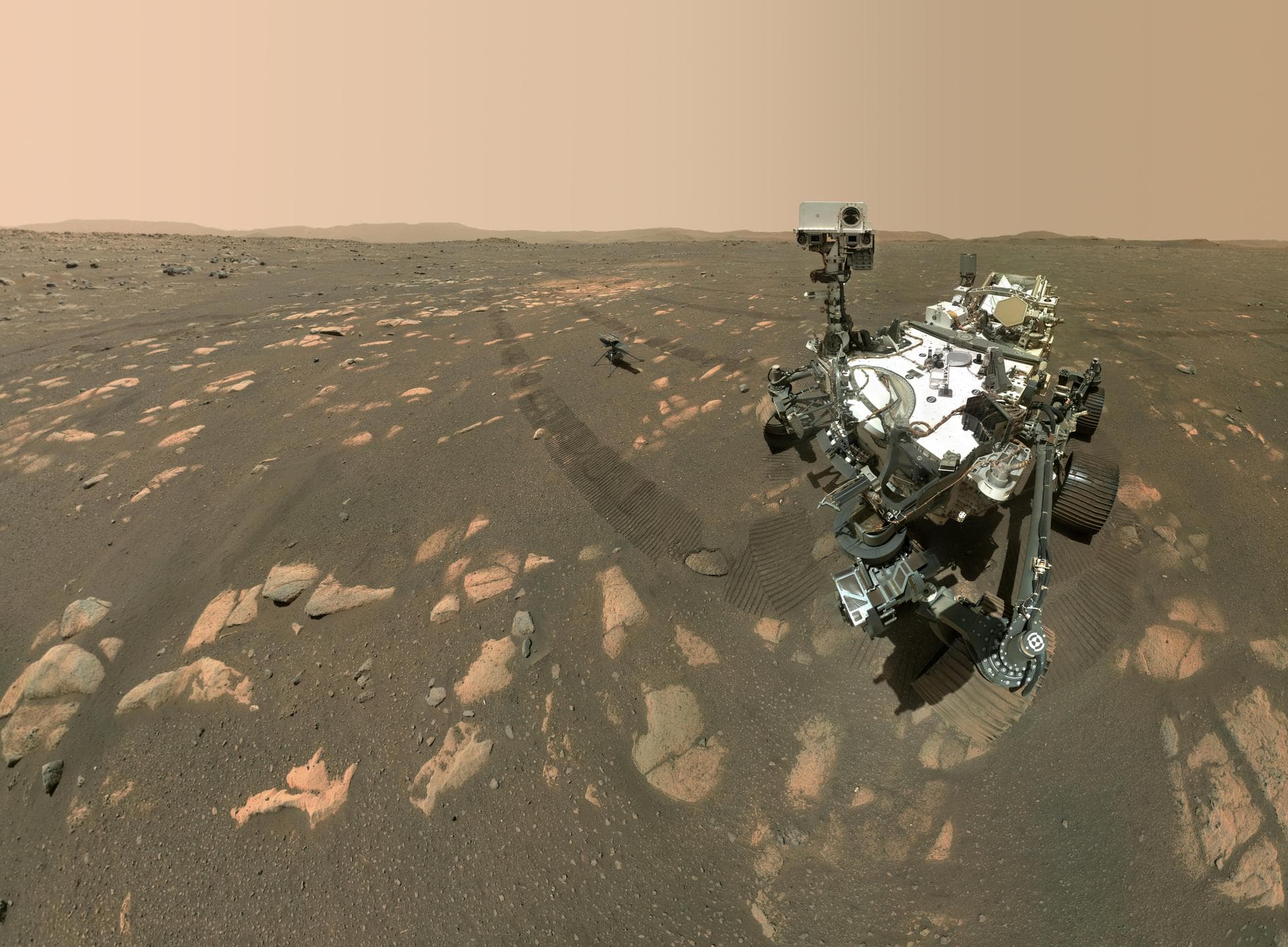
The sky crane worked on its first try. Curiosity touched down inside that ellipse on August 6, 2012 UTC, at a spot later named Bradbury Landing; confirmation reached JPL at 10:32 p.m. PDT on August 5.[2][3] The same landing architecture was reused in 2021 for the Perseverance rover.[26]
Ascent of Mount Sharp
Gale Crater, Curiosity's landing site, is a 154-kilometer impact crater whose central mound, formally Aeolis Mons and informally Mount Sharp, rises about 5,500 meters above the crater floor and preserves kilometers of stacked sediments.[5] Mission strategy has been to climb the mound and examine each successive layer, moving forward in geological time.
| Period | Location | Significance |
|---|---|---|
| 2012-2013 | Bradbury Landing and Yellowknife Bay | Ancient streambed gravels; first drill samples |
| 2014 | Pahrump Hills | Arrival at the base of Mount Sharp |
| 2017-2019 | Vera Rubin Ridge | Hematite-bearing ridge |
| 2019-2021 | Glen Torridon | Clay-rich trough recording lake deposits |
| 2022-2024 | Sulfate-bearing unit and Gediz Vallis | Salty minerals from a drying climate; stones of pure sulfur |
| 2025-2026 | Boxwork formations | Ridge networks left by late groundwater |
| 2026 | Upper sulfate and carbonate unit | Layered beds and a suspected break in the rock record, on the approach to the yardang unit |
By July 2026 the climb had added more than 1.35 kilometers of elevation over more than 37 kilometers of driving. The rover was working upward through the sulfate and carbonate layers toward the yardang unit, a band of pale, wind-sculpted hills higher on the mountain.[7]
Key science findings
Curiosity's first drill campaign at Yellowknife Bay in February 2013 recovered mudstone laid down in a calm freshwater lake. The rock contained clay minerals, a neutral-pH chemical environment, and the biologically essential elements carbon, hydrogen, nitrogen, oxygen, phosphorus, and sulfur. NASA concluded that ancient Gale Crater could have supported living microbes, satisfying the mission's primary goal within eight months.[6]
The rover's SAM laboratory has steadily expanded the inventory of Martian organic chemistry. In 2018 the team reported organic matter preserved in roughly 3.5-billion-year-old lakebed mudstones at Pahrump Hills, detected as thiophenic, aromatic, and aliphatic fragments released when SAM heated the samples to between 500 and 820 degrees Celsius.[10]
In March 2025, a reanalysis of the Cumberland sample, drilled at Yellowknife Bay in May 2013, revealed decane, undecane, and dodecane, chains of 10 to 12 carbon atoms and the largest organic molecules yet found on Mars. The team reads them as fragments of longer fatty acids. Fatty acids form through non-biological chemistry as well, but usually in shorter chains than these, and the source cannot be settled from rover data alone.[11][12]
A year later, in April 2026, the team published results from SAM's first tetramethylammonium hydroxide wet chemistry experiment, the first run of its kind on another planet. Only two of SAM's cups hold the solvent, which breaks large molecules into detectable pieces, so they were held back for high-value samples. Applied to Mary Anning 3, a clay-bearing sample drilled in the Glen Torridon area in October 2020, it identified 21 carbon-bearing molecules, seven of them detected on Mars for the first time, among them benzothiophene and a nitrogen heterocycle of the kind that forms the rings in RNA and DNA. As with the alkanes, a biological origin and a geological one both remain open.[13][14]
Atmospheric measurements found methane at a faint background level below one part per billion that rises and falls with the seasons, punctuated by transient spikes. The largest, about 21 parts per billion by volume, was measured in June 2019 and had dropped back below one part per billion by a follow-up experiment days later. Curiosity carries no instrument able to identify the gas's source, or to confirm that it comes from inside Gale Crater at all.[17] A 2025 reanalysis in the Journal of Geophysical Research: Planets questioned whether the detections are real, pointing to a pre-launch leak that left terrestrial air in the tunable laser spectrometer's foreoptics chamber at methane levels orders of magnitude above those reported for the sample cell, to unexplained pressure changes inside the instrument, and to disagreement between the three spectral lines used. The authors stop short of calling the detections artifacts and propose a two-night experiment that would separate a Martian signal from an instrumental one.[18]
Curiosity has also logged the radiation environment on the surface and during the cruise to Mars for the benefit of future crewed missions; NASA notes that unshielded exposure on the journey alone would exceed its career limit for astronauts.[6] In May 2024 the rover drove over a rock in the Gediz Vallis channel and cracked it open to reveal crystals of elemental sulfur, the first pure sulfur found on Mars and, in the project scientist's words, something that "shouldn't be there". A whole field of similar bright stones lay nearby.[19]
Carbonates and the ancient carbon cycle
Orbital surveys had long failed to find much carbonate on Mars, which was awkward: a thick early carbon dioxide atmosphere reacting with rock and water should have left large carbonate deposits behind. Curiosity's CheMin X-ray diffractometer found them hiding in plain sight. Three drill sites in the sulfate-bearing layers of Mount Sharp returned siderite, an iron carbonate, at 4.8 to 10.5 percent by weight, sitting alongside highly water-soluble salts that help mask the mineral from orbit.[15][16]
The siderite appears to have formed in water-limited conditions, driven by water-rock reactions and evaporation as the lakes dried. Scaling the result against orbital data, the authors estimated that similar strata deposited globally could have locked away the equivalent of 2.6 to 36 millibars of atmospheric carbon dioxide. That is direct evidence of a carbon cycle on early Mars, though still a fraction of the atmosphere the planet is thought to have lost.[15][16] The paper, led by Benjamin Tutolo of the University of Calgary, appeared in Science in April 2025.[15]
Boxwork formations
In mid-2025 Curiosity reached a long-planned target: a stretch of low ridges arranged in polygons that resemble giant spiderwebs in orbital images, spanning kilometers of lower Mount Sharp. The ridges stand roughly 1 to 2 meters tall with sandy hollows between them. They formed billions of years ago when mineral-laden groundwater seeped through fractures in the rock; the minerals hardened in the cracks, and wind later stripped away the softer surrounding stone, leaving the cemented lattice standing in relief. Because they record some of the last widespread liquid water in the region, they offer a way to study how long habitable conditions persisted as Mars dried out.[28]
Six months of close work produced surprises. Pea-sized nodules, another marker of drying groundwater, turned up along the ridge walls and in the hollows rather than clustered near the central fractures as expected. Finding boxwork this high on the mountain also implies the water table stood higher, and lasted later, than orbital data had suggested.[28]
The rover photographed the terrain extensively, including a 179-frame panorama on September 26, 2025 (sol 4,671) and a 1.5-billion-pixel, 360-degree mosaic assembled from 1,031 images taken between November 9 and December 7, 2025.[26][27] It left the boxwork region in March 2026 and drove on across the sulfate-bearing unit.[26][28]
Wheels, power, and expected lifetime
Curiosity's six aluminum wheels, each carrying 19 zigzag treads called grousers over a skin 0.75 millimeters thick, began showing punctures and tears in 2013 as the rover crossed ground studded with sharp embedded rocks. JPL responded by routing around the worst terrain, including the knife-edged surface the team nicknamed gator-back, and by uploading a traction-control algorithm in March 2017, after 18 months of testing, that varies each wheel's speed using suspension data to reduce the load the rocks impose. It was cleared for routine use that June.[20][24]
Broken grousers are the metric engineers actually track. JPL's threshold for considering intervention is 14 broken grousers on a single wheel, a level its 2021 modelling did not expect to reach until around 2034. If it ever does, there is a tested fallback: deliberately snapping the damaged inner section off against a rock and driving on the outer third of the wheel, a configuration validated on Scarecrow, the mobility test rover at JPL.[21] Inspections continue, with the arm camera photographing a cracked wheel on sol 4,963 in July 2026, and in June 2026 the team reported that the wheels remain usable with no loss of capability.[22]
Power sets the outer limit on the mission. The MMRTG was fueled in October 2008 with 4.8 kilograms of plutonium dioxide and converted about 110 watts to electricity at the start. Output falls at roughly one watt per 80 sols, faster than fuel decay alone would explain, because the thermocouples degrade as well; engineers projected 54 watts by late 2025.[25] The practical effect is longer battery recharges and less energy per sol for science, which the team offsets in software. The rover can now overlap tasks, communicating while it drives, for instance, and can end a plan early and nap when it finishes ahead of schedule.[23] A flight software release nicknamed R-Hope recovered 64 megabytes of storage as file system memory after the primary memory on one of the rover's computers failed. JPL expects generator decline to start eating into science output during the sixth extended mission, but for the rover to remain productive through 2035 and possibly beyond.[22]
The drill has needed similar improvisation. Its feed mechanism failed in 2016, and the workaround developed afterwards has since delivered more than 20 further rock samples.[7]
Status in 2026
Through the first half of 2026 Curiosity worked upward through the layered sulfate and carbonate unit above the boxwork, drilling its 47th successful hole at a target called Campo Marte in May and running the sample through CheMin, SAM, and the arm-mounted instruments.[9] By late July it was studying what the team suspects is an erosional supersurface: a regional break where wind or water stripped sediment away before new layers were laid down, which would mean a gap in the rock record rather than a continuous sequence. The rover backed off to image the whole layer with Mastcam and ChemCam before planning a route across it.[8]
The mission has no fixed end date. The plan is to keep climbing toward the yardang unit, using new drill samples together with the boxwork and carbonate results to chart when, and how quickly, ancient Mars lost its water.[7][8]
References
- Mars Science Laboratory: Curiosity Rover - NASA Science.
- NASA Lands Car-Size Rover Beside Martian Mountain - NASA Jet Propulsion Laboratory, August 5, 2012.
- Curiosity Mars Rover Reaching Edge of Its Landing Ellipse (PIA18399) - NASA Jet Propulsion Laboratory.
- Landing Accuracy on Mars: A Historical Perspective - NASA Science.
- Gale Crater (PIA24085) - NASA Jet Propulsion Laboratory.
- Curiosity Science Highlights - NASA Science.
- Curiosity Blog, Sols 4954-4960: Celebrating Our Rover Engineers Past and Present - NASA Science, July 23, 2026.
- Curiosity Blog, Sols 4961-4967: Approaching a Break in the Rock Record? - NASA Science, July 31, 2026.
- Curiosity Blog, Sols 4908-4912: Goodbye Campo Marte, It's Been Fun! - NASA Science, June 3, 2026.
- Organic matter preserved in 3-billion-year-old mudstones at Gale crater, Mars - Eigenbrode et al., Science 360, 1096-1101, 2018.
- NASA's Curiosity Rover Detects Largest Organic Molecules Found on Mars - NASA Jet Propulsion Laboratory, March 24, 2025.
- Long-chain alkanes preserved in a Martian mudstone - Freissinet et al., Proceedings of the National Academy of Sciences, 2025.
- NASA's Curiosity Finds Organic Molecules Never Seen Before on Mars - NASA Jet Propulsion Laboratory, April 21, 2026.
- Diverse organic molecules on Mars revealed by the first SAM TMAH experiment - Williams et al., Nature Communications, 2026.
- NASA's Curiosity Rover May Have Solved Mars' Missing Carbonate Mystery - NASA Jet Propulsion Laboratory, April 17, 2025.
- Carbonates identified by the Curiosity rover indicate a carbon cycle operated on ancient Mars - Tutolo et al., Science 388, 292-297, 2025.
- Curiosity's Mars Methane Mystery Continues - NASA Jet Propulsion Laboratory, June 23, 2019.
- Questioning the Reliability of Methane Detections on Mars by the Curiosity Rover - Viscardy, Catling and Zahnle, Journal of Geophysical Research: Planets, 2025.
- NASA's Curiosity Rover Discovers a Surprise in a Martian Rock - NASA Jet Propulsion Laboratory, May 30, 2024.
- An Algorithm Helps Protect Mars Curiosity's Wheels - NASA Jet Propulsion Laboratory, June 29, 2017.
- If Necessary, Mars Rover Curiosity Could Rip Its Own Wheels Off to Stay Mobile - IEEE Spectrum, May 12, 2021.
- The Ingenious Fixes Keeping the Curiosity Rover Rolling - IEEE Spectrum, June 9, 2026.
- Marking 13 Years on Mars, NASA's Curiosity Picks Up New Skills - NASA, August 4, 2025.
- 10 Years Since Landing, NASA's Curiosity Mars Rover Still Has Drive - NASA, August 5, 2022.
- The Design and Engineering of Curiosity: the MMRTG - The Planetary Society, book excerpt by Emily Lakdawalla.
- NASA's Perseverance, Curiosity Panoramas Capture Two Sides of Mars - NASA Jet Propulsion Laboratory, April 27, 2026.
- Image: Curiosity rover surveys boxwork region of Mars - Phys.org, February 2026.
- NASA's Curiosity Rover Sees Martian 'Spiderwebs' Up Close - NASA Jet Propulsion Laboratory, February 23, 2026.