Perseverance is a NASA rover that has operated in and around Jezero Crater on Mars since February 18, 2021.[20] The 1,025-kilogram vehicle, built and managed by the Jet Propulsion Laboratory (JPL), is the centerpiece of the Mars 2020 mission.[1] It characterizes the crater's ancient lake and river delta, searches for preserved signs of past microbial life, and by mid-2026 had used 33 of its 43 sample tubes for a possible future return to Earth.[5][24]
The rover launched on July 30, 2020, aboard an Atlas V 541 from Cape Canaveral. Its chassis is derived from the older Curiosity rover, with upgrades that include more capable autonomous driving software, 19 cameras on the rover itself out of 23 across the whole spacecraft, two microphones, and a sampling system built around 43 ultraclean titanium tubes. Power comes from a multi-mission radioisotope thermoelectric generator that supplied about 110 watts of electricity at launch.[1] The mission also carried two technology demonstrations: the Ingenuity helicopter, the first aircraft to fly on another planet, and the MOXIE oxygen generator.[1][9][29]
By mid-2026 Perseverance had driven a full marathon distance on Mars, climbed out of Jezero Crater, and pushed west of the rim into ground holding some of the oldest rocks it has yet encountered.[2][14] Its most discussed result so far is a mudstone called Cheyava Falls, cored in 2024, which NASA and a peer-reviewed study published in September 2025 describe as holding a potential biosignature.[3][4]
Design and landing
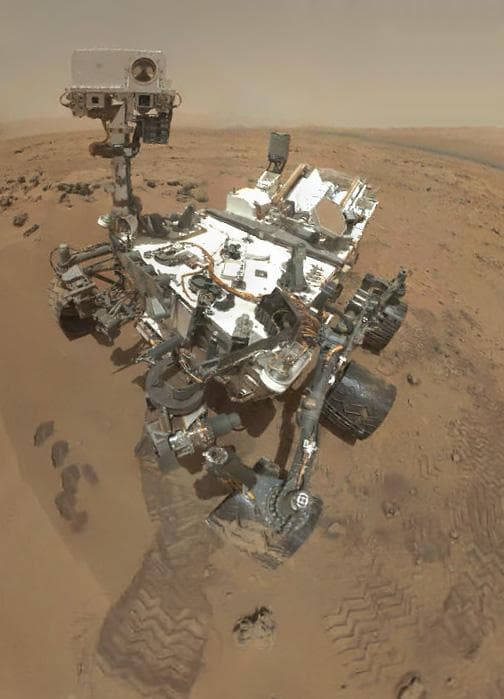
Perseverance is about 3 meters long excluding its robotic arm, 2.7 meters wide, and 2.2 meters tall, and rolls on six aluminum wheels 52.5 centimeters in diameter.[29]
| Property | Value |
|---|---|
| Mass | 1,025 kg on Earth, 393 kg on Mars |
| Dimensions | About 3 m long excluding the arm, 2.7 m wide, 2.2 m tall |
| Power | MMRTG, about 110 watts at launch, declining a few percent a year |
| Wheels | Six aluminum wheels, 52.5 cm in diameter, rocker-bogie suspension |
| Robotic arm | 2.1 m, five degrees of freedom, turret carrying the drill and instruments |
| Drill cores | 27 mm diameter |
| Sample tubes | 43 carried: up to 38 for rock and regolith, five witness tubes |
| Computer | Dual redundant Rover Compute Elements, up to 200 MHz, 2 GB flash |
Perseverance reached Mars after a 203-day cruise covering about 471 million kilometers, and descended through the atmosphere on February 18, 2021, using a guided entry at about 19,500 kilometers per hour, a 21.5-meter supersonic parachute, and a rocket-powered sky crane that lowered the rover to the surface on nylon cords.[28] It was the first robotic Mars mission to fly terrain-relative navigation, comparing camera images against onboard maps during descent to steer away from hazards; the rover touched down within 5 meters of the point the lander vision system had picked.[26] NASA named the touchdown point Octavia E. Butler Landing on March 5, 2021, for the science fiction author who died almost exactly 15 years earlier.[27]
Jezero, a crater about 45 kilometers wide on the western edge of the Isidis basin, was selected because a river once breached its rim and built a delta into a crater lake more than 3.5 billion years ago. Orbital data showed carbonates and clays there, minerals that on Earth are good at preserving traces of life.[20]
Science instruments
Perseverance carries seven science instruments, chosen to work at the scale of individual mineral grains as well as across whole outcrops.[1]
| Instrument | Type | Purpose |
|---|---|---|
| Mastcam-Z | Zoomable stereo camera | Panoramas and surface mineralogy from color imaging |
| SuperCam | Laser, spectrometers, microphone | Remote rock chemistry and mineralogy, plus sound recording |
| PIXL | X-ray fluorescence spectrometer | Fine-scale elemental chemistry on abraded patches |
| SHERLOC | Ultraviolet Raman and fluorescence spectrometer | Organic compounds and minerals, with the WATSON close-up imager |
| RIMFAX | Ground-penetrating radar | Layering and structure beneath the rover |
| MEDA | Weather station | Temperature, wind, pressure, humidity, and airborne dust |
| MOXIE | Oxygen generator | Technology demonstration, now complete |
Ingenuity and MOXIE
Ingenuity, a 1.8-kilogram solar-powered helicopter that rode to Mars attached to Perseverance's belly, was designed for up to five experimental flights in 30 days. After its first hop on April 19, 2021, it kept flying for almost three years as a scout, completing 72 flights, logging 128.8 minutes in the air, covering 17.0 kilometers of ground track, and reaching altitudes of 24 meters and groundspeeds of 10 meters per second.[10] Its final flight, number 72 on January 18, 2024, ended in a rough landing over featureless terrain that the navigation system struggled to track. The attitude change on touchdown loaded the rotor blades beyond their limits and snapped them, and NASA declared the mission complete on January 25, 2024.[23] NASA has since taken Ingenuity as the basis for SkyFall, a proposed mission that would release several helicopters in mid-air over Mars to scout landing sites for crews and map subsurface water ice.[10]
MOXIE, the Mars Oxygen In-Situ Resource Utilization Experiment, converted carbon dioxide from the Martian atmosphere into oxygen 16 times between 2021 and its final run on August 7, 2023. It produced 122 grams of oxygen in total, twice NASA's original goal, at rates up to 12 grams per hour and purities of 98 percent or better. Scaled-up versions could one day supply propellant oxidizer and breathable air for crews.[11]
Science campaigns and sample caching
Perseverance has worked through five science campaigns since landing, each focused on a different part of Jezero Crater and its rim.[12]
| Campaign | Period | Focus |
|---|---|---|
| Crater floor | 2021-2022 | Igneous rocks of the Seitah and Maaz formations |
| Delta front | 2022-2023 | Sedimentary rocks of the ancient river delta |
| Upper fan | 2023 | Delta-top deposits and old river channels |
| Margin unit | 2023-2024 | Carbonate-bearing rocks along the crater's inner edge |
| Northern Rim | 2024-present | Uplifted ancient rocks on and beyond the crater rim |
Sampling runs through every campaign. Perseverance carries 43 tubes, up to 38 of them for rock and regolith and five loaded as witness tubes, which are opened near sampling sites to record any contamination carried from Earth. The tubes were selected from 93 built for flight and cleaned to a standard where a single untreated fingerprint would have exceeded the entire organic contamination allowance by roughly 300 times.[19]
As of mid-2026 the rover had used 33 of the 43: 27 rock cores, two regolith samples, one atmospheric sample, and three sealed witness tubes. Twenty-five of the rock cores were sealed and two remained unsealed.[2][5][24] Ten tubes were dropped at a flat site called Three Forks between December 2022 and January 2023 as a backup depot; the remainder stay aboard the rover, which was long expected to hand them to a retrieval lander.[5]
Mars Sample Return status
Perseverance's cores were collected for Mars Sample Return (MSR), a campaign NASA planned jointly with the European Space Agency. A 2023 independent review found the cost had grown toward 11 billion dollars against an original figure near 4 billion, with samples arriving no earlier than 2040, which pushed NASA to look for cheaper designs. In January 2025 the agency outlined two alternative architectures: a sky crane derivative costed at 6.6 to 7.7 billion dollars, and a commercially provided heavy lander costed at 5.8 to 7.1 billion. Either would have returned samples between 2035 and 2039, with an ESA orbiter launching in 2030 and a NASA lander in 2031. NASA said it would not choose between them until mid-2026.[6]
The program lost its funding before that choice was made. The administration's fiscal year 2026 budget request proposed cancelling MSR outright. The House and Senate appropriations agreement, whose text was released on January 5, 2026, did not fund the program by name and instead provided 110 million dollars for a new "Mars Future Missions" line, well below the 300 million the House had proposed. Report language pointed the money at radar, spectroscopy, and entry, descent, and landing work carried over from MSR. Congress otherwise rejected the deeper cuts the administration had sought, holding NASA science at 7.3 billion dollars.[17] No formal termination was announced, but no retrieval mission is funded, and the samples remain on Mars with no set pickup date.
NASA's fiscal year 2027 request kept Mars Future Missions at 110 million dollars while redirecting it away from sample-return technology and toward a cadence of lower-cost missions and hosted instruments, including a solicitation for a 2030 mission capped at 220 million dollars. Four senators asked appropriators in April 2026 for at least 400 million instead, warning of "severe and irreversible harm" to the ability to land spacecraft on Mars.[18] China's national space agency meanwhile plans Tianwen-3, a pair of launches in 2028 returning Martian material to Earth in July 2031.[21] The mission's chief scientist, Hou Zengqian, has said it will aim to bring back at least 500 grams, collected by surface scooping, drilling two meters down, and a sample-grabbing drone.[30]
The rover team continues surface science regardless, treating the cached tubes as a long-term asset.[7]
Cheyava Falls potential biosignature
In July 2024, inside an ancient river channel called Neretva Vallis, Perseverance examined an arrowhead-shaped mudstone named Cheyava Falls in the Bright Angel formation. The rock contains organic carbon alongside millimeter-scale "leopard spot" features rimmed by vivianite, an iron phosphate, and greigite, an iron sulfide. On Earth, vivianite turns up in sediments and peat bogs near decaying organic matter, and some microbes produce greigite, though non-biological chemistry can produce similar textures.[3]
The rover sealed a core from the rock, named Sapphire Canyon, and the science team spent a year testing alternative explanations. The analysis, led by Joel Hurowitz, was published in Nature on September 10, 2025 under the title "Redox-driven mineral and organic associations in Jezero Crater, Mars," and NASA stated the sample holds one of the strongest potential biosignatures yet found on Mars.[3][4] A potential biosignature is not a detection of life. The team notes that settling the question would probably require Earth laboratories, which is one argument for eventually retrieving the samples.[3]
Crater rim campaign
Perseverance reached the top of Jezero's western wall on December 10, 2024, on sol 1,354, at a site called Lookout Hill. The climb took about three and a half months and gained roughly 500 vertical meters on grades reaching 20 percent. Its fifth science campaign, Northern Rim, examines rock thrown up from deep in the crust by the impact that formed the crater; some outcrops predate Jezero itself and rank among the oldest material any rover has studied in place.[7][12]
The first stop was Witch Hazel Hill, a slope about 135 meters tall on the rim. By April 2025 the rover had cored five rocks there, analyzed seven up close, and hit 83 more with SuperCam's laser, the fastest science tempo of the mission to that point.[13]
| Rim sample | Source rock | Notable for |
|---|---|---|
| Silver Mountain | Shallow Bay | First crater-rim core, taken January 28, 2025; the rock likely formed at least 3.9 billion years ago |
| Green Gardens | Tablelands | Almost entirely serpentine, which forms where water reacts with iron- and magnesium-rich igneous rock |
| Main River | Broom Point member | Alternating bright and dark bands in an impact-built sequence |
| Bell Island | Broom Point member | Second core from the same layered impact deposits |
Work at Witch Hazel Hill produced the mission's clearest reading of Mars' early impact history. A paper in the Journal of Geophysical Research: Planets published on July 15, 2026, led by Alexander Jones of Imperial College London, described the Broom Point member as a stack of layered rock about 75 meters thick and likely more than 3.9 billion years old. The team identified six rock types, with breccias alternating with fine-grained layers, and found fragments of once-molten rock and small dark glassy beads that point to repeated asteroid impacts rather than volcanism. Dating the two cores in an Earth laboratory would put timestamps on those impacts.[15]
During 2026 the rover pushed west beyond the rim into an area nicknamed Lac de Charmes, the farthest west it has been since landing. A selfie taken on sol 1,797, March 11, 2026, shows it beside an abrasion patch on an outcrop called Arathusa, where deputy project scientist Ken Farley said the exposure is "likely the oldest rocks we are going to investigate during this mission." The surrounding panorama shows megabreccia, blocks some of them the size of buildings, broken loose by the impact that formed Isidis Planitia about 3.9 billion years ago. From Arathusa the rover drove northwest to Arbot, and the team plans to head south afterward to Gardevarri, where olivine-bearing rock is clearly exposed, then southeast to a site it calls Singing Canyon.[2]
Status in 2026
Perseverance completed a marathon distance on June 14, 2026, on sol 1,890, reaching 42.195 kilometers after five years and four months of driving. Opportunity took 11 years and 2 months to cover the same ground. The Mars Reconnaissance Orbiter's HiRISE camera caught the rover the day before as a green speck west of Jezero, in an area called Arbot.[14] The off-Earth driving record still belongs to Opportunity, which logged 45.16 kilometers before a planet-wide dust storm ended its mission in 2018.[22]
On July 2, 2026, on sol 1,907, Mastcam-Z recorded Phobos passing in front of Earth. JPL called it the first time a spacecraft on the surface of another planet has watched Earth disappear behind another object. Earth showed up as a single pixel roughly 314 million kilometers away, and Phobos, a potato-shaped moon about 27 kilometers across, covered about a third of the width that the Moon shows from Earth.[16]
Operations continue to evolve. In December 2025 the mission executed the first Mars drives planned by an artificial intelligence system, on December 8 and 10, covering 210 and 246 meters. Vision-language models generated the waypoints from orbital imagery and terrain-slope data without input from human route planners, and engineers checked the resulting commands against a digital twin of the rover, verifying more than 500,000 telemetry variables, before sending them to Mars.[8]
Engineering assessments have been favorable. JPL reported in December 2025 that it had reviewed nearly all rover subsystems and expects them to keep working until at least 2031, with the wheel actuators certified for at least another 60 kilometers. More than 90 percent of the distance driven has been autonomous, and on June 19, 2025 the rover set a single-drive autonomy record of about 412 meters.[25] JPL reports the rover is in good health, with its instruments functioning and enough power margin to support years of further exploration.[2]
References
- Mars 2020 Perseverance Landing Press Kit: Quick Facts - NASA Jet Propulsion Laboratory.
- NASA's Perseverance Rover Snaps Selfie in Mars' Western Frontier - NASA Jet Propulsion Laboratory, May 12, 2026.
- NASA Says Mars Rover Discovered Potential Biosignature Last Year - NASA Jet Propulsion Laboratory, September 2025.
- Redox-driven mineral and organic associations in Jezero Crater, Mars - Nature, September 10, 2025.
- The 33 Sample Tubes Collected by Perseverance - NASA Jet Propulsion Laboratory, July 2025.
- The Fate of NASA's Mars Sample Return Program May Be Decided in 2026 - Scientific American, January 9, 2025.
- Perseverance continues science mission amid uncertainty about Mars Sample Return - SpaceNews.
- NASA's Perseverance Rover Completes First AI-Planned Drive on Mars - NASA Jet Propulsion Laboratory, January 30, 2026.
- Mars 2020 Perseverance Landing Press Kit: Perseverance Rover - NASA Jet Propulsion Laboratory.
- Ingenuity Mars Helicopter - NASA Science.
- NASA's Oxygen-Generating Experiment MOXIE Completes Mars Mission - NASA Jet Propulsion Laboratory, September 6, 2023.
- NASA's Perseverance Rover Reaches Top of Jezero Crater Rim - NASA Jet Propulsion Laboratory, December 12, 2024.
- NASA's Perseverance Mars Rover Studies Trove of Rocks on Crater Rim - NASA Jet Propulsion Laboratory, April 10, 2025.
- NASA's HiRISE Captures Perseverance Marking a Milestone on Mars - NASA Science, June 23, 2026.
- NASA's Perseverance Rover Reads Record of Ancient Mars Impacts - NASA Jet Propulsion Laboratory, July 15, 2026.
- NASA's Perseverance Rover Watches Earth Vanish Behind Martian Moon - NASA Jet Propulsion Laboratory, August 5, 2026.
- Great News for NASA in the House-Senate FY2026 Appropriations Report - SpacePolicyOnline, January 2026.
- Senators seek increased funding for NASA Mars missions - SpaceNews, April 15, 2026.
- A Martian Roundtrip: NASA's Perseverance Rover Sample Tubes - NASA Jet Propulsion Laboratory.
- Mars 2020: Perseverance Rover - NASA Science.
- Tianwen-3: China's Mars sample return mission - The Planetary Society.
- Opportunity - NASA Science.
- After Three Years on Mars, NASA's Ingenuity Helicopter Mission Ends - NASA Jet Propulsion Laboratory, January 25, 2024.
- Mars Rock Samples - NASA Science.
- Perseverance Mars rover ready to roll for miles in years ahead - Phys.org, December 17, 2025.
- Impact Story: Terrain Relative Navigation - NASA Space Technology Mission Directorate.
- Welcome to "Octavia E. Butler Landing" - NASA Science.
- Mars 2020 Perseverance Landing Press Kit: Mission Overview - NASA Jet Propulsion Laboratory.
- Perseverance Rover Components - NASA Science.
- China's Tianwen-3 Mars sample-return mission targeted for 2031 - Academic Divisions of the Chinese Academy of Sciences, July 2, 2025, reporting remarks by chief scientist Hou Zengqian.