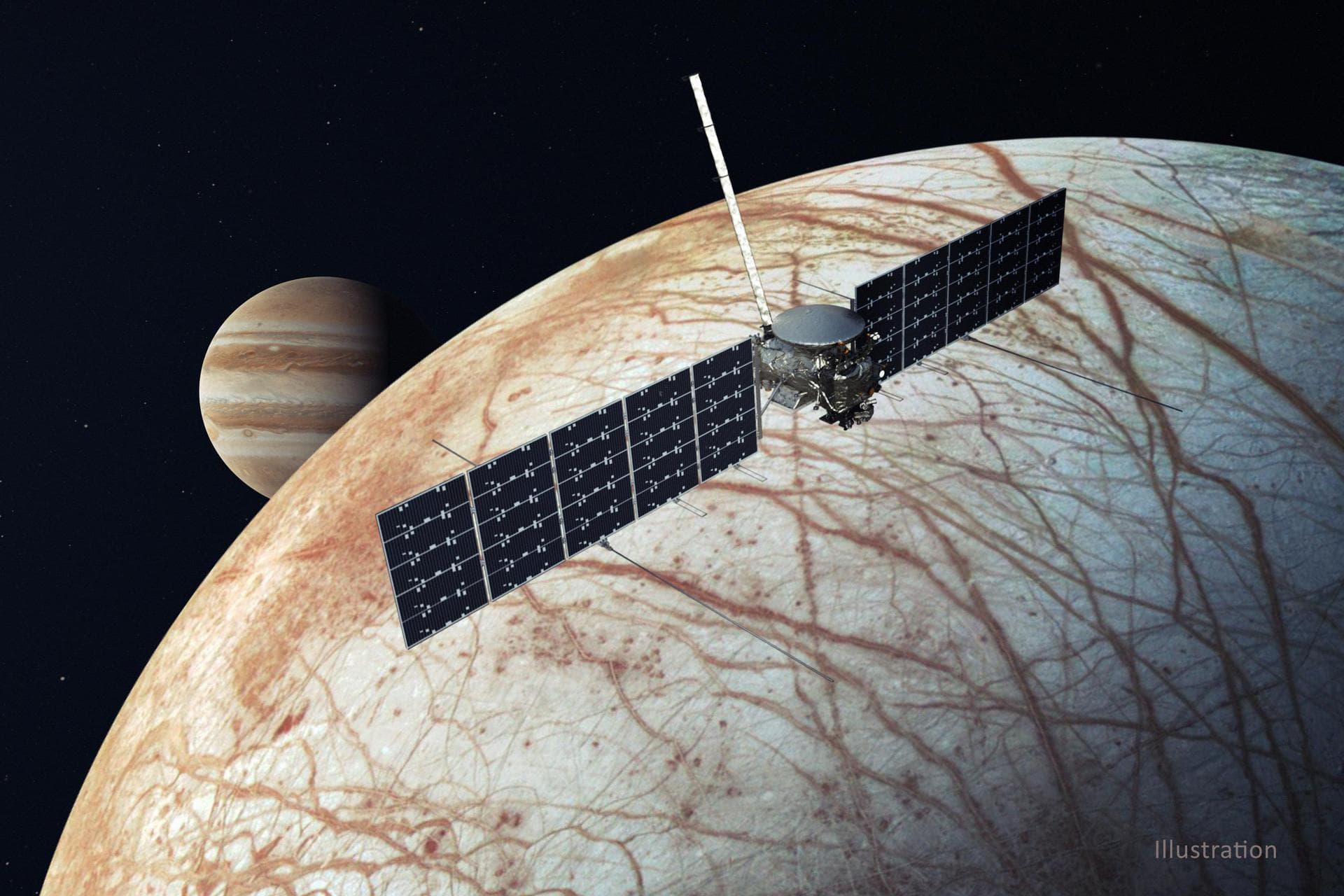
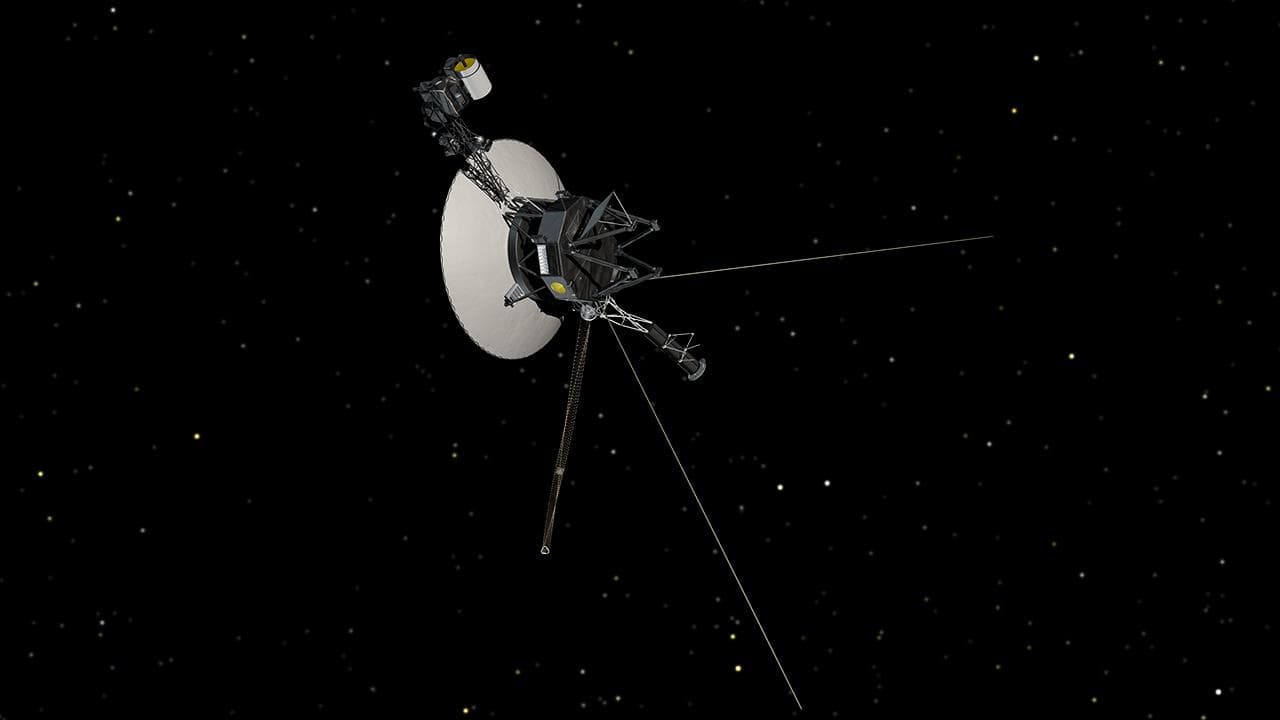
Cassini-Huygens was a flagship mission to Saturn conducted jointly by NASA, the European Space Agency (ESA), and the Italian Space Agency (ASI). The Cassini orbiter studied the Saturn system across 294 orbits from July 2004 until September 2017, and ESA's Huygens probe touched down on the moon Titan on January 14, 2005, the first landing ever made in the outer solar system.[1][2][3]
The scale of the mission set records for its era. The spacecraft stood 6.7 meters tall and 4 meters wide, and weighed 5,712 kilograms at launch including propellant, the Huygens probe, and the launch adapter. It carried 12 orbiter instruments and six more on Huygens.[6] Over 13 years at Saturn, Cassini made 162 targeted flybys of the planet's moons, returned 453,048 images and 635 gigabytes of science data, and discovered six named moons. Engineers and scientists from 27 countries took part in the project, whose total cost was about 3.9 billion dollars.[3][6]
Cassini reshaped planetary science by showing that small icy moons can hide liquid water. Its discoveries of the Enceladus plumes and Titan's methane seas made "ocean worlds" a central theme of solar system exploration, directly influencing missions such as Europa Clipper.[2][3]
Spacecraft and instruments
Cassini, built by NASA's Jet Propulsion Laboratory, was one of the largest interplanetary spacecraft ever flown. Sunlight is too weak at Saturn's distance for practical solar panels, so the orbiter drew power from three radioisotope thermoelectric generators, which supplied 885 watts at launch and 633 watts by the end of the mission. Most of the spacecraft's 4-meter width was its high-gain antenna, which handled the link to Earth and also served as the aperture for the radar and radio science experiments.[6][8]
The orbiter's instruments split between remote sensing, which observed targets at a distance, and fields and particles instruments, which measured the environment the spacecraft flew through.[8]
| Instrument | Name | Measured |
|---|---|---|
| ISS | Imaging Science Subsystem | Visible, near-ultraviolet and near-infrared images from wide- and narrow-angle cameras |
| VIMS | Visible and Infrared Mapping Spectrometer | Reflected and emitted radiation, used for surface and atmospheric composition |
| CIRS | Composite Infrared Spectrometer | Infrared emission, giving temperatures and composition of atmospheres, rings and surfaces |
| UVIS | Ultraviolet Imaging Spectrograph | Ultraviolet spectra of atmospheres, rings and the magnetosphere |
| RADAR | Cassini Radar | Titan's surface through the haze, by imaging, altimetry, backscatter and radiometry |
| RSS | Radio Science Subsystem | Atmospheres, rings and gravity fields, from changes in the radio link to Earth |
| CDA | Cosmic Dust Analyzer | Physical and chemical properties of dust and ice grains |
| INMS | Ion and Neutral Mass Spectrometer | Composition of upper atmospheres and the magnetosphere |
| CAPS | Cassini Plasma Spectrometer | Flux of ions as a function of mass per charge |
| MIMI | Magnetospheric Imaging Instrument | Energetic ions and electrons, plus remote imaging of the magnetosphere |
| MAG | Dual Technique Magnetometer | Strength and direction of the magnetic field near the spacecraft |
| RPWS | Radio and Plasma Wave Science | Electric and magnetic fields, electron density and temperature |
Huygens carried six instrument packages of its own: the Huygens Atmospheric Structure Instrument (HASI) for density, temperature, pressure and conductivity; the Descent Imager/Spectral Radiometer (DISR) for images and spectra; the Gas Chromatograph Mass Spectrometer (GCMS) for atmospheric and surface chemistry; the Aerosol Collector and Pyrolyser (ACP), which caught haze particles and heated them for the GCMS; the Doppler Wind Experiment (DWE), which measured winds from shifts in the probe's radio carrier; and the Surface Science Package (SSP), which characterized whatever the probe landed on.[5][8]
Mission profile and journey
Cassini launched on October 15, 1997, at 08:43 UTC atop a Titan IVB/Centaur from Cape Canaveral. Too heavy to fly directly to Saturn, it followed a looping Venus-Venus-Earth-Jupiter gravity assist route, passing Venus on April 26, 1998 and June 24, 1999, Earth on August 18, 1999, and Jupiter on December 30, 2000. The cruise took 6.7 years, and by the end of the mission the spacecraft had travelled 7.9 billion kilometers since launch. It was only the fourth spacecraft to visit Saturn, after Pioneer 11 and the two probes of the Voyager program, and the first to orbit it.[1][3][9]
| Date | Event |
|---|---|
| October 15, 1997 | Launch from Cape Canaveral |
| April 1998 and June 1999 | Venus gravity assists |
| August 1999 | Earth gravity assist |
| December 30, 2000 | Jupiter flyby |
| July 1, 2004 | Saturn orbit insertion |
| January 14, 2005 | Huygens lands on Titan |
| April 26, 2017 | First Grand Finale ring-gap dive |
| September 15, 2017 | Atmospheric entry ends the mission |
Saturn orbit insertion on July 1, 2004, threaded the spacecraft through the gap between the F and G rings. The four-year prime mission was extended twice: the Equinox mission from 2008 and the Solstice mission from 2010, which carried operations through Saturn's northern summer solstice in May 2017 and let scientists watch seasonal change across nearly half a Saturn year.[1][2]
| Phase | Dates | Notes |
|---|---|---|
| Prime mission | July 2004 to June 2008 | 75 orbits, the Huygens landing, and the discovery of the Enceladus plumes |
| Equinox mission | July 2008 to October 2010 | Covered the August 2009 ring-plane crossing, when the rings were lit edge-on |
| Solstice mission | October 2010 to September 2017 | Ran through northern summer solstice in May 2017; ended with the Grand Finale |
| Grand Finale | April 26 to September 15, 2017 | 22 dives between the cloud tops and the innermost ring |
Huygens lands on Titan
Cassini released the 318-kilogram, 2.7-meter-wide Huygens probe on December 25, 2004.[1][5] Twenty days later, on January 14, 2005, Huygens entered Titan's thick nitrogen atmosphere and descended under parachutes for 2 hours and 27 minutes, photographing branching drainage channels and shoreline-like boundaries through the haze. It touched down on a dark floodplain with the consistency of damp sand, strewn with rounded pebbles of water ice, and transmitted from the surface for about 72 minutes before Cassini, its radio relay, set below the horizon.[4][5]
The descent profile held surprises. Titan's upper atmosphere was warmer and denser than models had predicted, the mesosphere that theory called for was effectively absent, and the temperature bottomed out at 203 degrees below zero Celsius at 44 kilometers altitude before rising again to 180 below at the surface, where the pressure was 1.47 times Earth's at sea level.[39] On the ground the methane signal rose about 40 percent while the nitrogen count held steady and stayed there for roughly an hour, most likely because the probe was warming the surface material and driving methane out of it. Clear surface images were obtained below 40 kilometers altitude, and the probe made the first direct sampling of Titan's organic chemistry and of the aerosols below 150 kilometers.[4][40]
Half the intended data was lost to a single missing command. Huygens transmitted on two independent radio channels, and because the team had chosen to send different images on each rather than duplicate them, the failure cost unique pictures rather than backups. The command to switch on Cassini's receiver for Channel A with its ultrastable oscillator was never included in the relay sequence, so Channel A was never locked. About 350 images arrived instead of the planned 700, and the onboard record of the Doppler Wind Experiment was lost with it. Channel B ran without a single dropout.[10][11]
The wind measurements were recovered from the ground. A network of radio telescopes on Earth tracked the probe's faint carrier signal directly during the descent, and the Doppler precision of those observations taken together was roughly equivalent to what had been expected from the onboard link, which allowed the Titan wind profile to be reconstructed.[10]
Huygens remains both the first landing in the outer solar system and the most distant touchdown from Earth ever achieved. Its measurements showed that liquid methane had recently flowed at the site and gave the first ground-level view of a world where hydrocarbons play the role water plays on Earth.[4][5]
Enceladus plumes and ocean
In 2005 Cassini's magnetometer detected Saturn's magnetic field draping oddly around the small moon Enceladus, and follow-up flybys revealed the cause: jets of water vapor and ice grains erupting from four warm fractures, nicknamed tiger stripes, at the south pole. The plume feeds Saturn's diffuse E ring.[7]
Cassini made 23 targeted flybys of Enceladus over the mission[3] and flew directly through the plume repeatedly, including a pass 49 kilometers above the south polar region on October 28, 2015. Its instruments found salts, organic compounds, and silica nanograins whose size and composition point to water reacting with rock at 90 degrees Celsius or more on a seafloor, the first evidence of active hydrothermal chemistry anywhere beyond Earth.[7][12] A wobble in the moon's rotation, announced in September 2015, showed the ice shell floats on a global subsurface ocean rather than a local polar sea.[13] In April 2017 the team reported molecular hydrogen in the plume in Science, in quantities best explained by rock-water reactions and sufficient to feed microbes of the kind that live around terrestrial hydrothermal vents.[14]
Analysis of the archived plume data has continued to add to that picture long after the spacecraft was gone.
| Year | Finding | Source data |
|---|---|---|
| 2018 | Complex organic molecules above 200 atomic mass units, over ten times heavier than methane, implying an organic-rich film on the ocean surface | Cosmic Dust Analyzer and mass spectrometry[15] |
| 2023 | Sodium phosphates in salt-rich E ring grains, the first detection of phosphorus in an ocean beyond Earth, at concentrations at least 100 times those of Earth's seas | Cosmic Dust Analyzer[16][17] |
| 2023 | Hydrogen cyanide, plus oxidized organics indicating more chemical energy available than previously assumed | Ion and Neutral Mass Spectrometer[18] |
| 2025 | Aliphatic, cyclic ester and ether compounds, some with double bonds, in grains ejected minutes earlier | Cosmic Dust Analyzer during the 2008 E5 flyby[19][20] |
The 2025 result came from re-examining the E5 encounter, in which Cassini passed 21 kilometers above the surface at about 18 kilometers per second. The high impact speed broke the grains into molecular fragments that earlier, slower passes had never produced, and because those grains had left the ocean only minutes before, the chemistry could not be dismissed as the product of long exposure to radiation in the E ring.[19][20] Together these results made Enceladus one of the leading astrobiology targets in the solar system.
Titan's lakes and seas
Cassini made 127 targeted flybys of Titan, using radar and infrared imaging to map a surface hidden beneath orange haze. It found dune fields, mountains, river networks, and, beginning in 2006, radar-dark basins near the north pole that proved to be lakes and seas of liquid methane and ethane, including Kraken Mare, Ligeia Mare, and Punga Mare. These were the first stable bodies of surface liquid confirmed anywhere beyond Earth, sustained by a methane cycle of evaporation, rain, and runoff that mirrors Earth's water cycle.[2][7]
Radar soundings put numbers on those seas. During the T104 flyby on August 21, 2014, Cassini's radar altimeter timed echoes off the surface and the sea bottom of Kraken Mare, the largest of them. A bay called Moray Sinus came out about 85 meters deep, while the central basin returned no bottom echo at all, meaning more than roughly 300 meters. The liquid there is dominated by methane rather than the ethane many had expected in Titan's largest sea.[21]
Titan's interior has proved harder to settle. In 2012, radio tracking showed that Saturn raises solid tides about 10 meters high on Titan, far more than the roughly 1 meter a rigid rocky body would flex, and the team read that as near-inescapable evidence of a global water ocean under the ice.[22] A reanalysis of the same Cassini tracking data, published in Nature in December 2025, reached the opposite conclusion. By recovering the phase lag of the tidal response for the first time, the authors measured 3 to 4 terawatts of energy being dissipated inside Titan, a tidal quality factor of about 5 against roughly 300 for Earth's solid interior. A liquid layer would suppress dissipation beneath it, so the measurement argues against a global ocean and favors a warm high-pressure ice layer near its melting point, which could still hold pockets of liquid water.[23] The question is not closed, and NASA's Dragonfly rotorcraft will carry a seismometer capable of distinguishing solid ice from liquid by how seismic waves travel through the interior.[24]
| 2012 analysis | 2025 reanalysis | |
|---|---|---|
| Data used | Cassini radio tracking of Titan flybys | The same Cassini radio tracking |
| Key measurement | Solid tides about 10 meters high | 3 to 4 terawatts of tidal dissipation; quality factor about 5 |
| Conclusion | Global subsurface water ocean[22] | No global ocean; warm high-pressure ice with possible pockets of liquid water[23] |
Titan's organic chemistry made it the destination for Dragonfly, which NASA confirmed in April 2024 with a life-cycle cost of 3.35 billion dollars, a launch readiness date of July 2028, and arrival at Titan around 2034.[25] The launch window runs July 5 to 25, 2028, on a Falcon Heavy from Launch Complex 39A at Kennedy Space Center, under a firm-fixed-price contract worth about 256.6 million dollars.[44] The mission entered its integration and test phase in January 2026; by mid-2026 the team had completed vibration and sealing tests of the structure, integrated the high-gain antenna in May, and delivered the fuselage for further integration on June 29, 2026, ahead of schedule.[26]
Rings and moons
Cassini watched Saturn's rings behave as a dynamic system rather than a static disk. Ring particles range from grains smaller than sand to bodies the size of mountains, and the spacecraft imaged "propeller" wakes, some thousands of kilometers long, carved by embedded moonlets roughly a kilometer across.[41] It also found the moon that had been inferred from ripples along the edge of the Keeler Gap: Daphnis, a body 3.8 kilometers in mean radius, discovered on May 1, 2005, which raises waves ahead of itself in the faster-orbiting inner ring material and behind itself in the slower outer material.[42] During the 2009 equinox, with sunlight striking the rings edge-on, those waves and other vertical structures kilometers tall threw shadows across the ring plane, showing the rings to be far less flat than expected.[41]
Gravity data from the final orbits weighed the rings at about 0.41 times the mass of the moon Mimas. That is far too little material to have stayed as clean as it looks since Saturn formed, and the authors put the rings at roughly 10 million to 100 million years old.[27] A separate line of evidence agreed: measurements of how fast micrometeoroid dust falls into the system, published in 2023, limited the rings' exposure time to no more than a few hundred million years.[28] The conclusion is contested. A 2024 study argued that ring particles shed non-icy impactor debris rather than absorbing it, so the rings could stay bright while being far older, possibly as old as Saturn itself.[29] A 2026 dynamical study, accepted by The Planetary Science Journal, tried to reconcile the young-ring evidence with Saturn's interior and orbital history by proposing a two-stage collisional upheaval among the inner moons within the last few hundred million years.[30]
The six moons Cassini discovered are all small, and most orbit within or near the ring system. The Cassini imaging team found Methone, Pallene and Polydeuces in 2004, Daphnis in 2005, Anthe in 2007, and Aegaeon in 2008.[3][43] Among the larger moons, Cassini revealed the two-toned walnut shape of Iapetus, the sponge-like surface of Hyperion, and the geologic diversity of mid-sized icy satellites that had appeared as mere dots to Voyager.[1][7]
Saturn's atmosphere and interior
Because Cassini stayed at Saturn for most of a Saturn season, it caught weather in the planet's atmosphere that shorter visits would have missed. A storm that erupted in the northern hemisphere in late 2010 grew into the largest and most intense the mission observed. Its bright head raced westward around the planet, caught up with its own slow-moving vortex by mid-2011, and disturbed the atmosphere at the equator tens of thousands of kilometers away, an effect the team compared to teleconnection in Earth's climate. Its influence on cloud, temperature and composition lasted more than three years.[31]
The six-sided jet stream around Saturn's north pole, known as the hexagon, changed color over the mission. The region inside it appeared bluish in 2012 and golden by 2016. NASA attributed the shift to photochemical haze building up in the polar atmosphere after the pole emerged from winter darkness at the 2009 equinox, with the hexagon apparently acting as a barrier that keeps haze from outside from mixing in.[32]
Saturn's rotation rate had resisted measurement for decades, because the planet's magnetic field gives no tilted marker to time against. Waves in the C ring, observed by Cassini as stars passed behind them, act instead as a seismograph driven by oscillations inside the planet. Fourteen such waves yielded a rotation period of 10 hours, 33 minutes and 38 seconds.[33]
The Grand Finale
The Grand Finale was the closing phase of the Cassini mission: 22 orbits flown between April and September 2017 that passed inside Saturn's rings and ended with the spacecraft's destruction in the planet's atmosphere.[2] Cassini was running low on propellant by 2017, and to eliminate any chance of a derelict spacecraft one day crashing into, and contaminating, Enceladus or Titan, the team chose to end the mission this way. A final close Titan flyby on April 22, 2017, bent the orbit so the spacecraft would pass inside the rings, and beginning April 26 Cassini made its 22 weekly dives through the roughly 2,400-kilometer gap between the cloud tops and the innermost ring. It came within 1,628 kilometers of the clouds, reached 123,608 kilometers per hour relative to Saturn, and made five passes through the upper atmosphere and four through the D ring.[2][34]
These Grand Finale orbits produced measurements impossible from outside. Six papers published in Science in October 2018 reported that ring material rains into the atmosphere at about 10,000 kilograms per second, carrying not only water and silicates but methane, ammonia, carbon monoxide, nitrogen and carbon dioxide; that an electrical current system links the rings to the upper atmosphere; that a previously unknown radiation belt sits between the planet and the innermost ring; and that the gap is filled mainly with nanometer-sized particles.[35] The magnetometer measurements were the most puzzling result: Saturn's magnetic field is tilted less than 0.0095 degrees from its spin axis, against 11 degrees for Earth, which leaves no obvious way for the planet to sustain a dynamo at all.[36]
On September 15, 2017, the spacecraft entered the atmosphere and transmitted plasma density, magnetic field, temperature and composition data in near real time until its thrusters could no longer hold the antenna on Earth. It survived roughly a minute in the atmosphere. Saturn was about 1.4 billion kilometers away, so the final signal took 83 minutes to cross the gap, and loss of signal was called at mission control at 11:55 UTC.[2][37]
Legacy
Cassini's archive continues to generate research years after the mission's end. NASA's mission tally counts 3,948 science papers, and the phosphate, hydrogen cyanide and fresh-organics results at Enceladus all came out of data that had been sitting in the archive for a decade or more.[3][16][18][19] The argument over whether Titan holds a global ocean is likewise being conducted entirely on radio tracking recorded before 2017.[23]
The mission's findings established that habitable environments may exist far beyond the Sun's traditional habitable zone, a conclusion that shaped the Europa Clipper mission launched in 2024 and Dragonfly's selection for Titan. The 2023-2032 planetary science decadal survey ranked an Enceladus Orbilander, which would orbit the moon and then land to analyze fresh plume material, as its second-highest priority new flagship mission after a Uranus orbiter.[38] Huygens' descent record still stands, and no spacecraft has returned to Saturn since.[2][3]
References
- Cassini-Huygens: Mission Summary - ESA Science and Technology.
- Cassini's Grand Finale - Overview - NASA Science.
- Cassini-Huygens By the Numbers - NASA Science.
- The Huygens landing: one year on - European Space Agency.
- Huygens Probe - NASA Science.
- Cassini Quick Facts - NASA Science.
- Cassini: Science Overview - NASA Science.
- Cassini-Huygens: Instruments - ESA Science and Technology.
- Cassini-Huygens: Getting to Saturn - ESA Science and Technology.
- The Huygens Doppler Wind Experiment: results from Titan - ESA Science and Technology.
- Huygens Probe Delivers Data From Saturnian Moon - IEEE Spectrum.
- Hot water activity on icy moon's seafloor - European Space Agency, March 2015. Reports Hsu et al., "Ongoing hydrothermal activities within Enceladus," Nature 519, 207-210.
- Cassini Finds Global Ocean in Saturn's Moon Enceladus - NASA Jet Propulsion Laboratory, September 15, 2015.
- Cassini finds molecular hydrogen in the Enceladus plume: Evidence for hydrothermal processes - J. H. Waite et al., Science 356, 155-159, April 14, 2017.
- Macromolecular organic compounds from the depths of Enceladus - F. Postberg et al., Nature 558, 564-568, June 27, 2018.
- NASA Cassini Data Reveals Building Block for Life in Enceladus' Ocean - NASA Jet Propulsion Laboratory, June 14, 2023.
- Detection of phosphates originating from Enceladus's ocean - F. Postberg et al., Nature 618, 489-493, June 14, 2023.
- NASA Study Finds Life-Sparking Energy Source and Molecule at Enceladus - NASA Jet Propulsion Laboratory, December 14, 2023. Reports Peter et al., Nature Astronomy.
- NASA Cassini Study Finds Organics 'Fresh' From Ocean of Enceladus - NASA Jet Propulsion Laboratory, November 18, 2025.
- Detection of organic compounds in freshly ejected ice grains from Enceladus's ocean - N. Khawaja et al., Nature Astronomy, November 2025.
- Astronomers estimate Titan's largest sea is 1,000 feet deep - Cornell Chronicle, January 20, 2021. Reports Poggiali et al., Journal of Geophysical Research: Planets.
- Cassini Finds Likely Subsurface Ocean on Saturn Moon - NASA Jet Propulsion Laboratory, June 28, 2012. Reports Iess et al., Science.
- Titan's strong tidal dissipation precludes a subsurface ocean - F. Petricca et al., Nature 648, 556-561, December 17, 2025.
- New Views of Saturn's Moon Titan and Jupiter's Moon Europa Complicate Ocean Worlds Theory - Scientific American, December 17, 2025.
- Dragonfly Mission Confirmed for 2028 Launch to Saturn's Moon Titan - Johns Hopkins University Applied Physics Laboratory, April 2024.
- NASA's Dragonfly Clears Key Tests as Titan Rotorcraft Takes Shape - NASA Science, July 9, 2026.
- Measurement and implications of Saturn's gravity field and ring mass - L. Iess et al., Science 364, eaat2965, 2019.
- Micrometeoroid infall onto Saturn's rings constrains their age to no more than a few hundred million years - S. Kempf et al., Science Advances 9, eadf8537, May 12, 2023.
- Pollution resistance of Saturn's ring particles during micrometeoroid impact - R. Hyodo et al., Nature Geoscience, December 2024.
- Origin of Hyperion and Saturn's Rings in a Two-Stage Saturnian System Instability - M. Cuk et al., arXiv preprint, February 9, 2026, accepted by The Planetary Science Journal.
- Saturn's greatest storm - ESA Science and Technology.
- Changing Colors in Saturn's North - NASA Science.
- Cassini Ring Seismology as a Probe of Saturn's Interior. I. Rigid Rotation - C. R. Mankovich et al., The Astrophysical Journal 871, 1, 2019.
- Cassini By the Numbers: The Grand Finale - NASA Science.
- Groundbreaking Science Emerges from Ultra-Close Orbits of Saturn - NASA Jet Propulsion Laboratory, October 4, 2018.
- Saturn's magnetic field revealed by the Cassini Grand Finale - M. K. Dougherty et al., Science 362, eaat5434, October 5, 2018.
- Cassini concludes pioneering mission at Saturn - ESA Science and Technology, September 15, 2017.
- Origins, Worlds, and Life: A Decadal Strategy for Planetary Science and Astrobiology 2023-2032 - National Academies of Sciences, Engineering, and Medicine.
- Science highlights from Huygens: 1. Profiling the atmosphere of Titan - ESA Science and Technology.
- Science highlights from Huygens: 3. Methane mystery - ESA Science and Technology.
- Cassini: Saturn Rings - NASA Science.
- Daphnis - NASA Science.
- Saturn Moons - NASA Science.
- NASA Awards Launch Services Contract for Dragonfly Mission - NASA, November 2024.