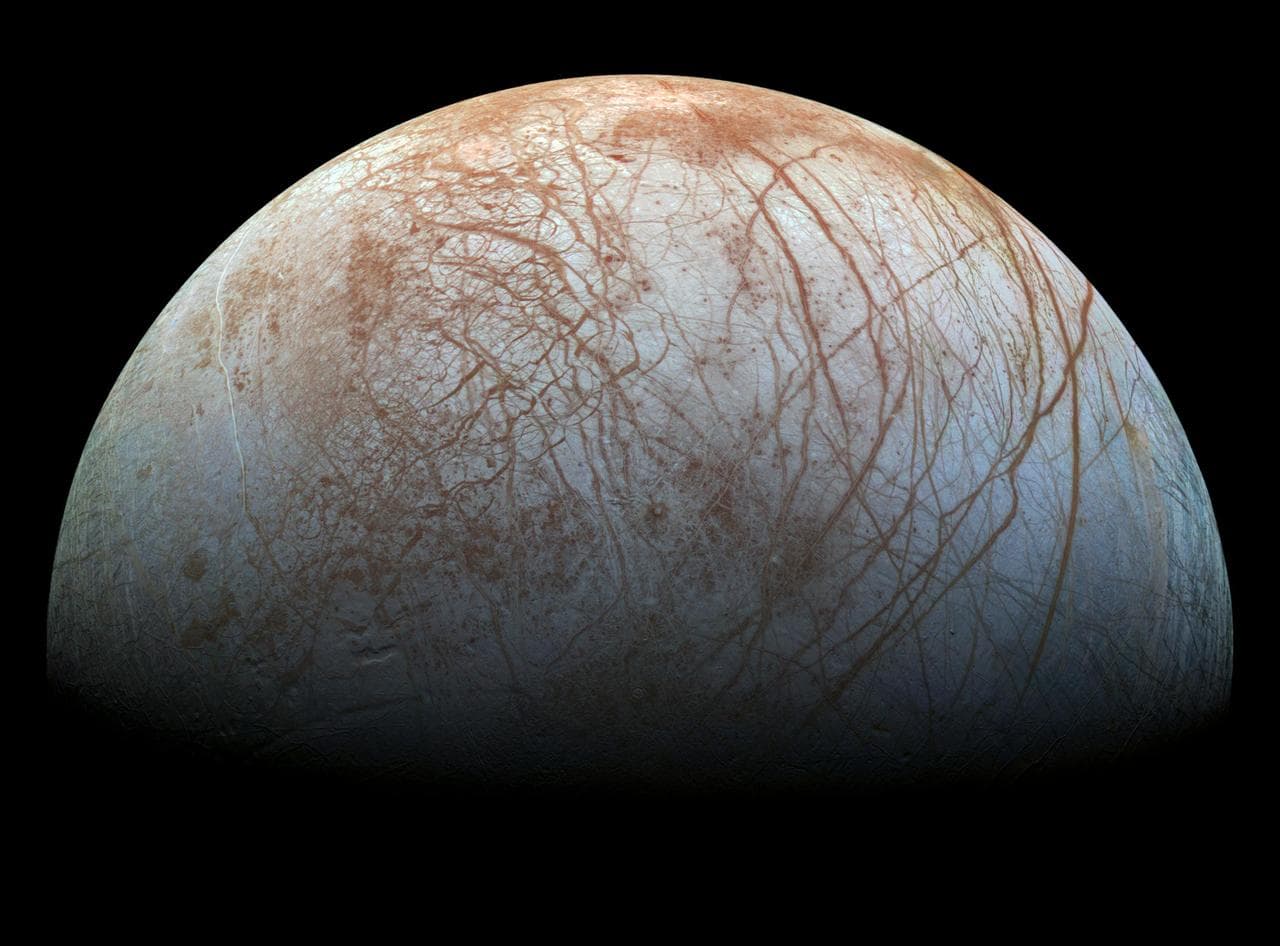
Europa Clipper is a NASA mission designed to determine whether Europa, an ice-covered moon of Jupiter, has conditions that could support life. The spacecraft launched on October 14, 2024, aboard a SpaceX Falcon Heavy from Kennedy Space Center, and is the largest spacecraft NASA has ever developed for a planetary mission, spanning 30.5 meters with its solar arrays deployed.[1][2]
Europa orbits inside Jupiter's harsh radiation belts, so rather than circling the moon directly the spacecraft will orbit Jupiter and perform about 49 close flybys of Europa, building near-global maps flyby by flyby. It carries nine science instruments plus a gravity experiment that uses its radio system.[1][2]
The probe is currently in its interplanetary cruise. It took a gravity assist at Mars on March 1, 2025, returns for an Earth gravity assist on December 3, 2026, and is scheduled to enter orbit around Jupiter on April 11, 2030.[3][4]
Background and development
Evidence for Europa's hidden ocean dates to the 1990s, when NASA's Galileo orbiter measured an induced magnetic field around the moon, the signature of a salty, electrically conductive layer of liquid water beneath the ice. Current models suggest an ice shell roughly 15 to 25 kilometers thick over an ocean 60 to 150 kilometers deep, holding perhaps twice as much liquid water as all of Earth's oceans. Because the seafloor touches rock and the surface receives chemical products of radiation, Europa may possess the water, chemistry, and energy that life requires.[1][6][8]
The planetary science decadal survey published in 2011 ranked a Europa orbiter as its second-highest large-scale priority, behind the Mars sample-caching rover that became Mars 2020, but priced the concept at about 4.7 billion dollars and advised cutting its scope; the cheaper flyby architecture that became Europa Clipper grew out of that advice.[11][25] NASA picked the nine science instruments in May 2015, with the Jet Propulsion Laboratory and the Johns Hopkins Applied Physics Laboratory leading the work. The project entered its design phase in February 2017, took the name Europa Clipper the following month, and was formally confirmed in August 2019, when the agency committed to a 4.25 billion dollar baseline and cleared the spacecraft for fabrication. Assembly began at JPL in March 2022.[7][14]
Congress had directed NASA to launch Europa Clipper on the Space Launch System. Lawmakers relaxed that requirement in the fiscal 2021 omnibus spending bill, NASA told the project in early 2021 to stop preparing for SLS, and on July 23, 2021 the agency awarded SpaceX a launch contract worth about 178 million dollars.[9][10] NASA's fiscal 2021 budget request had argued that a commercial launch would save more than 1.5 billion dollars against SLS; a May 2019 audit by the agency's inspector general, working from the estimates available then, put the net difference under 300 million dollars once the added operations cost of a longer cruise was counted.[10][11] The tradeoff was time. SLS could have flown the spacecraft straight to Jupiter in under three years, while the Falcon Heavy trajectory needs gravity assists at Mars and Earth and five and a half years.[10]
| Factor | Space Launch System | Falcon Heavy |
|---|---|---|
| Trajectory to Jupiter | Direct | Gravity assists at Mars and Earth |
| Transit time | Under three years | About five and a half years |
| Selection | Directed by Congress until the fiscal 2021 omnibus | Contract awarded July 23, 2021, about 178 million dollars |
In May 2024, months before launch, engineers found that metal-oxide-semiconductor transistors used throughout the spacecraft could fail at lower radiation doses than the industry qualification data implied. Testing over the summer showed that the parts recover between exposures through annealing, in which heat rearranges the disrupted atomic structure, and that the tour design leaves time for it: the spacecraft takes its dose during roughly one day of each orbit around Jupiter and spends the rest of the orbit outside the worst of the belts, with the option of warming selected circuits to speed the recovery. NASA cleared the mission at a Key Decision Point E review on September 9, 2024.[12] Hurricane Milton then pushed the launch back from October 10, and the fully expended Falcon Heavy lifted off at 12:06 p.m. EDT on October 14, 2024 from Launch Complex 39A.[13] NASA's life-cycle cost for the mission is about 5.2 billion dollars.[2]
Spacecraft
Europa Clipper weighed about 5,800 kilograms at launch, roughly 2,750 kilograms of it propellant for 24 small engines that each produce 27.5 newtons of thrust.[2][16] Its two solar arrays stretch just over 100 feet (30.5 meters) tip to tip because sunlight at Jupiter's distance is only 3 to 4 percent as strong as at Earth; even at that size the arrays will deliver about 700 watts there, roughly what a small microwave oven draws.[15] Sensitive electronics sit inside a vault with aluminum-zinc alloy walls up to 9.2 millimeters thick, and the mission's flyby-then-retreat orbit design further limits time spent in the worst radiation.[2][6][8]
| Property | Value |
|---|---|
| Launch mass | About 5,800 kg, including about 2,750 kg of propellant |
| Span | 30.5 m across the deployed solar arrays; each wing 14.2 by 4.1 m |
| Power | At least 700 W at Jupiter |
| Propulsion | 24 engines of 27.5 newtons, up to eight firing at once |
| Communications | 3 m high-gain antenna |
| Electronics vault | Aluminum-zinc alloy walls up to 9.2 mm thick |
| Magnetometer boom | 8.5 m |
| Radar antennas | Four high-frequency antennas spanning 17.6 m, plus eight VHF antennas of 2.76 m |
| Payload | Nine science instruments, plus gravity and radio science and radiation monitoring |
The spacecraft also carries a cultural payload. A tantalum plate about 18 by 28 centimeters is engraved on one face with waveforms of the word "water" spoken in 103 languages, arranged around the American Sign Language sign for water, and on the other with "In Praise of Mystery: A Poem for Europa" by US Poet Laureate Ada Limon, in her own handwriting. A silicon microchip stenciled with more than 2.6 million names submitted by the public is fixed to the plate.[17]
Journey to Jupiter
Europa Clipper's route from launch to Jupiter covers about 2.9 billion kilometers over five and a half years. Flying past Mars and Earth lets the mission trade time for propellant; without the two assists the spacecraft could not carry enough fuel to reach Jupiter on this trajectory.[2][3] The Earth encounter was designed with slack: depending on the launch date it could have fallen anywhere between December 2 and 7, 2026, at altitudes from about 3,140 to 3,450 kilometers. The team holds that path with trajectory correction maneuvers, three of them before the Mars flyby and another about 15 days after it; controllers expect upwards of 200 across the mission.[3][4]
| Date | Event |
|---|---|
| October 14, 2024 | Launch on Falcon Heavy from Kennedy Space Center |
| March 1, 2025 | Mars gravity assist, 884 km above the surface |
| December 3, 2026 | Earth gravity assist, about 3,200 km above the surface (planned) |
| April 11, 2030 | Jupiter orbit insertion, after a Ganymede flyby about 12 hours earlier (planned) |
| Spring 2031 | First Europa science flyby (planned) |
| May 2031 | First science campaign begins, anti-Jovian hemisphere (planned) |
| May 2033 | Second science campaign begins, sub-Jovian hemisphere (planned) |
| September 2034 | Prime mission ends with a planned impact on Ganymede |
During the Mars flyby on March 1, 2025, which passed 884 kilometers above the surface, the team exercised the science payload, using the E-THEMIS thermal imager to capture infrared images of the planet and running the REASON radar in flight for the first time.[4] Cruise operations have also included major deployments: the 8.5-meter magnetometer boom and the four 17.6-meter radar antennas unfolded in the months after launch, and each instrument was powered on for health checks through the first winter, although several of them, among them the visible imager and the gas and dust mass spectrometers, keep protective covers closed for about the first three years to shield their optics and inlets.[5]
Cruise observations
Several of Europa Clipper's instruments have returned real data years before reaching Jupiter, mostly through calibration exercises that doubled as science.
At Mars, E-THEMIS shot one image per second for about 18 minutes, more than a thousand grayscale frames, downlinked from May 5, 2025 and checked against thermal images taken at the same time by the twin THEMIS instrument on NASA's Mars Odyssey orbiter. In the colorized composite the red areas sit near 0 degrees Celsius and the purple areas near minus 125.[19] REASON ran for about 40 minutes on the same pass, transmitting and receiving between roughly 5,000 and 890 kilometers altitude. A full echo test on the ground would have needed a chamber about 76 meters long, so the flyby was the instrument's first end-to-end check; the radargram traced Martian topography cleanly, and principal investigator Don Blankenship said every part of the instrument proved itself.[18]
On November 5, 2025 one of the spacecraft's star trackers caught Uranus in a starfield from about 3.2 billion kilometers away, an unplanned capture during a test of the stellar reference units.[20] The next day Europa-UVS spent about seven hours observing 3I/ATLAS, the third confirmed interstellar object, from about 164 million kilometers. Europa Clipper sat between the comet and the Sun at a point when solar glare blocked the view from Earth, which gave the instrument a downstream look back along both tails; it detected oxygen, hydrogen, and dust features consistent with heavy outgassing just after the comet's closest approach to the Sun.[21] ESA's Juice carries an ultraviolet spectrograph built by the same team, and because the comet passed between the two spacecraft they imaged opposite hemispheres at once: Juice recorded glowing gas on the day side, Europa Clipper scattered dust on the night side, and both measured more carbon emission than solar system comets typically show.[22]
Instruments
Europa Clipper's nine science instruments operate together on every flyby, so each pass yields a co-registered slice of imaging, composition, and interior data.[1][6]
| Instrument | Measurement |
|---|---|
| EIS (Europa Imaging System) | Wide- and narrow-angle visible imaging of nearly the whole moon, in stereo for topography |
| E-THEMIS (Europa Thermal Emission Imaging System) | Thermal imaging to find warm, recently active regions |
| MISE (Mapping Imaging Spectrometer for Europa) | Infrared spectroscopy of surface composition, including salts and organics |
| Europa-UVS (Europa Ultraviolet Spectrograph) | Ultraviolet spectroscopy, including plume searches |
| REASON (Radar for Europa Assessment and Sounding: Ocean to Near-surface) | Ice-penetrating radar sounding of the shell and any shallow water |
| ECM (Europa Clipper Magnetometer) | Magnetometer to confirm the ocean and estimate depth and salinity |
| PIMS (Plasma Instrument for Magnetic Sounding) | Plasma measurements that sharpen the magnetic sounding |
| MASPEX (Mass Spectrometer for Planetary Exploration) | Mass spectrometry of gases in the thin atmosphere |
| SUDA (Surface Dust Analyzer) | Composition of dust grains ejected from the surface |
A gravity and radio science investigation uses the telecommunications system to probe the interior, and radiation sensors at more than a dozen places on the spacecraft log the accumulated dose and the electron flux, both to protect the vehicle and to characterize an environment no mission has sampled this closely.[23][24]
Science at Europa
Europa Clipper's Jupiter orbit insertion is planned for April 11, 2030, preceded about 12 hours earlier by a Ganymede flyby within roughly 200 kilometers of that moon's surface, which trims the propellant needed for capture. The spacecraft then spends about a year pulling its long initial orbit down before dedicated Europa flybys begin in spring 2031; the tour includes seven more Ganymede passes and nine Callisto passes purely to shape the trajectory. The 49 Europa flybys close to between 25 and 100 kilometers of the surface and are arranged so their ground tracks crisscross the moon. The first campaign, from May 2031, works the anti-Jovian hemisphere; a second, from May 2033, covers the sub-Jovian side. Each orbit delivers a heavy radiation dose over roughly a day, after which the spacecraft climbs back out of the belts to downlink data, take new commands, and let its electronics recover.[3][7][8][25] The prime mission ends with a planned impact on Ganymede in September 2034.[3]
Europa Clipper's three formal objectives are to measure the thickness of the ice shell and confirm how it exchanges material with the ocean below, to determine the composition of the surface and ocean, including any salts and organic compounds, and to characterize the geology of features such as ridges and chaos terrain. Together these define whether Europa is habitable; Europa Clipper is not designed to detect life itself.[1][25]
How much the shallow ice can say about the deep ocean is itself contested. A modeling study published in Nature Astronomy in July 2026 found that water forced upward through fractures would move turbulently, chill against the cold walls, and grow frazil ice crystals that plug narrow cracks within hours, so a shallow reservoir REASON detects may be a locally melted pocket rather than ocean water that traveled up.[26]
The mission is also meant to pick out scientifically compelling sites and hazards for a possible future Europa lander, a companion mission Congress once directed NASA to plan and that has not been built.[11] Clipper's results will complement those of the European Space Agency's Juice spacecraft, launched April 14, 2023, which reaches Jupiter in July 2031 and makes 35 flybys of Ganymede, Callisto, and Europa before settling into orbit around Ganymede.[27]
| Detail | Europa Clipper | Juice |
|---|---|---|
| Agency | NASA | European Space Agency |
| Launch | October 14, 2024 | April 14, 2023 |
| Jupiter arrival | April 11, 2030 (planned) | July 2031 (planned) |
| Moon flybys | 49, all of Europa | 35, of Ganymede, Callisto, and Europa |
| Final phase | Planned impact on Ganymede, September 2034 | Orbit around Ganymede |
References
- Europa Clipper - NASA Science.
- Europa Clipper Press Kit: Quick Facts - NASA Jet Propulsion Laboratory.
- Europa Clipper Press Kit: Mission Overview - NASA Jet Propulsion Laboratory.
- NASA's Europa Clipper Uses Mars to Go the Distance - NASA Jet Propulsion Laboratory.
- NASA's Europa Clipper: Millions of Miles Down, Instruments Deploying - NASA Jet Propulsion Laboratory.
- Meet Europa Clipper - NASA Science.
- Europa Clipper Mission Timeline - NASA Science.
- Europa Clipper Mission FAQ - NASA Science.
- NASA Awards Launch Services Contract for Europa Clipper Mission - NASA, July 23, 2021.
- Falcon Heavy to launch Europa Clipper - SpaceNews, July 23, 2021.
- Management of NASA's Europa Mission, Report No. IG-19-019 - NASA Office of Inspector General, May 29, 2019.
- Europa Clipper passes pre-launch review - SpaceNews, September 9, 2024.
- NASA Updates Coverage for Europa Clipper Following Hurricane Milton - NASA, October 3, 2024.
- Europa Clipper passes key review - SpaceNews, August 2019.
- NASA's Europa Clipper Gets Set of Super-Size Solar Arrays - NASA Jet Propulsion Laboratory, August 27, 2024.
- Europa Clipper Press Kit: Spacecraft - NASA Jet Propulsion Laboratory.
- Europa Clipper Vault Plate - NASA Science.
- NASA's Europa Clipper Radar Instrument Proves Itself at Mars - NASA Jet Propulsion Laboratory, August 1, 2025.
- NASA's Europa Clipper Captures Mars in Infrared - NASA Jet Propulsion Laboratory, May 12, 2025.
- Europa Clipper Captures Uranus With Star Tracker Camera - NASA Science, November 20, 2025.
- Europa Clipper Instrument Uniquely Observed Interstellar Comet 3I/ATLAS - Southwest Research Institute, December 18, 2025.
- Two Spacecraft Observed Both Hemispheres of Interstellar Comet Simultaneously - Southwest Research Institute, May 13, 2026.
- Europa Clipper Spacecraft Instruments - NASA Science.
- Radiation Monitoring Study - NASA Science.
- Science Overview of the Europa Clipper Mission - Pappalardo et al., Space Science Reviews, 2024.
- Limited direct fluid exchange between the deep subsurface ocean and the shallow subsurface environment of Europa - Ojha et al., Nature Astronomy, July 2026.
- Juice - European Space Agency.