New Horizons is a NASA probe that made the first reconnaissance of Pluto, passing 12,500 kilometers above the surface on July 14, 2015,[3] then flew 3,538 kilometers from the small Kuiper Belt object Arrokoth on January 1, 2019, the most distant world ever explored at close range.[13] Alan Stern of the Southwest Research Institute is the principal investigator; the Johns Hopkins University Applied Physics Laboratory (APL) operates the spacecraft.[3][5]
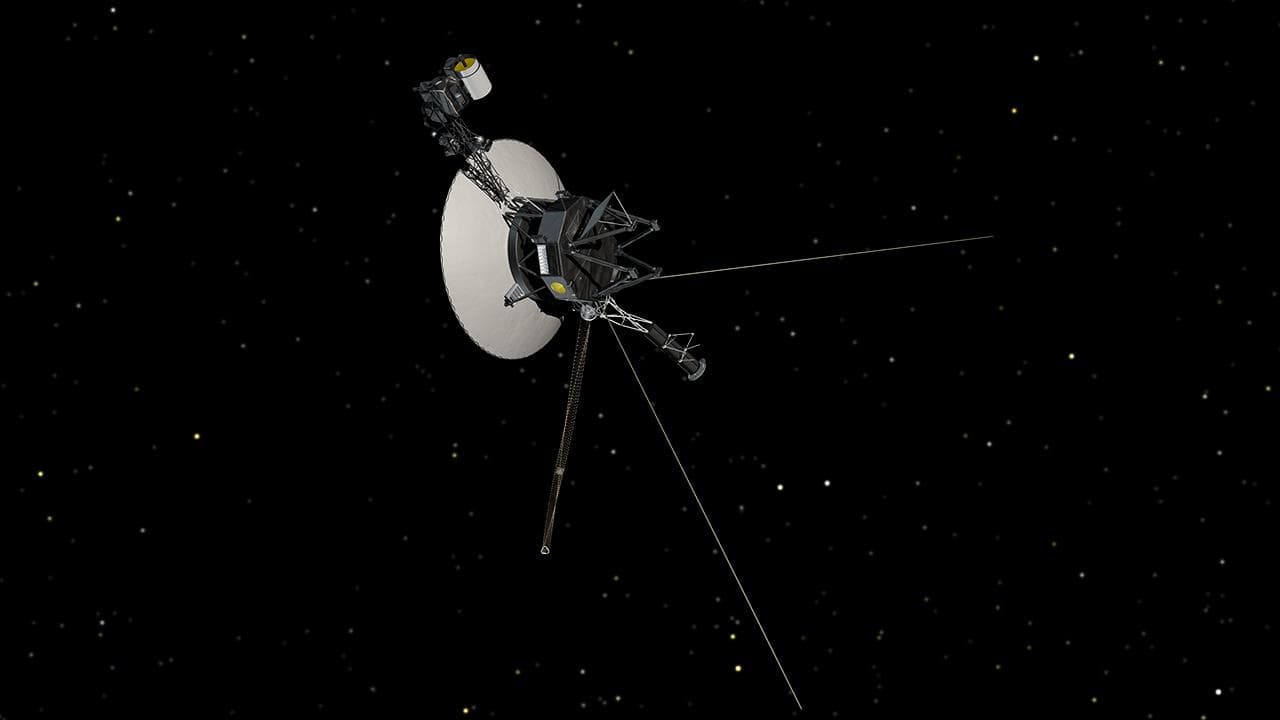
The spacecraft is about the size of a grand piano and weighed 478 kilograms at launch, including 77 kilograms of hydrazine propellant and a 30-kilogram science payload. It draws power from a radioisotope thermoelectric generator because sunlight in the outer solar system is far too weak for solar panels. Launched on January 19, 2006, it left Earth at about 16 kilometers per second, the fastest departure speed of any spacecraft at the time.[2]
New Horizons is now in an extended mission focused on heliophysics and Kuiper Belt science. On August 9, 2026 it was 65.30 astronomical units (AU) from the Sun, about 9.8 billion kilometers, receding at 13.58 kilometers per second, with radio signals taking close to nine hours each way.[7] It came out of the longest hibernation of the mission on June 23, 2026 in good health.[5]
Mission timeline
The New Horizons mission spans two decades so far, from launch in January 2006[2] to a healthy wake-up from its longest hibernation in June 2026.[5]
| Date | Event |
|---|---|
| January 19, 2006 | Launch on an Atlas V 551 from Cape Canaveral[2] |
| February 28, 2007 | Jupiter gravity assist at about 2.27 million kilometers[2] |
| July 14, 2015 | Pluto closest approach, 12,500 kilometers above the surface[3] |
| October 25, 2016 | Last of the Pluto encounter data received on Earth[12] |
| January 1, 2019 | Arrokoth flyby at 3,538 kilometers[13] |
| November 2019 | Object formally named Arrokoth[13] |
| September 29, 2023 | NASA extends the mission through the Kuiper Belt crossing[15] |
| October 2024 | Passes 60 AU from the Sun, twice Pluto's flyby distance[3] |
| August 7, 2025 | Enters the longest hibernation of the mission[1] |
| June 23, 2026 | Wakes after 321 days, reported healthy[5] |
Spacecraft and instruments
New Horizons carries seven science instruments with a combined mass of about 30 kilograms.[2]
| Instrument | Function |
|---|---|
| LORRI (Long Range Reconnaissance Imager) | Long-focal-length visible-light imager |
| Ralph | Color imaging and infrared composition mapping |
| Alice | Ultraviolet spectrometer |
| REX (Radio Science Experiment) | Radio science and atmospheric occultations |
| SWAP (Solar Wind Around Pluto) | Solar wind analyzer |
| PEPSSI (Pluto Energetic Particle Spectrometer Science Investigation) | Energetic particle spectrometer |
| Venetia Burney Student Dust Counter | Dust impact detector, built by students |
The seven instruments draw less than 28 watts between them, each using 2 to 10 watts when it is switched on. The generator supplied roughly 240 watts early in flight and about 200 watts by the 2015 Pluto encounter, losing close to 3.5 watts a year, so the mission team manages an ever-tighter power budget and cycles instruments rather than running them all at once.[2] Data come home through a 2.1-meter high-gain dish,[2] which returned the Pluto encounter at roughly 2,000 bits per second.[12] The spacecraft is expected to remain operable into the 2030s, and it still carries enough hydrazine to steer toward another Kuiper Belt object if one is found.[25]
Launch and journey to Pluto
New Horizons launched on an Atlas V 551 from Launch Complex 41 at Cape Canaveral and crossed the Moon's orbit in about nine hours, a distance the Apollo crews took roughly three days to cover. A Jupiter gravity assist on February 28, 2007, at a closest approach of about 2.27 million kilometers, added nearly 4 kilometers per second and cut roughly three years from the cruise, while giving the team a full rehearsal: the spacecraft imaged Jupiter's atmosphere, its faint rings, and a volcanic eruption plume rising from the moon Io. For most of the remaining trip the probe traveled in spin-stabilized hibernation, waking annually for checkouts.[2][3]
Pluto flyby
On July 14, 2015, after a journey of nine and a half years and about 5 billion kilometers, New Horizons passed 12,500 kilometers above Pluto. The flyby transformed a point of light into a complex world. It also settled a long-running argument about Pluto's size: images from LORRI taken the day before closest approach gave a diameter of 2,370 kilometers, larger than earlier estimates and larger than any other known body beyond Neptune, which in turn meant Pluto is slightly less dense and slightly icier inside than had been assumed.[9]
The most prominent feature, an ice-covered basin informally part of the heart-shaped Tombaugh Regio, is Sputnik Planitia: a nitrogen-ice glacier roughly 1,000 kilometers across whose churning surface shows no detectable impact craters, implying it renews itself and is geologically young. Around it stand mountains of water ice up to about 3,500 meters tall.[3][8] The glacier's surface is divided into polygonal cells at least 10 kilometers across, the signature of slow convection driven by heat leaking from the interior, and blocks of water ice float in the softer nitrogen like icebergs. Elsewhere the mission found fault systems hundreds of kilometers long cutting about 4 kilometers into the crust, two mountains with summit pits, Wright Mons and Piccard Mons, that may be cryovolcanic, and a field of methane-ice dunes along the western edge of the plain. Together these point to a water ocean that is still freezing and expanding under roughly 300 kilometers of ice, which would make Pluto an ocean world alongside Europa and Titan. Sputnik Planitia is also massive enough to have reoriented the whole dwarf planet relative to its spin axis.[8]
The spacecraft recorded roughly 20 layers of photochemical haze in Pluto's thin nitrogen atmosphere, which scatters light blue, stacked from near the surface to above 200 kilometers. As New Horizons crossed through Pluto's shadow, the REX radio experiment measured the temperature and surface pressure of that atmosphere directly, reaching all the way to the ground. The upper atmosphere turned out much colder and more compact than pre-encounter models predicted, which shuts off the rapid, comet-like escape of nitrogen that had been forecast.[10] Pluto's large moon Charon displayed a dark red polar cap, informally Mordor Macula, colored by methane escaping from Pluto, and a belt of equatorial canyons at least 1,800 kilometers long and 7.5 kilometers deep whose shape suggests Charon too once had a liquid layer that froze and cracked the crust from within.[3][11] Neither Pluto nor Charon has many craters smaller than about 1.6 kilometers, evidence that small Kuiper Belt objects are rarer than models expected.[8]
Because the probe sped past at about 14 kilometers per second and stored everything onboard, transmitting the full dataset across the solar system took until October 2016. The last fragment, part of a Ralph spectrometer sequence, arrived at APL on October 25, 2016, completing a return of more than 50 gigabits at downlink rates near 2,000 bits per second.[12]
Arrokoth flyby
New Horizons' second flyby target was found on June 26, 2014 by a dedicated search with the Hubble Space Telescope, and NASA approved an extended mission to reach it. On January 1, 2019, the spacecraft flew 3,538 kilometers from the object now named Arrokoth, about 6.5 billion kilometers from the Sun and 44.6 AU out in the cold classical Kuiper Belt, setting the record for the farthest close-up exploration of any body.[13]
Arrokoth proved to be a contact binary about 35 kilometers long, 20 kilometers wide and 10 kilometers thick: two flattened, reddish lobes joined at a narrow neck, turning once every 15.92 hours on an axis tipped 98 degrees to its orbit. Its smooth, lightly cratered surface and gentle geometry indicate the lobes formed near each other in a collapsing cloud of pebbles and merged at low speed, strong evidence for the "streaming instability" model of planetesimal formation and a snapshot of the solar system's original building blocks. Spectra found methanol ice, water ice, and organic molecules, and the surface is redder than Pluto, the reddest outer solar system object a spacecraft has visited. The name Arrokoth, adopted in November 2019 with the consent of Powhatan tribal elders, means "sky" in the Powhatan/Algonquian language.[13] A reprocessing of the LORRI images published as a preprint in May 2026 gives the two lobes, named Wenu and Weeyo, a volume ratio near 2 to 1 and makes the body thicker and larger than the original 2020 shape model, with the larger lobe distinctly flattened.[14]
Kuiper Belt extended mission and heliophysics
In September 2023 NASA approved a second extended mission for New Horizons that runs until the spacecraft exits the Kuiper Belt, expected around 2028-2029, with an emphasis on heliophysics: no other functioning spacecraft takes in-situ measurements in the region between the Voyager probes and everything closer to the Sun. The extension is jointly managed by NASA's planetary science and heliophysics divisions, and it preserves the option of a close flyby should a reachable object turn up.[4][15]
New Horizons' particle instruments sample the solar wind and pickup ions in the outer heliosphere. A study published in 2026 using SWAP measurements between 21 and 58 AU found the solar wind slowing steadily with distance as it picks up mass from ionized interstellar atoms: 5 to 10 percent slower than at Earth's orbit across 30 to 43 AU, and 13 to 15 percent slower by 58 AU.[18] The student-built dust counter recorded higher dust levels than models predicted all the way out to 55 AU, instead of the expected fall-off, hinting that the Kuiper Belt extends well beyond the 50 AU edge assumed for decades or that a second belt lies past it.[16]
The spacecraft has also used its cameras for observations impossible from Earth. In April 2020 it imaged Proxima Centauri and Wolf 359 from a vantage point billions of kilometers off Earth's, making stellar parallax directly visible in a single pair of pictures for the first time.[19] From 57 AU, where sunlight scattered by interplanetary dust no longer swamps the sky, LORRI made the cleanest measurement yet of the cosmic optical background and found that essentially all of it can be accounted for by known galaxies.[23] Alice observations reported in April 2025 produced the first map of the sky in galactic Lyman-alpha ultraviolet emission, a background roughly ten times brighter than expected and close to uniform, with no sign that a hypothesized wall of hydrogen at the edge of the heliosphere contributes much to it.[17] New Horizons and Hubble have also observed Uranus at the same moment from opposite vantage points, a test of how a distant, barely resolved planet would look to future exoplanet telescopes; from the spacecraft's position the planet was dimmer than predicted and did not vary in brightness as it rotated.[20]
The team continues to search, so far without success, for another Kuiper Belt object within reach of a third flyby. Machine-learning software applied to Subaru Telescope and Blanco Telescope survey images has sped the hunt up by a factor of about 100 and turned up dozens of objects human searchers had missed, though none close enough to New Horizons' path to reach.[21] A dedicated deep survey with the Vera C. Rubin Observatory, 30 hours spread over six visits starting in the summer of 2026, is expected to find roughly 730 Kuiper Belt objects, of which about 12 should be observable with LORRI and about three may pass within 1 AU of the spacecraft. The team describes the odds of turning up a genuine flyby target as low.[22]
Status in 2026
Flight controllers placed New Horizons into hibernation on August 7, 2025, after uploading upgraded fault-protection software. The sleep period was the longest of the mission, surpassing the previous record of 273 days set between June 2022 and March 2023. Hibernation is not idle: instruments recorded the charged-particle and dust environment around the clock while the spacecraft spun quietly and sent a weekly beacon tone home through the Deep Space Network.[1]
The spacecraft woke on June 23, 2026 after 321 days, about 9.5 billion kilometers from Earth, with its signal taking 8 hours and 52 minutes to reach a Deep Space Network station near Madrid. Every weekly status report during the hibernation had come back green. The team began by downlinking spacecraft health data and then the stored science data, and within three weeks turned the Alice spectrograph on the distribution of hydrogen in the outer heliosphere. Ground-system software upgrades meant to support operations at greater distances were in testing through the rest of 2026, alongside new onboard autonomy logic written for the lower power levels and longer signal delays ahead.[5]
The mission's future was debated during 2025, when the White House's fiscal year 2026 budget proposal targeted New Horizons among many operating science missions for termination. Both appropriations committees rejected the cut, and Congress funded the mission in the final appropriation, keeping NASA's plan to operate it through its Kuiper Belt exit intact.[6][26] The fiscal year 2027 request again proposed no funding for the mission; the House Appropriations Committee's bill, approved in May 2026, once more directed New Horizons to continue.[24][27]
Receding at roughly 2.9 AU per year, New Horizons could eventually return data from the region of the termination shock, where the supersonic solar wind slows abruptly and which Voyager 2 crossed at about 84 AU; it is still nearly 20 AU short of that distance.[7][18] Whether it will still be inside the Kuiper Belt by then is an open question, because its own dust measurements suggest the belt may run well past the 50 AU edge that the planned 2028-2029 exit was built around.[15][16]
References
- NASA's New Horizons Enters Mission's Longest Hibernation Period - NASA Science, August 22, 2025.
- New Horizons Launch Press Kit - NASA, January 2006.
- New Horizons - NASA Science.
- Beyond Pluto, New Horizons Gets a Reprieve from NASA - Scientific American.
- NASA's New Horizons Spacecraft Wakes from Hibernation in Good Health - NASA Science, June 2026.
- NASA's New Horizons mission faces an uncertain future (op-ed) - Space.com.
- Where Is New Horizons? Current Position - Johns Hopkins University Applied Physics Laboratory, trajectory readout for August 9, 2026.
- Five Years after New Horizons' Historic Flyby, Here Are 10 Cool Things We Learned About Pluto - NASA, July 2020.
- How Big Is Pluto? New Horizons Settles Decades-Long Debate - NASA, July 13, 2015.
- The Atmosphere of Pluto as Observed by New Horizons - G. R. Gladstone et al., Science 351, aad8866 (2016); consulted as the arXiv author manuscript.
- Pluto's 'Hulk-like' Moon Charon: A Possible Ancient Ocean? - NASA/JPL-Caltech, February 18, 2016.
- Final Pluto data transmission received from flyby probe - Spaceflight Now, October 27, 2016.
- Arrokoth (2014 MU69) In Depth - NASA Solar System Exploration.
- The Shape of (486958) Arrokoth - S. B. Porter et al., arXiv preprint arXiv:2605.30069, May 28, 2026.
- NASA's New Horizons to Continue Exploring Outer Solar System - NASA, September 29, 2023.
- NASA's New Horizons Detects Dusty Hints of Extended Kuiper Belt - NASA, February 20, 2024.
- New Horizons observations lead to first Lyman-alpha map from the galaxy - Southwest Research Institute, April 28, 2025.
- NASA's New Horizons research team extends key observations of interstellar material slowing the solar wind - Southwest Research Institute, June 29, 2026.
- NASA's New Horizons Conducts the First Interstellar Parallax Experiment - NASA, June 2020.
- NASA's Hubble, New Horizons Team Up for a Simultaneous Look at Uranus - NASA Science, October 2024.
- New Horizons Team Adds AI Smarts to Its Kuiper Belt Object Search - NASA, March 9, 2023.
- An Extremely Deep Rubin Survey to Explore the Extended Kuiper Belt and Identify Objects Observable by New Horizons - J. J. Kavelaars et al., The Astrophysical Journal Supplement Series 280, 1, August 14, 2025.
- New Horizons spacecraft measurements shed light on the darkness of the universe - Phys.org, August 29, 2024.
- House Appropriators Reject Deep Cuts to NASA in FY2027 - SpacePolicyOnline, May 2026.
- Ten years after Pluto, New Horizons faces a new threat - The Planetary Society, July 14, 2025.
- Senate Appropriators Join House in Opposing Trump's NASA Cuts - SpacePolicyOnline, July 2025.
- House Appropriators advance key NASA funding bill - The Planetary Society, May 14, 2026. </content>