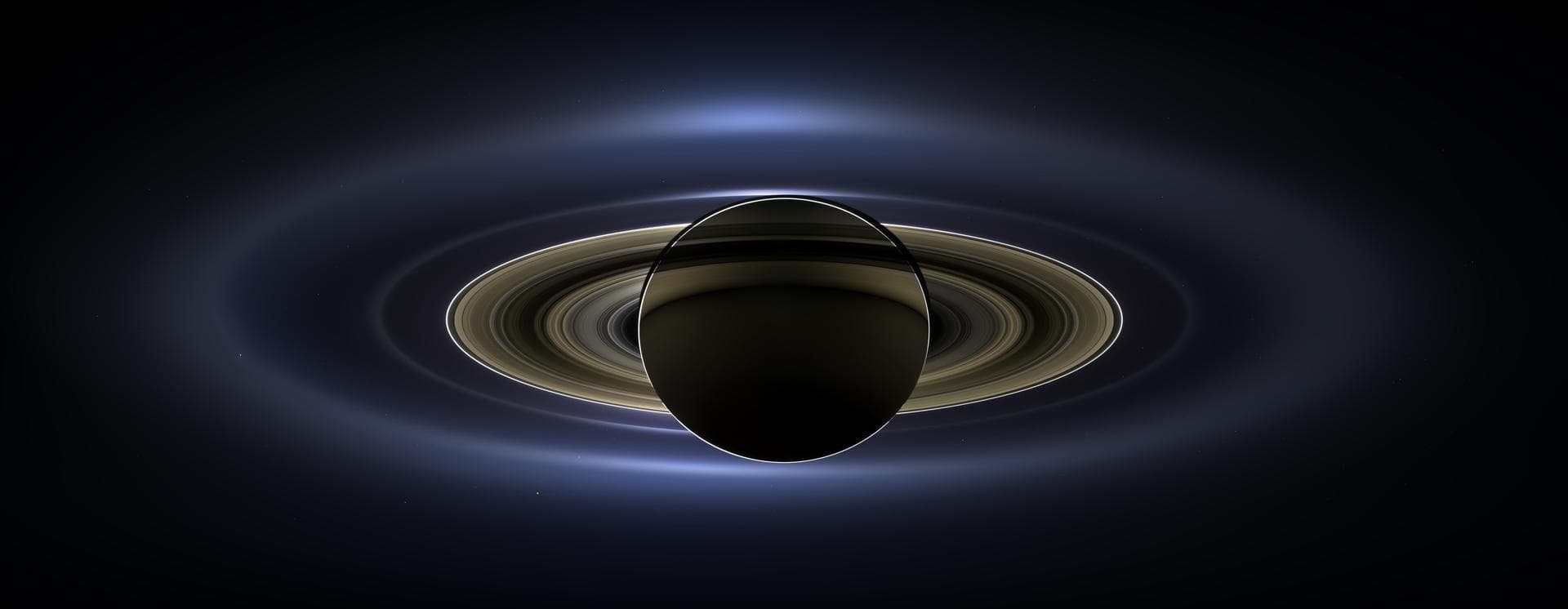
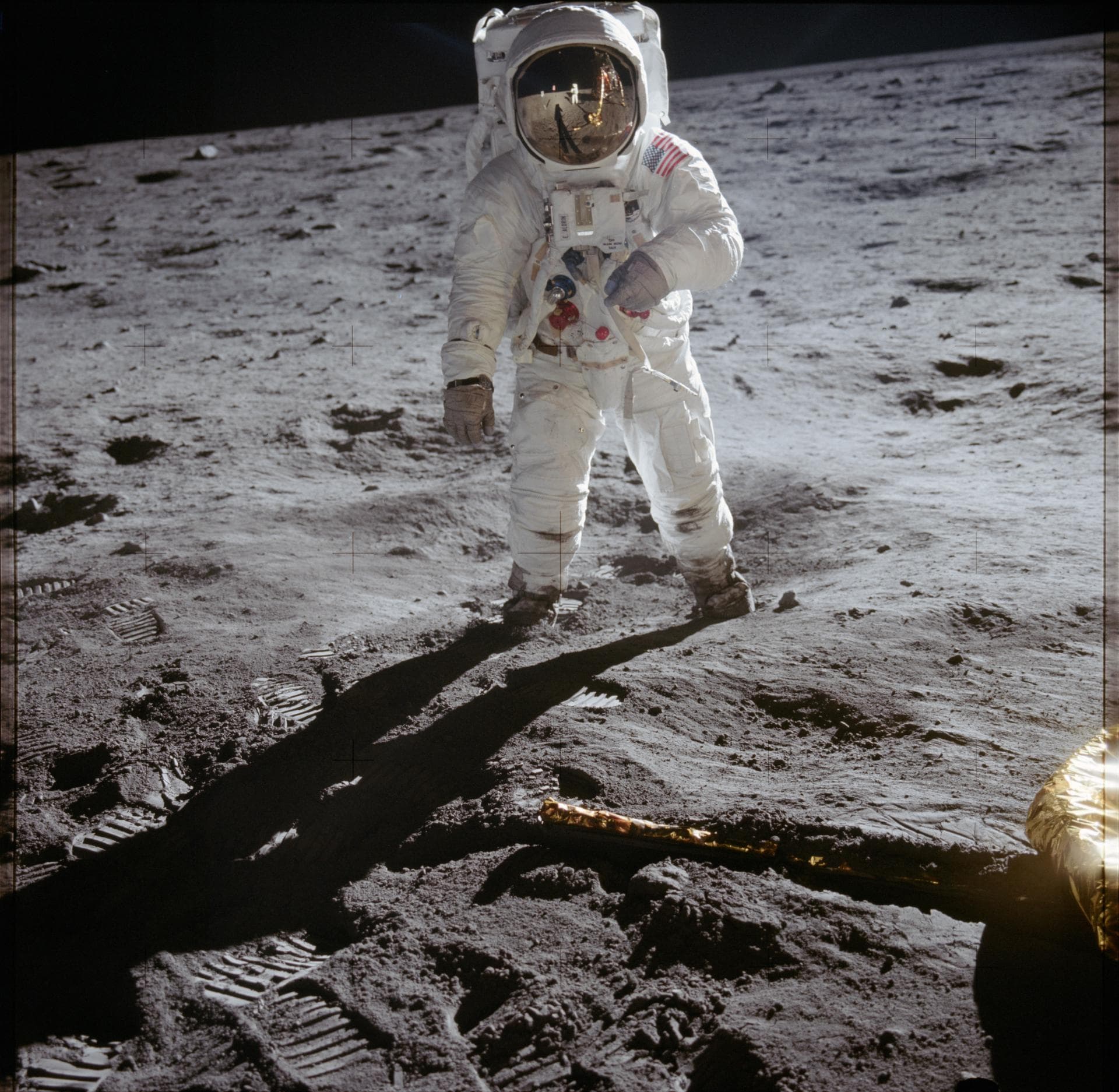
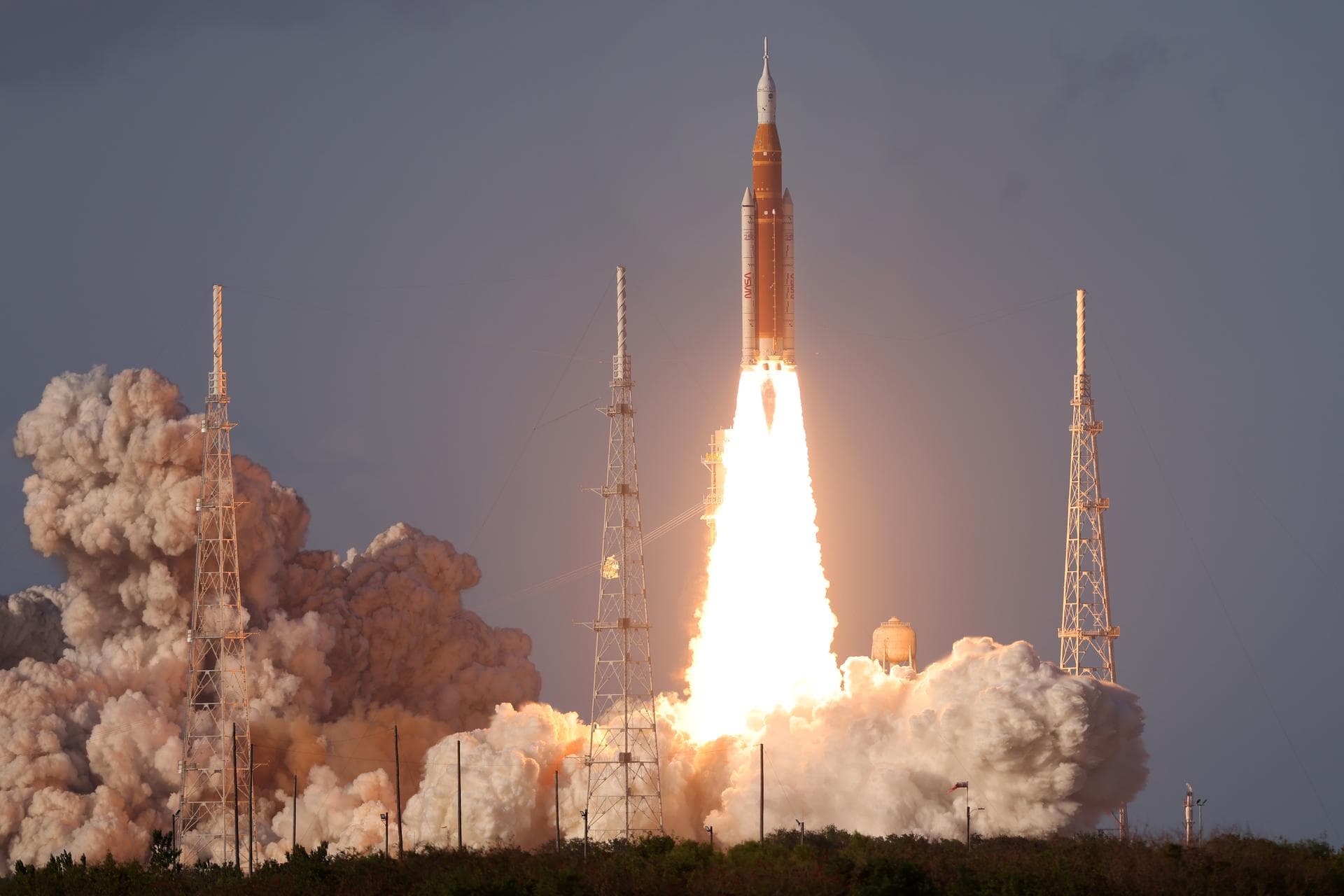
The Voyager program consists of the twin NASA robotic probes Voyager 1 and Voyager 2, launched in 1977 to survey the outer planets. Between them they made the first detailed studies of the Jupiter, Saturn, Uranus, and Neptune systems, and they are the only spacecraft operating in interstellar space; Voyager 1 was about 171 astronomical units (AU), or 25.6 billion kilometers, from the Sun in August 2026.[4][5][24]
Nearly 49 years after launch, the two probes still radio data home daily on shrinking power budgets. Voyager 1 is the most distant human-made object, and Voyager 2 remains the only spacecraft ever to visit Uranus or Neptune.[4][5]
The Grand Tour
The Voyager missions trace back to 1965, when JPL trajectory analyst Gary Flandro calculated that the four giant planets would line up on the same side of the Sun in the late 1970s, an arrangement that recurs only about once every 175 years. One spacecraft could reach all of them by using each flyby as a gravity assist toward the next.[8]
NASA's first answer was the Grand Tour, a four-spacecraft program priced at 750 to 900 million dollars that would have covered Jupiter, Saturn, Uranus, Neptune, and Pluto. Administrator James Fletcher canceled it in January 1972 as the agency's budget tightened around the Space Shuttle. On May 18, 1972, NASA approved a smaller replacement, Mariner Jupiter-Saturn 1977, capped at 360 million dollars and built on existing Mariner-class hardware. The option to go further was preserved quietly: Voyager 2's trajectory could be extended to Uranus and Neptune if the spacecraft survived Saturn, and NASA approved that extension in November 1980 at roughly 100 million dollars over five years. The project took the name Voyager on March 4, 1977, six months before launch.[8]
Each identical spacecraft carries ten science instruments, a 3.7-meter dish antenna, and three plutonium-fueled radioisotope thermoelectric generators. Both rode Titan IIIE-Centaur rockets: Voyager 2 launched first, on August 20, 1977, and Voyager 1 followed on September 5 on a faster path that overtook its twin in the asteroid belt.[4][5][11]
Spacecraft and communications
Each Voyager carries ten instrument packages that support eleven investigations once radio science is counted. Electricity comes from three multi-hundred-watt radioisotope thermoelectric generators rated at 158 watts each at the start of the mission, roughly 470 watts per spacecraft.[11][12] Decay of the plutonium-238 fuel and wear on the thermocouples cost about 4 watts a year, and by 2023 each probe was down to about 225 watts.[2][11]
| Item | Detail |
|---|---|
| Instruments per spacecraft | 10 packages, 11 investigations including radio science |
| High-gain antenna | 3.7 meters |
| Power source | Three multi-hundred-watt RTGs, 158 watts each at start of mission |
| Power in 2023 | About 225 watts per spacecraft, falling about 4 watts a year |
| Command uplink | S-band, 16 bits per second |
| Telemetry downlink | X-band, 160 bits per second; 1.4 kbit/s for plasma wave playback |
| Launch vehicle | Titan IIIE-Centaur |
| Cost through Neptune | 865 million dollars for both spacecraft |
Commands go up on S-band at 16 bits per second; telemetry comes back on X-band at 160 bits per second, rising to 1.4 kilobits per second when a probe plays back stored plasma wave data.[11] Only the Deep Space Network's 70-meter antennas can still close the link, and DSS-43 at Canberra, Australia is the sole dish capable of sending commands. Its upgrade took it offline from May 4, 2025 until February 2026, with brief transmission windows in August and December 2025.[15] The 865 million dollar program total covers launch, mission operations through the Neptune encounter, and the nuclear batteries supplied by the Department of Energy.[10]
Planetary encounters
The two Voyagers made six planetary flybys between March 1979 and August 1989, and Voyager 2's passes over Uranus and Neptune remain the only spacecraft visits to either planet.[5][9]
| Target | Spacecraft | Closest approach | Distance |
|---|---|---|---|
| Jupiter | Voyager 1 | March 5, 1979 | 280,000 km |
| Jupiter | Voyager 2 | July 9, 1979 | 645,000 km |
| Saturn | Voyager 1 | November 12, 1980 | 126,000 km |
| Saturn | Voyager 2 | August 25, 1981 | 101,000 km |
| Uranus | Voyager 2 | January 24, 1986 | 81,500 km |
| Neptune | Voyager 2 | August 25, 1989 | 4,800 km |
At Jupiter the probes discovered erupting volcanoes on the moon Io, the first active volcanism seen beyond Earth, along with a faint ring around the planet and the fractured ice shell of Europa that hinted at a buried ocean.[4] Sulfur, oxygen, and sodium thrown off by Io's eruptions turned up in Jupiter's magnetosphere, and the two encounters returned more than 33,000 pictures of the planet and its five major satellites.[9] Voyager 1 found the small inner moons Thebe and Metis; Voyager 2, arriving four months later, recorded how far the Great Red Spot had drifted in between.[4][5]
At Saturn, Voyager 1 was deliberately steered close to the haze-covered moon Titan, confirming a nitrogen-dominated atmosphere with signs of prebiotic chemistry; the maneuver bent the spacecraft's path north out of the plane of the planets and ended its planetary mission.[4] The same encounter turned up five more Saturnian moons and the tenuous G ring, and the pair measured equatorial winds of about 500 meters per second (1,100 miles per hour) and fixed the planet's rotation at 10 hours 39 minutes 24 seconds.[4][9]
Voyager 2 carried on alone. At Uranus in 1986 it passed 81,500 kilometers above the cloud tops, found ten previously unknown moons and two more rings, and measured a magnetic field tilted far from the rotation axis, its tail twisted into a helix stretching some 10 million kilometers downwind. The flyby also produced the mission's strangest landscape: Miranda, only about 500 kilometers across, carved with canyons possibly twelve times deeper than the Grand Canyon.[5][22]
At Neptune in 1989 the spacecraft skimmed about 4,800 kilometers above the north pole, its closest approach to any planet, and imaged the Great Dark Spot, an Earth-sized storm that has since vanished, in an atmosphere whose winds run above 1,900 kilometers per hour (1,200 miles per hour).[5][21][23] It confirmed Neptune's rings, added six moons, and five hours later passed roughly 40,000 kilometers from the frigid moon Triton, where images showed dark plumes venting from a surface at about minus 235 degrees Celsius (minus 392 degrees Fahrenheit). Observations continued to October 2, 1989 and returned more than 9,000 images of the planet, its rings, and its moons.[9][21]
The Golden Record
Each Voyager spacecraft carries a 12-inch gold-plated copper phonograph record, a message for any intelligence that might find it. Project manager John Casani asked astronomer Carl Sagan to lead the committee that chose the contents, working to a deadline of less than six weeks; Frank Drake proposed the record format, and Ann Druyan served as creative director.[27] The disc holds 115 images in analog encoding, spoken greetings in 55 languages running from Akkadian to the Wu dialect of Chinese, about 90 minutes of music from many cultures, and natural sounds including surf, wind, thunder, birds, and whales.[7] It plays at 16 2/3 revolutions per minute, and the aluminum jacket holds a cartridge and needle. The cover is etched with playback instructions, a diagram of the hydrogen atom, a pulsar map showing the Sun's location, and a sample of uranium-238 whose decay serves as a clock.[7]
Into interstellar space
On February 14, 1990, Voyager 1 turned its cameras back for a final "family portrait" of the solar system, taken from 6 billion kilometers (3.7 billion miles) from the Sun. It included the image of Earth that Sagan named the Pale Blue Dot, and the cameras were switched off shortly afterward.[26] Voyager 1 passed Pioneer 10 on February 17, 1998 to become the most distant human-made object.[4]
Voyager 1 reached the termination shock, where the solar wind slows abruptly, on December 16, 2004, and entered the heliosheath beyond it.[4] Voyager 2 crossed the same boundary on August 30, 2007 at about 84 AU, roughly 1.6 billion kilometers closer to the Sun than its twin's crossing, which showed that the bubble the solar wind carves into interstellar space is not round.[5][28]
Voyager 1 crossed the heliopause, where the Sun's outflowing plasma gives way to the interstellar medium, on August 25, 2012, at about 121.6 AU; confirmation came a year later from plasma density measurements.[4] Voyager 2 followed on November 5, 2018 at 119 AU, and its still-working plasma instrument returned the first direct measurements of the boundary crossing, showing a thin transition and interstellar plasma denser and colder than the solar wind inside.[5][16] Both probes remain within the Sun's gravitational domain, however; on their present paths they will take tens of thousands of years to pass through the distant Oort cloud region.[25]
Anomalies and repairs
On November 14, 2023, Voyager 1 stopped returning usable science and engineering data. The spacecraft still accepted commands, but its telemetry arrived as a repeating pattern. Engineers traced the fault in March 2024 to a single chip in the flight data subsystem, one of three onboard computers, which stored part of the computer's software; it had either been struck by an energetic particle or simply worn out after 46 years. With no way to repair the chip, the team split the affected code into sections, moved them to working areas of memory, and updated every reference to their new addresses. The engineering-data portion went up on April 18, 2024 and the first good telemetry came back on April 20.[13] A second upload on May 19 restored science data, and by mid-June 2024 all four of Voyager 1's then-active instruments were returning usable measurements again.[14]
Voyager 1's primary roll thrusters had failed in 2004 after their internal heaters lost power, leaving the spacecraft on backups whose fuel lines were accumulating residue that threatened to block them. An engineer suggested the original failure might have been a circuit fault rather than dead hardware, and on March 20, 2025 the team restored the heaters and revived the thrusters, finishing before the Canberra antenna went down for its upgrade.[15]
Power decline and instrument shutdowns
The Voyagers' radioisotope generators lose about 4 watts of output per year, and since 2024 JPL has been switching off instruments to keep the missions alive. Voyager 2's plasma science instrument was shut down in October 2024; Voyager 1's cosmic ray subsystem followed on February 25, 2025, and Voyager 2's low-energy charged particle instrument on March 24, 2025.[2]
On April 17, 2026, engineers powered down Voyager 1's low-energy charged particle experiment as well, an instrument that had run continuously since launch, leaving the spacecraft with two working instruments: its magnetometer and plasma wave subsystem. The shutdown was expected to buy about a year of operating margin.[3] Voyager 2 still operates three, the magnetometer, the plasma wave subsystem, and the cosmic ray subsystem.[6][18]
Engineers also prepared a coordinated power-system reconfiguration nicknamed "the Big Bang": switching off two heaters and a legacy device kept running mainly for its waste heat, and switching on three lower-power devices that keep the spacecraft and its fuel lines warm. Power and thermal tests ran on Voyager 2 through May and June 2026, the swap itself was carried out in July, and NASA announced on August 4 that it had worked, freeing close to 10 watts a year. Without it, another Voyager 2 instrument would have had to go dark before the end of 2026; instead all three should keep running at least a year longer.[6][17][18] The same procedure is planned for Voyager 1, with power testing already complete, and NASA has said the freed margin might even allow Voyager 1's charged particle instrument to be switched back on.[3][17]
Funding
Voyager is among the cheapest missions NASA operates, at roughly 5 million dollars a year. The White House's fiscal year 2026 request proposed cutting NASA science by nearly half and terminating dozens of operating missions; Voyager was not on that termination list, but in October 2025 people familiar with the project said its operating budget was being cut by 26 percent, with NASA declining to comment during the government shutdown.[19] Congress rejected the deeper reductions in the fiscal 2026 appropriations minibus released in January 2026, funding NASA science at 7.25 billion dollars, close to the previous year.[20]
Distances and end of mission
On August 9, 2026, Voyager 1 was about 171.4 AU (25.6 billion kilometers) from the Sun and 171.0 AU from Earth, far enough that a radio signal took about 23 hours 42 minutes to arrive, so a command and its acknowledgement take almost two days round trip. Voyager 2 was about 143.6 AU (21.5 billion kilometers) from the Sun, with a one-way light time near 19 hours 48 minutes.[24] Voyager 1 recedes from the Sun at roughly 17 kilometers per second, Voyager 2 at about 15, or about 3.5 and 3.1 AU per year.[24][25] On November 18, 2026, Voyager 1 is due to pass 25,902,068,356 kilometers (16,094,799,096 miles) from Earth, one full light-day, the first spacecraft to reach that mark.[1]
| Item | Voyager 1 | Voyager 2 |
|---|---|---|
| Launched | September 5, 1977 | August 20, 1977 |
| Planetary flybys | Jupiter (1979), Saturn (1980) | Jupiter (1979), Saturn (1981), Uranus (1986), Neptune (1989) |
| Crossed the heliopause | August 25, 2012 | November 5, 2018 |
| Distance from the Sun (August 9, 2026) | About 171.4 AU (25.6 billion km) | About 143.6 AU (21.5 billion km) |
| One-way light time | About 23 hours 42 minutes | About 19 hours 48 minutes |
| Speed away from the Sun | About 17 km/s (3.5 AU per year) | About 15 km/s (3.1 AU per year) |
| Instruments still operating | Two | Three |
Engineers expect to keep at least one instrument running on each spacecraft into the 2030s, and both probes should stay within reach of the Deep Space Network until around 2036.[2][25] When the power drops below what any instrument needs, the science mission will end and the probes will fall silent. Their trajectories continue regardless: in about 40,000 years Voyager 1 will pass within 1.6 light-years of the star Gliese 445 and Voyager 2 within about 1.7 light-years of Ross 248, each still carrying its Golden Record.[4][25] Farther out still, New Horizons is following them into the outer heliosphere, though it will not overtake either one.
References
- Where Are Voyager 1 and 2 Now? - NASA Science.
- NASA Turns Off 2 Voyager Science Instruments to Extend Mission - NASA Jet Propulsion Laboratory, March 5, 2025.
- NASA Shuts Off Instrument on Voyager 1 to Keep Spacecraft Operating - NASA Science, April 17, 2026.
- Voyager 1 - NASA Science.
- Voyager 2 - NASA Science.
- NASA Engineers Help Prolong Voyager 2's Science Mission - NASA Science, August 4, 2026.
- Golden Record Contents - NASA Science.
- Voyager: The Grand Tour of Big Science - NASA History, SP-4219.
- Planetary Voyage - NASA Science.
- Voyager Fact Sheet - NASA Science.
- Voyager Spacecraft - NASA Science.
- Radioisotope Power Systems: Power - NASA Science.
- NASA's Voyager 1 Resumes Sending Engineering Updates to Earth - NASA Science, April 22, 2024.
- Voyager 1 Returning Science Data From All Four Instruments - NASA Jet Propulsion Laboratory, June 13, 2024.
- NASA's Voyager 1 Revives Backup Thrusters Before Command Pause - NASA Science, May 14, 2025.
- Voyager 2 plasma observations of the heliopause and interstellar medium - Nature Astronomy, November 2019.
- NASA's Voyager 2 Survives Daring "Big Bang" Maneuver - Scientific American, August 2026.
- Voyager 2 cheats the power budget for another year - The Register, August 5, 2026.
- NASA Voyagers facing 26% budget cut - The Register, October 10, 2025.
- Minibus provides $24.4 billion for NASA for fiscal year 2026 - SpaceNews, January 2026.
- 30 Years Ago: Voyager 2 Explores Neptune - NASA.
- Voyager Mission Celebrates 30 Years Since Uranus - NASA.
- Neptune Facts - NASA Science.
- HORIZONS System - NASA/JPL Solar System Dynamics; ephemeris for Voyager 1 and Voyager 2, August 9, 2026.
- Voyager Frequently Asked Questions - NASA Science.
- The Pale Blue Dot - NASA Science.
- Voyager at 30: Looking Beyond and Within, The Golden Record - NASA Science.
- Voyager 2 Proves Solar System is Squashed - NASA Jet Propulsion Laboratory, December 2007.