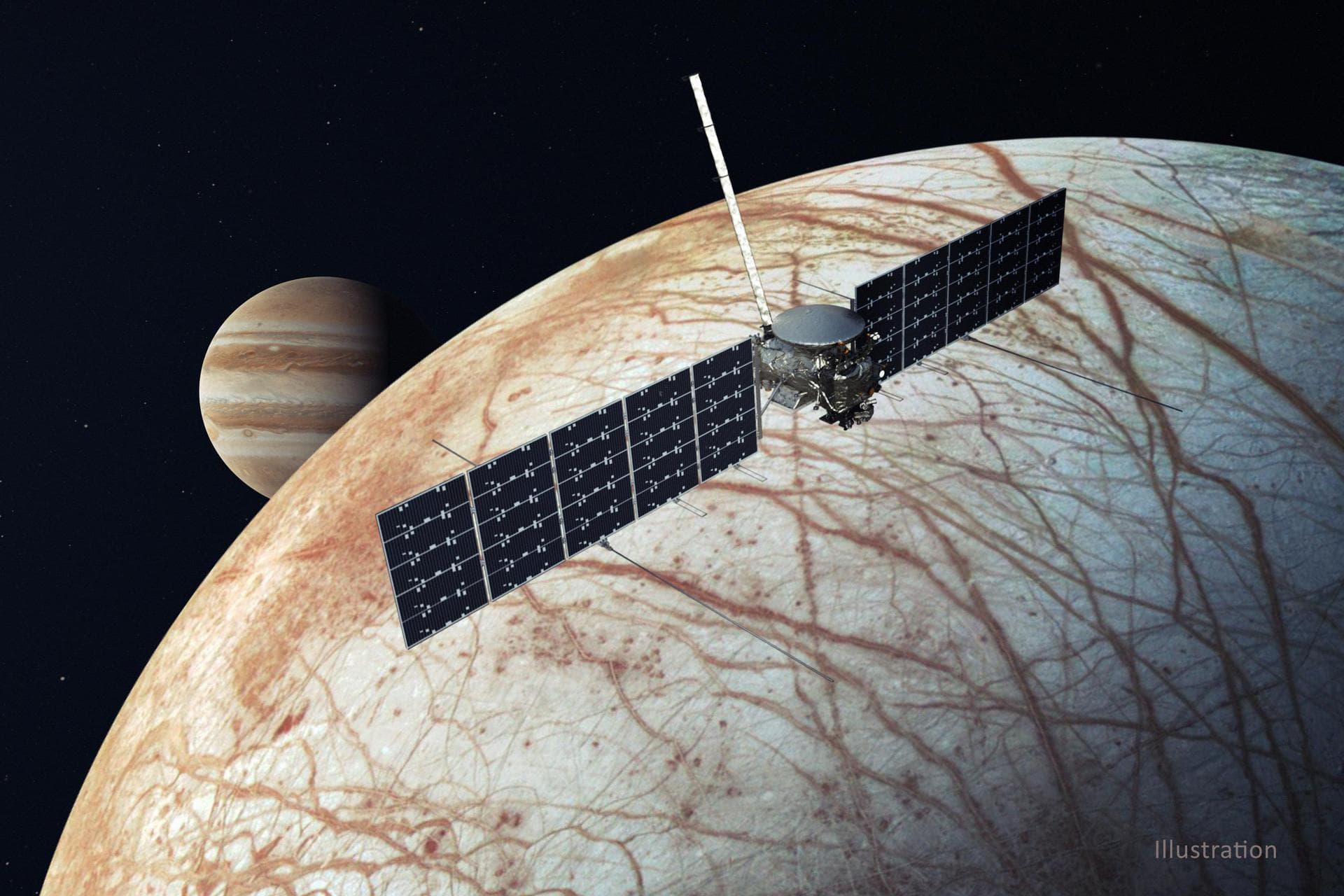
Europa is the smallest of Jupiter's four Galilean moons and, by most assessments, the most promising nearby place to look for present-day extraterrestrial life. Beneath a shell of water ice floats a global saltwater ocean estimated to hold roughly twice as much liquid water as all of Earth's oceans combined.[7] The moon measures 3,121.6 km across, slightly smaller than the Moon, and circles Jupiter every 3.55 days.[6][7]
Its interior stays liquid because of tides. Europa's orbit is held slightly eccentric by a resonance with neighboring Io and Ganymede, so Jupiter's gravity flexes the moon on every circuit and the friction generates heat. Two flagship spacecraft are on their way to examine it: NASA's Europa Clipper, which enters Jupiter orbit on April 11, 2030 and begins its dedicated Europa flybys in spring 2031, and the European Juice orbiter, arriving in July 2031.[1][2][8]
Orbit and tidal heating
Europa orbits 671,000 km from Jupiter and completes a circuit every 3.55 days, keeping the same hemisphere turned toward the planet.[7] The orbit cannot settle into a circle. Io, Europa, and Ganymede are locked in a 1:2:4 Laplace resonance, and their repeated alignments keep pumping Europa's eccentricity back up. Because the distance to Jupiter changes over each orbit, so does the height of the tidal bulge, and the constant flexing dissipates energy as heat inside the ice and the rock below it. Without that heat a body this far from the Sun would have frozen through long ago.
Surface conditions are still severe. Temperatures run from about -133 °C in dark equatorial material down to about -223 °C in bright icy patches near the poles.[6][9] Above the ice sits an oxygen atmosphere so thin that its surface pressure is roughly 100 billionth of Earth's, produced not by biology but by charged particles knocking molecules out of the ice.[10]
Evidence for a subsurface ocean
Voyager flybys of Europa in 1979 revealed a bright, nearly craterless surface crossed by dark fractures, hinting at geologic youth. The decisive measurement came from NASA's Galileo orbiter. Jupiter's tilted magnetic field sweeps past Europa as the planet rotates, and Galileo's magnetometer recorded an induced magnetic response, exactly what is expected if a global layer of electrically conductive fluid, such as salty water, lies close beneath the ice. Magnetometer lead Margaret Kivelson and colleagues laid out the case in 2000.[3] The clinching pass came on January 3, 2000, when Galileo crossed well south of Jupiter's magnetic equator, into a region where the driving field points inward toward Jupiter. That reversed geometry separated an induced response, which flips with the external field, from a permanent internal dipole, which would not.[3]
Supporting evidence has accumulated since. Crater counts imply an average surface age of only 40 to 90 million years, meaning the shell is continually recycled.[7] Gravity data indicate a layered interior with roughly 100 km of water and ice above a rocky mantle, and most models place the ice shell at 15-25 km thick over an ocean 60-150 km deep.[4][7] Europa Clipper's instruments are designed to confirm the ocean directly and measure its depth and salinity using induction, gravity, and ice-penetrating radar.[4]
Ice shell thickness
How thick Europa's ice shell is remains the central open question, because the shell's thickness governs how much material can move between the ocean and the surface. NASA's working figure is 15 to 25 km, but that range covers two families of models that behave very differently.[7] In thin-shell models the interior heat is concentrated enough to melt through locally, opening the surface directly onto liquid water. In thick-shell models the heat moves by solid-state convection, with warm ice rising slowly and never fully melting, so the ocean and the surface communicate only indirectly.[29]
The first spacecraft measurement of the shell arrived in December 2025. NASA's Juno flew within 360 km of Europa on September 29, 2022, and its microwave radiometer sounded the ice across part of the sub-Jovian hemisphere. Fitting the emission to a purely conductive shell with no convecting layer gives a thickness of 29 ± 10 km, toward the thick end of the earlier range.[11][12] The same data revealed small scatterers inside the ice, cracks and pores no more than a few centimeters across making up about 4.5 percent of the volume and reaching a few hundred meters down. The authors concluded those fractures are too small, too sparse, and too shallow to carry nutrients between the surface and the ocean on their own.[11]
Whether liquid water sits inside the shell is contested. A 2022 study compared Europa's double ridges, the most common landform on the moon, with a nearly identical ridge in northwest Greenland, and showed the Greenland feature formed as a shallow pocket of water within the ice sheet froze, pressurized, and cracked. If the same mechanism operates on Europa, shallow liquid water would be common throughout the shell.[13] A modeling study published in Nature Astronomy in July 2026 pushed the other way: water forced upward through a fracture would become supercooled as it mixed turbulently against cold walls, and the resulting frazil ice crystals would plug a narrow crack within hours. On that account a shallow reservoir is more likely a locally melted pocket than ocean water that traveled up, which matters because only the latter would report on conditions in the deep ocean.[14] Europa Clipper's REASON radar is meant to sound the shell directly and, if shallow water exists, to map its size and depth.[1][14]
Surface features
Europa's crust records the stress of constant tidal kneading. Long fractures called lineae wrap much of the globe, many of them double ridges with a central trough; arc-shaped cycloid cracks trace the changing pull of Jupiter across each orbit. Double ridges are the single most abundant feature on the surface and occur in every sector of the moon.[13] In regions of chaos terrain, such as Conamara Chaos, the surface has broken into blocks that drifted, rotated, and refroze like pack ice, possibly above shallow lenses of melt water. Reddish-brown material lining fractures and chaos is thought to be salts and sulfur compounds darkened by radiation, some of it likely delivered from the ocean below.
Craters are scarce. The few dozen that survive imply an average surface age of 40 to 90 million years, young enough that whatever resurfaces Europa is probably still working today.[7][10]
Surface composition
Europa's surface is mostly water ice mixed with a reddish non-ice component whose full composition is still unsettled.[6] Individual constituents have been identified from Earth orbit rather than in place, and nearly all of them concentrate in chaos terrain, which is the main argument that they come from inside the moon.
Hubble spectra published in 2019 found an absorption feature at 450 nanometers across the leading-hemisphere chaos region Tara Regio, the signature of sodium chloride that has been colored by radiation. Ordinary table salt on the surface points toward an ocean chemically closer to Earth's than the magnesium sulfate brines that earlier models favored.[15] In 2023, two teams working with James Webb Space Telescope spectra identified carbon dioxide concentrated in Tara Regio. One measured a carbon isotope ratio of 83 ± 19 for carbon-12 against carbon-13 and argued that the carbon is internal rather than delivered by comets or generated by radiation.[16] The other found the carbon dioxide mixed into the ice rather than sitting on it, and recorded no plume activity during the observations.[17] A preprint posted in March 2026 decomposed the same class of Webb data and reported that the carbon dioxide enrichment extends past Tara Regio across several chaos units in a lens-shaped pattern, tracking unusual ice textures; it has not yet completed peer review.[18]
Webb has also shown that the ice itself is being reworked. A 2025 analysis found a narrow crystalline water ice feature at 3.1 micrometers concentrated in Tara Regio and Powys Regio, both at the surface and below it. Charged particles should scramble crystalline ice into an amorphous form within days at those depths, so its survival means thermal recrystallization is outpacing the damage, and that the regolith is layered rather than uniform. The same regions carry the strongest signatures of sodium chloride, carbon dioxide, and hydrogen peroxide on the moon.[19]
Possible plumes
Hubble Space Telescope ultraviolet spectra from December 2012 showed hydrogen and oxygen emission near Europa's south pole consistent with water vapor plumes roughly 200 km tall, and later Hubble imaging caught possible plume silhouettes crossing Jupiter's face. In 2018 researchers reanalyzed data from Galileo's closest flyby, in December 1997, and found a magnetic field rotation spanning about 1,000 km plus a drop of more than 200 nanotesla, along with plasma wave changes, all consistent with the spacecraft having flown through a plume.[5]
None of this has held up as cleanly as the headlines suggested. The 2012 ultraviolet signal did not appear in earlier Hubble spectra or in follow-up campaigns. A 2020 reanalysis of the transit silhouettes showed that a slight misalignment between images, or ordinary statistical noise, could produce the same limb anomalies. Keck infrared spectroscopy caught water vapor on one night out of seventeen. Webb observations in 2022 set an upper limit on water above the south pole two to five times below the abundances the earlier detections had claimed, and searches with ALMA, SOFIA, and Subaru did not confirm them either.[17][20] A 2025 review written to shape Clipper's search strategy concluded that definitive proof is still elusive, that spacecraft images show no clear sign of ongoing activity, and that any venting is neither widespread nor large in scale and may be sporadic. That conclusion pushed the mission toward a systematic global survey rather than repeat visits to a favored site.[20] Confirmed plumes would offer free samples of the interior, which is why the question keeps its priority despite the thin evidence.
Radiation environment
Europa orbits deep inside Jupiter's radiation belts. Jupiter's magnetic field is about 20,000 times as strong as Earth's, and the belts it sustains make the planet the most intense radiation environment in the solar system apart from the Sun itself.[1] The dose is not spread evenly. Mapping published in 2018 showed the harshest bombardment falls in two oval zones centered on the leading and trailing hemispheres and joined at their narrow ends, together covering more than half the moon; the poles fare better. Inside those ovals, radiation destroys organic material to depths of 10 to 20 cm, while at middle and high latitudes the damage reaches less than 1 cm down. A future lander would therefore only need to trench a few centimeters to reach preserved organics, provided it set down in the right place.[21][22]
The same bombardment is not purely destructive. It splits surface ice into oxidants such as hydrogen peroxide and molecular oxygen, and it sputters the wispy oxygen atmosphere off the surface. How much oxygen that process makes was uncertain by more than two orders of magnitude until Juno's plasma instrument sampled the output during its 2022 flyby and put it near 12 kg per second, at the low end of estimates that had ranged from a few kilograms to more than 1,000 kg per second.[23] Radiation also punishes electronics, which is why Europa Clipper will not orbit Europa itself but will loop around Jupiter in long ellipses, dipping into the radiation zone for 49 flybys while its computers shelter inside a thick metal vault.[1][9]
Habitability
The habitability argument for Europa rests on long-lived liquid water in contact with rock and a plausible supply of chemical energy. Europa's ocean probably touches a silicate seafloor, allowing water-rock reactions of the kind that feed microbial ecosystems at Earth's hydrothermal vents, while radiation-made oxidants cycling down from the surface could serve as the other half of a chemical battery. Whether the ocean actually hosts hydrothermal activity, and how much organic chemistry it contains, is unknown. Clipper is formally a habitability mission rather than a life-detection mission: it will characterize the ocean, ice shell, composition, and geology to determine whether Europa could support life, alongside other candidate ocean worlds such as Enceladus and Titan.[4]
Two results published in January 2026 pulled that assessment in opposite directions. A modeling study in Nature Communications worked through Europa's size, the composition of its rocky interior, and the tidal forces acting on it, and found little to no active faulting at the seafloor today. On that picture the rock cooled long ago, tidal heating in the interior is far weaker than Io's, and the vents and fresh fractures that anchor the hydrothermal analogy are probably absent.[24] A separate paper in The Planetary Science Journal offered a route that does not depend on the seafloor at all: salt-rich surface ice, made dense and weak by its salt content, can founder and sink through the shell in Rayleigh-Taylor drips, reaching the base in anywhere from 30,000 to 10 million years and carrying surface oxidants down to the ocean with it.[25]
Both remain models rather than measurements, and they sit alongside the Juno and frazil-ice results that argue for limited exchange through fractures.[11][14] The disagreement is about energy supply and delivery routes, not about whether the ocean exists, and resolving it is much of what Clipper and Juice were built to do.
Missions
Galileo Galilei discovered Europa on January 8, 1610.[28] The NASA orbiter later named for him remains the only spacecraft to have studied the moon at length, making about a dozen close flybys between 1996 and 2000, one of them within 201 km of the surface, before controllers deliberately crashed the aging craft into Jupiter in September 2003 to eliminate any chance of contaminating the moon.[28]
| Mission | Agency | Europa encounters | Status |
|---|---|---|---|
| Pioneer 11 | NASA | Passed within 587,000 km, December 1974 | Completed |
| Voyager 1 | NASA | Distant imaging, March 5, 1979 | Encounter completed |
| Voyager 2 | NASA | Higher-resolution imaging, July 9, 1979 | Encounter completed |
| Galileo | NASA | About 12 close flybys, 1996-2000, closest 201 km | Ended 2003 |
| Cassini-Huygens | NASA/ESA | Distant observations during Jupiter gravity assist, 2000-2001 | Ended 2017 |
| New Horizons | NASA | Distant observations at about 3 million km, February 2007 | Encounter completed |
| Juno | NASA | One close flyby at 360 km, September 29, 2022 | Encounter completed |
| Europa Clipper | NASA | 49 flybys planned, first in spring 2031 | En route |
| Juice | ESA | 2 flybys planned, July 2032 | En route |
Europa Clipper, the largest planetary spacecraft NASA has built, with solar arrays spanning 30.5 meters, launched on a Falcon Heavy on October 14, 2024. It performed a Mars gravity assist on March 1, 2025, returns for an Earth flyby on December 3, 2026, and enters Jupiter orbit on April 11, 2030.[1][30] Roughly a year of orbit-shaping follows before the first dedicated Europa pass in spring 2031. A campaign over the anti-Jovian hemisphere begins in May 2031 and a second over the sub-Jovian side in May 2033, with the nine instruments working together on every pass to build near-global coverage from flybys as low as 25 km. The prime mission ends in September 2034 with a planned impact on Ganymede.[8][30]
The European Space Agency's Juice, launched April 14, 2023, follows a longer road. It takes an Earth gravity assist in September 2026 and another in January 2029 before reaching Jupiter in July 2031, where 35 flybys of the icy moons are planned.[2] Two of those are Europa passes in July 2032, closing to about 400 km, aimed at the surface chemistry and at sounding the ice for shallow water; Juice then works down to Ganymede orbit in late 2034, the first orbit of a moon other than our own.[27] The two missions are run independently, but the NASA and ESA teams coordinate observations so their measurements can be compared.
| Europa Clipper | Juice | |
|---|---|---|
| Agency | NASA | ESA |
| Launched | October 14, 2024 | April 14, 2023 |
| Jupiter arrival | April 11, 2030 | July 2031 |
| Europa flybys | 49 planned, from spring 2031 | 2 planned, July 2032 |
| Closest Europa pass | 25 km | About 400 km |
| Final phase | Ganymede impact, September 2034 | Ganymede orbit, late 2034 |
NASA also studied a Europa lander through the late 2010s. Congress added a lander to the Europa program in the fiscal 2016 appropriation, and the Consolidated Appropriations Act of 2019 provided the first direct funding for it, 195 million dollars, while directing a launch no later than 2025. A 2016 JPL study priced a full life-detection lander at about 3.2 billion dollars excluding the launch vehicle, which NASA judged too high in June 2017; a rescoped design that searched for biosignatures instead of life, dropped the relay orbiter, and ran on solar power and batteries came in near 2.7 billion dollars, with a surface lifetime of about 22 days set by battery capacity and radiation. NASA's inspector general concluded in 2019 that the 2025 date was not achievable and that running a lander alongside Clipper conflicted with the priorities the decadal survey had set.[26] The mission was never approved for flight, and any future landing will depend on Clipper reconnaissance to find safe, scientifically rich ground.
References
- Europa Clipper - NASA Science.
- Juice - European Space Agency.
- Galileo magnetometer measurements: a stronger case for a subsurface ocean at Europa - Kivelson et al., Science 289, August 25, 2000 (via PubMed).
- Exploring the Interior of Europa with the Europa Clipper - Space Science Reviews.
- Evidence of a plume on Europa from Galileo magnetic and plasma wave signatures - Jia et al., Nature Astronomy, 2018.
- Europa Clipper Press Kit: Quick Facts - NASA Jet Propulsion Laboratory.
- Europa: Facts - NASA Science.
- Europa Clipper Mission Timeline - NASA Science.
- Europa Clipper Mission FAQ - NASA Science.
- Europa Up Close - NASA Science.
- Europa's ice thickness and subsurface structure characterized by the Juno microwave radiometer - Levin et al., Nature Astronomy, December 2025 (via PubMed Central).
- NASA's Juno Measures Thickness of Europa's Ice Shell - NASA Jet Propulsion Laboratory.
- Double ridge formation over shallow water sills on Jupiter's moon Europa - Culberg, Schroeder and Steinbrugge, Nature Communications, April 19, 2022.
- Limited direct fluid exchange between the deep subsurface ocean and the shallow subsurface environment of Europa - Ojha et al., Nature Astronomy, July 2026.
- Sodium chloride on the surface of Europa - Trumbo, Brown and Hand, Science Advances 5(6), 2019.
- The distribution of CO2 on Europa indicates an internal source of carbon - Trumbo and Brown, Science, September 21, 2023.
- Endogenous CO2 ice mixture on the surface of Europa and no detection of plume activity - Villanueva et al., Science, September 21, 2023.
- Spectral Decomposition Reveals Surface Processes on Europa - Yoffe and Shahaf, arXiv preprint, March 2026 (not peer reviewed).
- JWST Reveals Spectral Tracers of Recent Surface Modification on Europa - Cartwright et al., The Planetary Science Journal 6, May 28, 2025.
- Plume Activity on Europa: Current Knowledge and Search Strategy for Europa Clipper - The Planetary Science Journal, 2025.
- Preservation of potential biosignatures in the shallow subsurface of Europa - Nordheim, Hand and Paranicas, Nature Astronomy, July 23, 2018.
- Radiation Maps of Jupiter's Moon Europa: Key to Future Missions - NASA Jet Propulsion Laboratory, July 2018.
- NASA's Juno Mission Measures Oxygen Production at Europa - NASA Jet Propulsion Laboratory, March 4, 2024.
- Little to no active faulting likely at Europa's seafloor today - Byrne et al., Nature Communications 17, January 2026.
- Dripping to Destruction: Exploring Salt-driven Viscous Surface Convergence in Europa's Icy Shell - Green and Cooper, The Planetary Science Journal 7(1), January 20, 2026.
- Management of NASA's Europa Mission, Report No. IG-19-019 - NASA Office of Inspector General, May 29, 2019.
- The moons of Jupiter: What will Juice discover? - European Space Agency.
- Europa Exploration History - NASA Science.
- Thick or Thin Ice Shell on Europa? - NASA Science.
- Europa Clipper Press Kit: Mission Overview - NASA Jet Propulsion Laboratory.