Starcloud is an American startup developing orbital data centers, satellites that run commercial computing hardware in space. Its first satellite, Starcloud-1, carried the first NVIDIA H100 GPU to orbit on November 2, 2025.[3][4] The company had raised $200 million as of March 2026,[15] and it has asked the United States Federal Communications Commission to authorize up to 88,000 satellites.[11]
Philip Johnston, Ezra Feilden, and Adi Oltean founded the company in January 2024 as Lumen Orbit. It is based in Redmond, Washington, with Johnston as chief executive, Feilden as chief technology officer, and Oltean as chief engineer.[1][2] Starcloud-1 deployed from a SpaceX Falcon 9, and both NVIDIA and the launch record confirm the H100 milestone.[3][4] Starcloud later reported that the satellite ran Google's Gemma language model and trained NanoGPT onboard.[5][6] That supports a narrower claim about the first reported training of a language model in space. It was not the first training of any artificial-intelligence or machine-learning model in orbit: a University of Oxford-led team trained a small cloud classifier aboard D-Orbit's ION SCV004 spacecraft in autumn 2022.[7][8]
Everything beyond Starcloud-1 remains developmental. Starcloud-2 has a company target of January 2027,[9] Starcloud-3 depends on commercial Starship service,[10] and the proposed 88,000-satellite network had not received FCC authorization as of mid-August 2026.[11][12] The distinctions among flown hardware, company-reported results, contracts, and projections are central to assessing the program.
Status as of August 2026
Starcloud remains a one-satellite company as of mid-August 2026. Starcloud-1, deployed on November 2, 2025, is its only flown spacecraft, and the Gemma and NanoGPT demonstrations reported in December 2025 are its only published flight results.[3][5][6] Total funding is $200 million at a $1.1 billion valuation, from the Series A announced on March 30, 2026; no later round has been disclosed.[10][15] The newest announced agreement is a May 26, 2026 contract for more than 50 Starlink Mini Laser terminals.[17] Earlier announcements, the Crusoe partnership of October 2025 and the AWS, Google Cloud, and NVIDIA partnerships named in the March financing release, remain announcements rather than operating services.[15][21] The next mission, Starcloud-2, has a company launch target of January 2027 on a Falcon 9, and Starcloud's product page promises full operation in sun-synchronous orbit in 2027.[9][16] The FCC application for up to 88,000 satellites is pending review, with no grant and no announced action date.[11][12]
Company history and financing
Starcloud joined Y Combinator's Summer 2024 batch. Before the accelerator, the company had raised a $2.4 million pre-seed round led by Nebular. TechCrunch reported an oversubscribed seed round of more than $10 million in October 2024.[2] In February 2025, the company adopted the Starcloud name after Lumen Technologies asserted rights to "Lumen" for data-center services. At the same time, Starcloud disclosed another $10 million and described the two seed financings as a combined $21 million round.[13]
NVIDIA's early role is sometimes overstated. GeekWire reported in February 2025 that NVIDIA supplied discounted chips through NVIDIA Inception, its startup program.[13] Participation in that program is not by itself an equity investment. NVIDIA later identified Starcloud as one of the companies using its accelerated-computing platforms for space missions, but neither announcement establishes that NVIDIA invested in Starcloud.[4][14]
On March 30, 2026, Starcloud announced a $170 million Series A led by Benchmark and EQT Ventures. The corrected company release and independent reporting put the valuation at $1.1 billion and total capital raised at $200 million.[15][10] Those are dated financing figures, not revenue or deployed infrastructure. The release said the money would support Starcloud-3 development, a manufacturing facility, hiring, and future launch procurement.[15]
Program status
Starcloud has flown one demonstration satellite; its larger spacecraft and the filed constellation remain designs, applications, or concepts.[3][11]
| Element | Latest public specification or scope | Evidence on August 12, 2026 |
|---|---|---|
| Starcloud-1 | About 60 kg; NVIDIA H100 payload; technology demonstrator[3][4] | Launched and deployed November 2, 2025; Gemma inference and NanoGPT training reported by the company[3][5][6] |
| Starcloud-2 | About 450 kg and 8 kW; GPU cluster, storage, radiator, and two Starlink Mini Laser terminals[16][9] | In development; January 2027 is a company target, not a completed launch booking or flight result[16][17][9] |
| Starcloud-3 | About 3 metric tons and 200 kW; designed around Starship deployment[10][9] | Concept in development; company expectation of mid- to late 2028 depends on Starship accepting customer payloads[10][9] |
| Filed constellation | Up to 88,000 satellites in sun-synchronous orbits from 600 to 850 km[11] | FCC application pending; no grant, deployment, or operating constellation[11][12] |
| Gigawatt-scale data center | Early white paper illustrated a 5 GW complex with an approximately 4 km by 4 km solar array[18] | Concept study and company projection, not flight hardware or an authorized configuration[18] |
Starcloud's dates and designs have changed. In December 2025, Starcloud described Starcloud-2 as an October 2026 launch and Starcloud-3 as a roughly 2 metric ton, 100 kW spacecraft.[6] By March 2026, the reported Starcloud-3 design had grown to about 3 metric tons and 200 kW.[10] In May, reporting on the Starlink laser order moved Starcloud-2 to January 2027 and put Starcloud-3 no earlier than the point when Starship could carry commercial payloads, which Johnston estimated as mid- to late 2028.[9] The current figures are therefore a dated plan, not durable specifications.
Starcloud-1
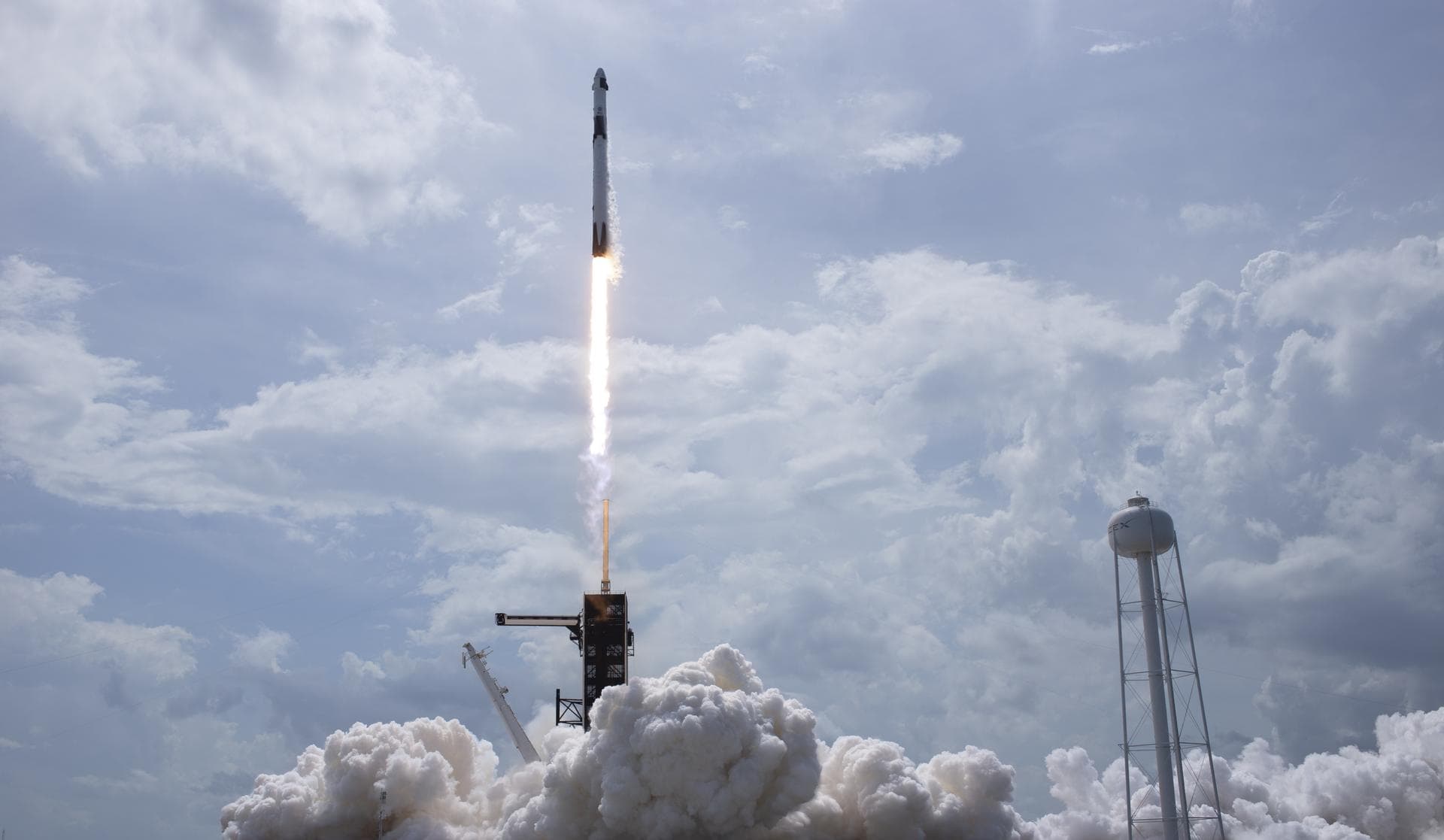
Starcloud-1 flew on SpaceX's Bandwagon-4 mission, which lifted off from Cape Canaveral Space Force Station at 1:09 a.m. Eastern Time on November 2, 2025. The mission carried 18 payloads, and SpaceX's timeline records Starcloud-1 deployment 1 hour, 13 minutes, and 38 seconds after launch.[3] NVIDIA described the spacecraft before launch as a 60 kg demonstrator carrying an H100, the first flight of that data-center GPU.[4]
Public technical descriptions of the bus and orbit are less authoritative. Gunter's Space Page identifies an Astro Digital Corvus-Micro bus and separation into an approximately 325 km orbit.[19] Published mission-duration claims conflict: Gunter's lists an expected 11 months, while a November 2025 IEEE Spectrum report called it a three-year mission.[20][19] Starcloud has not published a mission factsheet that resolves that discrepancy, so a single planned duration should not be treated as established.
The two clearly described computing results are limited but real engineering demonstrations. Starcloud says it ran Gemma for inference and trained NanoGPT on a Shakespeare corpus in December 2025.[5] GeekWire separately reported the demonstrations after speaking with Johnston, but no peer-reviewed paper, raw telemetry, power profile, fault log, model checkpoint, or independently reproduced result has been published.[6] The correct wording is therefore "company-reported first LLM training in orbit," not "first AI model trained in orbit."
The distinction matters because earlier onboard training is documented. Oxford researchers uploaded code to ION SCV004 in 2022 and trained the classifier portion of their RaVAEn cloud-detection model onboard. Oxford's account says the training used more than 1,300 images and took about 1.5 seconds.[7] The associated 2023 paper is an arXiv preprint that was presented at IGARSS, not a peer-reviewed journal article.[8]
Starcloud also proposed using its H100 to process synthetic-aperture-radar imagery from Capella Space and return compact insights instead of raw imagery. In December 2025, Johnston described that work as something the satellite would begin in 2026.[6] The public sources cited here do not document a completed Capella result by August 12. TechCrunch also reported Johnston's statement that a separate NVIDIA A6000 aboard the mission failed during launch, but no engineering failure report has been released.[10]
Starcloud-2 and commercial partners
Starcloud calls Starcloud-2 its first commercial mission. Its product page promises a GPU cluster, persistent storage, continuous access, and proprietary power and thermal systems, with full operation in sun-synchronous orbit during 2027.[16] SpaceNews reported a current design mass of about 450 kg, roughly 8 kW of generation, and a Falcon 9 launch target of January 2027.[9] None of those values has been demonstrated in flight.
Crusoe announced a signed partnership in October 2025 to place Crusoe Cloud on Starcloud-2 and offer limited orbital GPU capacity in 2027.[21] Starcloud's March 2026 financing release also named AWS, Google Cloud, and NVIDIA as partners and described planned Blackwell and AWS hardware.[15] NVIDIA independently confirms that Starcloud is using NVIDIA platforms.[14] The cited public materials from AWS and Google do not define their commitments, so the relationship should not be described as a confirmed cloud-service deployment by either company.
Connectivity has a more specific contractual record. On May 26, 2026, Starcloud announced a contract for more than 50 Starlink Mini Laser terminals across at least 25 future satellites. It said each spacecraft would carry two terminals, with up to 25 Gbit/s per terminal at distances up to 4,000 km.[17] That is a supplier announcement, not an operating Starcloud mesh. The first hardware was expected in orbit within one year of the announcement, beginning with Starcloud-2.[17][9]
Starcloud-3 and scaling assumptions
The latest public Starcloud-3 description is a roughly 3 metric ton, 200 kW spacecraft shaped for Starship's satellite-deployment system.[10][9] Starcloud has not published a detailed Starcloud-3 specification sheet, environmental qualification record, launch contract, or fixed flight date. Johnston's mid- to late 2028 estimate was explicitly tied to when Starship might be ready for customer payloads.[9]
The economics depend on that launch system. Johnston told TechCrunch that Starcloud-3 could approach a power cost near $0.05 per kilowatt-hour if commercial launch prices reached about $500 per kilogram. He also acknowledged that Starcloud would not be competitive on energy cost until Starship flew frequently.[10] Neither the launch price, flight rate, nor resulting compute price has been achieved.
Starcloud's public concept has also shifted. Its September 2024 white paper centered on training and illustrated a modular 5 GW complex with a solar array about 4 km by 4 km. Its cost table assumed a $5 million launch carrying a 40 MW cluster, very low solar-cell cost, a ten-year service period, and no backup power.[18] In a May 2026 interview, Johnston instead emphasized distributed inference satellites and described the filed constellation as potentially delivering on the order of 20 GW.[22] Both figures are company scenarios. They are not the output of an authorized system, and the FCC filing allows different computing payloads rather than committing every satellite to one power level.[23]
FCC application
Starcloud filed application SAT-LOA-20260202-00073, call sign S00803, with the Federal Communications Commission on February 4, 2026. The FCC accepted it for filing on March 13.[11] "Accepted for filing" means that the agency opened the application to review and public comment; it is not an authorization. The ICFS record still listed the application as "Pending Review" on August 12, with no grant or action date.[12]
The application requests authority for up to 88,000 satellites operating as a distributed data center. Its main parameters are:
| Parameter | What the filing says | Evidentiary limit |
|---|---|---|
| Orbits | Sun-synchronous inclinations, nominal 06:00 crossing, between 600 and 850 km | It describes narrow shells up to 50 km wide but does not publish a complete deployment manifest[11][23] |
| Spacecraft commonality | Same size, mass, maneuverability, communications, and control systems | Computing hardware may vary; the filing does not give a single public mass or compute rating for every satellite[23] |
| Primary communications | Optical links routed through third-party satellite backhaul networks | The narrative names Starlink, Amazon Leo, TeraWave, and Kepler subject to commercial arrangements; only the Starlink terminal purchase is separately documented here[17][23] |
| Backup radio | 18.8-19.3 GHz space-to-Earth and 28.6-29.1 GHz Earth-to-space | Requested only for telemetry, tracking, and command on a non-interference, unprotected basis[11][23] |
| Operational lifetime | Five years from launch | Schedule S figure, not an observed fleet lifetime[24] |
| Disposal | Active orbit lowering followed by atmospheric reentry | Applicant design representation; full-scale performance is not demonstrated[25] |
Schedule S appears to list two satellites in two orbital planes at 600 and 850 km. Starcloud's waiver request explains that these are representative boundary cases used because the form could not encode the full range of orbital planes and beam configurations.[24][26] They should not be read as replacing the narrative request for up to 88,000 spacecraft. Starcloud also seeks waivers from the FCC's ordinary processing-round, buildout-milestone, and surety-bond rules, so the filing does not establish a binding rollout schedule.[11][26]
The orbital-debris assessment describes triple-redundant propulsion, automated collision avoidance, lower-altitude checkout, and active end-of-life lowering. It says a failed spacecraft at the worst-case 850 km altitude would passively decay in about 16.2 years, according to the applicant's model.[25] The same document calls for uncontrolled atmospheric reentry after active lowering, with controlled reentry attempted but not relied upon. It says the satellites will be designed for demisability and that a final assessment will be conducted, rather than presenting a completed fleet-wide demise demonstration.[25]
The scale drew formal objections. The American Astronomical Society asked the FCC to deny the application in its current form or delay action until Starcloud supplied independently verified aggregate analyses of optical, infrared, radio, atmospheric, and debris effects.[27] Secure World Foundation did not oppose orbital computing as a category, but argued that a constellation of this size needed coordinated, system-level review across agencies.[28] These are comments in a pending proceeding, not FCC findings.
Technical and environmental evidence
Starcloud's near-term edge-computing case is narrower than its terrestrial-cloud case. Processing imagery beside the sensor can reduce a large raw dataset to a small result, avoiding a downlink bottleneck.[6] Sending workloads from Earth to orbit and returning their outputs adds network, ground-station, storage, security, and availability requirements.[29] The broader engineering trade-offs are covered in the orbital data centers article.
Heat rejection is the most visible scaling constraint. Vacuum prevents convective cooling, so almost all electrical power used by the computers must ultimately leave through radiators as thermal radiation. An independent IEEE Spectrum analysis estimated about 1.4 square meters of radiator for one 700 W H100 held near 60 C under idealized conditions, about 80 square meters for a 40 kW rack, and a roughly 40 percent area increase after modeled coating degradation. Its rough cost model still put a GPU-year in orbit at least ten times above a terrestrial equivalent even while assuming an optimistic $44 per kilogram Starship launch cost.[29] Those are analyst calculations, not peer-reviewed measurements or Starcloud flight data, but they show why a working H100 does not validate megawatt-scale cooling or economics.
Academic work reaches conditional, not universal, conclusions. A 2025 peer-reviewed Nature Electronics perspective presents orbital edge and cloud data centers as technically plausible frameworks and supplies a lifecycle-carbon method.[30] A 2025 HotCarbon workshop paper modeled launch, operation, and reentry and found that its orbital cases produced up to an order of magnitude more carbon emissions than terrestrial computing, mainly through embodied launch and reentry costs.[31] The different results depend on system lifetime, launch vehicle, electricity mix, utilization, hardware replacement, and what emissions are counted. Starcloud's claim of tenfold carbon savings remains a projection rather than a measured outcome.[4]
Astronomy and atmospheric effects also depend on hardware that has not yet been specified in enough detail. A peer-reviewed 2026 MNRAS paper analyzed the early 5 GW, 4 km-array concept and estimated that such a structure could span about 0.4 degrees and reach magnitude -5 to -7 during twilight.[32] That model does not predict the brightness of Starcloud-1 or prove that every satellite in the FCC filing would have that geometry. A separate peer-reviewed Journal of Geophysical Research study modeled a generic 10 gigagram-per-year aluminum-oxide reentry scenario and found potentially significant middle-atmosphere changes, while emphasizing uncertainty in actual reentry aerosols.[33] It is relevant to cumulative megaconstellation review, not a forecast of Starcloud's emissions without satellite mass, materials, launch cadence, and measured ablation products.
What is demonstrated and what is not
As of mid-August 2026, Starcloud's demonstrated record is one deployed spacecraft carrying an H100 and company-reported execution of two small language-model workloads. The result establishes that a modern terrestrial GPU can survive launch, power on, and execute selected code in orbit. It does not establish continuous commercial availability, long-duration radiation tolerance, useful customer throughput, a profitable service, a large deployable radiator, inter-satellite cloud networking, or cost and carbon advantages over terrestrial data centers.[3][5][6][11]
The next meaningful evidence would be Starcloud-2 telemetry: sustained input power, radiator temperature and degradation, corrected and uncorrected compute errors, storage integrity, link availability, completed customer workloads, and the cost of delivering them.[16][9][29] Until those measurements exist, Starcloud-2, Starcloud-3, the 20 GW figure, and the 88,000-satellite system remain plans at very different levels of technical and regulatory maturity.[9][10][11][12][22][23]
References
- Starcloud team - Starcloud, accessed August 12, 2026.
- Lumen Orbit closed one of the biggest rounds from Y Combinator's last cohort - TechCrunch, October 24, 2024.
- Bandwagon-4 mission - SpaceX, November 2, 2025.
- How Starcloud Is Bringing Data Centers to Outer Space - NVIDIA, October 15, 2025.
- Starcloud-1 - Starcloud, accessed August 12, 2026.
- Starcloud plans its next moves after training first AI model in space - GeekWire, December 22, 2025.
- Researchers successfully train a machine learning model in outer space for the first time - University of Oxford, July 28, 2023.
- Fast model inference and training on-board of satellites - arXiv preprint and IGARSS 2023 conference paper, July 17, 2023.
- Starcloud orders Starlink lasers for orbital data center network - SpaceNews, May 26, 2026.
- Starcloud raises $170 million Series A to build data centers in space - TechCrunch, March 30, 2026.
- Applications accepted for filing, Report SAT-01982 - Federal Communications Commission, March 13, 2026.
- ICFS application summary for SAT-LOA-20260202-00073 - Federal Communications Commission ICFS portal, accessed August 12, 2026.
- Lumen Orbit changes its name to Starcloud and raises $10M for space data centers - GeekWire, February 26, 2025.
- NVIDIA launches space computing - NVIDIA Newsroom, March 16, 2026.
- Correcting and replacing: Starcloud raises $170M Series A at $1.1bn valuation - Starcloud press release via Business Wire, March 30, 2026.
- Starcloud-2 - Starcloud, accessed August 13, 2026.
- Starcloud to integrate SpaceX's Starlink Mini Lasers into its orbital data center constellation - Starcloud press release via Business Wire, May 26, 2026.
- Why we should train AI in space - Lumen Orbit, now Starcloud, white paper version 1.03, September 2024.
- Starcloud 1 (Lumen 1) - Gunter's Space Page, updated January 31, 2026.
- NVIDIA sends a powerful GPU to space - IEEE Spectrum, November 3, 2025.
- Crusoe to become first cloud operator in space through partnership with Starcloud - Crusoe, October 22, 2025.
- The case for data centers in space - McKinsey & Company interview with Philip Johnston, May 8, 2026.
- Application for launch and operating authority for the Starcloud Orbital Datacenter System - Starcloud filing with the Federal Communications Commission, February 4, 2026.
- FCC Form 312 Schedule S for the Starcloud Orbital Datacenter System - Starcloud filing with the Federal Communications Commission, February 2026.
- Starcloud Orbital Debris Assessment Report - Starcloud filing with the Federal Communications Commission, February 2026.
- Starcloud waiver requests - Starcloud filing with the Federal Communications Commission, February 2026.
- AAS comments on Starcloud FCC application to operate 88,000 orbital data centers - American Astronomical Society, April 13, 2026.
- Comments on Starcloud's orbital data center application - Secure World Foundation, April 10, 2026.
- Why orbital data centers are harder than Silicon Valley thinks - IEEE Spectrum, June 11, 2026.
- The development of carbon-neutral data centres in space - Nature Electronics, peer-reviewed perspective, October 27, 2025.
- Dirty Bits in Low-Earth Orbit: The Carbon Footprint of Launching Computers - HotCarbon 2025 workshop paper and ACM SIGENERGY Energy Informatics Review, July 10, 2025.
- The impact on astronomy of data centres orbiting Earth - Monthly Notices of the Royal Astronomical Society, peer-reviewed article, May 1, 2026.
- Investigating the Potential Atmospheric Accumulation and Radiative Impact of the Coming Increase in Satellite Reentry Frequency - Journal of Geophysical Research: Atmospheres, peer-reviewed article, 2025.