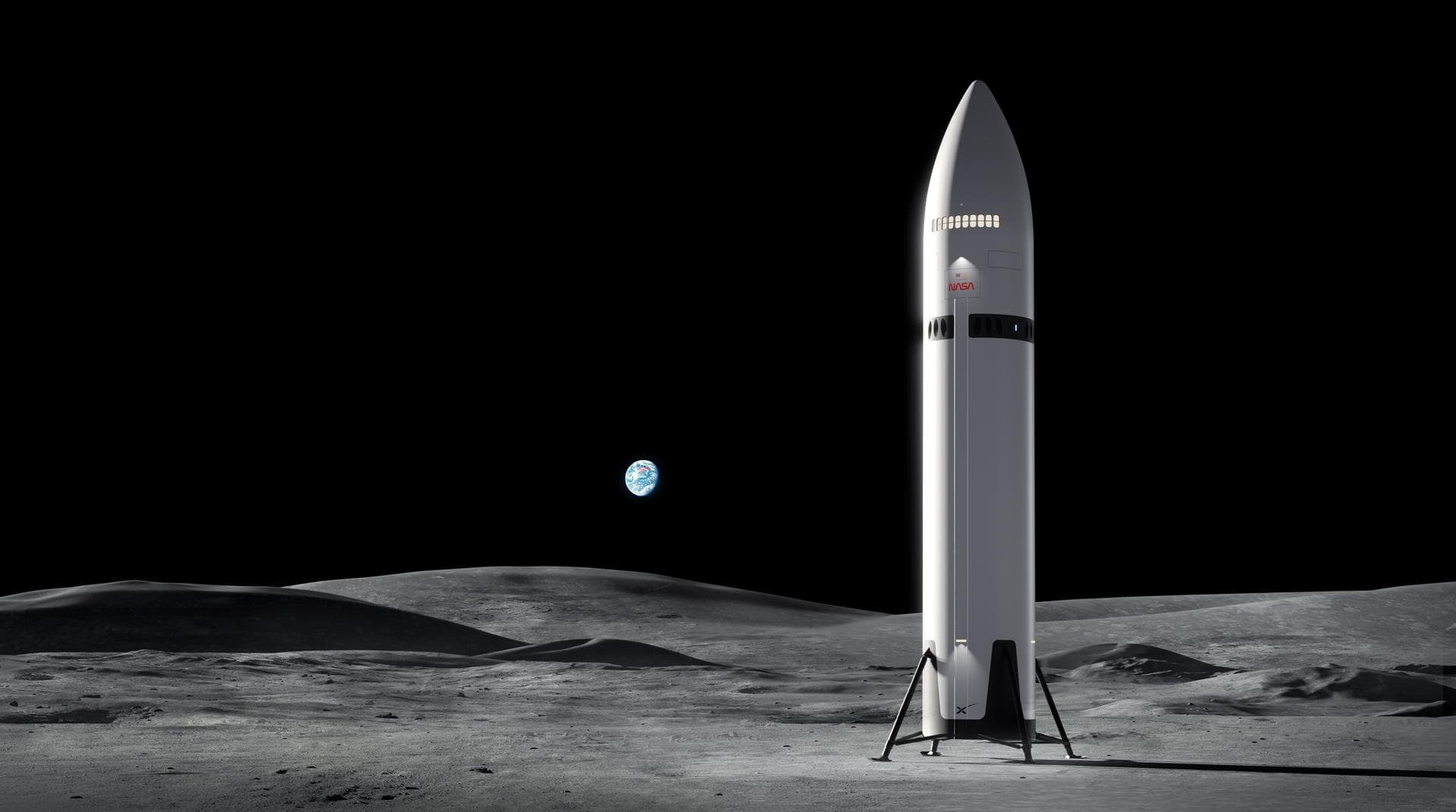
Falcon 9 is a two-stage orbital launch vehicle designed, manufactured, and operated by SpaceX. It first flew on June 4, 2010, and through August 12, 2026 it made 676 physical liftoffs.[3] SpaceX's own counter recorded 627 successful first-stage landings through the same date.[4] The fleet carries Starlink satellites, commercial and national-security spacecraft, NASA science missions, station cargo, and people.
Both stages burn liquid oxygen and rocket-grade kerosene, or RP-1. The reusable first stage can return to a landing zone or an autonomous drone ship and fly again; the second stage is expended. Falcon 9 flies with either a payload fairing or a Dragon spacecraft, and SpaceX says the stages themselves are common to both configurations.[1][2]
The 676 figure is a physical liftoff count: it excludes the Amos-6 vehicle destroyed before launch and excludes every Falcon Heavy mission.[3] The recoverable booster made repeated flight routine: SpaceX's Falcon 9 counter recorded 593 missions flown with a previously used booster through the same August 12 cutoff.[4]
Status as of August 2026
Falcon 9 remained in routine service in mid-August 2026. The audited manifest records 676 physical liftoffs through August 12, 94 of them in calendar 2026, an average of one every 2.4 days this year; the most recent was Starlink Group 17-49 from Vandenberg Space Force Base on August 12.[3] SpaceX's live counter, read on August 13, showed 674 completed missions, 627 successful first-stage landings, and 593 flights with previously flown boosters.[4] The demonstrated booster reuse record is 36 missions, set by B1067 on July 9, 2026; no stage had exceeded it as of the manifest's August 12 update.[3][10] The most recent booster loss during recovery came on March 2, 2025, when B1086 was destroyed by fire after its drone-ship landing.[16][17] SpaceX reported 165 Falcon 9 launches in 2025, and the 2026 count is tracking just below that rate.[3][5] NASA crew rotations remain under contract through October 2027.[21]
Counting the record
Falcon 9 statistics are easy to misstate because three different events can be counted: a rocket leaving the pad, the primary payload completing its launch objective, and the booster landing afterward. This article treats each physical liftoff as a launch, even when the mission failed. It does not count Amos-6 because that rocket never lifted off, or combine Falcon 9 with Falcon Heavy. The manifest is audited against astrophysicist Jonathan McDowell's General Catalog of Artificial Space Objects, whose Falcon table was updated after the August 12 Starlink Group 17-49 flight.[3]
SpaceX's live Falcon 9 statistics use a different convention. Its totalLaunches field was 674 on August 12, two fewer than the 676 physical liftoffs. The difference matches the two flights that lost their primary payloads, CRS-7 and Starlink Group 9-3; the earlier CRS-1 flight is included because Dragon reached the station even though a secondary satellite did not reach its intended orbit. That reconciliation is an inference from the manifest and SpaceX's published counter, not a definition supplied with the application programming interface.[3][4]
| Measure | Record and exact cutoff | Counting method and source |
|---|---|---|
| Physical Falcon 9 liftoffs | 676 through August 12, 2026 | 677 numbered Falcon 9 vehicles in the GCAT sequence through Starlink Group 17-49, minus Amos-6 because it was destroyed before liftoff.[3] |
| Outcomes of those liftoffs | 673 full successes, 1 partial success, 2 primary-mission failures | The partial is CRS-1; the failures are CRS-7 and Starlink Group 9-3. The categories are reconciled against the GCAT outcome codes and the mission investigations described below.[3] |
| SpaceX completed-mission counter | 674 through August 12, 2026 | Direct reading of SpaceX's Falcon 9 statistics endpoint. It is not a physical-liftoff total.[4] |
| Successful first-stage landings | 627 through August 12, 2026 | Direct reading of SpaceX's Falcon 9 statistics endpoint. This is Falcon 9 only, not a Falcon-family recovery total.[4] |
| Flights using a previously flown first stage | 593 through August 12, 2026 | Direct reading of SpaceX's totalReflights field. A reflight is a mission using a flight-proven booster, not the sum of all prior booster uses.[4] |
| 2025 Falcon 9 launches | 165, including 157 with flight-proven boosters | SpaceX's June 2026 securities prospectus reports both annual figures.[5] |
| 2026 Falcon 9 liftoffs | 94 through August 12, 2026 | Calendar-year count from the same audited manifest. The August 11 mission was number 93 of the year, and the August 12 mission was the next recorded liftoff.[3][6] |
These are dated counters, not durable specifications. A later mission will make them stale even if the underlying counting rules remain valid.[3][4]
Development and versions
Falcon 9 grew out of NASA's Commercial Orbital Transportation Services partnership. NASA's 2006 Space Act Agreement with SpaceX funded milestones for an end-to-end cargo system, including Falcon 9, Dragon, ground operations, and station berthing. NASA ultimately contributed $396 million under COTS, including augmentation funding, while NASA's program history reports about $454 million in SpaceX financing. Those amounts therefore should not be described as the standalone development cost of the rocket.[7] The first Falcon 9 launched a qualification unit in June 2010, the second flew Dragon to orbit and back in December 2010, and the May 2012 COTS demonstration made Dragon the first commercial spacecraft to visit the International Space Station.[3][7]
The family passed through four principal configurations. Counts below use physical liftoffs, so their sum is 676 and Amos-6 is excluded.[3]
| Version | Physical liftoffs | Flight period | Main changes and achieved milestones |
|---|---|---|---|
| v1.0 | 5 | June 2010 to March 2013 | Nine Merlin 1C engines in a 3 by 3 arrangement; 318 metric-ton liftoff mass in NASA's historical data sheet; no intact booster recovery.[8] |
| v1.1 | 15 | September 2013 to January 2016 | Stretched stages, 505.8 metric-ton liftoff mass, Merlin 1D engines in an eight-around-one pattern, and the first flown grid fins and landing legs. NASA records 14 successes in 15 v1.1 flights.[8] |
| Full Thrust before Block 5 | 36 | December 2015 to April 2018 | Subcooled propellants and increased performance; first land landing, drone-ship landing, and first-stage reflight were all achieved with this configuration.[2][9] |
| Block 5 | 620 | May 2018 to August 12, 2026 | Improved engine performance, thermal shielding, avionics, thrust structures, reliability, and service life. The configuration was developed to meet government crew and uncrewed mission requirements.[2][3] |
The version boundaries matter when comparing historical specifications. For example, NASA listed v1.0 at 48.1 m tall and 318 metric tons, while its v1.1 data sheet listed 68.4 m with a fairing and 505.8 metric tons. Those figures are not specifications for the current 70 m Block 5.[8] Likewise, a test-flight target or a design life is not an achieved reuse record. The demonstrated maximum as of this article's cutoff is 36 flights by one booster, B1067.[10]
Vehicle design and specifications
Falcon 9's current fairing-equipped Block 5 has aluminum-lithium propellant tanks joined by friction-stir welding. With its standard fairing the vehicle is 70 m tall and 3.7 m in core diameter, and SpaceX's current documents put the maximum fully expendable payload at 22,000 to 22,800 kg to low Earth orbit and 8,300 kg to geosynchronous transfer orbit.[1][2][11] A common dome divides each stage's oxygen and fuel tanks, and a double-wall pipe carries liquid oxygen through the RP-1 tank. The composite interstage contains the low-shock pneumatic separation hardware. Falcon avionics use redundant, fault-tolerant strings, and an autonomous flight termination system can end a flight if safety rules are violated.[2]
Nine sea-level Merlin 1D engines power the first stage. Each is rated by SpaceX at up to 845 kN, for about 7.6 MN total liftoff thrust. The engines use a gas-generator cycle and a pintle injector, and eight surround a center engine in the arrangement commonly called the octaweb. The second stage is a shorter structural relative of the first and uses one restartable Merlin Vacuum engine, rated at 981 kN with a 397-second published burn time.[1][2]
| Parameter | Current Block 5 fairing configuration | Scope or caveat |
|---|---|---|
| Height | 70 m with standard fairing; 75.2 m with extended fairing | The extended fairing is a nonstandard service.[2] |
| Core diameter | 3.7 m | SpaceX's vehicle page rounds the 3.66 m user-guide figure.[1][2] |
| Liftoff mass | 549,054 kg on the vehicle page; 594,054 kg in the June 2026 prospectus | The prospectus pairs 594,054 kg with 1,207,920 lb, but that pound figure converts to about 548,000 kg and closely matches the vehicle-page value.[1][5] |
| First-stage propulsion | 9 Merlin 1D, LOX/RP-1 | Up to 845 kN each at sea level, about 7.6 MN total.[1][2] |
| Second-stage propulsion | 1 Merlin Vacuum, LOX/RP-1 | 981 kN, restartable, published burn time 397 seconds.[1] |
| Standard fairing | 5.2 m outer diameter, 13.2 m overall height | Recoverable carbon-composite fairing; the payload keep-in volume is smaller than the outside dimensions.[1][2] |
| Extended fairing | 5.2 m outer diameter, 18.7 m overall height | Available as a nonstandard service.[2] |
| Published LEO payload | 22,000 kg in the sales sheet; 22,800 kg on the vehicle page | Both are first-party figures. The sales sheet says its performance is the maximum for a fully expendable vehicle.[1][11] |
| Published GTO payload | 8,300 kg | Maximum fully expendable figure; actual orbit and mission constraints matter.[1][11] |
| Published Mars payload | 4,020 kg | Maximum fully expendable figure.[1][11] |
SpaceX's current public documents contain two internal inconsistencies. The vehicle page gives 549,054 kg for liftoff mass, while the June 2026 prospectus prints 594,054 kg beside 1,207,920 lb; the latter pound figure converts to about 548,000 kg. For maximum low-Earth-orbit payload, the vehicle page gives 22,800 kg while the capabilities sheet gives 22,000 kg but pairs it with 50,265 lb, which converts to about 22,800 kg. This article reports the discrepancies rather than silently selecting or averaging the values. SpaceX does not publish a single current payload limit for booster-recovery missions; the user guide directs customers to request mission-specific performance. Its performance tables also apply to fairing missions and explicitly direct users to contact SpaceX for Dragon capability data.[1][2][5][11]
Flight sequence and mission profiles
Falcon 9 is held down after ignition while automated systems check engine performance. After release, the nine Merlins throttle through maximum dynamic pressure and continue until main engine cutoff. Pneumatic latches and pushers separate the stages, then Merlin Vacuum ignites a few seconds later. The fairing is normally released after the vehicle has left the dense atmosphere, about three minutes after liftoff, while Dragon remains attached until orbital insertion. Exact event times, coast periods, restart count, and payload-release sequence vary by mission.[1][2]
After staging, the booster turns for its return only if recovery is planned. A return-to-launch-site profile uses a boostback burn to reverse more of its downrange velocity. A drone-ship profile preserves more ascent performance and sends the stage to a ship positioned downrange. Grid fins steer through entry; engines relight for an entry burn and again for landing; four legs deploy before touchdown. On higher-energy missions the booster is deliberately expended, and even on recovery missions landing is secondary to placing the payload on its required trajectory.[2][12]
The upper stage may coast and restart to reach a transfer orbit or deploy payloads at different points. After deployment, SpaceX attempts a controlled deorbit when the trajectory and propellant margin permit. Otherwise the stage remains in orbit until decay. That expendable upper stage, not the recovered booster, is the main recurring source of Falcon 9 orbital hardware and atmospheric reentry.[2][13]
Recovery and reuse engineering
Falcon 9 booster recovery began with parachute concepts, but the operational system became propulsive. On December 21, 2015 the Orbcomm-2 first stage returned to Landing Zone 1, the first intact landing of an orbital-class booster after launch. On April 8, 2016 the CRS-8 booster completed the first drone-ship landing. That same stage launched SES-10 on March 30, 2017 and landed again, becoming the first orbital-class booster to fly a second mission.[9][14]
Downrange recovery retains more payload performance than flying all the way back to the coast, at the cost of ships, towing, weather exposure, and port handling. A Government Accountability Office review found that recovery and refurbishment reduce SpaceX's need to manufacture new boosters but also add demands on federal range infrastructure. GAO reported that one reused-booster launch can require at least ten oversized movements through Cape Canaveral for stage and support equipment logistics.[15]
The booster is not the only recovered hardware. The standard fairing separates into two halves that SpaceX recovers after ocean splashdown for potential reflight. The upper stage remains expendable. SpaceX's user guide reported 307 missions with reused fairing halves through February 2025, but its live public Falcon 9 statistics endpoint does not expose a current fairing-reuse total.[1][2][4][13]
B1067 extended the demonstrated booster record to 36 missions on July 9, 2026. It entered service on a NASA cargo flight in June 2021 and also carried Crew-3, Crew-4, and 24 Starlink batches before the record mission. It landed on A Shortfall of Gravitas after the 36th launch.[10] This is an achieved fleet record, not a promise that every Block 5 stage can fly 36 times or a published certification limit for all customers.
Recovery failures have not necessarily been launch failures. On August 28, 2024, B1062 delivered 21 Starlink satellites but tipped over during its 23rd landing attempt, ending a run of 267 successful Falcon landings. The FAA required an investigation and allowed launches to resume while it continued.[12][16] On March 2, 2025, B1086 landed after deploying its payload but was lost when leaked kerosene ignited in the oxygen-rich environment on the drone-ship deck. SpaceX and NASA reviewed ascent risk, and the FAA accepted corrective findings before return to flight.[17]
Dragon and human spaceflight
Falcon 9 launches both Cargo Dragon and Crew Dragon without a fairing. The interface above the second stage changes, while the stage systems remain common with satellite missions. Crew Dragon adds its own SuperDraco launch-escape system. An uncrewed January 2020 in-flight abort test demonstrated separation from a failing booster about 90 seconds after liftoff.[2][18]
Demo-2 launched NASA astronauts Doug Hurley and Bob Behnken on May 30, 2020. In November 2020, NASA certified the integrated Crew Dragon, Falcon 9, ground, and mission systems for regular astronaut flights, the first new NASA-certified crew transportation system since the Space Shuttle. Certification applies to that integrated configuration, not to every payload-fairing Falcon 9 mission.[19]
NASA's 2014 Commercial Crew Program award to SpaceX had a maximum potential value of $2.6 billion and covered development, certification, a crewed test, and post-certification transportation rather than a price for Falcon 9 alone.[20] NASA's inspector general reported in June 2026 that the contract had grown to $4.9 billion after eight additional rotations, for 14 post-certification missions in total. Crew-12 launched on February 13, 2026 with Jessica Meir, Jack Hathaway, Sophie Adenot, and Andrey Fedyaev, and NASA had Crew-13 and Crew-14 under contract to extend SpaceX rotations through October 2027.[21][22]
Falcon 9 has also launched private crews. Inspiration4 flew without docking to a station, Polaris Dawn conducted the first commercial spacewalk, Axiom missions carried private astronauts to the ISS, and Fram2 entered the first crewed polar orbit in March 2025. These missions used Dragon's crew system and Falcon 9's ascent capability, but their objectives and customer arrangements were distinct from NASA Commercial Crew rotations.[23][24][25][26]
Mission roles
Falcon 9's flight history spans cargo, crew, commercial communications, science, planetary defense, reconnaissance, and large constellations. The following missions are representative, not a complete manifest.[3]
| Date | Mission | Why it matters |
|---|---|---|
| June 4, 2010 | Falcon 9 demonstration | First physical liftoff and first orbital success for the vehicle.[3][7] |
| May 22, 2012 | COTS 2 | Dragon became the first commercial spacecraft to visit the ISS and completed SpaceX's COTS demonstration.[7] |
| December 3, 2013 | SES-8 | First Falcon 9 mission to geosynchronous transfer orbit and an early commercial v1.1 flight.[3] |
| May 30, 2020 | Demo-2 | First Falcon 9 flight with people; it began the crewed test that preceded NASA certification.[19] |
| November 24, 2021 | DART | Launched NASA's first planetary-defense demonstration toward the Didymos system.[3][27] |
| March 11, 2025 | SPHEREx and PUNCH | Shared science launch carrying an infrared sky survey and four solar-wind spacecraft.[17][28] |
| September 24, 2025 | IMAP rideshare | Carried NASA's IMAP and Carruthers Geocorona Observatory plus NOAA's SWFO-L1 toward the Sun-Earth L1 region.[29] |
| December 9, 2025 | NROL-77 | National Security Space Launch mission from SLC-40; the booster returned to Landing Zone 2.[30] |
| February 13, 2026 | Crew-12 | Twelfth operational SpaceX crew rotation for NASA and the first booster landing inside the SLC-40 perimeter.[22] |
Starlink supplies the largest share of current demand. SpaceX reported 165 Falcon 9 launches in 2025, 157 of them with flight-proven boosters. The audited manifest records 94 Falcon 9 liftoffs through August 12, 2026; 73 were Starlink deployment missions. That 2026 customer split is a manifest classification, while the 2025 figures come directly from SpaceX's securities filing.[3][5][6]
Three launch sites support the vehicle: LC-39A at Kennedy Space Center, SLC-40 at Cape Canaveral Space Force Station, and SLC-4E at Vandenberg Space Force Base. Florida provides access to common low-inclination, station, transfer-orbit, and escape trajectories. Vandenberg is the baseline site for high-inclination, polar, and sun-synchronous missions, although SpaceX has also flown polar trajectories from Florida.[2][13]
Reliability and anomaly record
A single mission-success percentage for Falcon 9 hides important distinctions. The vehicle has lost two primary missions in flight, delivered the primary payload but not a secondary payload once, suffered a prelaunch vehicle loss, and experienced later-stage disposal or booster-recovery failures after payload success. The manifest and investigation sources in the table separate those categories.[3][4]
| Date and mission | Primary payload result | Event and finding | How it is counted here |
|---|---|---|---|
| October 8, 2012, CRS-1 | Dragon reached the ISS; the secondary Orbcomm prototype entered too low an orbit and reentered | One first-stage Merlin 1C shut down. Guidance extended the remaining burns, but station-safety rules prevented the planned second-stage restart for Orbcomm.[31] | Partial mission success and a physical liftoff; included in SpaceX's completed-mission counter.[3][4] |
| June 28, 2015, CRS-7 | Dragon and cargo lost | The second-stage liquid-oxygen tank ruptured. NASA found a liberated helium pressure vessel and failed support strut credible. SpaceX called a material defect most probable, while NASA judged manufacturing damage, misinstallation, collateral damage, or another strut failure equally credible and identified inadequate use and screening of an industrial-grade part as a design error.[32] | Primary-mission failure and physical liftoff.[3] |
| September 1, 2016, Amos-6 | Vehicle and satellite lost before launch | The vehicle was being fueled in preparation for a preflight static firing when it was destroyed at SLC-40. No one was injured.[33] | Prelaunch loss, excluded from all liftoff totals.[3] |
| July 11, 2024, Starlink Group 9-3 | Twenty satellites deployed but all were left with a 135 km perigee and reentered | A second-stage liquid-oxygen leak developed after a nominal first burn; the restart did not complete orbit raising. The FAA approved return to flight on July 25 after a public-safety review.[16][34] | Primary-mission failure and physical liftoff.[3] |
| August 28, 2024, Starlink Group 8-6 | Satellites deployed as planned | B1062 failed during drone-ship landing after its 23rd ascent. The FAA required an investigation.[12][16] | Launch success, recovery failure.[4] |
| September 28, 2024, Crew-9 | Dragon and crew reached orbit | After separation, the second stage landed outside its designated hazard area. The FAA required an investigation.[16] | Launch success, postdeployment disposal anomaly.[3] |
| February 1, 2025, Starlink Group 11-4 | Satellites deployed as planned | A small oxygen leak froze a thrust-vector-control line, the stage lost attitude control, skipped its deorbit burn, and reentered over Europe on February 19. Debris reached Poland; no injuries were reported.[17] | Launch success, postdeployment disposal anomaly.[3] |
| March 2, 2025, Starlink Group 12-20 | Satellites deployed as planned | Kerosene leaked during ascent and ignited after B1086 landed, destroying the booster. The FAA accepted the investigation findings before return to flight.[17] | Launch success, postlanding recovery loss.[4] |
| February 2, 2026, Starlink Group 17-32 | Satellites deployed as planned | The second-stage engine failed to ignite before the planned deorbit burn. The FAA closed the investigation and authorized return to flight on February 6.[16] | Launch success, postdeployment disposal anomaly.[3] |
CRS-7 and Starlink Group 9-3 are therefore the two losses of a primary mission among 676 liftoffs through the cutoff. That does not mean every other flight was anomaly-free, and it does not turn a booster landing into part of payload success. The distinction also explains why a headline Falcon-family success total, a Falcon 9 liftoff count, and SpaceX's completed-mission counter cannot be substituted for one another.[3][4]
Pricing, contracts, and market role
SpaceX's published standard Falcon 9 price through 2026 is $74 million in nominal U.S. dollars for up to 5.5 metric tons to its standard geosynchronous transfer orbit. The user guide says this price includes range services, standard payload integration, and third-party liability insurance. It excludes nonstandard services and customer satellite insurance. It is a service price, not SpaceX's production cost, marginal cost, or profit per launch.[2][11]
Government awards illustrate why a single per-launch number can be misleading.[15][20][27][28]
| Award year | Public amount | Scope caution |
|---|---|---|
| 2019, NASA DART launch service | About $69 million | Included the Falcon 9 launch service and other mission-related costs, in nominal award-year dollars.[27] |
| 2021, NASA SPHEREx launch service | About $98.8 million | Included the launch service and other mission-related costs; SPHEREx later shared its flight with PUNCH.[28] |
| 2014, NASA Commercial Crew award | Up to $2.6 billion initially | Covered integrated Crew Dragon and Falcon 9 development, certification, a crewed test, and transportation missions, not a standalone rocket launch.[20] |
| 2025, Space Force NSSL Phase 3 Lane 2 | $5.9 billion for 28 assigned launches | Included launch services, mission-unique services, support, studies, and integration work across Falcon assignments. Dividing the ceiling by 28 does not produce a Falcon 9 list price.[15] |
Commercial contract terms, internal Starlink launch costs, refurbishment costs, and mission-specific discounts are not public. Claims about savings from reuse should therefore distinguish an observable reduction in new booster production from an undisclosed unit-cost calculation. SpaceX's prospectus says 157 of 165 Falcon 9 launches in 2025 used flight-proven boosters, direct evidence that reuse dominates current operations, but it does not publish cost per flight.[5]
Falcon 9's market role now combines third-party launch service with SpaceX's internal constellation. The 2025 launch count exceeded one flight every three days on average, while the company said Falcon 9 carried about 13 metric tons per mission on average from 2023 onward. National-security procurement also makes Falcon vehicles part of the U.S. assured-access strategy: GAO reported a $5.9 billion SpaceX Lane 2 award and described the program's attempt to sustain competition among certified providers.[5][15]
Regulation and environmental effects
The FAA licenses Falcon 9's commercial launches and reentries, evaluates public safety, oversees operator-led mishap investigations, and completes or adopts environmental reviews. Falcon 9 operates from federal launch ranges, so the Air Force, Space Force, NASA, and local range organizations also have site and mission roles. FAA environmental decisions specify analyzed activity envelopes; they are not launch forecasts or unconditional permission for every flight.[13]
For example, the 2025 final environmental assessment for SLC-40 analyzed up to 120 Falcon 9 launches and 34 first-stage landings per year at a new on-site landing zone. The FAA issued a mitigated finding of no significant impact and record of decision. At Vandenberg, a 2025 environmental impact statement evaluated as many as 100 annual Falcon-family launches across SLC-4 and SLC-6. Actual operations still require applicable licenses, range availability, and mission-specific compliance.[13][35]
Local environmental review and global atmospheric research answer different questions. A peer-reviewed 2022 model led by NOAA researchers examined black carbon from the global rocket fleet, not Falcon 9 alone. It found that soot injected directly into the stratosphere can accumulate, absorb sunlight, and alter atmospheric chemistry and circulation in modeled high-emission scenarios. The paper cannot supply a Falcon 9-specific climate effect per launch.[36]
A 2026 peer-reviewed case study did measure pollution from a particular Falcon 9 upper stage. After the uncontrolled February 19, 2025 reentry over Europe, a lidar in Germany detected a tenfold lithium enhancement near 96 km altitude about 20 hours later. Atmospheric back-trajectories intersected the stage's reentry path. The authors described it as the first time- and altitude-resolved measurement of upper-atmospheric pollution from reentering space debris, while emphasizing that long-term chemical and climate consequences remain uncertain.[37] The public sources reviewed for this article do not provide a complete lifecycle environmental inventory for a Falcon 9 mission covering manufacturing, launch, recovery ships, refurbishment, and reentry.[2][13][36][37]
Future
SpaceX says it expects Falcon 9 launch volume to decline over time as Starship enters operational service and takes a larger share of payload. That is a company plan, not an achieved transition. The same June 2026 prospectus says Falcon 9 and Falcon Heavy are expected to remain important for specialized missions, including NASA crew rotations and national-security payloads.[5]
The SpaceX, NASA, and GAO sources reviewed here do not specify a Falcon 9 retirement date. Instead, they document Crew Dragon rotations contracted through October 2027, assigned national-security work, and SpaceX's expectation that Falcon vehicles will remain important for specialized missions.[5][15][21] Replacing every Falcon 9 role therefore involves more than moving Starlink payloads to a larger rocket. Statements that Starship "will replace" Falcon 9 should remain attributed forecasts rather than present fact.[5]
References
- Falcon 9 - SpaceX, accessed August 12, 2026.
- Falcon Payload User's Guide - SpaceX, May 9, 2025.
- Falcon 9 Launch Catalog - Jonathan McDowell, General Catalog of Artificial Space Objects, updated August 12, 2026.
- Falcon 9 Statistics - SpaceX, live data read August 13, 2026.
- SpaceX EU Prospectus - Space Exploration Technologies Corp., June 5, 2026.
- SpaceX launches 29 Starlink satellites to orbit from Florida - Space.com, August 11, 2026.
- Commercial Orbital Transportation Services: A New Era in Spaceflight - NASA, 2014.
- SpaceX Falcon 9 v1.1 Data Sheet - NASA Safety and Mission Assurance, accessed August 12, 2026.
- SpaceX Mission Milestones - SpaceX, accessed August 12, 2026.
- SpaceX launches Falcon 9 rocket on record-breaking 36th flight - Spaceflight Now, July 9, 2026.
- Capabilities and Services - SpaceX, accessed August 12, 2026.
- FAA Statements on Aviation Accidents and Incidents - Federal Aviation Administration, accessed August 12, 2026.
- SpaceX Falcon Program - Federal Aviation Administration, updated November 5, 2025.
- SES-10 Mission - SpaceX, March 30, 2017.
- National Security Space Launch: Increased Commercial Use of Ranges Underscores Need for Improved Cost Recovery - U.S. Government Accountability Office, June 30, 2025.
- FAA General Statements - Federal Aviation Administration, accessed August 12, 2026.
- SpaceX details Falcon 9 anomaly that temporarily grounded the rocket fleet - Spaceflight Now, March 10, 2025.
- Dragon Launch Escape Demonstration - SpaceX, January 19, 2020.
- NASA and SpaceX Complete Certification of First Human-Rated Commercial Space System - NASA, November 10, 2020.
- NASA Chooses American Companies to Transport U.S. Astronauts to International Space Station - NASA, September 16, 2014.
- NASA's Management of Its Commercial Crew Program - NASA Office of Inspector General, June 30, 2026.
- NASA's SpaceX Crew-12 Launches to International Space Station - NASA, February 13, 2026.
- Fram2 Mission - SpaceX, March 31, 2025.
- Inspiration4 Mission - SpaceX, September 15-18, 2021.
- Polaris Dawn Mission - SpaceX, September 10-15, 2024.
- Ax-1 Mission - SpaceX, April 8-25, 2022.
- NASA Awards Launch Services Contract for Asteroid Redirect Test Mission - NASA, April 11, 2019.
- NASA Awards Launch Services Contract for SPHEREx Astrophysics Mission - NASA, February 4, 2021.
- Liftoff: Three New Space Weather Spacecraft Soar into Florida Sky - NASA, September 24, 2025.
- NRO Successfully Launches NROL-77 Mission Through National Security Space Launch Program - U.S. Space Force Space Systems Command, December 10, 2025.
- SpaceX Falcon 9 Data Sheet - NASA Safety and Mission Assurance, accessed August 12, 2026.
- NASA Independent Review Team Public Summary: SpaceX CRS-7 Accident Investigation - NASA Launch Services Program, March 12, 2018.
- Aerospace Safety Advisory Panel Annual Report for 2016 - NASA Aerospace Safety Advisory Panel, January 2017.
- Starlink Group 9-3 Mission - SpaceX, July 11, 2024.
- SpaceX Falcon SLC-40 Environmental Assessment - Federal Aviation Administration, September 2, 2025.
- The Climate and Ozone Impacts of Black Carbon Emissions From Global Rocket Launches - Maloney et al., Journal of Geophysical Research: Atmospheres, 2022.
- Measurement of a lithium plume from the uncontrolled re-entry of a Falcon 9 rocket - Wing et al., Communications Earth & Environment, February 19, 2026.