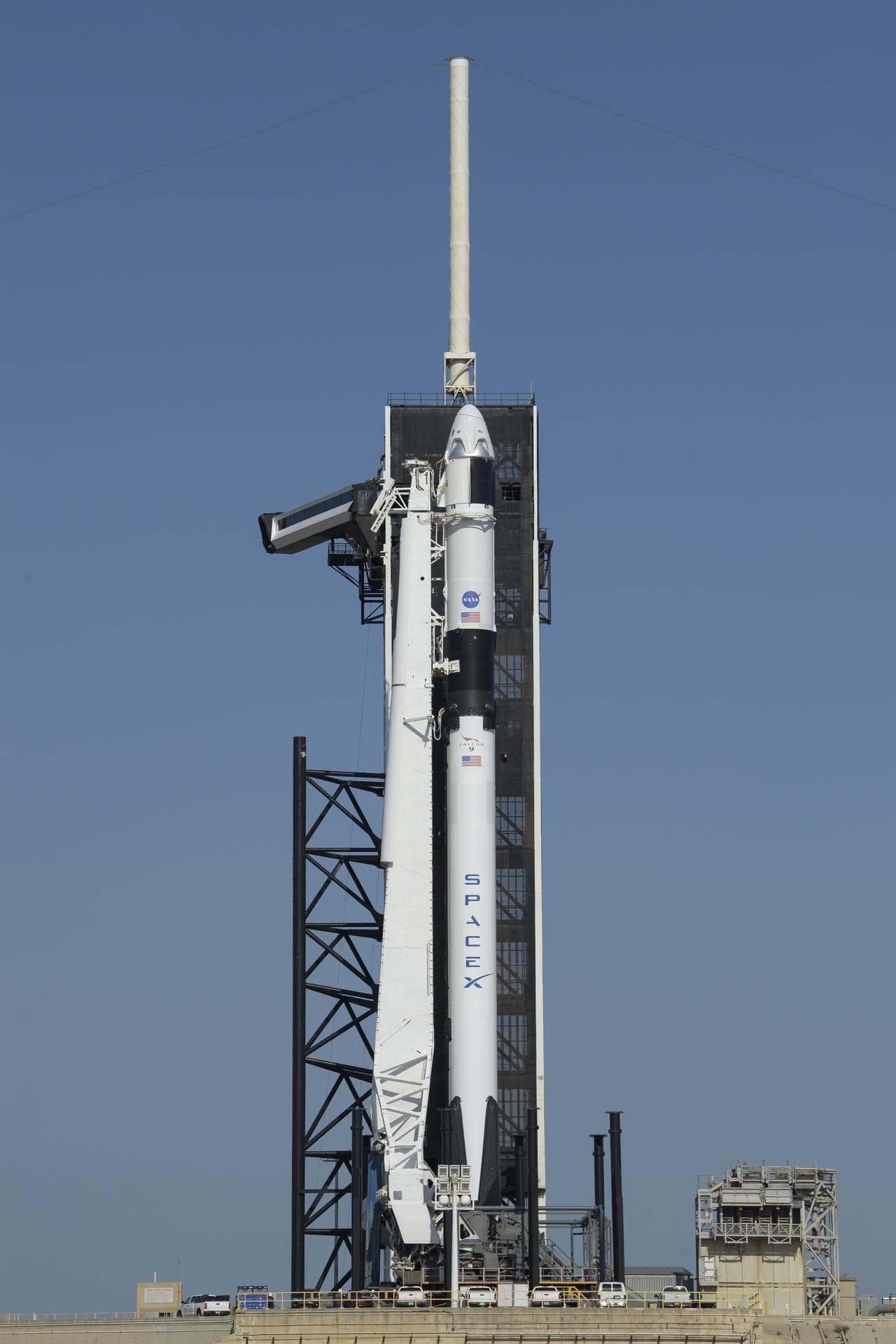
Starship is a two-stage super heavy-lift launch system that SpaceX is developing to launch its larger Starlink satellites, serve as NASA's lunar Human Landing System, and ultimately support missions beyond Earth. Both stages are designed to return for repeated use. The current Version 3 design is 124.4 meters tall and 9 meters in diameter, with a published design mass of about 5,533 metric tonnes at liftoff.[1][2]
A Super Heavy first stage carries an upper stage that is also called Starship, or the ship. SpaceX projects that a fully reusable V3 could carry more than 100 metric tonnes to low Earth orbit, but no Starship flight had entered a sustained orbit or delivered an operational payload to orbit by August 13, 2026, and the complete system has not yet demonstrated full reuse.[1][2]
Thirteen integrated tests flew from Starbase between April 2023 and July 2026. They demonstrated hot staging, controlled returns by both stages, three catches of Super Heavy, one booster reflight, four upper-stage engine relights in space, and payload release in space. The program had not yet recovered or reflown an upper stage, transferred propellant between two spacecraft, or flown people.[7][11][12][15][16][17][20]
Status as of August 2026
As of August 13, 2026, Starship has flown 13 integrated test flights from Starbase, Texas, all on suborbital profiles, and none has entered a sustained orbit.[7][20] The current Version 3 configuration has flown twice, on May 22 and July 24, 2026.[18][20] Flight 13, on July 24, released 20 production Starlink V3 satellites on a suborbital trajectory and, for the first time, left the ship intact and afloat after splashdown. SpaceX then spent weeks trying to tow the ship, an effort Elon Musk said on August 7 was "not looking good right now" in rough seas,[20][38] before the company announced on August 18 that it had brought the ship to calmer waters off Christmas Island for inspection ahead of a possible return to Starbase.[39] On the company's August 4 earnings call, Musk said Flight 14, targeted for late August, would attempt the program's first orbital flight and operational Starlink V3 deployment, with a possible first tower catch of a ship pending regulatory approval.[35] Both parts of that plan have since receded: an August 20 briefing for airspace managers listed September 15 for the flight, and Musk wrote the same day that a ship catch was probably a few months away.[39] NASA's current Artemis plan uses a Version 3 Starship test article for a 2027 low Earth orbit docking test with Orion, ahead of a crewed lunar landing targeted for 2028.[22]
Starship's demonstrated record is narrower than its planned capability. The distinction matters because vehicle specifications, economic projections, and mission architectures published by SpaceX describe the system the company is trying to build, not an operational service.[1][2]
| Capability | Demonstrated state by the cutoff date |
|---|---|
| Integrated launch | Thirteen launches. No flight completed a sustained orbit.[7][20] |
| Super Heavy recovery | Three tower catches, on Flights 5, 7, and 8. Other tests used controlled or hard water impacts.[11][13][14] |
| Hardware reflight | One Super Heavy booster flew a second time on Flight 9. It was not recovered again.[15] |
| Ship return | Several ships completed controlled atmospheric entry and propulsive splashdown, most recently on Flight 13. No ship had been caught, recovered for reuse, or reflown.[10][12][16][17][18][20] |
| Engine restart in space | A ship Raptor relit on Flights 6, 10, 11, and 13.[12][16][17][20] |
| Payload operations | Flights 10 and 11 released mass simulators. Flight 12 released simulators and two modified Starlink spacecraft. Flight 13 released 20 production Starlink V3 satellites on a suborbital trajectory, so none entered an operational orbit.[16][17][18][20] |
| Propellant transfer | Flight 3 moved roughly 5 metric tonnes of liquid oxygen between tanks inside one ship. No vehicle-to-vehicle transfer had occurred.[2][21] |
| Crewed or lunar flight | None. NASA still requires certification work and an uncrewed lunar landing before a crewed landing.[22][23] |
Vehicle architecture
Propulsion and staging
Starship's current V3 stack uses 39 Raptor 3 engines. Super Heavy carries 33 sea-level engines, while the ship carries three sea-level engines and three vacuum-optimized engines. Raptor is a full-flow staged-combustion engine burning liquid methane and liquid oxygen. SpaceX says Raptor 3 removes much of the external plumbing and heat shielding used on earlier versions and is nearly one metric tonne lighter per engine. Those are manufacturer specifications for the current design, not a record of 39 engines completing a full mission together.[1][2]
Super Heavy operates during ascent and then separates while some ship engines are already firing, a sequence called hot staging. The system first performed the maneuver on Flight 2. A vented interstage directs exhaust away from the booster, which then turns for either a return toward its launch site or a water-landing test.[8]
The ship carries its main propellant in large oxygen and methane tanks. Smaller header tanks retain landing propellant during the vehicle's horizontal descent. For missions beyond low Earth orbit, SpaceX's architecture also calls for tanker ships and an orbiting depot to transfer cryogenic propellant into a mission vehicle. Tank-to-tank movement inside one ship is not equivalent to the long-duration storage and ship-to-ship transfer that architecture requires.[2][21][23]
Return and reuse
Super Heavy uses grid fins during descent and relights engines for its boostback and landing burns. At the launch site, mechanical arms on the integration tower are designed to close around load-bearing fittings on the booster. Flight 5 achieved the first catch in October 2024. SpaceX repeated it on Flights 7 and 8, but a catch remains a flight-specific result rather than proof that every booster configuration is routinely reusable.[11][13][14]
The ship returns differently. Four movable flaps control a broadside, or "belly-first," atmospheric descent. Ceramic tiles cover its windward surface. Near the surface, the vehicle is designed to rotate upright, ignite sea-level Raptors, and descend vertically. The smaller SN15 prototype demonstrated this flip and landing sequence in 2021, and integrated ships have since completed it over the ocean.[3][6][10]
The tower is ultimately intended to catch both stages, avoiding landing legs and returning hardware directly to the pad. By the cutoff date, however, only boosters had been caught. Even Flight 13's intact, floating ship had completed a planned ocean splashdown, not a recovery and refurbishment cycle.[2][20]
Versions
"V1," "V2," and "V3" are useful names for major test configurations, but Starship also changes between flights within a version. In particular, the five V2 flights used a second-generation ship with a first-generation Super Heavy booster.[4][17]
| Version | Integrated flights | Approximate configuration | What the flights established |
|---|---|---|---|
| V1 | 1 through 6 | About 121 m tall; Raptor 2 engines; first integrated ship and booster design.[37] | Hot staging, controlled returns by both stages, the first booster catch, and the first ship-engine relight in space.[8][10][11][12] |
| V2 | 7 through 11 | About 123 m tall. The ship was nearly 2 m longer, with about 25 percent more propellant volume, revised feed systems, smaller forward flaps moved away from the hottest part of the heat shield, and upgraded avionics. It flew with a V1-type booster.[4][17] | Three early ship losses were followed by two full suborbital profiles. Two boosters were caught, and one booster became the program's first reflown stage.[13][14][15][16][17] |
| V3 | 12 onward | 124.4 m tall; redesigned ship and booster; Raptor 3 engines; increased propellant capacity; first flown from Starbase Pad 2.[2][18] | Two suborbital profiles, an upper-stage engine relight on Flight 13, and release of production Starlink V3 satellites. Neither V3 booster completed a soft return, and the version had not reached sustained orbit.[18][19][20][36] |
SpaceX associates V3 with a fully reusable payload capacity above 100 metric tonnes to low Earth orbit. That figure is a design objective. It cannot be inferred from the suborbital payloads flown on Flights 12 and 13, and SpaceX had not published an independently verified operational payload performance figure.[1][2][20]
Development history
SpaceX began flying methane-fueled Starship development hardware at Boca Chica, Texas, before an integrated booster existed. The short Starhopper vehicle completed a roughly 150-meter test hop on August 27, 2019.[5] A series of full-diameter upper-stage prototypes then tested ascent, the controlled horizontal descent, and the landing flip. Several were destroyed during or shortly after landing attempts. SN15 completed a 10-kilometer flight and landed intact on May 5, 2021.[6]
Work then shifted toward an orbital-class launch site, Super Heavy, and a full stack. The first integrated vehicle launched in April 2023. SpaceX's iterative method has allowed hardware and operations to change between tests, but each flight is also conducted under a Federal Aviation Administration license. When a flight ends in a mishap, the FAA oversees the investigation and decides whether required corrective actions have been completed or otherwise addressed before authorizing another launch.[7][19][32]
Integrated flight tests
All thirteen integrated Starship flights followed suborbital test profiles. Some ships crossed the internationally used 100-kilometer boundary of space and approached orbital velocity, but none made a sustained orbit. "Completed profile" below means that the vehicle completed the planned suborbital sequence for that test, not that Starship had entered operational service.[7][8][20]
| Flight | Date | Version | Verified result |
|---|---|---|---|
| 1 | April 20, 2023 | V1 | The stack cleared the pad but lost several engines, did not separate, and was destroyed by its flight termination system about four minutes after liftoff.[7] |
| 2 | November 18, 2023 | V1 | All 33 booster engines completed the initial ascent burn and the first hot staging occurred. The booster broke apart after separation, and the ship reached about 150 km altitude before its flight termination system activated.[8] |
| 3 | March 14, 2024 | V1 | The ship completed ascent, tested its payload door, and began an internal oxygen-transfer demonstration. An engine relight was skipped while the ship was rolling; the booster was lost near the water and the ship was lost during entry.[9][21] |
| 4 | June 6, 2024 | V1 | Super Heavy completed a landing burn and soft water landing. The ship survived entry despite visible heat-shield damage, performed its flip and landing burn, and splashed down under control.[10] |
| 5 | October 13, 2024 | V1 | The launch tower caught Super Heavy for the first time. The ship completed a controlled entry and water landing in the Indian Ocean.[11] |
| 6 | November 19, 2024 | V1 | Controllers diverted the booster to a water landing after an automated tower-health check ruled out a catch. The ship performed the program's first Raptor relight in space and completed entry and splashdown.[12] |
| 7 | January 16, 2025 | V2 ship, V1 booster | The booster was caught. The first V2 ship was lost after a fire developed in its aft section about eight and a half minutes after launch.[13] |
| 8 | March 6, 2025 | V2 ship, V1 booster | The booster was caught again. The ship lost engines after an energetic event in its aft section and broke up before completing ascent.[14] |
| 9 | May 27, 2025 | V2 ship, reflown V1 booster | A booster flew for a second time for the first time in the program. It was lost during its water-landing test. The ship completed ascent, but payload-door and attitude-control problems prevented its planned payload and relight tests, and contact was lost during entry.[15] |
| 10 | August 26, 2025 | V2 ship, V1 booster | The ship released eight Starlink-shaped mass simulators, relit a Raptor in space, and completed its entry and controlled splashdown. The booster completed its planned water-landing sequence.[16] |
| 11 | October 13, 2025 | V2 ship, V1 booster | The final V2 ship released eight simulators, performed another in-space relight, and completed controlled entry and splashdown. Super Heavy completed a water-landing test.[17] |
| 12 | May 22, 2026 | V3 | The first V3 stack launched from Pad 2. The ship reached its target trajectory despite losing one vacuum engine, released 20 simulators and two modified Starlink spacecraft, and completed entry and a soft splashdown. Controllers skipped the planned in-space relight after the ascent engine loss. Booster engine problems led to a hard water impact.[18][19][36] |
| 13 | July 24, 2026 | V3 | The ship released 20 production Starlink V3 satellites onto the same suborbital path, relit an engine, completed entry, and made a soft splashdown northwest of Australia. The satellites later reentered. The booster's return burn ended early and it made a hard Gulf water impact.[20] |
The table also shows why a single label such as "success" can obscure the program's state. Flight 13 completed the ship objectives SpaceX set for that test, yet the booster was destroyed and the payload was never intended to remain in orbit. Conversely, early flights that lost both stages still supplied data and achieved some intermediate objectives. The directly observable outcomes are more useful than the company's pass-or-fail characterization.[7][20]
The FAA closed its Flight 12 mishap investigation on July 13, 2026. It accepted SpaceX's findings that heat effects on propulsion components and incorrect engine-alarm settings contributed to the booster's return failure, and it identified four corrective actions involving hardware and software. The closure did not permanently authorize every later mission; Flight 13 still had to satisfy the applicable licensing requirements.[19]
Production and launch sites
Starbase, on the Gulf coast of South Texas, remained the only site from which an integrated Starship had launched as of August 13, 2026. SpaceX builds ships and boosters there in its Starfactory complex, integrates them beside the pads, and conducts structural, component, static-fire, and flight testing. Pad 1 supported Flights 1 through 11. Pad 2, designed around the V3 configuration, first supported a launch on Flight 12.[1][2][18]
The broader production and test network is distributed. SpaceX's Hawthorne, California, site manufactures Raptor engines and other components, while McGregor, Texas, is the principal site for Raptor qualification, acceptance, and post-flight testing. The company says vertical integration is intended to shorten design and production cycles, but its own prospectus identifies engine and vehicle output, test capacity, propellant production, electric power, launch infrastructure, regulatory approvals, and capital as constraints on a high flight rate.[1][2]
SpaceX is also building Starship infrastructure at two Florida sites. A pad at Launch Complex 39A at Kennedy Space Center was under construction, and redevelopment of Space Launch Complex 37 at Cape Canaveral Space Force Station was planned for two Starship pads. SpaceX projected four operational pads across Texas and Florida by the end of 2027, but that was a company schedule, not an achieved capacity.[1][2][34]
NASA human landing system
NASA selected a lunar version of Starship in April 2021 for the first crewed Human Landing System demonstration, awarding SpaceX a $2.89 billion firm-fixed-price contract. In November 2022, NASA added a $1.15 billion Option B for a later, more sustainable lander demonstration. NASA uses fixed-price, milestone-based payments for these awards, so the contract amounts are not a measure of SpaceX's total Starship development spending.[24][25][26]
The mission plan has changed since those awards. NASA's July 15, 2026 description of the current architecture places an Artemis III lander test in low Earth orbit in 2027. A V3-derived Starship test article is to carry a docking system, but the astronauts are to remain in Orion rather than enter the lander. Orion is to rendezvous and dock with the test article, and Starship is to control the combined vehicles during its portion of the test.[22]
That Earth-orbit test should not be confused with the later lunar mission. For a crewed landing, NASA's published architecture still calls for a commercial lander to be positioned in lunar orbit, where Orion would dock and transfer its crew. NASA targets the first landing under the revised sequence for 2028, but lander readiness and the evolving assignment of providers remain schedule variables.[22][23]
| NASA milestone | Starship's dated role | Work still required |
|---|---|---|
| Artemis III, planned for 2027 | A V3-derived test article is planned to dock with Orion in low Earth orbit. The Artemis crew is to remain in Orion.[22] | SpaceX must complete and certify the test article and its docking integration. The mission is a systems and operations test, not a lunar landing.[22] |
| Uncrewed lunar demonstration | NASA requires an uncrewed landing before a crewed landing. GAO reported in July 2026 that this and other SpaceX HLS milestones were more than a year behind their original schedules.[23] | The architecture requires long-duration cryogenic storage, multiple Starship launches, vehicle-to-vehicle transfer, navigation and communications, and an operational lunar lander.[2][23] |
| First crewed landing in the revised sequence, targeted for 2028 | A commercial lander is to wait in lunar orbit for Orion and then carry astronauts to and from the surface.[22][23] | NASA certification and provider readiness determine whether the date and mission assignment can be met.[22][23] |
Refueling is the central Starship-specific dependency. SpaceX's concept uses multiple tanker launches and a depot before the lunar lander leaves Earth orbit. Flight 3's internal transfer was a useful fluid-management test, but it did not address docking two ships, transferring between vehicles, or storing cryogenic propellants for a lunar campaign. GAO identified cryogenic propellant management as one of NASA's highest HLS risks and reported that SpaceX's long-duration and transfer demonstrations had slipped more than a year from their original schedules.[21][23]
NASA's Office of Inspector General reported in March 2026 that the potential value of SpaceX's HLS contracts had increased by about 6 percent, or $253 million, from an original value of about $4.3 billion by December 2025. The audit found that the fixed-price structure helped contain NASA's cost exposure, while technical development and integration delays continued to pressure the schedule.[27]
Economics and market rationale
Starship is not yet offered with a standard published launch price. SpaceX argues that recovering both stages, producing vehicles at scale, and increasing flight rate could make propellant the main marginal expense. In its 2026 securities filings, the company set a goal of reducing launch cost by more than 99 percent relative to a historical industry average. That is a forward-looking company target, not a measured Starship cost reduction.[1][2]
The same filing says SpaceX had invested more than $15 billion in Starship. It allocated about $3.004 billion of research and development expense to the program in 2025, up from about $1.835 billion in 2024, and another $930 million in the first quarter of 2026.[1] The company's second-quarter report adds $1.076 billion of Space segment research and development expense for the quarter, spending it says relates mainly to Starship.[40] These accounting allocations describe development spending; they do not reveal a cost per flight or prove the economics of a mature reusable system.[1]
Starlink provides an internal payload market while Starship develops. SpaceX says a full load of 60 Starlink V3 satellites would add roughly 20 times the downlink capacity of a Falcon 9 launch carrying V2 Mini satellites. The company also says initial low Earth orbit Starlink missions do not require upper-stage recovery or orbital refueling. This could allow useful launches before the full architecture is complete, but neither the 60-satellite load nor operational orbital delivery had been demonstrated by the cutoff date.[1][28]
An independent peer-reviewed comparison published in the CEAS Space Journal modeled Starship using public data from the early integrated tests. It found that heavy payload performance could be plausible under the study's mass, engine, and recovery assumptions, while emphasizing that full, rapid reuse is a decisive condition for the system's intended cost and operational advantage. The paper's results are engineering estimates, not measured operational performance.[29]
Licensing and environmental review
The FAA regulates Starship launch and reentry safety and conducts or adopts environmental reviews for proposed operations. An environmental finding defines an envelope that may be considered; it does not by itself issue a launch license or approve every flight within that envelope. Vehicle changes, trajectories, landing plans, and mishap findings can require license modifications or additional review.[19][30][33]
For Starbase, the FAA completed an environmental review in May 2025 that supported a license modification for up to 25 annual launches, 25 ship landings, and 25 booster landings. SpaceX still has to meet safety and other license conditions for its actual missions. The site adjoins sensitive Lower Rio Grande Valley habitat and public beach access, so the FAA's earlier programmatic assessment required more than 75 mitigation measures. They included wildlife and vegetation monitoring, lighting controls, public notice, and debris-response requirements.[30][31]
The first integrated flight also showed that pad and debris effects are part of launch safety, not just vehicle reliability. After its mishap investigation, the FAA required SpaceX to address 63 corrective actions involving leaks and fires, pad robustness, safety-critical system analysis, and change control before a return to flight.[32]
In Florida, the FAA's final environmental impact statement and record of decision for Launch Complex 39A considered an upper envelope of 44 Starship launches and 44 returns of each stage per year. That decision did not mean 44 flights had been licensed, and no Starship had launched from the site by August 13, 2026.[33] The Department of the Air Force separately selected redevelopment of Space Launch Complex 37 for Starship after its environmental review. Construction schedules and eventual operations at both sites remained subject to licensing, infrastructure, and vehicle readiness.[1][34]
Technical risks and unresolved dependencies
Starship has retired some early uncertainties, including hot staging, high-speed ship entry, booster catch, and in-space engine restart. Its highest-consequence objectives require several capabilities to work together repeatedly, however. The evidence available by August 13, 2026 leaves the following gaps:[8][10][11][12][23]
| Area | Evidence so far | Remaining risk |
|---|---|---|
| Upper-stage thermal protection and reuse | Multiple ships completed controlled entries and water landings, including both V3 flights.[18][20] | Tiles and structure have not been recovered, inspected, refurbished, and reflown after an orbital-class entry. No ship catch has occurred.[20][29] |
| V3 propulsion and booster return | Both V3 ships completed controlled entries and water landings. Flight 13 relit a ship engine in space after Flight 12 had skipped that test.[18][20][36] | V3 had only two flights. Both boosters made hard water impacts, and Flight 12 required propulsion hardware and software corrections overseen by the FAA.[19][20] |
| Orbit and payload performance | Starship has reached space and released simulators and satellites.[16][17][18][20] | No flight has completed sustained orbit or delivered a payload that remained there. The 100-plus-tonne reusable capacity is still a design projection.[1][2] |
| Cryogenic propellant management | Flight 3 transferred oxygen between tanks inside one ship.[21] | Depot operations, long-duration storage, automated rendezvous, and ship-to-ship transfer remain unflown and are critical to the lunar architecture.[2][23] |
| Rapid reuse and cadence | One booster has reflown and three have been caught.[11][13][14][15] | No stage has completed repeated catch, inspection, and quick reflight cycles. The required production, pad, test, propellant, power, and regulatory capacity is still being expanded.[1][2] |
| Human landing system | NASA and SpaceX have defined a 2027 low Earth orbit docking test, and development is funded through milestone contracts.[22][24][25] | SpaceX still must demonstrate the lunar mission chain, complete an uncrewed landing, and satisfy NASA's human-rating and certification requirements.[22][23][27] |
| Economics | SpaceX has an internal Starlink market and says low Earth orbit service can begin without every reuse and refueling milestone.[1][28] | No operational price, mature flight rate, recurring refurbishment cost, or fully reusable payload performance has been demonstrated. Published cost reductions remain company forecasts.[1][29] |
Planned uses and near-term outlook
Starlink launches are Starship's nearest planned operational use. NASA's Human Landing System depends on a longer chain of refueling, rendezvous, deep-space, and lunar-surface operations. SpaceX also presents Starship as the transport at the center of its long-term Mars plans, but it had published no firm, licensed Mars mission schedule by the cutoff date.[1][2]
On SpaceX's August 4, 2026 earnings call, Elon Musk said the company was targeting Flight 14 for late August. He described it as an attempt at Starship's first sustained orbital flight and operational Starlink V3 deployment, with a possible ship catch subject to regulatory approval. Those were dated company plans, not completed milestones or an FAA-authorized schedule.[35] By August 21 the launch target had moved to mid-September, and Musk had written that a first ship catch was probably a few months away.[39]
References
- Space Exploration Technologies Corp. final prospectus - SpaceX filing with the U.S. Securities and Exchange Commission, June 12, 2026.
- SpaceX EU Prospectus - SpaceX, June 5, 2026.
- Starship - SpaceX.
- SpaceX launches first second-generation Starship upper stage - Spaceflight Now, January 16, 2025.
- SpaceX's Starhopper completes test flight - SpaceNews, August 27, 2019.
- Starship SN15 - SpaceX, May 5, 2021.
- Starship Flight Test - SpaceX, April 20, 2023.
- Starship's Second Flight Test - SpaceX, November 18, 2023.
- Starship's Third Flight Test - SpaceX, March 14, 2024.
- Starship's Fourth Flight Test - SpaceX, June 6, 2024.
- Starship's Fifth Flight Test - SpaceX, October 13, 2024.
- Starship's Sixth Flight Test - SpaceX, November 19, 2024.
- Starship's Seventh Flight Test - SpaceX, January 16, 2025.
- Starship's Eighth Flight Test - SpaceX, March 6, 2025.
- Starship's Ninth Flight Test - SpaceX, May 27, 2025.
- Starship's Tenth Flight Test - SpaceX, August 26, 2025.
- Starship's Eleventh Flight Test - SpaceX, October 13, 2025.
- Starship's Twelfth Flight Test - SpaceX, May 22, 2026.
- FAA general statements on Starship - Federal Aviation Administration, including the Flight 12 mishap closure of July 13, 2026.
- SpaceX giant Super Heavy-Starship rocket test flight - CBS News, July 24, 2026.
- NASA Artemis mission progresses with SpaceX Starship test flight - NASA, March 2024.
- How NASA's Artemis III lander test will pave the way for Moon landings - NASA, July 15, 2026.
- NASA: Assessments of Major Projects - U.S. Government Accountability Office, GAO-26-108556, July 23, 2026.
- As Artemis moves forward, NASA picks SpaceX to land next Americans on Moon - NASA, April 16, 2021.
- NASA awards SpaceX second contract option for Artemis Moon landing - NASA, November 15, 2022.
- NextSTEP H: Human Landing System - NASA.
- NASA's Management of the Human Landing System Contracts - NASA Office of Inspector General, Report IG-26-004, March 2026.
- Starlink Version 3 satellites - SpaceX.
- Comparison of SpaceX's Starship with winged heavy-lift launcher options for Europe - CEAS Space Journal, volume 18, 2026.
- SpaceX Starship/Super Heavy at the Boca Chica Launch Site - Federal Aviation Administration.
- FAA requires SpaceX to take over 75 actions to mitigate environmental impact of planned flights - Federal Aviation Administration, June 13, 2022.
- FAA closes SpaceX Starship mishap investigation - Federal Aviation Administration, September 8, 2023.
- SpaceX Starship/Super Heavy at Kennedy Space Center - Federal Aviation Administration.
- Record of Decision for Starship operations at Cape Canaveral Space Force Station - Department of the Air Force, December 2025.
- SpaceX wants to launch next Starship this month and catch it too - Space.com, August 4, 2026.
- SpaceX just launched Starship V3 into space for the first time - Space.com, May 22, 2026.
- The key moment came 38 minutes after Starship roared off the launch pad - Ars Technica, November 19, 2024.
- 'Not looking good right now': Starship likely to be lost at sea 2 weeks after epic 13th test flight, Elon Musk says - Space.com, August 7, 2026.
- SpaceX scales back plans for next Starship launch - SpaceNews, August 21, 2026.
- Form 10-Q for the quarterly period ended June 30, 2026 - Space Exploration Technologies Corp., U.S. Securities and Exchange Commission, filed August 4, 2026.