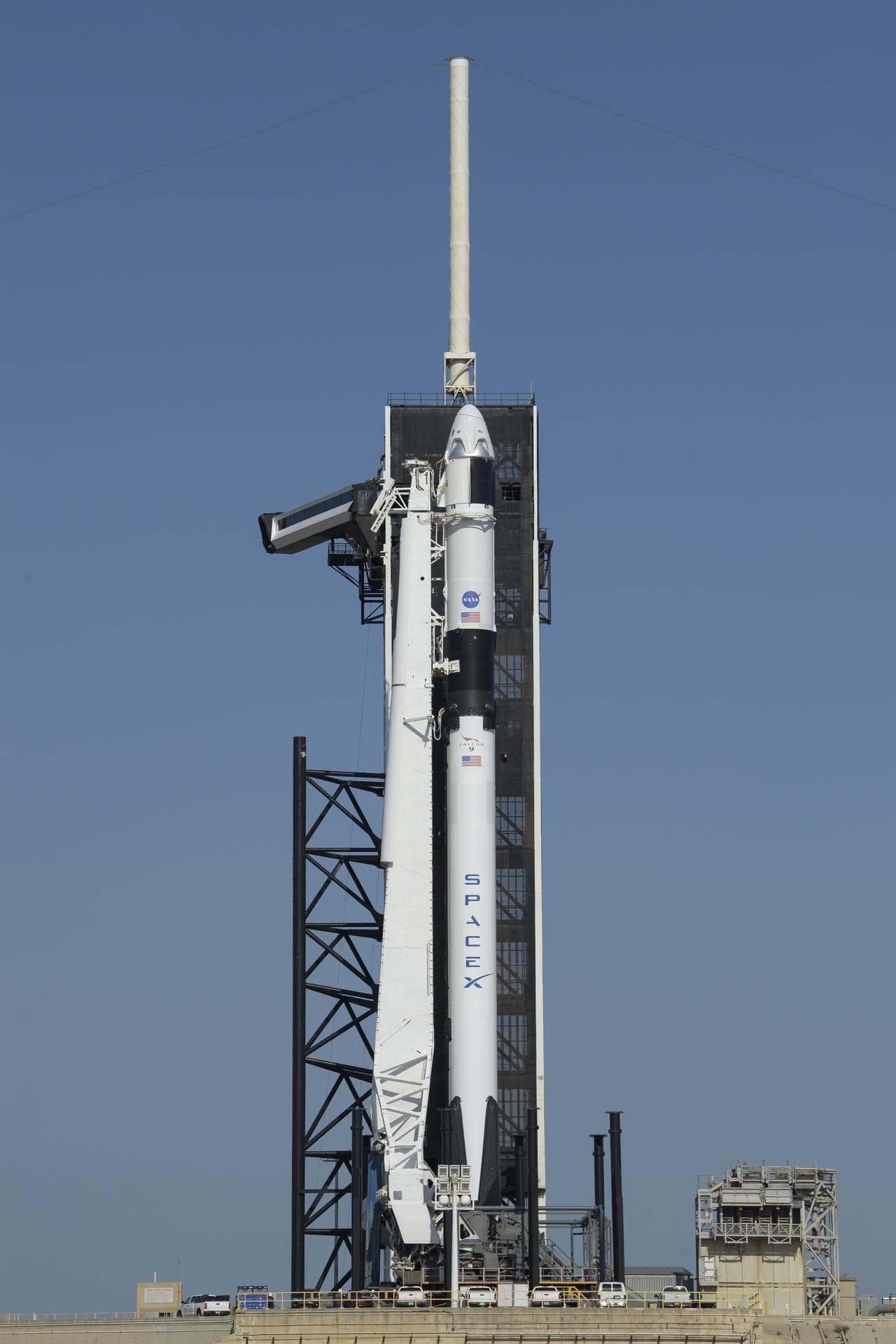
SpaceX (Space Exploration Technologies Corp.) is an American spacecraft manufacturer, launch provider, and satellite communications company headquartered in Starbase, Texas. It launches more mass to orbit than every other operator on Earth combined, deploying 1,041 metric tons across 78 missions in the first half of 2026,[23] and it is flight-testing Starship, the largest and most powerful rocket ever flown.[1]
Elon Musk founded the company in 2002 with the stated goal of reducing the cost of spaceflight far enough to make life multiplanetary. Today it operates the Falcon 9 and Falcon Heavy rockets, the Dragon spacecraft, and the Starlink satellite internet constellation. Falcon rockets flew 77 of those 78 first-half missions,[23] and Falcon 9 had made 676 physical liftoffs through August 12, including 94 during 2026,[2] while Falcon Heavy had flown 12 times.[27] The company is also NASA's primary crew transportation provider to the International Space Station and is building the Starship lunar lander for the Artemis program. In 2026 SpaceX absorbed Musk's artificial intelligence startup xAI and went public on the Nasdaq under the ticker SPCX, in the largest initial public offering in history.[9][10]
Status as of August 2026
SpaceX has traded on the Nasdaq as SPCX since June 12, 2026, and its first earnings report as a public company, on August 4, showed quarterly revenue of 7.81 billion dollars, up 92 percent from a year earlier, against a 541 million dollar net loss.[23] Falcon rockets had flown 95 missions in 2026 through August 12, 94 of them on Falcon 9[2] and one on Falcon Heavy.[27] Starlink served 12.0 million subscribers at the end of June,[23] and about 10,990 of its satellites were in orbit on August 12.[25] Starship last flew on July 24, when Flight 13 released 20 production Starlink V3 satellites on a suborbital trajectory,[16] and Musk told analysts on August 4 that Flight 14 would carry Starlink V3 satellites to an operational orbit for the first time.[56] The flight has since slipped: an August 20 briefing for airspace managers listed September 15, and Musk wrote the same day that a first ship catch was probably a few months away.[63] SpaceX closed its 60 billion dollar all-stock purchase of Cursor developer Anysphere on August 14.[62]
History
Elon Musk founded SpaceX in March 2002 to reduce launch cost and support eventual Mars exploration. The company began in El Segundo, California, and later moved to a larger factory in Hawthorne.[4]
The company's first rocket, the small Falcon 1, failed on its first three flights between 2006 and 2008. The fourth flight, on September 28, 2008, reached orbit and made Falcon 1 the first privately developed liquid-propellant rocket to do so. Three months later NASA awarded SpaceX a 1.6 billion dollar Commercial Resupply Services contract, a decision Musk has credited with saving the company from bankruptcy.[4] A fifth and final Falcon 1 flight put Malaysia's RazakSAT into orbit in July 2009, after which SpaceX retired the vehicle to concentrate on Falcon 9.[4]
Falcon 9 first flew in June 2010, and in May 2012 a Dragon capsule became the first commercial spacecraft to berth with the International Space Station. SpaceX then spent years learning to recover its boosters: the first successful landing came on December 21, 2015, and the first reflight of a used booster followed on March 30, 2017. Falcon Heavy debuted in February 2018, and in May 2020 the Demo-2 mission carried NASA astronauts Doug Hurley and Bob Behnken to the station, the first crewed orbital flight by a private company.[4][5]
In the 2020s the company scaled up on every axis: Starlink grew into the world's largest satellite constellation, Starship development consumed the Boca Chica site in South Texas, and SpaceX moved its headquarters there in 2024. The surrounding area incorporated as the city of Starbase, Texas in May 2025, on a vote of 212 to 6 cast almost entirely by SpaceX employees and their families.[49]
The company itself changed shape in 2026. On February 2 SpaceX acquired xAI, Musk's artificial intelligence startup, in an all-stock deal that valued the combined company at 1.25 trillion dollars, with 1 trillion attributed to SpaceX and 250 billion to xAI. The deal brought the Grok chatbot and the X social platform under SpaceX, and Musk said its main purpose was to build orbital data centers.[9] On June 12 the company listed on the Nasdaq under the ticker SPCX in the largest initial public offering in history; shares priced at 135 dollars,[61] closed their first day up 19 percent, and made Musk the world's first trillionaire.[10][11] The offering closed on June 15 at 638,888,888 Class A shares, for net proceeds of about 85.7 billion dollars, and was followed on June 26 by a 25 billion dollar inaugural bond issue.[23] The AI business completed its rebrand as SpaceXAI that July, a name Musk had announced in May for the merged operation.[12] SpaceX's first earnings report as a public company, on August 4, showed quarterly revenue of 7.8 billion dollars, up 92 percent from a year earlier and well ahead of expectations, against a 541 million dollar net loss and 18.4 billion dollars of quarterly capital spending, most of it on the AI buildout.[13][14][23]
Organization and finances
Elon Musk is SpaceX's founder, chief executive, and chairman, and Gwynne Shotwell is president and chief operating officer, responsible for day-to-day operations, launch, and customer relationships. The company's IPO prospectus disclosed more than 22,000 full-time employees as of March 2026.[61] Its registered headquarters is at Starbase, moved from Hawthorne in 2024, though the Hawthorne factory remains the main Falcon and Dragon production site.
The IPO ended more than two decades as a private company and forced SpaceX to publish figures it had previously kept internal. It reports three segments: Space, covering launch services and Starship development; Connectivity, covering Starlink and Starshield; and AI. For the quarter ended June 30, 2026, only Connectivity was profitable.
| Segment | Revenue, Q2 2026 | Income (loss) from operations | Capital spending |
|---|---|---|---|
| Space | 962 million dollars | -542 million dollars | 1.17 billion dollars |
| Connectivity | 4.29 billion dollars | 1.66 billion dollars | 1.37 billion dollars |
| AI | 2.56 billion dollars | -1.26 billion dollars | 15.83 billion dollars |
| Total | 7.81 billion dollars | -143 million dollars | 18.37 billion dollars |
Revenue for the quarter was up 92 percent year over year, adjusted earnings before interest, taxes, depreciation and amortization were 3.5 billion dollars, and the net loss was 541 million dollars. SpaceX ended the quarter with 100 billion dollars in cash, cash equivalents and marketable securities, and a 47.5 billion dollar backlog.[23] For the full year 2025 the prospectus reports 18.7 billion dollars of revenue, 11.4 billion of it from the Connectivity segment, which is mostly Starlink; its 4.4 billion dollars of operating income made it the only profitable segment that year as well, against losses in Space and AI.[61]
Launch vehicles
SpaceX has flown four launch vehicle families: the small Falcon 1, retired in 2009,[4] the active Falcon 9 and Falcon Heavy, and Starship, which remains in flight testing.[1]
| Vehicle | First flight | Status | Payload to low Earth orbit |
|---|---|---|---|
| Falcon 1 | 2006 | Retired (2009) | 450 kg |
| Falcon 9 | 2010 | Active | 22,000 kg (expendable) |
| Falcon Heavy | 2018 | Active | 63,800 kg (expendable) |
| Starship | 2023 | Flight testing | 100,000+ kg (planned) |
Falcon 9 is SpaceX's workhorse rocket. Its first stage lands on drone ships or landing zones and flies again, making SpaceX the first operator to repeatedly refly an orbital-class booster.[4] SpaceX's published price list quotes 74 million dollars for a dedicated Falcon 9 launch through 2026, with a maximum expendable performance of 22,000 kilograms to low Earth orbit, 8,300 kilograms to geostationary transfer orbit, and 4,020 kilograms to Mars.[24] The fleet leader, booster B1067, flew for a record 36th time on July 9, 2026, five years after its debut on a Dragon cargo mission.[26] By August 12, Falcon 9 had made 676 physical liftoffs, while SpaceX's live counter recorded 627 successful first-stage landings and 593 missions flown with a previously used booster.[2][3]
Falcon Heavy flies rarely. It has launched 12 times since February 2018, most recently on April 29, 2026 with the ViaSat-3 F3 communications satellite, its first mission in 18 months and the first since Europa Clipper in October 2024. On that flight the two side boosters landed back at the Cape while the center core was expended.[27]
Starship is the proposed successor to much of the Falcon fleet, but it remains in flight testing. The fully reusable two-stage vehicle completed its twelfth integrated test flight on May 22, 2026, the first flight of the upgraded Version 3 design and its new Raptor 3 engines. The ship reached its target suborbital trajectory despite an engine shutdown during ascent, released 20 mass simulators and two modified Starlink spacecraft, and splashed down under control in the Indian Ocean. Controllers skipped the planned in-space engine relight after the ascent engine loss. The Super Heavy booster lost engines during its return and was destroyed on a hard water impact.[5] The FAA required SpaceX to complete a mishap investigation into the booster failure before Flight 13 could fly.[28]
Flight 13 followed on July 24, 2026, after a first attempt on July 16 ended in an automatic abort at T-0 when four Raptor engines failed to start.[15] The ship released 20 production Starlink V3 satellites onto a suborbital path; none entered an operational orbit. A Raptor engine relit in space, and the ship survived reentry to a propulsive splashdown in the Indian Ocean about 65 minutes after liftoff, staying intact in the water for the first time. The booster reached the Gulf but made a hard water impact and was destroyed after its return burn ended early.[16][29]
Launch sites and manufacturing
SpaceX launches Falcon rockets from three pads: Space Launch Complex 40 at Cape Canaveral Space Force Station, Launch Complex 39A at NASA's Kennedy Space Center, which handles crewed missions and Falcon Heavy, and Space Launch Complex 4E at Vandenberg Space Force Base in California for polar orbits. In October 2025 the Department of the Air Force approved doubling Vandenberg activity from 50 to 100 launches a year, allowing up to 70 Falcon 9 flights from SLC-4 and adding SLC-6, the former Delta IV pad, for 25 Falcon 9 and five Falcon Heavy launches a year from about 2027. The California Coastal Commission had voted against the plan in August 2025, saying it lacked the data to judge the effects of launch noise and sonic booms on marine and land species; the federal approval went ahead anyway.[33]
Starship flies only from Starbase, where Pad 2 entered service with Flight 12 in May 2026 while the original Pad 1 is being rebuilt to the same design.[23] Three more Starship sites are approved or under construction. The Department of the Air Force cleared the redevelopment of Space Launch Complex 37 at Cape Canaveral in November 2025 for up to 76 Starship launches and 152 landings a year, and the FAA issued a record of decision on January 30, 2026 permitting up to 44 launches and 88 landings a year from LC-39A.[32][30]
Manufacturing is spread across four states. Falcon rockets and Dragon capsules are built in Hawthorne, California; engines are tested at McGregor, Texas; Starship vehicles are assembled at the Starfactory at Starbase; and Starlink hardware comes from Redmond, Washington, which the IPO prospectus said turned out about 70 satellites a week between December 2025 and April 2026, and from a user-terminal plant at Bastrop, Texas.[43][61]
Dragon
Dragon 2 is the only American spacecraft currently certified to carry crews to orbit. Since Demo-2 in 2020, SpaceX has flown regular crew rotation missions for NASA under the Commercial Crew Program, along with a series of private flights: Inspiration4 in September 2021 (the first all-civilian orbital mission), the Axiom Space missions to the station, Polaris Dawn in September 2024 (the first commercial spacewalk), and Fram2 in 2025 (the first crewed flight over the poles). In January 2026 a Dragon brought Crew-11 home about a month early because of a medical concern involving one stable crew member; NASA did not identify the person or condition.[6][53] Crew-12 launched on February 13, 2026 from SLC-40 with NASA astronauts Jessica Meir and Jack Hathaway, ESA astronaut Sophie Adenot, and Roscosmos cosmonaut Andrey Fedyaev, docking the following day to restore the station to a full complement.[50]
Cargo Dragon continues to fly resupply missions under a Commercial Resupply Services 2 contract that NASA extended in November 2024 to run through the end of 2030; the agency had obligated about 2.8 billion dollars to SpaceX under that contract by then.[51] NASA has separately ordered 14 crew rotation missions under a Commercial Crew Transportation Capability contract worth 4.93 billion dollars, also running through 2030.[52]
NASA selected a modified Dragon design, the US Deorbit Vehicle, to bring the International Space Station down safely after operations end. The June 2024 development contract has a maximum value of 843 million dollars; NASA will own and operate the finished vehicle and procure its launch separately. The controlled reentry is expected in 2031 under the current transition plan.[34][54]
Starlink
Starlink is SpaceX's satellite internet business and its main source of revenue. SpaceX reported 12.0 million subscribers at the end of June 2026, double a year earlier,[23][7] across 167 countries, territories, and other markets,[64] at an average revenue per user of 66 dollars a month.[23] Of 12,745 Starlink satellites launched since 2019, about 10,990 were in orbit on August 12, 2026.[25] Connectivity revenue reached 4.29 billion dollars in the second quarter of 2026, up 66 percent year over year, with 1.66 billion dollars of operating income, making it the only SpaceX segment in profit.[23]
Newer satellites add direct-to-cellphone service, sold in the United States through T-Mobile and offered by carriers including SoftBank, NTT Docomo and Spark NZ. In May 2026 the FCC approved SpaceX's purchase of about 65 megahertz of nationwide spectrum from EchoStar, subject to a 2.4 billion dollar escrow condition, giving the company its first dedicated terrestrial wireless licenses for that business.[23][48] Starlink has also signed inflight connectivity deals with airlines including American, Southwest, Virgin Atlantic, Iberia and Aer Lingus.[23] The constellation's scale has made SpaceX central to debates about space debris and orbital traffic management.
Starshield and national security
Starshield is the government version of the Starlink platform, sold to national security customers for communications, sensing, and hosted payloads. SpaceX said it won more than 6 billion dollars in multi-year US government Starshield contracts during the second quarter of 2026 alone, mostly from two Space Force awards for low Earth orbit communications and sensing constellations.[23]
The larger of the two, announced on May 29, 2026 and worth 4.16 billion dollars, covers the first increment of the Space-Based Airborne Moving Target Indicator program, a sensing constellation intended to track aircraft, cruise missiles and other moving airborne targets from orbit as part of the Golden Dome missile defense architecture.[36] Two days earlier the Space Force awarded SpaceX 2.29 billion dollars to build the backbone of a Space Data Network, previously called MILNET: an optically interconnected mesh of Starshield satellites carrying military traffic through space instead of over ground relays, with a fully operational prototype required by the end of 2027.[35] The company also builds and operates a large classified imaging constellation for the National Reconnaissance Office.
Starmind and AI infrastructure
SpaceX's February 2026 acquisition of xAI made AI infrastructure a core business alongside launch. The company ended June 2026 with 1.4 gigawatts of computing capacity and 2.6 billion dollars in quarterly AI revenue, against 15.8 billion dollars of AI capital spending in the same quarter.[13][23] During that quarter it also agreed to buy Anysphere, the company behind the Cursor AI coding tool,[23] and it completed the all-stock purchase on August 14, issuing about 391 million Class A shares at an implied equity value of 60 billion dollars.[62] On August 14, 2026, Musk forecast that orbital compute would become "the only way to scale AI," probably sometime in 2029, because of power availability and permitting constraints on land.[57] This was a dated forecast, not a demonstrated capability. SpaceX's IPO prospectus said deployment could begin as early as 2028, but also described the initiative as early-stage and unproven at commercial scale or at all; it warned that the schedule and required launch cadence may be difficult or impossible to determine.[58][61] The GAO reported in April that large centers would require solar arrays larger than any launched and assembled in space as of that month, while cooling at that scale remained unproven; it also identified manufacturing and launch costs as barriers.[59] A 2026 technical preprint found that general-purpose orbital computing for terrestrial users would require low space-to-ground communications intensity, high utilization, long service life, and combined launch and spacecraft costs below the public Falcon 9 dedicated-launch benchmark.[60] See orbital data centers for the technical and economic case in detail.
The scale of that ambition surfaced in a January 2026 regulatory filing: SpaceX asked the FCC for authority to operate an "Orbital Data Center system" of up to one million satellites at altitudes between 500 and 2,000 kilometers, connected to one another and to Starlink by optical links, and asked to be excused from the deployment milestones that normally apply to new constellations.[17][18] The FCC's Space Bureau accepted the application for filing on February 4, 2026; that procedural step was not an authorization, and the application remained pending on August 12.[17]
On August 4, 2026, SpaceX announced that it is working with NVIDIA on the Starmind AI1 compute payload, using NVIDIA Rubin GPUs and Vera CPUs.[19] SpaceX's current program page lists a 30-meter deployed height, 75-meter wingspan, up to 250 kilowatts of peak compute, 175 kilowatts of average compute, a 210-kilowatt solar array, and a 160-square-meter radiator. Those are company design figures, not flight measurements, and SpaceX has not published an individual AI1 launch date.[55]
Musk told analysts that SpaceX intended its broader AI-compute buildout to use NVIDIA hardware and that he expected total company computing capacity to exceed 2 gigawatts by the end of 2026, up from 1.4 gigawatts at the end of the second quarter.[20][22] That statement does not establish an exclusive supplier for every future AI1 design: SpaceX's Starmind page describes the payload architecture as modular and vendor agnostic.[55] NVIDIA's separate Space-1 announcement did not name SpaceX, so the public record does not identify AI1 as a Space-1 module.[21] SpaceX has not published AI1's total mass, unit cost, or launch price. Smaller rivals, including Starcloud, are pursuing the same market at a much earlier scale.
Starship and Mars
SpaceX is developing Starship at Starbase as a fully reusable system intended to carry more than 100 tonnes to orbit. Thirteen integrated flights have been conducted since April 2023, including the first "chopsticks" catch of a returning Super Heavy booster in October 2024, the Version 3 debut in May 2026, and the release of production Starlink V3 satellites in July 2026.[16] Upcoming test objectives include orbital flights, in-space propellant transfer, and higher-cadence launches from the new Pad 2.[1][5]
The company's stated long-term purpose is Mars settlement. Musk has discussed sending uncrewed Starships toward Mars as soon as the next favorable transfer windows; no firm mission has been confirmed, and the near-term program remains focused on Earth-orbit testing and the lunar lander.
NASA partnerships and Artemis
SpaceX holds NASA contracts across cargo, crew, science launches, and exploration. In 2021 NASA selected Starship as the Human Landing System for the Artemis program under a 2.89 billion dollar award. Under NASA's current architecture, the crewed Artemis III mission is intended to test Earth-orbit rendezvous and docking with Starship and Blue Moon lander test vehicles. NASA plans to choose a provider after those demonstrations for the first crewed landing, assigned to Artemis IV no earlier than 2028. Starship still must demonstrate large-scale cryogenic propellant transfer and an uncrewed lunar landing before carrying astronauts to the surface.[8][47] SpaceX rockets have also launched flagship science missions such as Europa Clipper in October 2024.
Regulation and environment
Every SpaceX launch requires an FAA license, and the agency's environmental reviews now set the ceiling on how often each site can fly. The FAA raised the Starbase limit from 5 to 25 Starship launches a year in a May 2025 record of decision,[31] then approved 44 launches and 88 landings a year at LC-39A in January 2026 while conceding that "significant effects associated with the proposed action are unavoidable," including noise and airspace closures that can delay Florida air traffic by up to two hours.[30] In July 2026 the Department of Transportation proposed exempting commercial launch licensing from 13 federal statutes, among them the National Environmental Policy Act, the Endangered Species Act, and parts of the Clean Water and Clean Air Acts, a rule that would remove much of that review process.[46]
The company has also been penalized. In September 2024 the FAA proposed 633,009 dollars in fines over two 2023 Falcon 9 launches conducted outside license terms, prompting Musk to say SpaceX would sue the agency for "regulatory overreach."[44] Texas and federal environmental regulators separately found that the Starbase deluge system had discharged industrial wastewater without a permit; SpaceX disputed the characterization, saying it had worked with the Texas Commission on Environmental Quality throughout construction and testing, that the water is potable and mostly vaporized at launch, and that a mercury reading of 113 micrograms per liter in its permit application was a typographical error.[45]
Criticism
Radio astronomers have measured interference from SpaceX's Starlink satellites. A Curtin University team led by Dylan Grigg cataloged 112,534 unintended radio emissions from 1,806 Starlink satellites in 76 million images taken by a prototype Square Kilometre Array station, finding satellite signals in up to 30 percent of images and detecting 703 satellites radiating at 150.8 MHz, a band reserved for radio astronomy. The authors note that Starlink is not breaking any rule, because International Telecommunication Union regulations cover intentional transmissions only, and argue the rules need updating.[37]
Orbital congestion is the second recurring complaint. SpaceX's own semi-annual reports to the FCC recorded 207,152 Starlink collision-avoidance maneuvers between December 2025 and May 2026, up from 148,696 in the previous six months and more than 355,000 across the year to May 31, 2026, which works out at more than 40 maneuvers per satellite per year.[38]
Workplace safety has drawn sustained scrutiny since a 2023 Reuters investigation documented at least 600 previously unreported injuries at SpaceX sites, including crush injuries, amputations, and one death, and found that the company had not filed required injury summaries with the Occupational Safety and Health Administration for most of the preceding seven years.[39] The pattern has continued at Starbase: OSHA opened an investigation after a 25-year-old contractor died in a fall there on May 15, 2026, and the agency had already issued seven serious citations and 115,850 dollars in penalties in January 2026 over a crane collapse at the site's Massey test area, which SpaceX is contesting.[40]
A third line of criticism concerns concentration rather than conduct. Svetla Ben-Itzhak of Johns Hopkins University notes that five of every six US launches are flown by SpaceX and that Dragon is the country's only crewed spacecraft, so a financial, technical, or political disruption at one firm would propagate through the whole national program; she cites Musk's brief 2025 threat to decommission Dragon as a demonstration of the exposure, and argues for deliberate redundancy, including the requirement that NASA use at least two commercial lunar lander providers.[41] Industry data supports the underlying picture: BryceTech counted 165 SpaceX launches in 2025 out of 325 worldwide, carrying 85 percent of all satellites deployed that year.[42]
References
- Starship - SpaceX - SpaceX.
- Falcon 9 Launch Catalog - Jonathan McDowell, General Catalog of Artificial Space Objects, updated August 12, 2026.
- Falcon 9 Statistics - SpaceX, live data read August 12, 2026.
- SpaceX Mission Milestones - SpaceX, accessed August 12, 2026.
- SpaceX launches more powerful Super Heavy-Starship rocket on test flight - CBS News.
- SpaceX - Launches - SpaceX.
- SpaceX's Starlink Surpasses 12M Customers Across 160 Countries As Growth Accelerates - Yahoo Finance.
- NASA Marches Toward Artemis III Mission in 2027, Names Crew Members - NASA.
- Musk's xAI, SpaceX combo is the biggest merger of all time, valued at $1.25 trillion - CNBC, February 3, 2026.
- SpaceX raising $75 billion in record-setting IPO as Nasdaq debut awaits - CNBC, June 11, 2026.
- SpaceX IPO closes up 19% and delivers the world's first trillionaire - TechCrunch, June 12, 2026.
- xAI is now officially known as SpaceXAI - Engadget, July 7, 2026.
- SpaceX revenue surges 92% to $7.8 billion, blowing past Wall Street expectations by nearly $1 billion - Fortune, August 4, 2026.
- Elon pledges to give Nvidia a virtual monopoly over the stars - The Register, August 5, 2026.
- SpaceX Starship Flight 13 launch updates - Space.com, July 24, 2026.
- Super Heavy-Starship rocket chalks up mostly successful test flight - Spaceflight Now, July 25, 2026.
- Public Notice DA-26-113: Space Bureau accepts for filing and seeks comment on SpaceX's Orbital Data Center system application - Federal Communications Commission, February 4, 2026.
- SpaceX files plans for million-satellite orbital data center constellation - SpaceNews, January 2026.
- SpaceX announcement of the Starmind AI1 partnership with NVIDIA - SpaceX on X, August 4, 2026.
- SpaceX (SPCX) Q2 2026 earnings: Soaring AI costs outweigh revenue beat in first report since IPO - CNBC, August 4, 2026.
- NVIDIA Launches Space Computing, Rocketing AI Into Orbit - NVIDIA, March 16, 2026.
- Earnings call transcript: SpaceX beats revenue estimates in Q2 2026, shares swing - Investing.com, August 4, 2026.
- SpaceX Reports Second Quarter 2026 Results - Space Exploration Technologies Corp. earnings release, Exhibit 99.1 to Form 8-K, U.S. Securities and Exchange Commission, August 4, 2026.
- Capabilities and Services - SpaceX.
- Starlink statistics - Jonathan McDowell, planet4589.org, updated August 12, 2026, read August 13, 2026.
- SpaceX launches Falcon 9 rocket on record-breaking 36th flight - Spaceflight Now, July 9, 2026.
- SpaceX launches 6-ton ViaSat-3 F3 satellite on Falcon Heavy rocket - Spaceflight Now, April 29, 2026.
- FAA requires SpaceX-led mishap investigation before resumption of Starship launches - Spaceflight Now, May 27, 2026.
- SpaceX conducts 13th Starship test flight - SpaceNews, July 2026.
- FAA approves Starship launches from LC-39A - SpaceNews, February 5, 2026.
- FAA gives environmental approval for increased Starship launch rate - SpaceNews, May 2025.
- SpaceX gets approval to build Starship launch complex at Cape Canaveral - SpaceNews, November 2025.
- SpaceX wins approval for increased Falcon launches from Vandenberg - SpaceNews, October 16, 2025.
- NASA awards SpaceX contract for space station deorbit vehicle - SpaceNews, June 2024.
- SpaceX wins $2.29 billion Space Force contract for military data network - SpaceNews, May 2026.
- SpaceX wins $4 billion Space Force contract for satellites that target 'airborne threats' anywhere on Earth - Space.com, May 2026.
- Interference to astronomy: the unintended consequence of faster internet - Phys.org, July 2025.
- Every SpaceX Starlink satellite has to dodge a collision almost weekly, and experts fear the worst - Space.com, 2026.
- Worker injuries at SpaceX soar in Elon Musk's rush to Mars, Reuters reports - NPR, November 16, 2023.
- OSHA probing worker death at SpaceX's Starbase site - TechCrunch, May 18, 2026.
- A Plan B for space? On the risks of concentrating national space power in private hands - The Conversation, March 3, 2026.
- BryceTech Report Shows SpaceX Accounted for 50% of Launches in 2025 - Via Satellite, April 10, 2026.
- SpaceX is churning out 70 Starlink satellites a week in Redmond, and other tidbits from its IPO filing - GeekWire, May 2026.
- FAA fines SpaceX for launch license violations - SpaceNews, September 17, 2024.
- SpaceX tries to wash away Texas pollution allegations - The Register, August 13, 2024.
- Proposed rule would exempt commercial launch licensing from environmental regulations - SpaceNews, July 2026.
- Revised Artemis lunar lander plans take shape - SpaceNews, June 13, 2026.
- FCC approves SpaceX spectrum deal with $2.4 billion escrow condition - SpaceNews, May 2026.
- Residents of SpaceX's Starbase launch site vote to incorporate as a city - TechCrunch, May 4, 2025.
- Crew-12 Launches - NASA, February 13, 2026.
- NASA extends ISS cargo contracts through 2030 - SpaceNews, November 9, 2024.
- NASA Awards SpaceX More Crew Flights to Space Station - NASA, August 31, 2022.
- NASA's SpaceX Crew-11 Mission Returns, Splashes Down off California - NASA, January 15, 2026.
- NASA Selects International Space Station US Deorbit Vehicle - NASA, June 26, 2024.
- Starmind - SpaceX, accessed August 12, 2026.
- SpaceX wants to launch next Starship this month (and catch it, too), Elon Musk says in 1st earnings call since historic IPO - Space.com, August 4, 2026.
- Musk forecasts orbital compute could become necessary to scale AI around 2029 - Elon Musk on X, August 14, 2026.
- SpaceX EU Prospectus - SpaceX, June 5, 2026.
- Science & Tech Spotlight: Data Centers in Space - U.S. Government Accountability Office, GAO-26-109012, April 28, 2026.
- Orbital Data Centers: Spacecraft Constraints and Economic Viability - Slava G. Turyshev, arXiv preprint, April 29, 2026.
- Space Exploration Technologies Corp., Prospectus (Form 424B4) - U.S. Securities and Exchange Commission, June 12, 2026.
- Form 8-K, completion of the acquisition of Anysphere, Inc. - Space Exploration Technologies Corp., U.S. Securities and Exchange Commission, August 14, 2026.
- SpaceX scales back plans for next Starship launch - SpaceNews, August 21, 2026.
- Form 10-Q for the quarterly period ended June 30, 2026 - Space Exploration Technologies Corp., U.S. Securities and Exchange Commission, filed August 4, 2026.