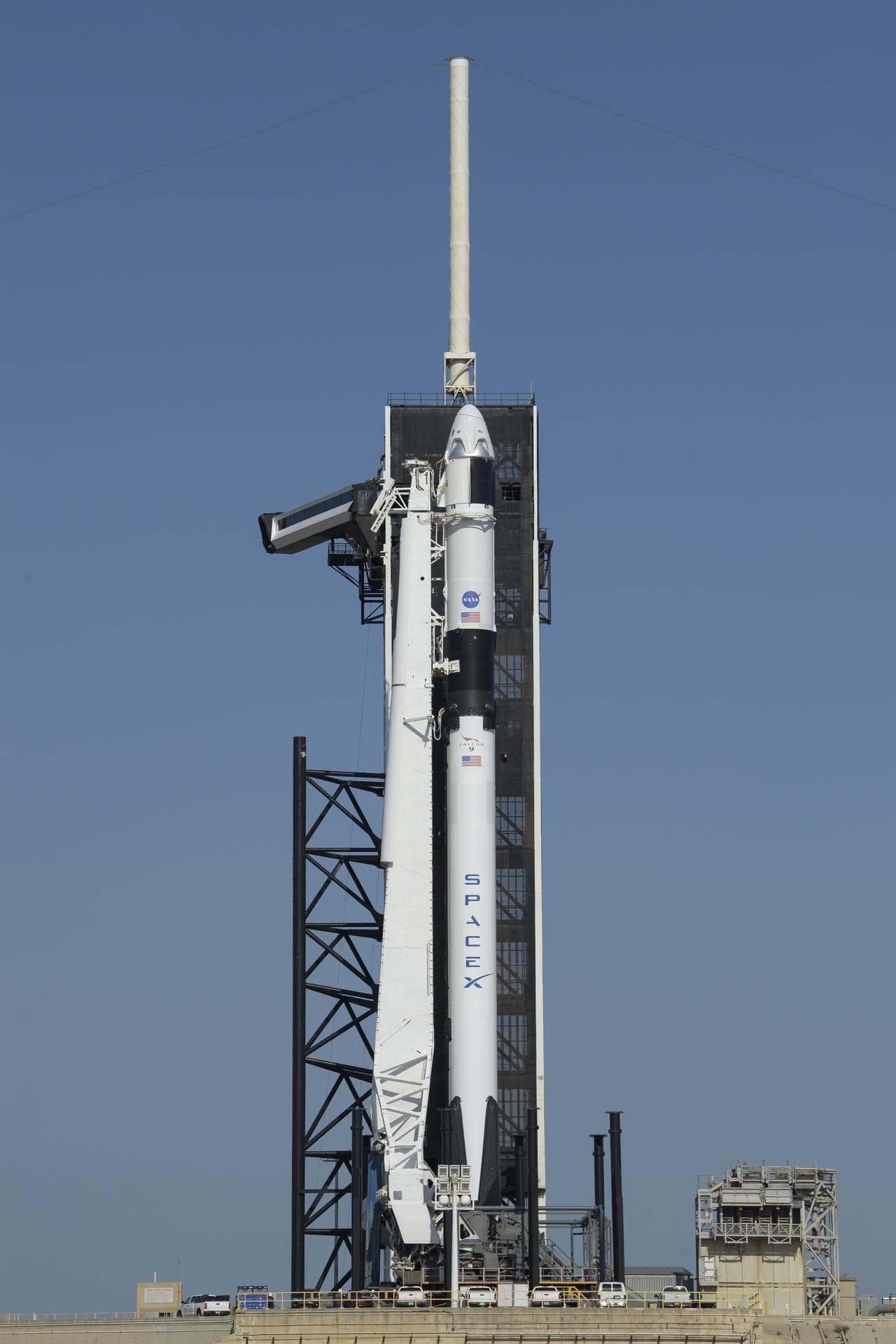
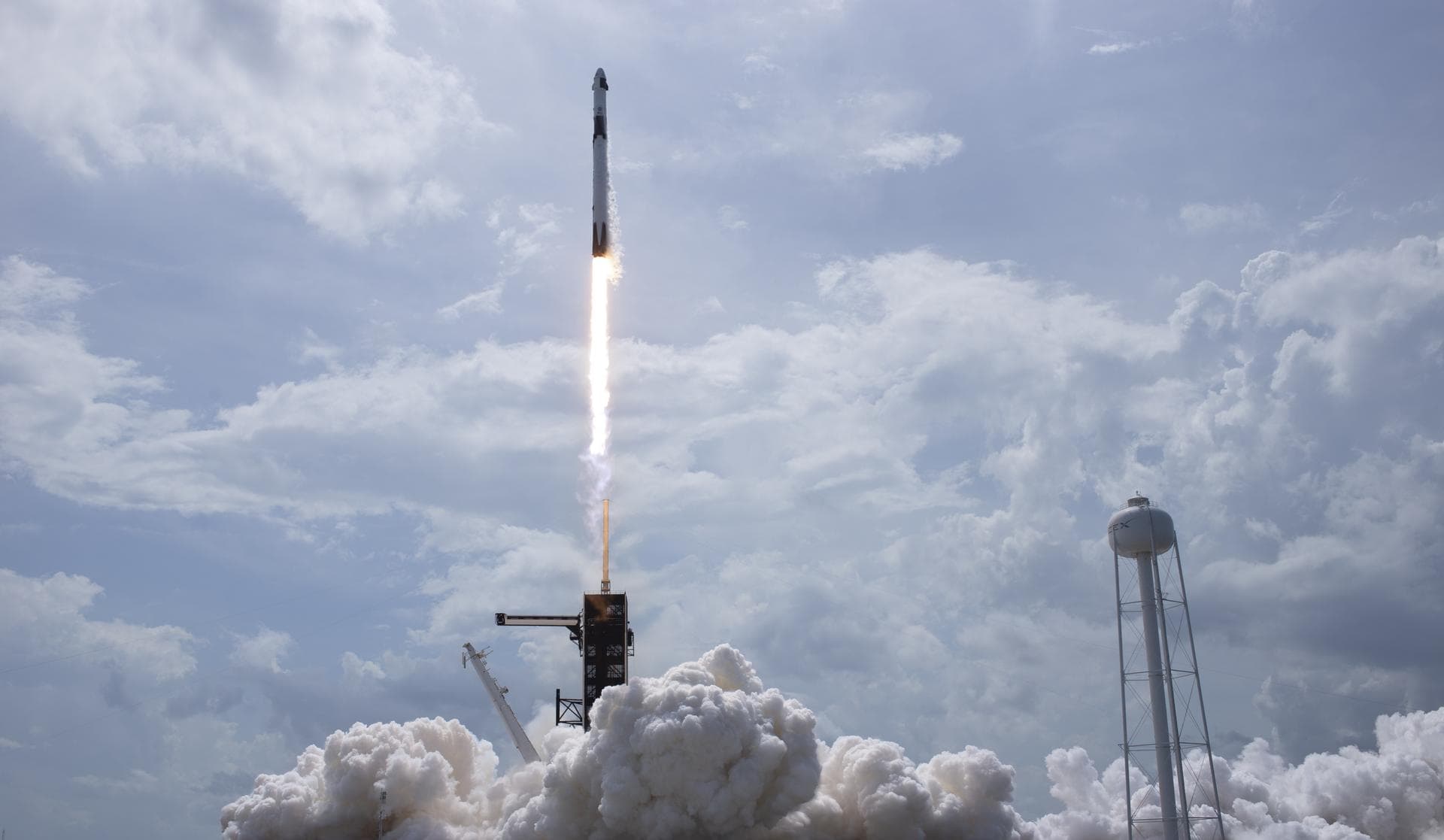
Neutron is a reusable medium-lift launch vehicle developed by Rocket Lab, designed to carry 13,000 kilograms to low Earth orbit, or 15,000 kilograms when the first stage is expended, and to land that stage back on Earth for reflight.[1] The rocket stands 43 meters tall, spans 7 meters across its base, and is built of carbon fiber composite throughout its stages and tanks, which the company says makes it the world's largest carbon composite launch vehicle.[1] Nine methane-fueled Archimedes engines power the first stage; a single vacuum-optimized Archimedes powers the second stage, which rides to orbit suspended inside the first stage rather than stacked on top of it.[1] Neutron has never flown. Rocket Lab targets a first launch from Wallops Island, Virginia no earlier than the fourth quarter of 2026, and said in August 2026 that the window for flying before the end of the year was narrowing.[2]
Neutron is Rocket Lab's step up from its small Electron rocket, aimed at satellite constellation deployment and national security missions at a price of 50 to 55 million dollars per launch.[3] The US Space Force added the rocket to its National Security Space Launch program in March 2025,[4] and NASA can order Neutron missions through its VADR launch contract.[5]
Status as of August 2026
Rocket Lab said on its August 10, 2026 earnings call that first-stage tank production remained aligned with delivering Neutron to its launch pad in the fourth quarter of 2026, though chief executive Peter Beck cautioned that the window for a launch before the end of the year was narrowing.[2][3] The Archimedes engine program had passed 400 hot fire tests by then, and the full set of flight engines for the first mission was in production.[3] Beck identified the integrated static fire of the fully fueled rocket at its Virginia pad as the highest-risk milestone still ahead of the debut.[2] That first flight is planned to carry no customer payload[6] and will end with a soft splashdown rather than a recovery attempt.[7] Bookings have kept arriving ahead of the schedule: on the day of the earnings call, Canadian satellite operator Kepler Communications signed for a dedicated Neutron launch no earlier than 2028.[8][9]
Development
Rocket Lab announced Neutron on March 1, 2021, the same day it revealed the merger that took the company public, describing an 8-ton-class rocket for constellation deployment with a first launch then targeted for 2024.[10] The US Space Force's Space Systems Command put 24.35 million dollars toward development of the rocket's upper stage that September.[11] A redesign unveiled in December 2021 gave the vehicle most of its current shape: a 7 meter carbon composite base tapering toward the top, fixed landing legs, a captive "Hungry Hippo" fairing that opens to release a lightweight expendable second stage instead of being jettisoned, and new methane-fueled Archimedes engines. At that point the first stage carried seven engines and the quoted payload was 8,000 kilograms with recovery or 15,000 kilograms expended.[12] The design later settled on nine first-stage engines and a 13,000 kilogram standard payload figure.[1] In September 2022 Rocket Lab signed a 10-year lease at NASA's Stennis Space Center in Mississippi to build the Archimedes Test Complex for engine testing.[13]
Archimedes ran for the first time on a Stennis test stand in August 2024, reaching 102 percent power on its first hot fire.[14][15] By late 2025 two stands were running engine qualification tests up to 20 hours a day, seven days a week.[6] Launch Complex 3, the rocket's dedicated pad at the Mid-Atlantic Regional Spaceport on Wallops Island, Virginia, opened on August 28, 2025 after less than two years of construction.[16][17] The Hungry Hippo fairing completed qualification on December 8, 2025, a campaign that included loading 275,000 pounds of force onto the structure to simulate maximum aerodynamic pressure and opening and closing the halves under flight-like conditions in 1.5 seconds; the hardware then shipped to Wallops, arriving in January 2026.[18][19]
The schedule has slipped repeatedly: the 2024 target at announcement[12] became mid-2025 by the time Archimedes first fired,[14] then late 2025.[20] On November 10, 2025 the company pushed the debut into 2026, saying the rocket would reach the pad in the first quarter with launch to follow.[20] Then, on January 21, 2026, a first-stage qualification tank ruptured during hydrostatic pressure testing in Maryland.[21][22] The failure traced to a hand-built joint supplied by a third party, used while Rocket Lab's own automated fiber placement machine was still being commissioned, and the company moved the replacement tank's construction in house.[21] The first flight moved to no earlier than the fourth quarter of 2026.[21]
Design and specifications
Neutron is a two-stage rocket with an unusual layout: the second stage hangs from its top flange inside the first stage's extended interstage, and the payload fairing never leaves the vehicle. Both stages are carbon fiber composite monocoque structures with common bulkhead tanks for liquid oxygen and liquid methane.[1]
| Parameter | First stage | Second stage |
|---|---|---|
| Height | 42.8 m (with captive fairing) | 11.5 m |
| Diameter | 7 m | 4.9 m |
| Structure | Carbon fiber composite monocoque | Carbon fiber composite monocoque |
| Engines | 9 Archimedes | 1 Archimedes Vacuum |
| Engine cycle | Oxidizer-rich staged combustion | Oxidizer-rich staged combustion |
| Propellant | Liquid methane / liquid oxygen | Liquid methane / liquid oxygen |
| Thrust (stage total) | 6,600 kN at sea level | 900 kN in vacuum |
| Throttle | To 65 percent minimum | To 65 percent minimum |
| Recovery | Fully reusable, fairing included | Expended each flight |
Archimedes is an oxidizer-rich staged combustion rocket engine producing up to 733 kilonewtons of thrust, with a single shaft carrying the turbine and both propellant pumps and many components 3D printed. Rocket Lab chose the cycle for its performance without the thrust limits of an expander cycle or the complexity of full-flow staged combustion, and says it runs the engine at a deliberately benign operating point so that it can be reused rapidly and reliably.[1][14] Methane gives higher specific impulse than kerosene without the bulky tanks liquid hydrogen would require,[1] and it burns without the soot that kerosene leaves in engines between flights, a factor Beck cited in choosing it for a reusable vehicle.[12]
The second stage is built as light and cheap as possible because it is thrown away every flight. Hanging it inside the interstage means it does not carry the vehicle's structural loads during ascent, and a pneumatic system pushes it out at separation.[1] Its single vacuum-optimized Archimedes can relight in space, and Rocket Lab quotes up to 2,000 kilograms on a trans-lunar injection for missions beyond Earth orbit.[1] Four forward canards and the landing gear steer the first stage during its return, and each stage flies with independent flight computers and an autonomous flight safety system.[1]
Reusability and recovery
Neutron's first stage returns from every mission as one piece, fairing and all. The two fairing halves, nicknamed Hungry Hippo, open to release the second stage and payload, close again within seconds, and reenter with the booster, so nothing needs to be fished out of the ocean or rebuilt between flights.[1][18] Rocket Lab designed the vehicle around reusability from the start, drawing on data from its Electron recovery campaign, which pulled boosters from the Pacific and reflew a recovered engine before the company shifted that effort onto Neutron.[24]
The company plans two recovery profiles: a return to the launch site, where the stage flies back and touches down on its landing gear at Launch Complex 3, and a downrange landing at sea for heavier missions.[1] Sea landings will use Return On Investment, a 122 meter modified barge being fitted out at Bollinger Shipyards in Louisiana with autonomous ground support equipment, blast shielding, and station-keeping thrusters; Rocket Lab announced the vessel in February 2025 and expected delivery in early 2026.[23] Beck has said the barge should be ready to support the second Neutron launch.[6] The first flight will attempt neither profile. The stage will instead glide back through the atmosphere and relight its engines for a soft splashdown offshore, which exercises the landing sequence without putting a platform at risk.[7]
Customers and economics
Neutron's manifest was filling well before the rocket reached its pad. NASA agreed in January 2025 to add Neutron to Rocket Lab's existing VADR (Venture-Class Acquisition of Dedicated and Rideshare) launch services contract, so the agency can order Neutron launches directly.[5] Two months later the US Space Force on-ramped Neutron to National Security Space Launch Phase 3 Lane 1, a 5.6 billion dollar pool whose task orders the company can compete for once Neutron completes a successful flight.[4] The Air Force Research Laboratory signed in May 2025 for a rocket cargo survivability experiment under its REGAL program, a mission announced for no earlier than 2026 that would use Neutron's reentry to explore point-to-point cargo delivery.[27][28]
Commercial deals have stayed mostly anonymous. A confidential satellite constellation operator signed a two-launch agreement in November 2024, with missions starting from mid-2026 and the stated potential for Neutron to deploy the operator's entire constellation.[25] In May 2026 another confidential customer signed the largest launch deal in Rocket Lab history, covering five Neutron and three Electron missions between 2026 and 2029.[26] The named bookings are more recent. An August 4, 2026 Space Force contract worth 397 million dollars has Rocket Lab building and flying its own Flatellite spacecraft for the Space-Based Airborne Moving Target Indicator program, with Neutron named as the launch vehicle, a national security mission booked before the rocket had flown.[29] On August 10, Kepler Communications booked a dedicated launch of optical relay satellites for no earlier than 2028; Kepler's earlier satellites flew as rideshares on rockets such as SpaceX's Falcon 9.[8][9] As of November 2025 the company described two fully priced Neutron missions in its backlog plus a third contract to be flown as a rideshare.[6]
Development has cost more than planned. Rocket Lab originally guided 250 to 300 million dollars for the program; its chief financial officer, Adam Spice, said in November 2025 that spending would reach about 360 million dollars through the end of that year, including roughly 15 million dollars per quarter in workforce costs.[20] On pricing, Spice said in August 2026 that Neutron came to market at an average selling price of 50 to 55 million dollars with a commitment to avoid significant discounts on early launches, and that the company saw more room for prices to rise than fall.[3]
Launch site
Neutron launches and lands at Launch Complex 3, Rocket Lab's dedicated pad at the Virginia Spaceport Authority's Mid-Atlantic Regional Spaceport on Wallops Island, Virginia.[1][16] The complex is both the launch pad and the landing zone for return-to-launch-site missions, and the company's Neutron assembly and integration building stands on the same island.[1][16] The rest of the production line is spread across the country: Archimedes engines are built in Long Beach, California, composite structures come from the Space Structures Complex in Middle River, Maryland, and engine testing runs at Stennis Space Center in Mississippi.[1]
References
- Neutron Payload User's Guide, Version 1.0 - Rocket Lab, January 2025.
- Window for 2026 launch debut of Rocket Lab's Neutron rocket 'is narrowing' as development continues - Spaceflight Now, August 10, 2026.
- Earnings call transcript: Rocket Lab Q2 2026 revenue tops forecasts, shares fall - Investing.com, August 2026.
- Rocket Lab's Neutron Rocket On-Ramped to U.S. Space Force's $5.6b National Security Space Launch (NSSL) Program - Rocket Lab, March 27, 2025.
- Rocket Lab Selected by NASA to Provide Neutron Launch Services Under VADR Launch Contract - Rocket Lab, January 2025.
- Rocket Lab delays debut of Neutron rocket to 2026 - Spaceflight Now, November 11, 2025.
- Rocket Lab's next step - Aerospace America, AIAA, March 30, 2026.
- Rocket Lab Inks Neutron Launch Deal with Kepler Communications - Rocket Lab, August 10, 2026.
- Kepler books Neutron for 2028 optical relay launch - SpaceNews, August 10, 2026.
- Rocket Lab debuts plans for a new, larger, reusable rocket for launching satellite constellations - TechCrunch, March 1, 2021.
- Rocket Lab Wins $24m U.S. Space Force Contract to Develop Neutron Upper Stage - Rocket Lab, September 27, 2021.
- Rocket Lab updates Neutron design - SpaceNews, December 2, 2021.
- Rocket Lab expands US presence with engine testing, launch facilities - TechCrunch, September 21, 2022.
- Rocket Lab Completes Successful First Hot Fire of Archimedes Engine for Neutron Rocket - Rocket Lab, August 8, 2024.
- Rocket Lab fires Archimedes engine for the first time - SpaceNews, August 2024.
- Rocket Lab Opens Launch Complex 3, A Critical Milestone On The Path To Neutron's First Launch - Rocket Lab, August 28, 2025.
- Rocket Lab inaugurates Neutron launch pad - SpaceNews, August 2025.
- Hungry Hippo Fairing Successfully Qualified: Rocket Lab Clears Significant Milestone on Path to First Neutron Launch - Rocket Lab, December 8, 2025.
- Rocket Lab's Hungry Hippo Fairing Arrives at Virginia Launch Site Ahead of First Neutron Flight - Rocket Lab, January 2026.
- Rocket Lab delays first Neutron launch to 2026 - SpaceNews, November 11, 2025.
- Rocket Lab delays Neutron debut to late 2026 - SpaceNews, 2026.
- Rocket Lab's new Neutron rocket suffers fuel tank rupture during test - Space.com, 2026.
- Rocket Lab Reveals Ocean Platform for Neutron Rocket Landings at Sea - Rocket Lab, February 27, 2025.
- Peter Beck discusses Neutron development as maiden flight nears - NASASpaceflight, October 2025.
- Rocket Lab Signs Multi-Launch Contract for Neutron with Confidential Commercial Satellite Constellation Operator - Rocket Lab, November 12, 2024.
- Rocket Lab's Biggest Launch Deal Yet: Confidential Customer Books Multiple Neutron and Electron Launches - Rocket Lab, May 2026.
- Rocket Lab Partners With U.S. Air Force for Neutron Launch for Re-Entry Mission - Rocket Lab, May 2025.
- Rocket Lab to debut point-to-point cargo transportation capability on 2026 Air Force mission - Spaceflight Now, May 10, 2025.
- Rocket Lab Awarded $397 Million Contract to Build and Launch Flatellites for U.S. Space Force's Space-Based Airborne Moving Target Indicator Program - Rocket Lab, August 4, 2026.