Valentina Vladimirovna Tereshkova (born March 6, 1937) is a Soviet-era cosmonaut, engineer, and Russian politician who became the first woman in space and remains the only woman to have flown a solo space mission.[2][8] On June 16, 1963, at age 26, she launched alone aboard Vostok 6 and completed 48 orbits of Earth over nearly three days, logging more flight time than every American astronaut combined up to that date.[1][4]
A textile factory worker who qualified for the flight through amateur parachuting rather than piloting, Tereshkova never flew in space again. She instead built a long career in Soviet public life and, since 2011, has served as a member of the Russian State Duma.[2][8]
Tereshkova is 89 years old as of mid-2026 and continues to serve as a Duma deputy for the ruling United Russia party. In April 2026 she said she intended to stand again for her home region of Yaroslavl in the State Duma election scheduled for September 18 to 20, 2026.[15]
Textile worker and parachutist
Tereshkova was born on March 6, 1937, in the village of Bolshoye Maslennikovo in the Yaroslavl region, northeast of Moscow. Her father, a tractor driver, was killed in the Soviet-Finnish Winter War in 1940, when she was two; her mother raised three children while working in a textile mill. Tereshkova left school at 16 and followed her mother into the Krasny Perekop cotton mill in Yaroslavl, continuing her education by correspondence courses.[5][6]
Her route to space opened at the local aeroclub, where she took up skydiving and made her first jump in May 1959, at age 22.[4] She was an active member of the mill's Komsomol (Young Communist League) organization, a record that later counted in her favor.[1]
Parachuting mattered more than piloting for Vostok selection, and for a specific engineering reason. The Vostok descent module had no landing rockets and touched down too hard for a cosmonaut to ride it in, so the crew member was ejected several kilometers up and came down under a separate canopy. Candidates with aviation or parachuting experience were therefore preferred, and jump experience was treated as the qualification that could not be trained away in a few months.[1][2] By the time the women's group was formed, Soviet records credited Tereshkova with 78 jumps, well behind Irina Solovyeva's 900 but ahead of Valentina Ponomareva's 10.[1]
The 1962 women's cosmonaut group
After Yuri Gagarin flew in April 1961, chief designer Sergei Korolev pushed to fly a woman next, and looked for candidates outside the all-male pool of military pilots.[2] Roughly 400 women were screened. The list was cut to 58 by January 1962, and a Mandate Commission that included Gagarin himself narrowed it to three candidates on March 3, 1962, with the formal induction orders signed nine days later and orders for two more women signed on April 3. NASA's Johnson Space Center history office instead dates the selection of the group of five to February 16, 1962.[1][2]
| Candidate | Age at selection | Background |
|---|---|---|
| Tatyana Kuznetsova | 20 | Parachutist |
| Valentina Ponomareva | 28 | Pilot with 320 flying hours, Moscow Aviation Institute graduate, Academy of Sciences mathematician |
| Irina Solovyeva | 24 | Parachutist with 900 jumps, Ural University graduate |
| Valentina Tereshkova | 24 | Textile worker and parachutist |
| Zhanna Yerkina | 22 | Parachutist |
None of the five was an air force pilot. Ponomareva was the most technically accomplished of them, and became the center of an argument when Gagarin opposed her selection because she was the only candidate with a child; Academy of Sciences president Mstislav Keldysh backed her and her name stayed on the list. Tereshkova had the weakest academic record of the group.[1] The women trained in secret at the cosmonaut training center outside Moscow, running centrifuge, pressure chamber, and vibration tests alongside weightless flights, isolation tests, and jet familiarization, and made a further 120 parachute jumps. Four passed their examinations in November 1962 and were commissioned as junior lieutenants in the Soviet Air Force.[1][4] Their names were kept secret until 1987.[2]
The original plan was to fly two women on separate Vostok capsules as early as late 1962. Delays forced a change to a single woman flying opposite a male cosmonaut, and Nikita Khrushchev made the final choice himself: Tereshkova as prime, with Solovyeva as first backup and Ponomareva as second.[2] Tereshkova was not the strongest candidate on paper, but she fitted the political brief, a mill worker from a family that had lost its father in the war.[1][2]
Vostok 6
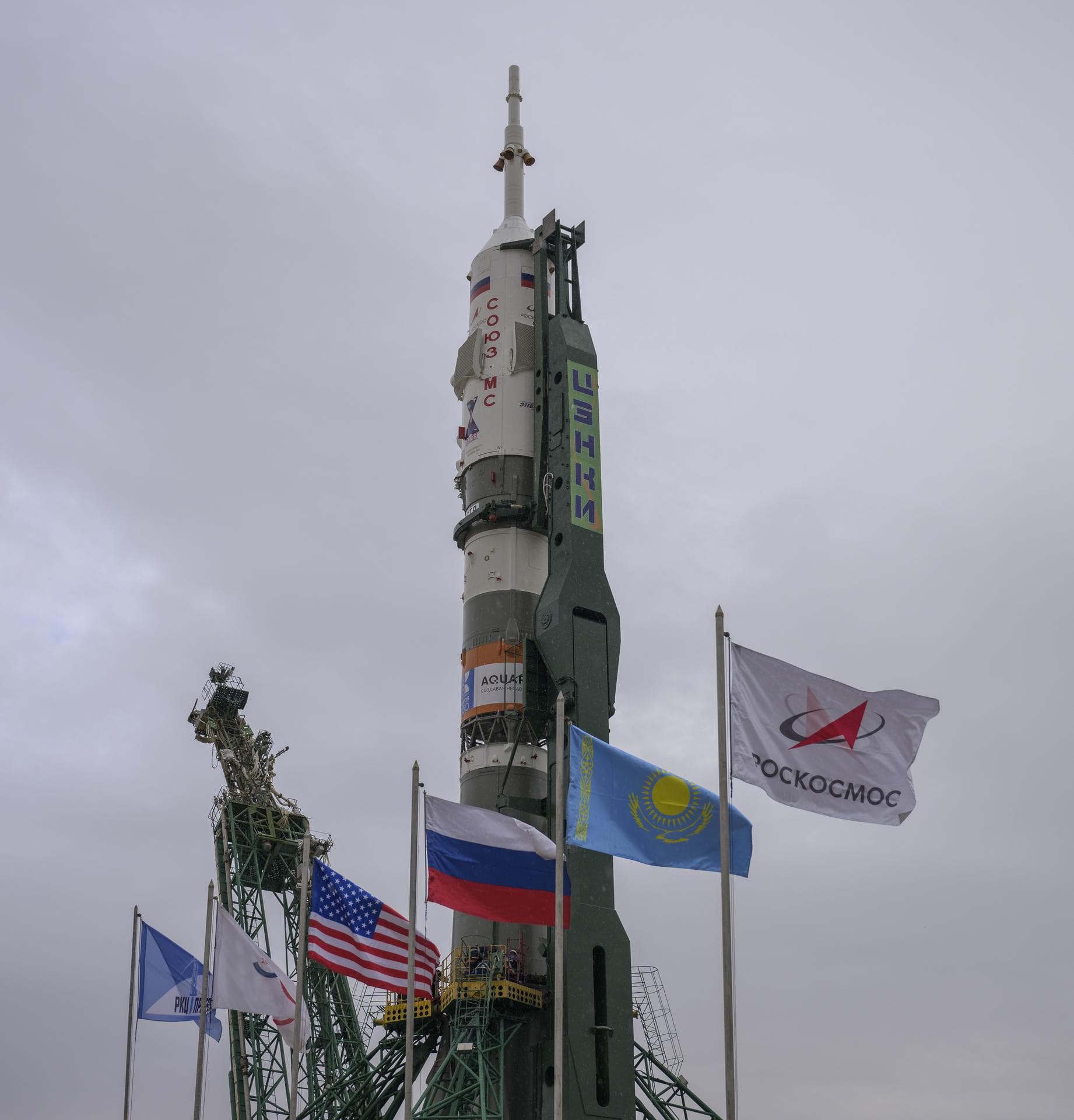
Tereshkova's Vostok 6 flew as the second half of a paired mission: Valery Bykovsky launched first, in Vostok 5, on June 14, 1963. Two days later Tereshkova lifted off from Tyuratam, the launch range later known as Baikonur, at 12:29:52 Moscow Time on June 16 under the call sign "Chaika" (Seagull), reaching an initial orbit of 180.9 by 231.1 kilometers at an inclination of 64.95 degrees.[1][2] Soviet news agencies were instructed to describe her in the launch communique as a civilian, although she had been commissioned as a junior lieutenant before the flight.[1]
The two spacecraft flew in orbital planes about 30 degrees apart and passed closest immediately after her launch, at a range of about five kilometers. They established radio contact by 13:00, and Moscow television was showing live pictures from her cabin within three hours. Bykovsky never spotted Vostok 6; Tereshkova thought she might have glimpsed Vostok 5, and both saw the spent third stage of the booster.[1]
On June 18 the State Commission fixed the landing times: Bykovsky would come down on his 82nd orbit at the end of his fifth day, and Tereshkova on her 49th orbit at the end of her third, after 48 completed orbits.[1] The main technical task assigned to her was a manual attitude control exercise, which mattered because a failure of the automatic system at reentry would have left her to orient the spacecraft by hand. Her first attempt failed. Korolev, according to control-system designer Boris Chertok, was "beside himself" and had Rauschenbach explain the landing orientation procedure again; Nikolai Kamanin had Gagarin, Gherman Titov, and Andriyan Nikolayev send up instructions.[1][3] On the morning of June 19, on her 45th orbit, she carried out a 20-minute manual orientation exercise and held the correct reentry attitude for a full 15 minutes.[1] Accounts written from Soviet records disagree on the point. NASA's history of the program notes that several otherwise reliable Russian sources indicate she never completed the orientation tests at all, while Kamanin's contemporary diaries record that she did.[1]
The order to fire the retro engine went up at 09:39:40 Moscow Time on June 19. Tereshkova then stayed silent through reentry, reporting neither the retrofire nor the separation of the spacecraft modules, and for more than two hours the control center did not know what had happened to Vostok 6. Confirmation that both cosmonauts were safe did not reach Korolev until the afternoon.[1][3] She ejected at about 6.5 kilometers altitude as designed. Contrary to her training she looked up at the canopy while descending, and a piece of metal from the upper line of her pressure helmet struck her on the nose; the resulting bruise was covered with makeup at the official ceremonies that followed.[1][7] She touched down about 620 kilometers northeast of Karaganda, in Kazakhstan, near the Altai region. Bykovsky landed roughly three hours later and 800 kilometers away.[1]
Vostok 6 flight summary
Tereshkova's only spaceflight lasted just under three days, from launch at Tyuratam on June 16, 1963 to landing in Kazakhstan on June 19, and covered 48 orbits of Earth.[1]
| Parameter | Value |
|---|---|
| Mission | Vostok 6 |
| Launch | June 16, 1963, 12:29:52 Moscow Time, Tyuratam (Baikonur) |
| Call sign | Chaika (Seagull) |
| Initial orbit | 180.9 by 231.1 km, 64.95 degrees inclination |
| Companion flight | Vostok 5, Valery Bykovsky, launched June 14, 1963 |
| Closest approach to Vostok 5 | About 5 km, on the first orbit |
| Orbits completed | 48 |
| Landing | June 19, 1963, about 620 km northeast of Karaganda, Kazakhstan |
| Duration | 2 days, 22 hours, 50 minutes to the cosmonaut's own landing; 2 days, 22 hours, 40 minutes, 48 seconds for the descent module |
Published durations for Vostok 6 vary because the two figures are measured to different events. Soviet reference works give 2 days, 22 hours, 40 minutes, and 48 seconds for the descent apparatus, while the widely quoted 2 days, 22 hours, and 50 minutes is timed to Tereshkova's own touchdown under parachute.[1]
Vostok 6 and its companion flight are easiest to tell apart by their schedules. Bykovsky launched two days before Tereshkova and stayed up about two days longer, and both cosmonauts landed on June 19, 1963, roughly three hours and 800 kilometers apart.[1]
| Vostok 5 | Vostok 6 | |
|---|---|---|
| Cosmonaut | Valery Bykovsky | Valentina Tereshkova |
| Launch | June 14, 1963 | June 16, 1963 |
| Landing orbit | 82nd | 49th, after 48 completed orbits |
| Time aloft | End of the fifth day | 2 days, 22 hours, 50 minutes |
| Landing | June 19, 1963, about three hours after Tereshkova | June 19, 1963, about 620 km northeast of Karaganda, Kazakhstan |
Health, criticism, and the programming error
Soviet officials acknowledged after Vostok 6 that Tereshkova "was not feeling so well on the first few orbits" and that the State Commission discussed cutting the flight short. Commission chairman Georgiy Tyulin raised it with her by radio; she asked that the flight not be interrupted, said she already felt better, and telemetry supported her.[1] Television pictures on June 18 nonetheless showed her tired and drawn.[1]
Her own postflight report was blunt about the hardware rather than about herself. She reported a nagging pain in her right knee from the second day, a helmet that pressed against her shoulder and left ear, sensors that itched and gave her headaches, film that was hard to remove from the camera, and biological experiment objects she could not reach. She said she vomited once and attributed it to the food rather than to any vestibular disorder.[1][7] Chertok recorded that she had had no appetite for three days and made short work of the local food laid out for her at the landing site, against medical instructions.[3] Because she also gave away the remaining rations to the villagers who reached her, doctors could not verify her account of how much she had eaten in orbit.[1]
The medical verdict went against her. Vladimir Yazdovskiy's team wrote a hypercritical report stating that she had felt poorly on the 32nd and 42nd orbits, had vomited, had a poor appetite, and had shown "weak cardiac activity". Korolev summoned her on July 11 for a private conversation whose contents were never recorded; Chertok, who had arranged a technical debriefing for the same day, described her emerging in tears after about half an hour. Korolev complained publicly that he would have to agree "one more time to launch a broad", which Chertok took as theater for the benefit of onlookers, and his deputy Vasily Mishin later said she "turned out to be at the edge of psychological stability".[1][3]
NASA's history of the Soviet program judges that the standards applied to her were not the standards applied to the men. Titov had suffered severe motion sickness on Vostok 2 and failed to complete much of his assigned work, and was never treated as a pariah; he was moved on to other space projects, while Tereshkova never flew again.[1] Chertok, whose group had designed the control system, argued at the time that manual attitude control on a Vostok was not a task requiring fighter experience and that any trained person could do it, a view the air force disputed.[3]
One element of the flight stayed hidden for decades. At a press conference at Star City on June 7, 2013, Tereshkova said that "due to a technical error, the spaceship was programmed not for a landing but for taking the ship into a higher orbit", so that the ship was moving away from Earth rather than setting up for descent. By her account she reported the discrepancy, a corrected program was sent up from the ground, and Korolev then asked her to say nothing about it. "I kept the secret for 30 years," she said. The problem was not mentioned in any Soviet account published at the time, and it rests on her own testimony.[7]
After Vostok 6
Tereshkova returned from Vostok 6 to state honors: she was named a Hero of the Soviet Union, awarded the Order of Lenin, and sent around the world as an emissary for Soviet achievements.[8] On November 3, 1963 she married cosmonaut Andriyan Nikolayev in a state wedding attended by Khrushchev, with Korolev speaking at the reception.[1][3] Their daughter Elena, born in June 1964, was the first child of two parents who had both flown in space.[2] The couple separated in 1979, but the divorce was not formalized until 1982 because it required Leonid Brezhnev's personal approval. Tereshkova later lived with the military physician Yuliy Shaposhnikov until his death in 1999.[8]
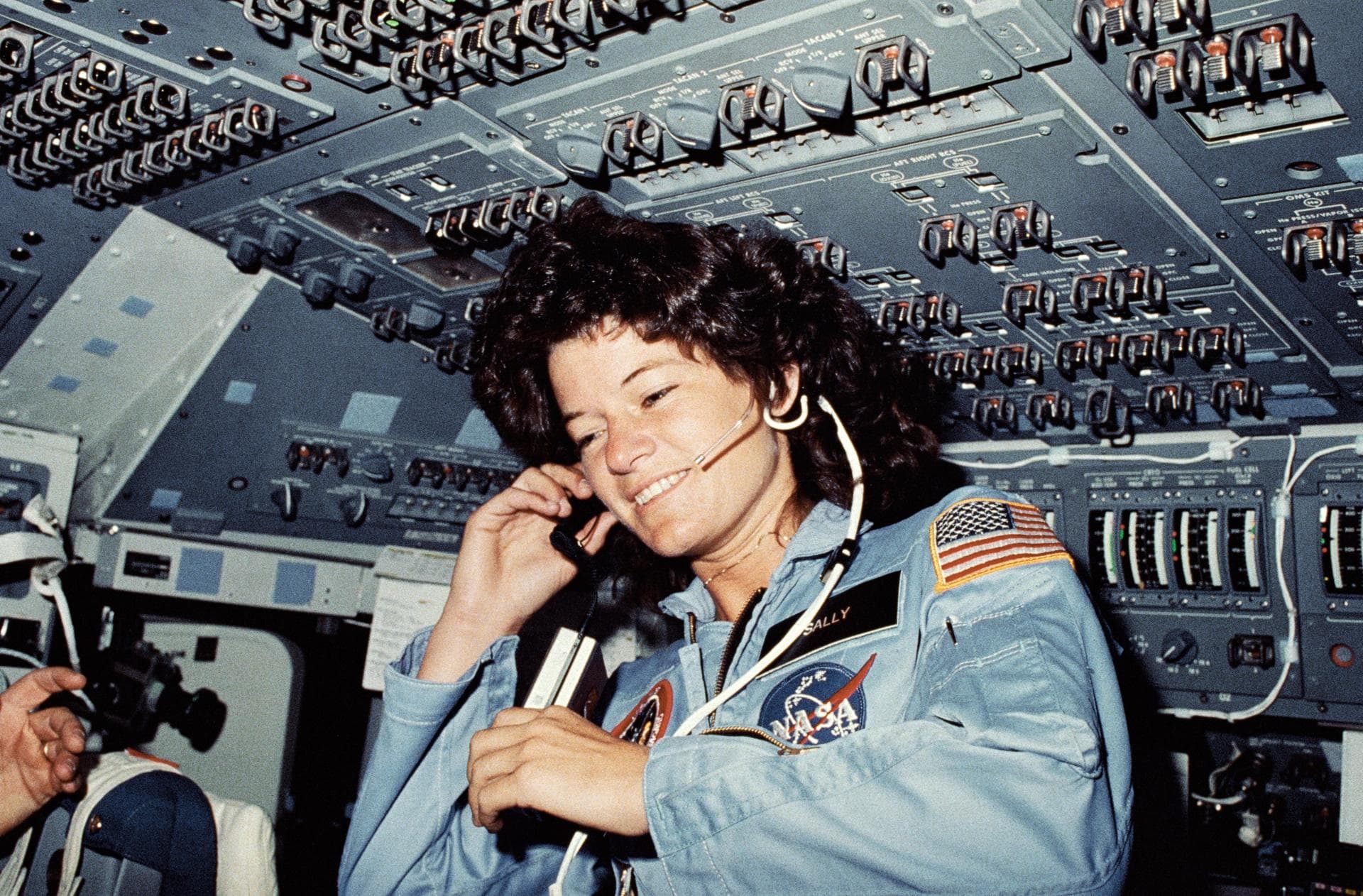
A second women's mission was considered, an all-female flight by Ponomareva and Solovyeva that would have included a spacewalk, but the plan was shelved after Korolev's death in 1966 and the female cosmonaut group was formally disbanded in October 1969.[2] No Soviet woman flew again until Svetlana Savitskaya, who launched aboard Soyuz T-7 on August 19, 1982 for a week aboard Salyut 7, nineteen years after Vostok 6.[9] The first American woman, Sally Ride, followed on June 18, 1983.[2]
Tereshkova stayed in the program in nonflying roles. She graduated from the Zhukovsky Air Force Engineering Academy in 1969 and was made an air force colonel; she completed a doctorate in engineering in 1977, rose eventually to major general, and retired in 1997.[2][3][5]
Political career
Tereshkova spent decades in Soviet public office. She became chair of the Committee of Soviet Women in 1968, vice president of the International Democratic Federation of Women in 1969, and a member of the World Peace Council; from 1971 she sat on the Communist Party Central Committee, and in 1974 she became a deputy and member of the Presidium of the Supreme Soviet as well as chair of the Soviet friendship society for relations with other countries.[3] She headed the women's committee until 1987 and remained on the Presidium until 1989.[6] After the Soviet collapse she led Russia's center for international scientific and cultural cooperation and served in regional politics in Yaroslavl.[6]
In 2011 she was elected to the State Duma for United Russia and was re-elected in 2016 and 2021. On March 10, 2020 she proposed the constitutional amendment that reset the count of presidential terms, allowing Vladimir Putin to run again and potentially remain in office until 2036; the Duma approved it the following day by 383 votes to none, with 43 abstentions.[14]
In December 2022 the European Union added her to its sanctions list, imposing an asset freeze and travel ban and citing her vote on October 3, 2022 in favor of annexing the Donetsk, Luhansk, Kherson, and Zaporizhzhia regions of Ukraine.[12] The United States Treasury had already listed her that year under Executive Order 14024 as a member of the State Duma.[13] She remains a serving deputy as of 2026.[15]
Legacy
Tereshkova's 1963 flight demonstrated, within two years of Yuri Gagarin's, that women could withstand spaceflight, even if the Soviet program treated it as a one-off propaganda victory in the Space Race rather than a policy. Her solo record stands: every woman who has flown since, on Soyuz, the Space Shuttle, Chinese missions, or commercial vehicles, has flown as part of a crew.[8] Women have remained rare in the Russian corps in particular. Anna Kikina, the only woman among Roscosmos cosmonauts when she launched in 2022, flew to the International Space Station on a SpaceX Crew Dragon under a seat-exchange agreement with NASA.[16]
A 31-kilometer crater on the far side of the Moon, centered at 28.2 degrees north and 143.8 degrees east, was named Tereshkova by the International Astronomical Union in 1970, while she was still living.[10] Minor planet 1671 Chaika, a main-belt asteroid discovered at Simeis in 1934, carries her call sign.[11] She carried the Olympic flag at the opening of the 2014 Sochi Winter Games, and a museum in her home region preserves her story.[6] In interviews she has repeatedly said she still hopes to fly to Mars, even on a one-way trip.[2][7]
References
- Challenge to Apollo: The Soviet Union and the Space Race, 1945-1974 (NASA SP-2000-4408), Part 1 - Asif A. Siddiqi, NASA History Division, 2000.
- Valentina Tereshkova and Sally Ride: Women Space Pioneers - John Uri, NASA Johnson Space Center History Office (NTRS 20180002182).
- Rockets and People, Volume III: Hot Days of the Cold War (NASA SP-2009-4110) - Boris Chertok, NASA History Division.
- First woman in space: Valentina - European Space Agency.
- Valentina Tereshkova | Biography, Vostok 6, & Facts - Encyclopaedia Britannica.
- Valentina Tereshkova | Biography - EBSCO Research Starters.
- Fifty years ago, Tereshkova became first woman in space - AFP via Phys.org, June 14, 2013.
- Valentina Tereshkova: First woman in space - Space.com.
- Svetlana Y. Savitskaya - New Mexico Museum of Space History, International Space Hall of Fame.
- Tereshkova (Moon) - Gazetteer of Planetary Nomenclature, IAU Working Group for Planetary System Nomenclature / USGS.
- 1671 Chaika (1934 TD) - JPL Small-Body Database, NASA Jet Propulsion Laboratory.
- Council Implementing Regulation (EU) 2022/2476 of 16 December 2022, Official Journal of the European Union L 322I - entry 1293.
- Specially Designated Nationals and Blocked Persons List - US Department of the Treasury, Office of Foreign Assets Control (program RUSSIA-EO14024).
- Russian Parliament Allows Putin 2 More Terms As President - NPR, March 10, 2020.
- First woman in space wants to return to the Duma at 89 - Keystone-SDA via Blue News, April 16, 2026.
- Russian cosmonaut Anna Kikina will fly on SpaceX's Crew-5 mission to the International Space Station - Space.com.