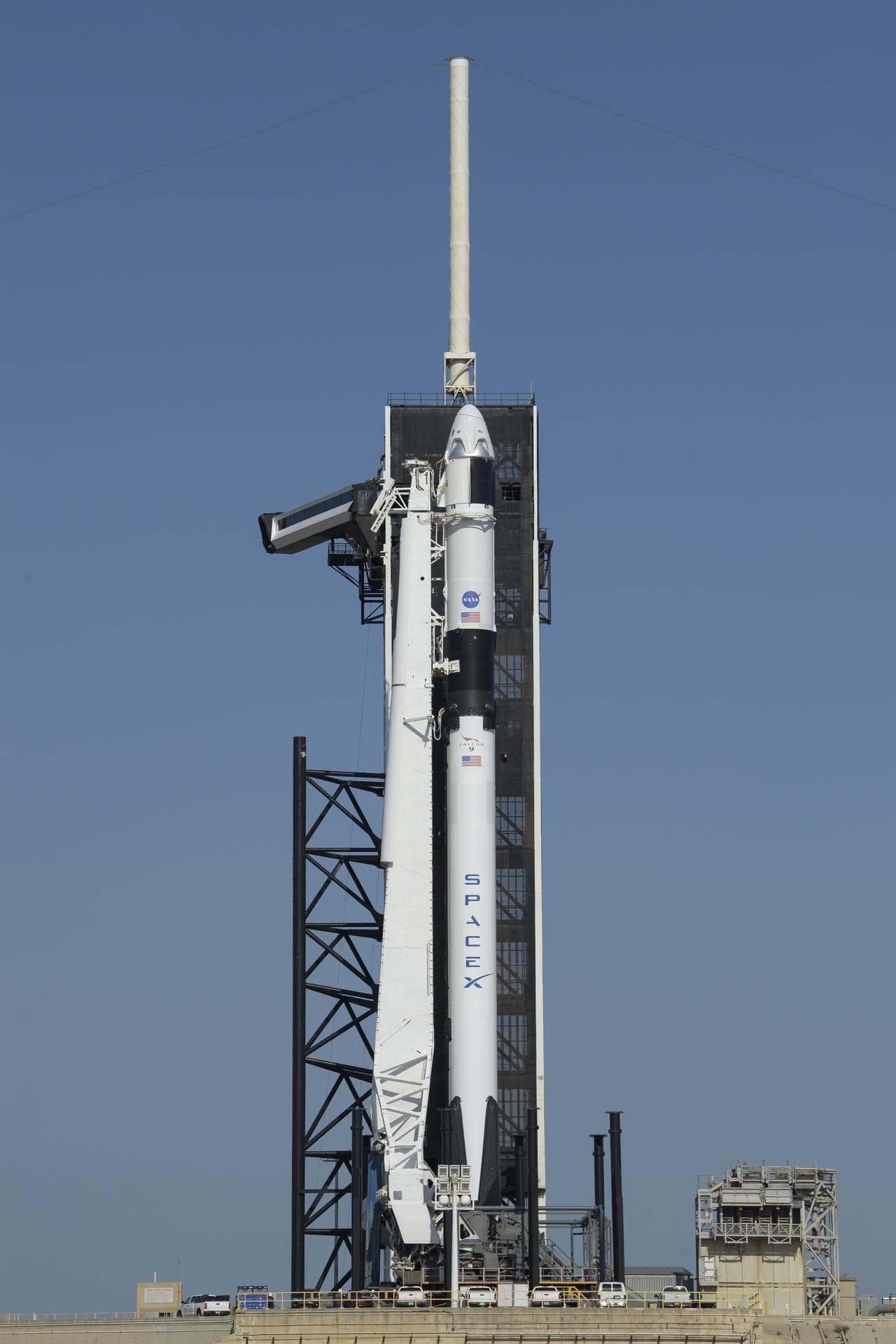
Soyuz names two different things: a family of Soviet and Russian launch vehicles and a family of crewed spacecraft. This article focuses on the rockets. During a crewed mission, a Soyuz spacecraft rides on top of a Soyuz rocket, separates after reaching orbit, and later returns its crew to Earth. The two vehicles share a name, but they have different structures and jobs.[1][5]
The active launchers are Soyuz-2.1a and Soyuz-2.1b, medium-lift descendants of the R-7 missile. They carry Soyuz crew vehicles, uncrewed Progress cargo ships, and satellites from Baikonur, Plesetsk, and Vostochny. Progress Rocket Space Centre builds the launch vehicles.[1][3]
Rocket and spacecraft are different
The distinction is easiest to see by following a crewed launch from the pad to landing.
| Name | Type | Job |
|---|---|---|
| Soyuz-2 | Three-stage expendable launch vehicle | Accelerates the payload to orbit. Its boosters, core, and third stage are discarded.[3][6] |
| Soyuz MS | Three-module crew spacecraft | Carries as many as three people in orbit. Only its descent module returns to Earth.[5] |
| Progress MS | Uncrewed cargo spacecraft | Delivers supplies and propellant to a space station. It launches on the same rocket family as Soyuz spacecraft.[1][6] |
The rocket sits below the payload fairing. On a crew mission, the fairing encloses the Soyuz spacecraft and a launch escape system is attached above it. After the rocket's third stage finishes its burn, the spacecraft separates and uses its own propulsion, navigation, docking, and life-support systems. NASA's concise description is literal: the "Soyuz capsule launches on top of a Soyuz rocket."[4][5][6]
R-7 heritage and naming
The lineage begins with Sergei Korolev's R-7 intercontinental ballistic missile. Its first three test flights in 1957 failed; the first successful flight came on August 21. A modified R-7 launched Sputnik 1 on October 4, 1957, establishing the basic booster-and-core architecture that later launchers retained.[2]
Progress Rocket Space Centre uses "Soyuz series" broadly. Its history begins that series with a three-stage R-7 derivative flown in 1963 and commonly called Voskhod. The manufacturer reserves the official Soyuz name for the 1966 modification. The first uncrewed Soyuz spacecraft, Cosmos 133, launched on November 28, 1966.[1][4]
This difference in scope matters when launch totals are quoted. Some catalogs begin with the 1963 Voskhod version, others with the official 1966 Soyuz, and still others count the entire R-7 family from 1957. Because those totals do not describe the same set of vehicles, this article does not combine them into one "Soyuz launches" figure.[1][6]
The physical layout is much less ambiguous. Four tapered strap-on boosters surround a central core, and all five engines ignite before liftoff. The boosters constitute the first stage in Russian terminology, the core the second, and a Block I stage the third. All three use kerosene and liquid oxygen.[6]
Launcher variant timeline
The table tracks the main branches without mixing their flight totals.
| Variant | First flight or introduction | Status and significance |
|---|---|---|
| Soyuz | November 28, 1966 | First officially named Soyuz launch-vehicle version; launched Cosmos 133.[1][4] |
| Soyuz-U | 1973 | Standardized workhorse for crew, cargo, and satellites; final flight was February 22, 2017.[1][7] |
| Soyuz-U2 | 1982 | Soyuz-U modification identified separately by the manufacturer.[1] |
| Soyuz-FG | 2001 | Crew launcher before Soyuz-2. Its 70th and final flight launched Soyuz MS-15 on September 25, 2019.[1][7] |
| Soyuz-2.1a | November 8, 2004 | Added digital control and support for larger fairings; remains active.[3][8] |
| Soyuz-2.1b | December 27, 2006 | Added the higher-performance RD-0124 third-stage engine; remains active.[3] |
| Soyuz-ST | October 21, 2011 | Soyuz-2 adapted for French Guiana. The 27-launch program ended after its February 10, 2022 flight.[10][11] |
| Soyuz-2.1v | December 2013 | Two-stage light version without the four R-7-style side boosters; its 13th and final flight was in February 2025.[29] |
Soyuz-2.1a replaced the earlier analog guidance system with a digital computer, a change that allowed in-flight roll control and larger fairings. Soyuz-2.1b keeps those changes and replaces the RD-0110 third-stage engine with the closed-cycle RD-0124. ESA described that engine change as a 33-second increase in specific impulse, equivalent to roughly 950 kilograms of additional payload capacity.[3][8][9]
Soyuz-FG carried the last crew launched by that version in September 2019. An uncrewed Soyuz MS test had already flown on a Soyuz-2.1a in August, and Soyuz MS-16 became the first crewed flight to use Soyuz-2.1a on April 9, 2020.[7][19]
Soyuz-2 configuration
Payload capacity depends on the launch site, orbital inclination, target altitude, fairing, and any upper stage. The figures below use the manufacturer's like-for-like case: a 3.715-meter fairing and a 200-kilometer circular orbit.[3]
| Parameter | Soyuz-2.1a | Soyuz-2.1b |
|---|---|---|
| Main stages | 3 | 3 |
| Maximum vehicle length | 46 m | 46 m |
| Third-stage engine | RD-0110 | RD-0124 |
| Baikonur payload, 51.8-degree inclination | 7,020 kg | 8,200 kg |
| Vostochny payload, 51.7-degree inclination | 7,150 kg | 8,320 kg |
| Optional upper stage | Fregat or Volga | Fregat or Volga |
The four boosters and core ignite together on the pad. The boosters separate after about two minutes, while the core continues firing. The third stage then ignites through the open lattice between the stages shortly before the core shuts down. A Fregat or Volga upper stage is an additional vehicle above those three main stages and is used for higher or more complex orbits.[3][6]
Baikonur Cosmodrome in Kazakhstan supports crew, cargo, and satellite missions. Plesetsk in northern Russia serves high-inclination orbits, while Vostochny in the Russian Far East entered Soyuz service in 2016. French Guiana was a fourth Soyuz launch site from 2011 to 2022, but it is no longer active for the vehicle.[3][7][10][11]
Soyuz spacecraft history
The spacecraft program began with the uncrewed Cosmos 133 flight on November 28, 1966. The first crewed spacecraft, Soyuz 1, launched Vladimir Komarov on April 23, 1967. Electrical-power and attitude-control problems forced an early return, and failures in the main and reserve parachute systems killed Komarov on April 24. This was a spacecraft recovery failure, not a launch-vehicle failure.[4][13]
Crewed flights resumed with Soyuz 3 in October 1968. Georgi Beregovoy rendezvoused with the uncrewed Soyuz 2 but did not dock. In January 1969, Soyuz 4 and Soyuz 5 became the first two crewed spacecraft to dock with each other, and two cosmonauts transferred between them by spacewalk.[4][14]
Soyuz 11 launched Georgi Dobrovolski, Vladislav Volkov, and Viktor Patsayev on June 6, 1971. They became the first crew to occupy a space station, Salyut 1. During return on June 30, a pressure-equalization valve opened prematurely after module separation and the cabin depressurized. All three died because they were not wearing pressure suits. Later Soyuz crews wore suits during launch and landing, initially reducing capacity from three people to two.[15]
The Apollo-Soyuz Test Project supplied the program's best-known international milestone. Soyuz 19 launched Alexei Leonov and Valeri Kubasov on July 15, 1975; an American Apollo followed the same day. The spacecraft docked on July 17 and stayed together for about two days while the crews conducted joint work.[16]
The spacecraft kept its three-part arrangement while its systems changed. NASA's catalogs distinguish the 7K-OK, 7K-T, Soyuz-T, Soyuz-TM, and Soyuz TMA generations. The first uncrewed Soyuz-T flew in 1979, Soyuz-TM in 1986, and Soyuz TMA in 2002. The first upgraded Soyuz MS, MS-01, launched on July 6, 2016 with redundant thrusters, improved power, updated rendezvous equipment, and new navigation and telemetry systems.[4][12][18]
Soyuz TM-31 carried William Shepherd, Yuri Gidzenko, and Sergei Krikalev from Baikonur on October 31, 2000. They opened Expedition 1, the first resident crew of the International Space Station.[17]
Crewed operations and escape system
After the Space Shuttle's last flight in 2011, Soyuz was the sole means of crew transportation to and from the International Space Station until SpaceX's Crew Dragon entered service in 2020. NASA and Roscosmos now exchange seats so that each station segment retains a crew member if either transportation system is temporarily unavailable.[24][31]
Current crews launch from Baikonur on Soyuz-2.1a. An escape tower can pull the spacecraft away from a failing rocket while the tower is attached; later in ascent, other abort modes are available. On October 11, 2018, a booster anomaly forced the Soyuz MS-10 ascent to be aborted. The spacecraft made a ballistic landing, and NASA astronaut Nick Hague and Roscosmos cosmonaut Alexey Ovchinin emerged safely. The event demonstrated the difference between a failed rocket and the crew capsule that survived it.[4][20]
The two fatal Soyuz missions, Soyuz 1 and Soyuz 11, were spacecraft accidents. No crew was lost in either launch. The MS-10 abort was a launch-vehicle failure, but its crew survived. Treating the rocket and spacecraft as one machine obscures that safety record.[13][15][20]
Soyuz MS-22 provided a different example in orbit. Ground teams saw coolant leaking from the docked spacecraft on December 14, 2022. Roscosmos determined that it was unsuitable for a normal crew return, though it remained available in an emergency. The replacement Soyuz MS-23 launched without a crew on February 23, 2023.[21][22]
The replacement extended the missions of NASA astronaut Frank Rubio and cosmonauts Sergey Prokopyev and Dmitri Petelin. They landed aboard MS-23 on September 27, 2023 after 371 days, then a record for the longest single spaceflight by an American.[23]
Operations since 2022
The Soyuz-ST partnership in French Guiana ended after Russia's full-scale invasion of Ukraine. ESA says the final flight took place in February 2022 and that the launcher was withdrawn from Europe's Spaceport. The Russian pads at Baikonur, Plesetsk, and Vostochny remained active.[11]
In 2025, Russia made 17 orbital launch attempts. Jonathan McDowell's annual catalog assigns 13 of them to Soyuz, four for the defense ministry and nine for Roscosmos, all classed as government launches. His report treats the December 28 Soyuz-2.1b mission as a partial success: the rocket reached orbit, but the sixth Fregat burn apparently malfunctioned and some payloads were released into the wrong orbit.[28]
Crew rotations continue alongside Progress cargo flights. Soyuz MS-28 returned NASA astronaut Chris Williams and cosmonauts Sergey Kud-Sverchkov and Sergei Mikaev on July 26, 2026 after 241 days in space.[26] Soyuz MS-29 had docked on July 14 with Pyotr Dubrov, Anna Kikina, and NASA astronaut Anil Menon aboard.[25] NASA and Roscosmos also agreed in July 2026 to continue station operations and reciprocal crew flights through 2030.[27]
Soyuz-5 project
Soyuz-5 shares the name but not the R-7 architecture. It is a new two-stage medium launcher intended to take over missions previously assigned to Zenit. Its first test flight left Baikonur on April 30, 2026 with a fixed mass simulator on a planned suborbital trajectory; Roscosmos reported the test as successful.[30]
References
- Soyuz Series - Progress Rocket Space Centre.
- Korolev and Freedom of Space: February 14, 1955-October 4, 1957 - NASA History Division.
- Soyuz-2 Launch Vehicle - Progress Rocket Space Centre.
- Crewmembers on Soyuz - NASA/SP-2010-578.
- What Is the Soyuz Spacecraft? - NASA.
- International Partner Rockets and Spacecraft - NASA.
- Chronology of Events - Progress Rocket Space Centre.
- New Soyuz model successfully launched - European Space Agency, November 9, 2004.
- RD-0124 - European Space Agency, September 30, 2004.
- Soyuz in French Guiana - CNES.
- Soyuz - European Space Agency.
- Mir Hardware Heritage - NASA Reference Publication 1357.
- NASA Engineering and Safety Center Technical Update 2020 - NASA.
- 50 Years Ago, Soviets Return Cosmonauts to Space - NASA.
- 50 Years Ago: Remembering the Crew of Soyuz 11 - NASA.
- 45 Years Ago: Historic Handshake in Space - NASA.
- Space Station 20th: Expedition 1 Crew Launches to the International Space Station - NASA.
- Crew Launches for Two-Day Ride to Station - NASA, July 6, 2016.
- NASA Astronaut Chris Cassidy Available for Interviews Before Launch - NASA, March 17, 2020.
- Statement on Soyuz MS-10 Launch Abort - NASA, October 11, 2018.
- International Space Station Operations, Soyuz Status Update - NASA, January 11, 2023.
- Uncrewed Replacement Soyuz Docks to the Space Station - NASA, February 25, 2023.
- Record-Setting NASA Astronaut, Crewmates Return from Space Mission - NASA, September 27, 2023.
- NASA extends seat barter agreement with Roscosmos into 2027 - SpaceNews, April 13, 2025.
- Soyuz Docks to Station, Hatches Open Soon for Crew Greeting - NASA, July 14, 2026.
- Soyuz MS-28 Back Home After 8 Months on ISS - SpacePolicyOnline, July 26, 2026.
- Russia Agrees to ISS Operations, Seat-Swaps, Through 2030 - SpacePolicyOnline, July 16, 2026.
- Space Activities in 2025 - Jonathan McDowell, February 4, 2026.
- Soyuz-2-1v launches first mission of 2025 - RussianSpaceWeb.
- Soyuz-5 flies its first test mission - RussianSpaceWeb.
- NASA's Management of Its Commercial Crew Program - NASA Office of Inspector General, June 25, 2026.