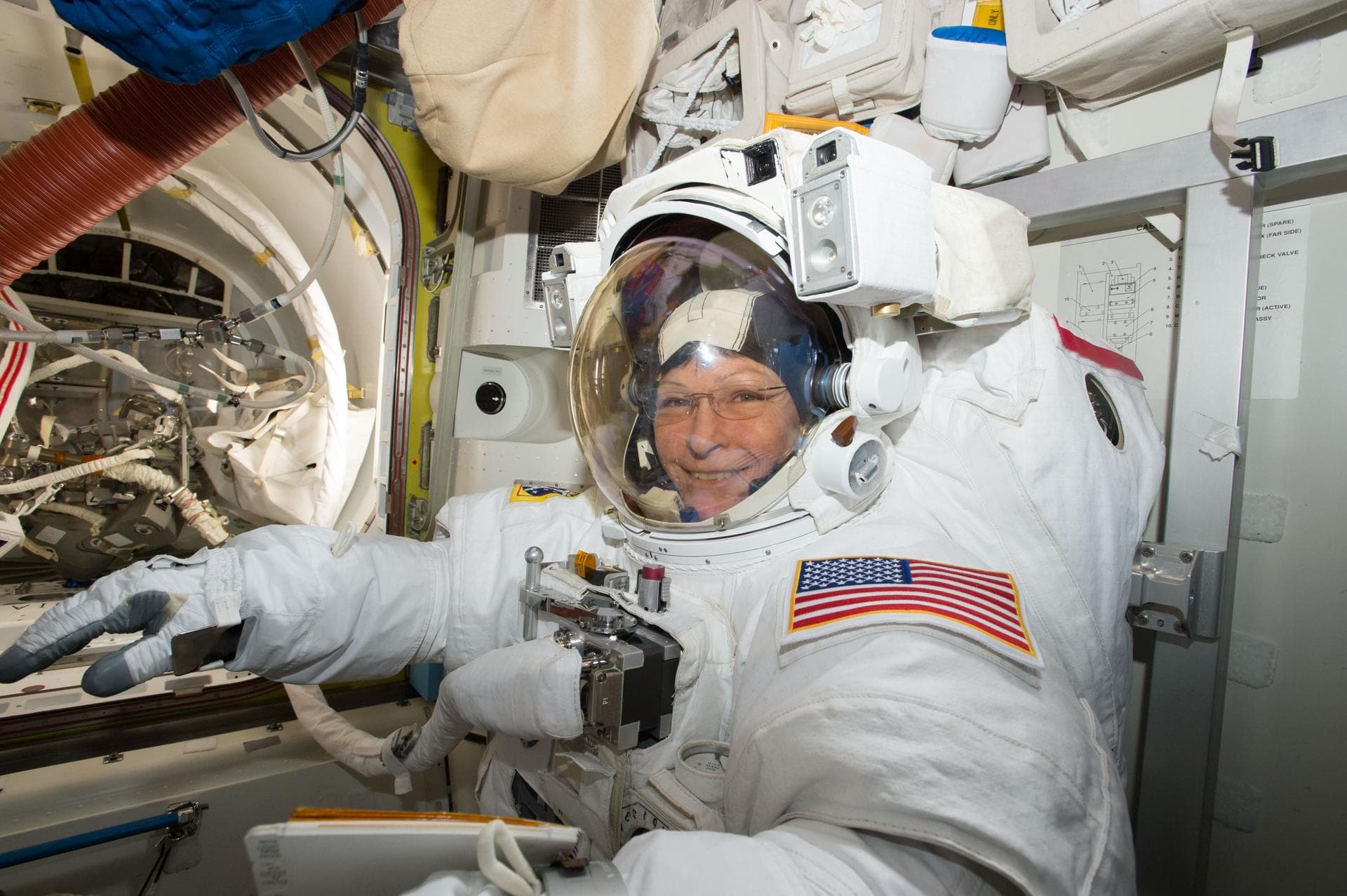
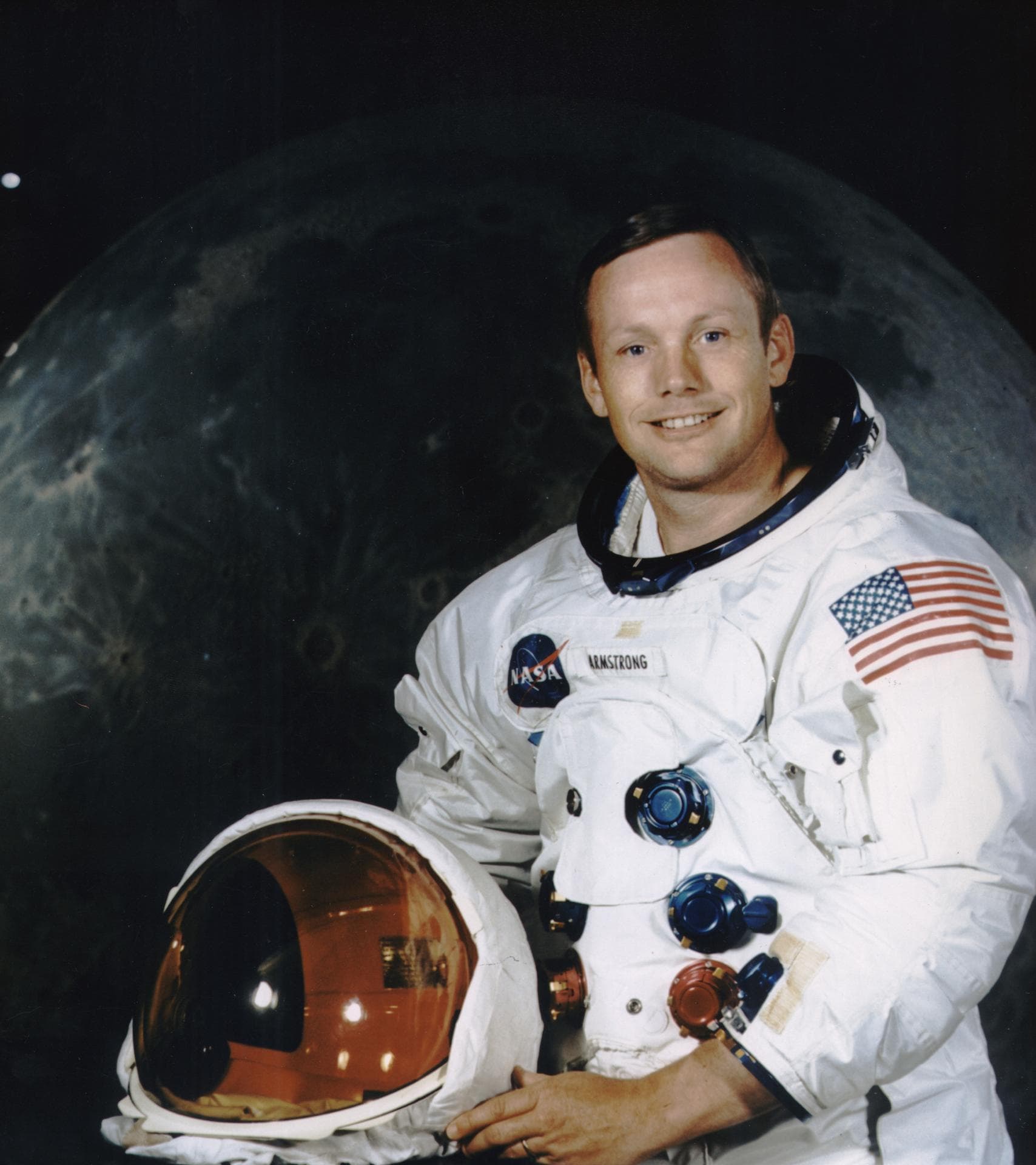
Sally Kristen Ride (1951-2012) was an American physicist and NASA astronaut who became the first American woman in space on June 18, 1983, flying as a mission specialist aboard the Space Shuttle Challenger on mission STS-7. She flew two shuttle missions, logged about 343 hours in orbit, and at 32 was the youngest American to have flown in space at that time.[1][6]
Ride operated the shuttle's robotic arm, which she had helped develop, on both of her flights, and after the 1986 Challenger disaster served on the Rogers Commission that investigated it. When the shuttle Columbia broke apart in 2003, she joined that investigation as well, making her the only person to serve on both accident boards. Her post-NASA career centered on physics teaching and on Sally Ride Science, the education company she co-founded in 2001 to draw girls into science and engineering.[1][11]
Ride died of pancreatic cancer in 2012 at age 61. Her obituary disclosed, for the first time publicly, her 27-year relationship with Tam O'Shaughnessy, making Ride the first astronaut publicly known to have been in a same-sex relationship.[1][24][32]
Education and selection
Sally Ride was born on May 26, 1951, in Los Angeles, to Dale Ride, a teacher, and Joyce Ride. She played competitive junior tennis from childhood, reached a national ranking as a junior, and worked for a time as an instructor.[1][11] She attended the Westlake School for Girls in Los Angeles on a partial tennis scholarship and graduated in 1968.[1][11]
Ride spent three semesters at Swarthmore College in Pennsylvania, studying physics and playing on the tennis, basketball, and field hockey teams, then went home to California, weighed a professional tennis career, and transferred to Stanford University in 1970.[11] At Stanford she earned bachelor's degrees in physics and English literature in 1973, a master's in physics in 1975, and a Ph.D. in physics in 1978.[1] Her dissertation, "The interaction of X-rays with the interstellar medium," went to Stanford's physics department in 1978 and is listed by NASA's High Energy Astrophysics Science Archive among the doctoral theses built on data from the Copernicus X-ray satellite.[8][9] She also worked on free-electron laser theory, co-authoring a paper with William B. Colson on the behavior of such a laser in a uniform magnetic field.[10]
In January 1977, near the end of her doctoral work, Ride saw an advertisement in the Stanford student newspaper, placed by the university's Center for Research on Women on behalf of NASA, announcing that the agency was taking astronaut applications and would accept women for the first time. She sent a handwritten note to the Astronaut Selection Office at the Johnson Space Center asking for the forms.[4] About 8,000 people applied.[6] NASA cut the field to 200 finalists, brought them to Houston in groups of twenty for a week of interviews, briefings, and medical and psychological evaluations, and told the successful candidates by telephone; Ride was woken before dawn in January 1978 by a call from George W. S. Abbey.[4] Her class, NASA Astronaut Group 8, had 35 members, 29 men and 6 women, and was the first to include women; NASA also calls it the class of 1978, and it is widely known as the Thirty-Five New Guys, or TFNG.[6][34] Ride defended her thesis in late June, drove to Houston in July, and finished the one-year training and evaluation period in August 1979.[1][4]
Her first assignments put her on the shuttle's Canadian-built Remote Manipulator System while the arm was still in development. She worked on the simulators used to check that they modeled the arm correctly, wrote the in-orbit and malfunction procedures, and traveled repeatedly to the contractor in Toronto for hardware testing. "There weren't any checklists when we started; we developed them all," she said afterwards.[4] She also flew in a T-38 chase aircraft for STS-1, helped plan Earth observations for STS-2, and served as an on-orbit capsule communicator for STS-2 and STS-3, the first woman in that job.[4][11]
STS-7: first American woman in space
NASA named Sally Ride to STS-7 in April 1982, making her the first American woman assigned to a space mission.[2] Abbey told her privately before the rest of the crew, then walked her up to center director Christopher C. Kraft, who warned her about the press attention coming and told her to ask for help.[4]
Reporters put questions to her that no male astronaut faced. She was asked whether she would need a bra in weightlessness, what she would do about menstruation, what makeup she would take, whether spaceflight would harm her ability to have children, and whether she wept when things went wrong on the job.[7][11][27] To the last of those she gestured at crewmate Rick Hauck and asked why nobody put the question to him.[12] Engineers preparing her flight kit asked whether 100 tampons was the right number for a week in orbit.[12] "It's too bad this is such a big deal," she said. "It's too bad our society isn't further along."[27]
The Soviet Union had flown Valentina Tereshkova in June 1963, during the space race, and Svetlana Savitskaya in 1982, so Ride was the third woman to reach orbit and the first American.[7]
Challenger lifted off from Kennedy Space Center's Launch Complex 39A on June 18, 1983, carrying the first five-person crew flown: commander Robert Crippen, pilot Frederick Hauck, mission specialists John Fabian and Ride, and the physician-astronaut Norman Thagard, added part-way through training to study space motion sickness. Ride flew as flight engineer, tracking the ascent checklists and standing ready with the malfunction procedures.[1][2][4]
The mission was heavy on satellite work. The crew deployed the Canadian communications satellite Anik C-2 and Indonesia's Palapa B-1, then used the robotic arm to release and recapture SPAS-01, a German-built free-flying pallet carrying ten experiments. Fabian and Ride each flew a release and retrieval cycle, the first deployment and retrieval of a satellite with the arm, and the orbiter also flew the first formation flight with a free-flying satellite.[1][2] STS-7 carried the first joint United States and German materials science payload, OSTA-2, along with the Continuous Flow Electrophoresis System, the Monodisperse Latex Reactor, and seven Getaway Special canisters.[1] A camera aboard SPAS-01 took the first full photograph of an orbiter in space; the crew spent longer than the flight plan allowed bending the arm into the shape of a 7 before the shot.[2][4]
Mary Cleave worked part of the flight as capsule communicator, the first exchange between two women on the air-to-ground loop.[2] Weather closed the planned first shuttle landing in Florida, and Challenger came down on the lakebed at Edwards Air Force Base on June 24 after 98 orbits and 6 days, 2 hours, 24 minutes in flight.[1][2]
STS-41-G: second spaceflight
Sally Ride returned to orbit on her second mission, STS-41-G, which lifted off on October 5, 1984, again aboard Challenger and again under Robert Crippen's command. Its seven members made the largest crew flown to that point. They included Kathryn Sullivan, which made this the first spaceflight with two women aboard, as well as Canada's Marc Garneau and the oceanographer Paul Scully-Power.[1][3] Ride operated the arm to deploy the Earth Radiation Budget Satellite and later used it to push a stuck Ku-band antenna panel closed. Sullivan and David Leestma made a 3 hour 29 minute spacewalk that tested plumbing for refueling satellites in orbit, with Sullivan becoming the first American woman to walk in space.[3] The flight also carried the OSTA-3 Earth observation pallet with the Shuttle Imaging Radar-B and the Large Format Camera. Challenger landed at Kennedy Space Center on October 13 after 133 orbits and 8 days, 5 hours, 24 minutes.[1][3] Across the two missions Ride logged about 343 hours in space and twice received the NASA Space Flight Medal.[1][25]
Missions
Sally Ride made two spaceflights, both aboard Challenger, totaling 14 days, 7 hours, and 48 minutes in orbit, about 343 hours.[1]
| Mission | Dates | Shuttle | Role | Duration | Notes |
|---|---|---|---|---|---|
| STS-7 | June 18-24, 1983 | Challenger | Mission specialist, flight engineer | 6 d 2 h 24 min, 98 orbits | First American woman in space; first satellite deployed and retrieved with the robotic arm; first five-person crew |
| STS-41-G | October 5-13, 1984 | Challenger | Mission specialist | 8 d 5 h 24 min, 133 orbits | Largest shuttle crew flown at the time; first flight with two women aboard; first spacewalk by an American woman |
Challenger, Columbia, and the accident boards
Sally Ride was assigned in June 1985 to the crew of shuttle mission STS-61-M. Training stopped in January 1986, after Challenger broke apart 73 seconds into launch on January 28 and its seven crew members were killed.[1][26] She served on the presidential commission that investigated the accident, the Rogers Commission, and chaired its operations subcommittee.[1][13]
The commission traced the accident to a solid rocket booster joint seal that lost resilience in cold weather. Ride pushed on the temperature question and is credited with helping expose that NASA management had known the seals could fail in the cold.[11] Donald Kutyna, the Air Force general who sat with her on the commission, said afterwards that Ride had quietly handed him a NASA document tabulating O-ring resilience against temperature, and that he steered the lead to fellow commissioner Richard Feynman in a way that protected her and her source. Her part in it became public only after her death.[26]
After the investigation Ride moved to NASA Headquarters as special assistant to the administrator for long-range and strategic planning.[1] She ran an agency-wide planning exercise that pulled ideas from every NASA center and distilled them into four candidate initiatives: robotic exploration of the solar system, Mission to Planet Earth, a permanent lunar outpost, and human exploration of Mars. The result, "Leadership and America's Future in Space: A Report to the Administrator," appeared in August 1987 and is known as the Ride Report.[5][14] Two things came directly out of it, she said later: NASA's Mission to Planet Earth and a new Office of Exploration, of which she became the first director.[5]
She left NASA in 1987 for the Center for International Security and Arms Control at Stanford, and in 1989 became a professor of physics at the University of California, San Diego, where she taught until 2007, and director of the University of California's California Space Institute, which she led until 1996.[1][29]
On March 5, 2003, NASA added Ride, the physicist Douglas Osheroff, and the space policy scholar John Logsdon to the Columbia Accident Investigation Board, then examining the loss of Columbia during reentry on February 1.[13] The board settled on foam shed from the external tank as the physical cause but also found that NASA's safety program fell short of what the shuttle needed and that schedule pressure had contributed to the accident.[28] No one else has served on both shuttle accident investigations.[1] In 2009 Ride joined the Review of U.S. Human Space Flight Plans Committee, the panel chaired by Norman Augustine that reassessed NASA's exploration plans for President Obama.[6][24]
Sally Ride Science
In 2001 Ride co-founded Sally Ride Science with Tam O'Shaughnessy, the physicist Karen Flammer, Terry McEntee, and Alann Lopes, and ran it as chief executive. The company held science festivals, trained teachers, and published classroom material aimed particularly at upper elementary and middle-school students, the age at which girls' interest in science often falls away.[1][11] Ride wrote or co-wrote several children's science books, starting with To Space and Back (1986) and continuing with a series co-authored with O'Shaughnessy that included The Third Planet, The Mystery of Mars, and Exploring Our Solar System.[1][5]
She also built student camera projects onto NASA missions. KidSat, begun while she was teaching at UC San Diego and developed with colleagues at the Jet Propulsion Laboratory, let middle-school classes command a camera aboard the shuttle; the camera later moved to the International Space Station and became EarthKAM, which NASA renamed Sally Ride EarthKAM after her death.[5][15] Sally Ride Science ran MoonKAM for the twin GRAIL orbiters, and when the two spacecraft were flown into a lunar mountain near the crater Goldschmidt on December 17, 2012, NASA named the location the Sally K. Ride Impact Site.[16]
The organization moved to UC San Diego in 2015 and now runs as a nonprofit inside the university's Division of Extended Studies, with O'Shaughnessy as executive director. It marked 25 years in March 2026 and reached nearly 800 students in kindergarten through eighth grade in its summer program alone.[11][23]
Death and personal life
Sally Ride was diagnosed with pancreatic cancer in 2011 and died on July 23, 2012, at her home in La Jolla, California, at 61, after a 17-month illness.[24][25] She had been married to fellow astronaut Steven Hawley from 1982 to 1987.[25]
NASA's own biography of Ride, issued the month she died, opened its list of survivors with "Tam O'Shaughnessy, her partner of 27 years."[1] The obituary Ride approved in her final weeks did the same, disclosing publicly for the first time a relationship with a woman she had first met as a girl on the junior tennis circuit. O'Shaughnessy, a professor emerita of school psychology, was also her business partner, and the two registered as domestic partners in California during Ride's illness.[12][30] O'Shaughnessy later said Ride told her it was all right to be open about the relationship shortly before she died.[31] A 2025 National Geographic documentary, Sally, directed by Cristina Costantini and built around O'Shaughnessy's account, brought the story to a wider audience; it began streaming on Disney+ and Hulu in June 2025.[32]
Legacy
President Obama awarded Ride the Presidential Medal of Freedom posthumously on November 20, 2013, with O'Shaughnessy accepting on her behalf.[17] She had already been inducted into the National Women's Hall of Fame and the Astronaut Hall of Fame, and had received the Jefferson Award for Public Service, the von Braun Award, the Lindbergh Eagle, and the NCAA's Theodore Roosevelt Award.[1]
The Navy research vessel R/V Sally Ride (AGOR 28) was christened at Anacortes, Washington, on August 9, 2014, with O'Shaughnessy breaking the bottle as sponsor; it was the first ship in the national academic research fleet named for a woman. Built by Dakota Creek Industries, it was delivered to the Scripps Institution of Oceanography on July 1, 2016, and Scripps operates it under charter from the Office of Naval Research.[18][19] The Postal Service issued a Sally Ride Forever stamp on May 23, 2018, dedicating it at UC San Diego.[20] The U.S. Mint's Sally Ride quarter, the second design in the American Women Quarters series, went into circulation in 2022.[21] Northrop Grumman named its NG-18 Cygnus cargo ship S.S. Sally Ride and launched it toward the space station on November 7, 2022.[22] NASA also created a Sally Ride Internship in her name.[15]
NASA's astronaut corps, all male until her class, is now routinely mixed. The Artemis program crew that flew around the Moon on Artemis II, launching April 1, 2026 and splashing down on April 10, included Christina Koch as mission specialist.[33] Asked in 2002 what she thought her legacy would be, Ride said: "Certainly my most significant legacy will be that I was the first American woman to go into space."[5]
References
- Biographical Data: Sally K. Ride (Ph.D.), NASA Astronaut (Deceased) - NASA Lyndon B. Johnson Space Center, July 2012.
- 40 Years Ago: STS-7 and the Flight of Sally Ride - NASA History.
- 40 Years Ago: STS-41G, A Flight of Many Firsts and Records - NASA History.
- Sally K. Ride oral history transcript, October 22, 2002 - NASA Johnson Space Center Oral History Project.
- Sally K. Ride oral history transcript 2, December 6, 2002 - NASA Johnson Space Center Oral History Project.
- Sally Ride (1951-2012) - NASA Science.
- Sally Ride and Valentina Tereshkova: Changing the Course of Human Space Exploration - NASA History.
- The interaction of X-rays with the interstellar medium (catalog record for Sally Kristen Ride's 1978 Ph.D. thesis) - Stanford University Libraries.
- Copernicus Ph.D. theses bibliography - NASA High Energy Astrophysics Science Archive Research Center.
- A free-electron laser in a uniform magnetic field - S. K. Ride and W. B. Colson, Applied Physics.
- Dr. Sally Ride - UC San Diego Division of Extended Studies.
- Happy Birthday, Sally Ride! Here Are 25 Things You Might Not Know About the Trailblazing Astronaut - UC San Diego Today.
- New Members Added to the Columbia Accident Investigation Board - NASA, March 5, 2003.
- Leadership and America's Future in Space: A Report to the Administrator - Sally K. Ride, NASA, August 1987.
- NASA and the White House Pay Tribute to Sally Ride - NASA.
- NASA's GRAIL Lunar Impact Site Named for Astronaut Sally Ride - NASA Jet Propulsion Laboratory.
- Remarks by the President at Presidential Medal of Freedom Ceremony, November 20, 2013 - The White House.
- Navy, Scripps Christen R/V Sally Ride - Scripps Institution of Oceanography, UC San Diego.
- R/V Sally Ride - Scripps Institution of Oceanography, UC San Diego.
- Sally Ride Stamp Launches Tomorrow - United States Postal Service, May 2018.
- United States Mint Begins Shipping American Women Quarters Program Coins Honoring Dr. Sally Ride - U.S. Mint, March 2022.
- Northrop Grumman's S.S. Sally Ride cargo ship launches on flight to International Space Station - Spaceflight Now, November 7, 2022.
- 25 Years of Courage and Curiosity: Sally Ride Science at UC San Diego Division of Extended Studies - UC San Diego Today, March 2026.
- Sally Ride, First U.S. Woman in Space, Succumbs to Cancer - SpaceNews.
- Sally Ride, America's first woman in space, dies after bout with cancer - CBS News.
- Sally Ride - Encyclopaedia Britannica.
- Biography: Sally Ride - National Women's History Museum.
- Columbia Accident Investigation Board Synopsis - NASA History.
- Sally Ride, First American Woman in Space and Former California Space Institute Director, Dies at 61 - UC San Diego Today, July 2012.
- Sally Ride Kept Her Love Story Private. Her Partner Shares the Truth in a New Documentary - Biography.com.
- Sally Ride told her partner it was OK to come out 10 days before her death - The Advocate.
- Nat Geo documentary 'SALLY,' about the 1st US woman in space, now streaming on Disney+ and Hulu - Space.com.
- Christina Koch - NASA.
- 1978 Astronaut Class - NASA.