The Space Race was the Cold War spaceflight competition between the United States and the Soviet Union, dated from rival satellite announcements in 1955 to the joint Apollo-Soyuz docking in July 1975.[21] The Soviet Union orbited Sputnik 1, the first artificial satellite, on October 4, 1957,[1] and the United States won the defining prize on July 20, 1969, when the roughly 25.8-billion-dollar Apollo program[12] landed Apollo 11 on the Moon.
The competition began as an extension of the nuclear arms race, since the same rockets that could orbit a satellite could deliver a warhead, and became a proxy contest over which political system could master the most demanding technology of the age. The Soviet Union dominated the early scoreboard of firsts, the United States took the crewed lunar landing, and both countries ended the period with capabilities, institutions, and industries that still shape spaceflight. Half a century later, the vocabulary of the era has returned in a slower-moving lunar competition between the United States and China.
Origins
The American and Soviet rocket programs both grew out of the same machine, Germany's V-2 missile. The V-2, developed under Wernher von Braun at the secret Peenemunde site on the Baltic coast and first launched successfully in October 1942, was a liquid-propellant missile about 14 meters long that flew faster than 5,600 kilometers per hour and was fired at western European targets from September 1944. It was assembled at the underground Mittelwerk plant using prisoners from the attached Mittelbau-Dora concentration camp; von Braun knew the conditions there and took part in decisions about the use of forced labor.[2] When Germany surrendered, about 125 German engineers including von Braun went to the United States under Project Paperclip, worked on guided missiles at Fort Bliss in Texas and launched captured V-2s at White Sands, then moved in 1950 to Redstone Arsenal at Huntsville, Alabama.[2] The Soviet Union took the Nordhausen production plant and part of the German workforce, and the captured missile became the blueprint for its first large liquid-fueled rocket, the R-1, built under Sergei Korolev at the OKB-1 design bureau and flown to its target area from Kapustin Yar on October 10, 1948.[3]
On July 29, 1955, the White House announced that the United States would launch a small scientific satellite during the International Geophysical Year of 1957-1958; Moscow declared its own satellite plans within days. Behind the scientific framing sat military programs: both nations were racing to field intercontinental ballistic missiles. The Soviet R-7, designed under Korolev, flew the length of its test range on August 21, 1957 after three failures earlier in the year, although the dummy warhead broke up during reentry, and Moscow announced the missile on August 27.[4] Korolev's identity was a state secret, and he was publicly known only as the Chief Designer. In the United States, the Army, Navy, and Air Force ran competing rocket projects: the civilian satellite assignment sat with the Navy's Vanguard,[5] while von Braun's Army group at Huntsville built the Redstone and Jupiter ballistic missiles.[2]
Sputnik and the shock of 1957
On October 4, 1957, a Soviet R-7 rocket placed Sputnik 1, an 83.6-kilogram polished sphere and the first artificial satellite, into orbit, where its radio beeps could be picked up by amateur operators around the world. Its batteries ran down on October 26 and the satellite reentered on January 4, 1958.[1] The launch stunned the American public: it announced that Soviet rockets could reach any point on Earth and punctured assumptions of US technological superiority. A month later Sputnik 2 carried the dog Laika, the first animal in orbit, on a one-way flight. At about 508 kilograms it was six times the mass of Sputnik 1, and a further demonstration of how much the R-7 could lift.[1]
The first US response failed in full view of television cameras. Vanguard TV-3 rose roughly a meter on December 6, 1957 before its main engine lost thrust, then fell back onto the pad and exploded; the press called it Flopnik and Kaputnik.[5] Von Braun's team then orbited Explorer 1 on a Jupiter C on January 31, 1958.[2] Its Geiger counter, designed by James Van Allen, registered radiation about a thousand times higher than anyone expected and then stopped counting at greater altitudes, a saturation effect that turned out to be two belts of charged particles trapped in Earth's magnetic field.[6] The Van Allen belts were the first major scientific discovery of the space age. Institutional responses followed within a year: the creation of NASA, which opened for business on October 1, 1958 after President Eisenhower signed the National Aeronautics and Space Act that July, the defense research agency now known as DARPA, and a federal education act aimed at science and engineering.[1]
The scoreboard of firsts
The major firsts of the Space Race ran from Sputnik 1 in October 1957 to Salyut 1, the first space station, in April 1971, with the Soviet Union holding most of the early entries and the United States the later ones on the way to the Moon.
| Milestone | Date | Mission | Nation |
|---|---|---|---|
| First artificial satellite | October 4, 1957 | Sputnik 1 | Soviet Union |
| First animal in orbit | November 3, 1957 | Sputnik 2 (Laika) | Soviet Union |
| First lunar flyby and impact | January and September 1959 | Luna 1, Luna 2 | Soviet Union |
| First images of the Moon's far side | October 1959 | Luna 3 | Soviet Union |
| First human in space | April 12, 1961 | Vostok 1 (Yuri Gagarin) | Soviet Union |
| First American in space | May 5, 1961 | Freedom 7 (Alan Shepard) | United States |
| First successful mission to another planet | December 14, 1962 | Mariner 2 (Venus) | United States |
| First woman in space | June 16, 1963 | Vostok 6 (Valentina Tereshkova) | Soviet Union |
| First spacewalk | March 18, 1965 | Voskhod 2 (Alexei Leonov) | Soviet Union |
| First soft Moon landing (uncrewed) | February 3, 1966 | Luna 9 | Soviet Union |
| First crewed orbital docking | March 16, 1966 | Gemini 8 | United States |
| First humans to orbit the Moon | December 1968 | Apollo 8 | United States |
| First crewed Moon landing | July 20, 1969 | Apollo 11 | United States |
| First space station | April 19, 1971 | Salyut 1 | Soviet Union |
The Soviet Luna probes set the early pace. Luna 1 launched on January 2, 1959 and missed the Moon by about 6,400 kilometers, becoming the first spacecraft to enter solar orbit; Luna 2 launched on September 12 and became the first object from Earth to reach the surface of another body; and Luna 3 launched on October 4 and returned 29 photographs covering roughly 70 percent of the far side, a hemisphere no one had ever seen.[7]
The pattern in the table is real but partly misleading. Soviet firsts often depended on accepting risks and improvisations that did not build toward a lunar capability, while the US Gemini program of 1965-1966 systematically rehearsed the rendezvous, docking, spacewalking, and endurance skills Apollo would need.[9]
Capsules and rehearsals
The United States and the Soviet Union each worked through a sequence of spacecraft rather than one design, but the sequences were built to different ends. The Soviet capsules were quick to field and good at collecting firsts; the American ones were commissioned one after another with a specific destination in mind.
| Program | Years | What it established |
|---|---|---|
| Vostok (USSR) | 1961-1963 | A one-cosmonaut capsule that carried the first human and the first woman into orbit |
| Mercury (US) | 1961-1963 | Six crewed flights that put Americans into space, then into orbit, and proved crew and capsule recovery |
| Voskhod (USSR) | 1964-1965 | A modified Vostok flown with a multi-person crew and used for the first spacewalk |
| Gemini (US) | 1965-1966 | Ten crewed flights covering orbital rendezvous, docking, spacewalking, and 14-day endurance |
| Soyuz (USSR) | 1967 onward | The spacecraft built for Soviet lunar work, and still flying half a century later |
| Apollo (US) | 1968-1972 | Lunar orbit, six landings, and the Saturn V |
The Soviet sequence produced firsts quickly. Vostok carried Gagarin in April 1961 and, in June 1963, Valentina Tereshkova through 48 orbits over nearly three days,[10] more time in orbit than the entire Mercury program accumulated, which came to 53 hours, 55 minutes, and 27 seconds across six flights.[8] The American sequence was slower and more specific. Mercury's stated objectives were narrow: place a crewed spacecraft in orbit, find out how well a person could function there, and recover both safely.[8] Gemini then took on the parts of a lunar mission nobody had attempted, with Gemini VIII making the first docking between two spacecraft, Gemini VII spending 14 days in orbit, and Gemini IV carrying the first American spacewalk.[9] By the time Apollo flew, the untested elements left were the ones unique to the Moon.
The Moon race and why the Soviets lost it
After Yuri Gagarin orbited the Earth on April 12, 1961, President John F. Kennedy asked Congress on May 25, 1961 to commit the country to "landing a man on the moon and returning him safely to the earth" before the decade was out. Gagarin was not his only reason: Alan Shepard's May 5 flight had been suborbital, the Bay of Pigs landing had failed in April, and the Moon was a goal on which the United States could plausibly start level. Kennedy asked for 531 million dollars in the coming fiscal year and seven to nine billion more over five years.[11] The Apollo program that followed cost about 25.8 billion dollars between 1960 and 1973, roughly 309 billion in 2025 terms, and absorbed three of every five dollars NASA spent in those years, with annual spending peaking in 1966.[12] It employed about 400,000 people, among them mathematicians such as Katherine Johnson, who verified trajectory calculations.
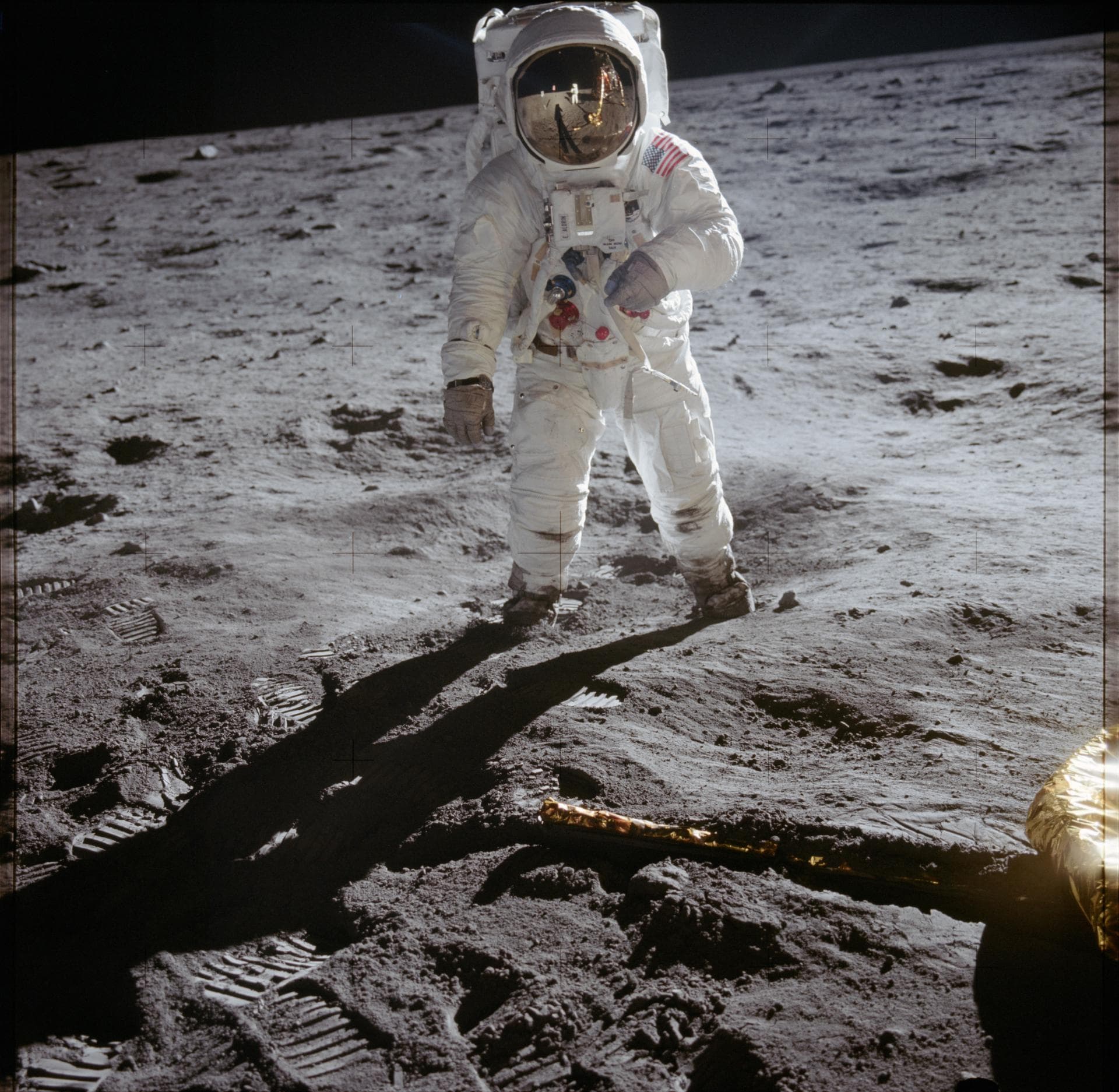
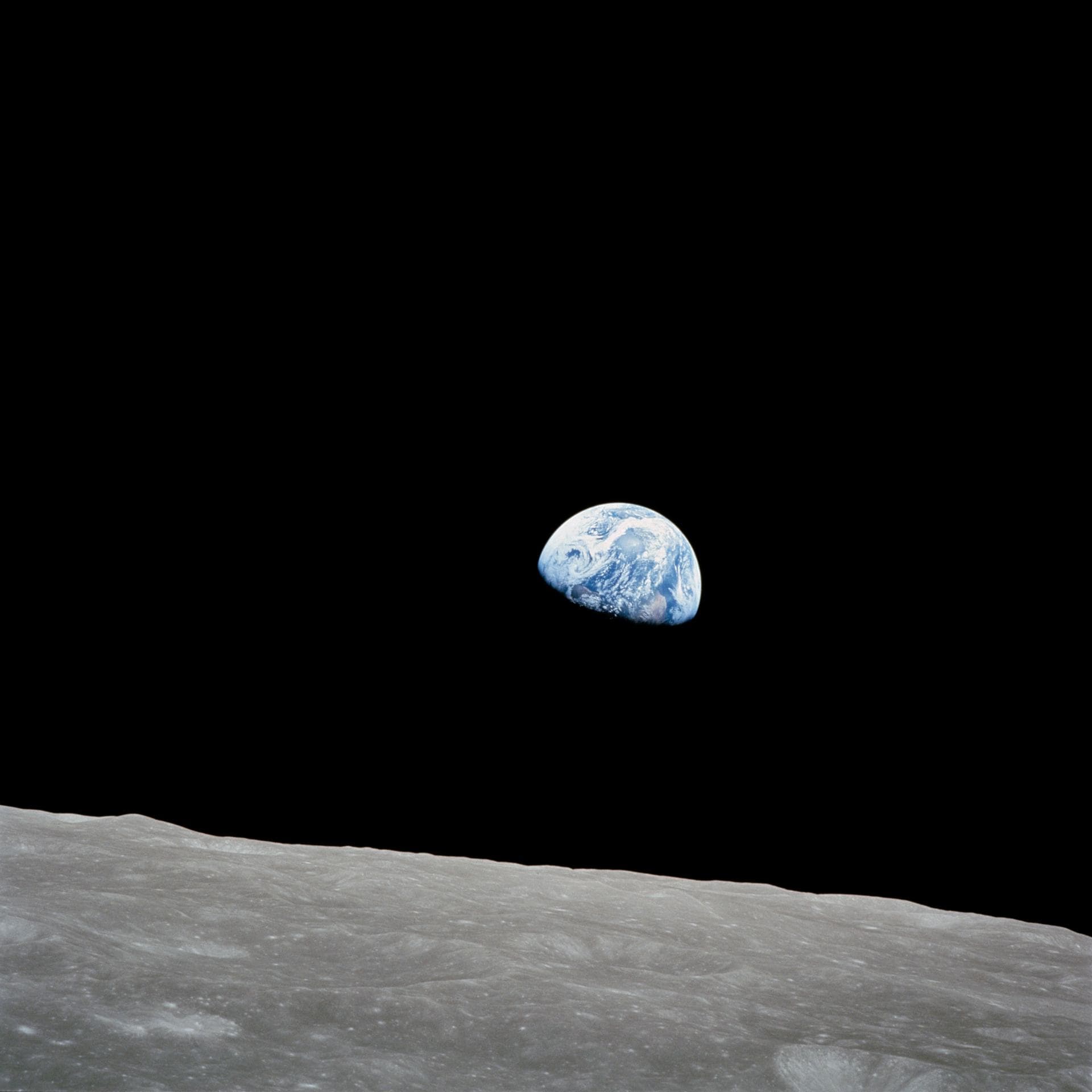
The program's worst day came before any Apollo spacecraft flew. A fire swept the command module during a launchpad test at Cape Kennedy on January 27, 1967, killing Virgil Grissom, Edward White, and Roger Chaffee; the investigation and redesign that followed suspended crewed launches for close to a year.[14] The Saturn V built for the program then flew 13 times without a launch failure. Apollo 8 entered lunar orbit on December 24, 1968 with Frank Borman, Jim Lovell, and Bill Anders aboard, the first crewed mission to orbit the Moon, and returned on December 27.[13] Apollo 11 landed Neil Armstrong and Buzz Aldrin at Tranquility Base on July 20, 1969, and five more landings followed through 1972.
The Soviet lunar program lost for reasons historians can now document from the Soviet archives opened in the 1990s.[16] It started late, receiving formal approval only in 1964, three years after Kennedy's speech.[17] It was split among rival design bureaus, with Korolev and Vladimir Chelomei running competing programs, and the N1 Moon rocket's engines came not from Valentin Glushko, the established Soviet rocket propulsion designer, but from Nikolai Kuznetsov's aviation engine bureau. The first stage flew with 30 comparatively small NK-15 engines, a cluster whose plumbing proved impossible to test as an integrated stage on the ground.[17] Korolev, the program's driving force, died during surgery in January 1966. The N1 then failed on all four launch attempts, on February 21, 1969, July 3, 1969, June 27, 1971, and November 23, 1972.[17]
The second attempt was the worst. A liquid-oxygen turbopump exploded a fraction of a second before liftoff, the vehicle's control system shut down all but one engine, and the rocket reached roughly 200 meters before falling back and destroying the launch pad at Site 110. Debris landed as far as 10 kilometers away and windows broke 40 kilometers from the site, although only about 15 percent of the propellant on board actually detonated and nobody was killed.[18] The program was cancelled in May 1974 and officially denied for another 15 years, while Soviet publicity insisted there had never been a Moon race at all. The Soviet Union redirected its effort toward space stations, launching Salyut 1, the world's first, on April 19, 1971.[15]
Luna 15 and the robotic race
The US-Soviet competition did not stop at the crewed Moon landing. On July 13, 1969, three days before Apollo 11 lifted off, the Soviet Union launched Luna 15, a robotic lunar sample return mission, on a Proton rocket; it entered an elliptical lunar orbit on July 17 while Apollo 11 was still in transit.[19] The aim was to scoop lunar soil robotically and get it back to Earth, an achievement the Soviet Union could still have claimed even after the astronauts landed. Luna 15 completed 52 lunar orbits and then fired its retrorocket to begin the descent. Signals stopped four minutes later, and the spacecraft is believed to have crashed in Mare Crisium about 800 kilometers from Tranquility Base at an estimated 480 kilometers per hour, on the same day Armstrong and Aldrin lifted off from the surface.[20]
Apollo-Soyuz and the end of the race
The Apollo-Soyuz Test Project of July 1975 brought detente into orbit, on groundwork laid three years earlier. On May 24, 1972, President Richard Nixon and Soviet Premier Aleksei Kosygin signed an agreement on cooperation in the exploration and use of outer space for peaceful purposes that committed both sides to a joint docking mission, exchanges of lunar samples, and joint work in space biology and medicine. Because the two spacecraft used different cabin atmospheres, NASA contracted North American Rockwell to build a docking module that doubled as an airlock, and the Soviet engineer Vladimir Syromyatnikov designed an androgynous docking system that either vehicle could initiate.[22]
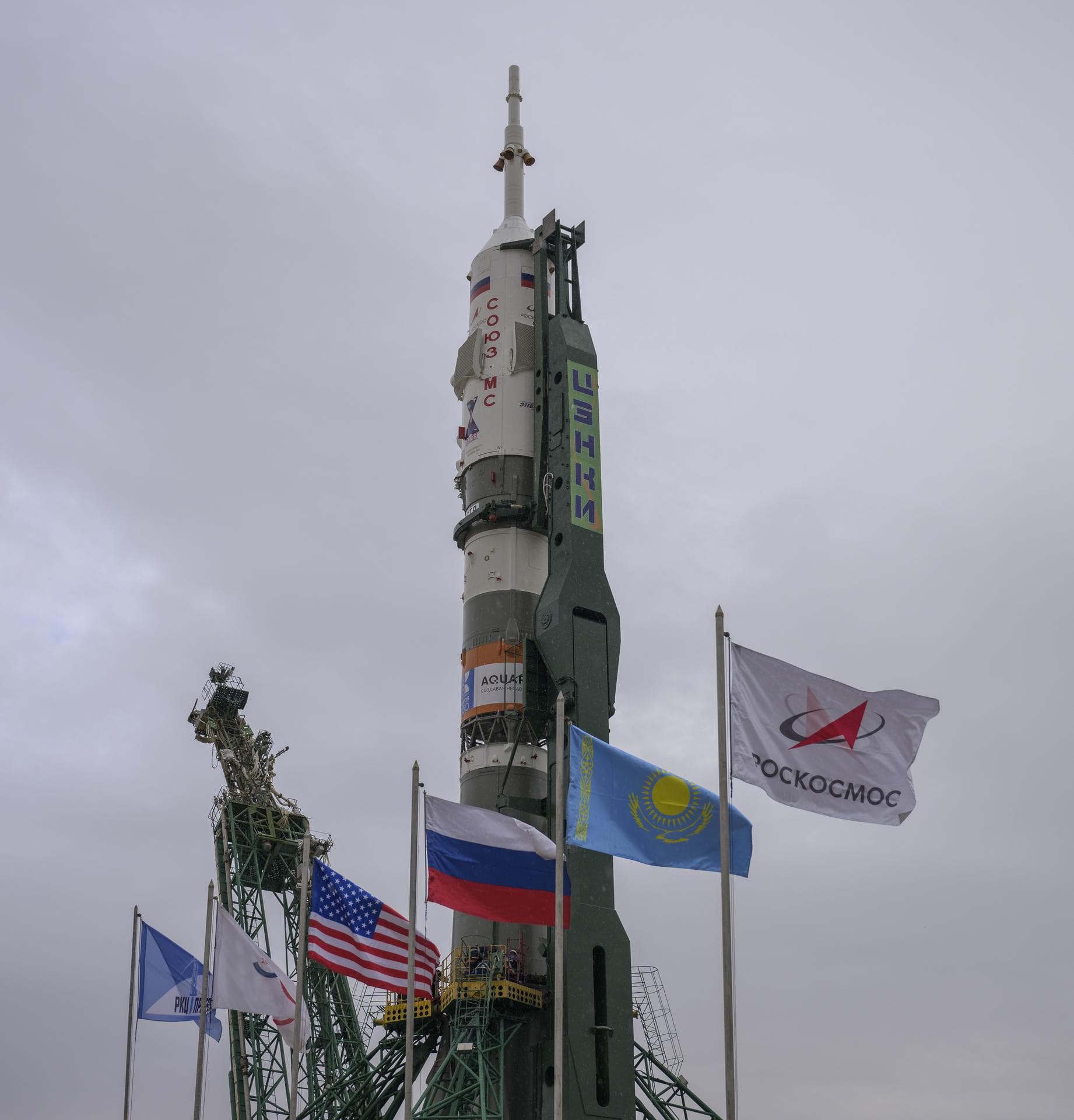
A Soyuz carrying cosmonauts Alexei Leonov and Valeri Kubasov launched from Baikonur on July 15, 1975, and an Apollo carrying Thomas Stafford, Vance Brand, and Donald Slayton followed the same day. The two spacecraft docked on July 17, and Stafford and Leonov shook hands through the hatch.[21] The nine-day Apollo-Soyuz Test Project proved compatible docking systems, ran five joint experiments, and gave each side a look at the other's hardware.[21] It is the conventional endpoint of the Space Race: the last Apollo flight, the first international docking, and the start of a cooperative thread that led decades later to the Shuttle-Mir flights and the International Space Station, where Roscosmos, the Soviet program's successor, remains a core partner. Syromyatnikov's androgynous design is still the basis of docking hardware on the station.[22]
Legacy
The Space Race compressed decades of engineering into years. It produced the first weather, communications, and navigation satellites and an early, voracious market for integrated circuits; Apollo's guidance computer was among the first major applications of silicon chips. It built the launch sites, design bureaus, and research centers both countries still use, and it opened planetary science, with the first probes to Venus and Mars flying as race-era prestige missions. Mariner 2 launched on August 27, 1962 and became the first spacecraft to complete a successful mission to another planet when it passed Venus on December 14, returning the first measurements of the solar wind on the way.[23] The race also fixed spaceflight in public culture as a measure of national capability, which is why "Sputnik moment" survives as shorthand for a technological wake-up call. President Barack Obama used it in his State of the Union address on January 25, 2011 to argue for a level of research spending "we haven't seen since the height of the Space Race."[24]
The costs were real. Apollo's budget share proved politically unsustainable once the race was won, and both programs killed crews in the pursuit, including the Apollo 1 fire[14] and the Soyuz 1 and Soyuz 11 accidents in the Soviet program. Soyuz 11 was the worse of the two: on June 30, 1971 a pressure equalization valve jarred open during separation for reentry, and Georgi Dobrovolski, Vladislav Volkov, and Viktor Patsayev, who wore no pressure suits, died within about two minutes.[15]
A new lunar competition
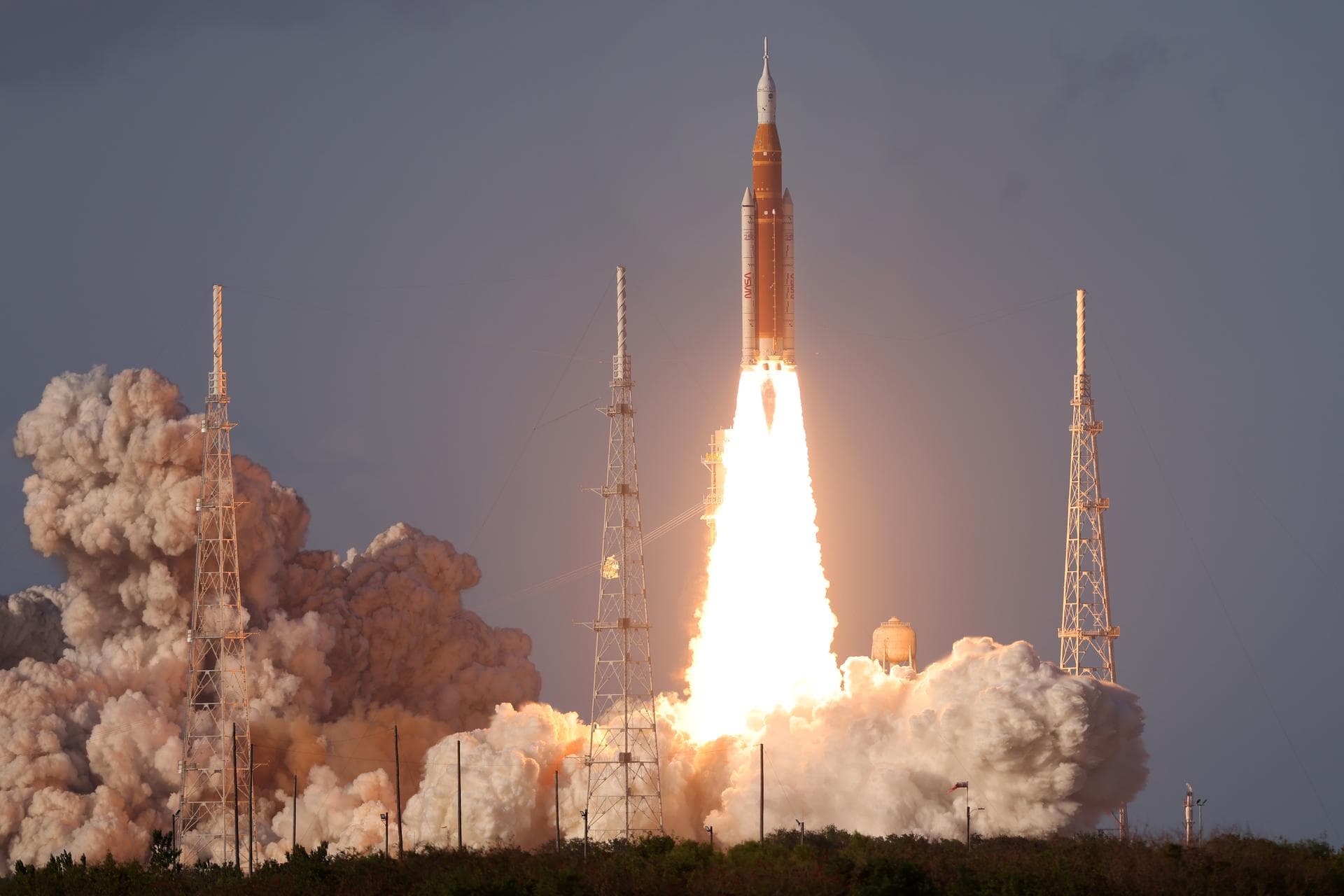
A slower two-power dynamic between the United States and China has re-emerged around the Moon. The United States' Artemis program flew the crewed Artemis II lunar flyby from April 1 to 10, 2026 aboard the Space Launch System, a mission of 9 days, 1 hour, and 32 minutes and the first astronauts to travel to the Moon's vicinity since 1972.[25] Under the plan NASA adopted in 2026, Artemis III in 2027 is a low Earth orbit demonstration in which Orion practices rendezvous and docking with lander hardware from SpaceX and Blue Origin, and the first crewed landing moves to Artemis IV in 2028.[26]
China, coordinated by CNSA and its state contractors, is working toward a crewed landing before 2030 using the Mengzhou spacecraft and Lanyue lander launched on two Long March 10 rockets. It flew a maximum dynamic pressure abort test in February 2026, and the crew-rated rocket's first orbital flight, carrying an uncrewed Mengzhou, remains targeted for late 2026.[28] On July 10, 2026 the Long March 10B, a single-core commercial variant of the lunar rocket, reached orbit on its first flight and its first stage was caught in a net aboard a recovery ship, making China the second country to bring back an orbital-class booster intact.[27]
Analysts differ on how closely the parallel holds. Both programs target the south pole and recruit international partners, the United States through the Artemis Accords, which reached 70 signatories in July 2026,[29] and China through its International Lunar Research Station. Today's competition, though, features commercial contractors, longer timelines, and stated goals of sustained presence rather than single landings.[30]
References
- 65 Years Ago: Sputnik Ushers in the Space Age - NASA.
- Wernher von Braun - NASA.
- R-1 ballistic missile - RussianSpaceWeb.
- R-7 intercontinental ballistic missile - RussianSpaceWeb.
- 60 Years Ago: Vanguard Fails to Reach Orbit - NASA.
- Studying the Van Allen Belts 60 Years After America's First Spacecraft - NASA.
- 60 Years Ago: Luna 2 Makes Impact in Moon Race - NASA.
- Project Mercury - NASA.
- Project Gemini - NASA.
- Sally Ride and Valentina Tereshkova: Changing the Course of Human Space Exploration - NASA.
- The Decision to Go to the Moon - NASA.
- How much did the Apollo program cost? - The Planetary Society.
- This Week in NASA History: Apollo 8 Captures "Earthrise", Dec. 24, 1968 - NASA.
- Apollo 1 - NASA.
- 50 Years Ago: Remembering the Crew of Soyuz 11 - NASA.
- Challenge to Apollo: The Soviet Union and the Space Race, 1945-1974 (NASA SP-2000-4408) - Asif A. Siddiqi, NASA History Office, 2000.
- N1 heavy launch vehicle - RussianSpaceWeb.
- Second launch attempt of the N1 rocket, vehicle No. 5L - RussianSpaceWeb.
- 50 Years Ago: National Goal Nears Fulfillment - NASA.
- 50 Years Ago: Apollo 11, The Journey Home - NASA.
- Apollo-Soyuz Test Project - NASA.
- 50 Years Ago: The United States and the Soviet Union Sign a Space Cooperation Agreement - NASA.
- Mariner 2 - NASA Jet Propulsion Laboratory.
- Remarks by the President in State of Union Address, January 25, 2011 - The White House (archived).
- Artemis II - NASA.
- How NASA's Artemis III Lander Test Will Pave Way for Moon Landings - NASA.
- China becomes second country to recover orbital booster with Long March 10B - SpaceNews.
- China targets 2026 for first Long March 10 launch, new lunar crew spacecraft flight - SpaceNews.
- Mauritius becomes 70th nation to sign the Artemis Accords - SpaceNews.
- Analysis: NASA's Lunar Success Sharpens Focus on China's 2030 Crewed Landing Goal - US News & World Report.