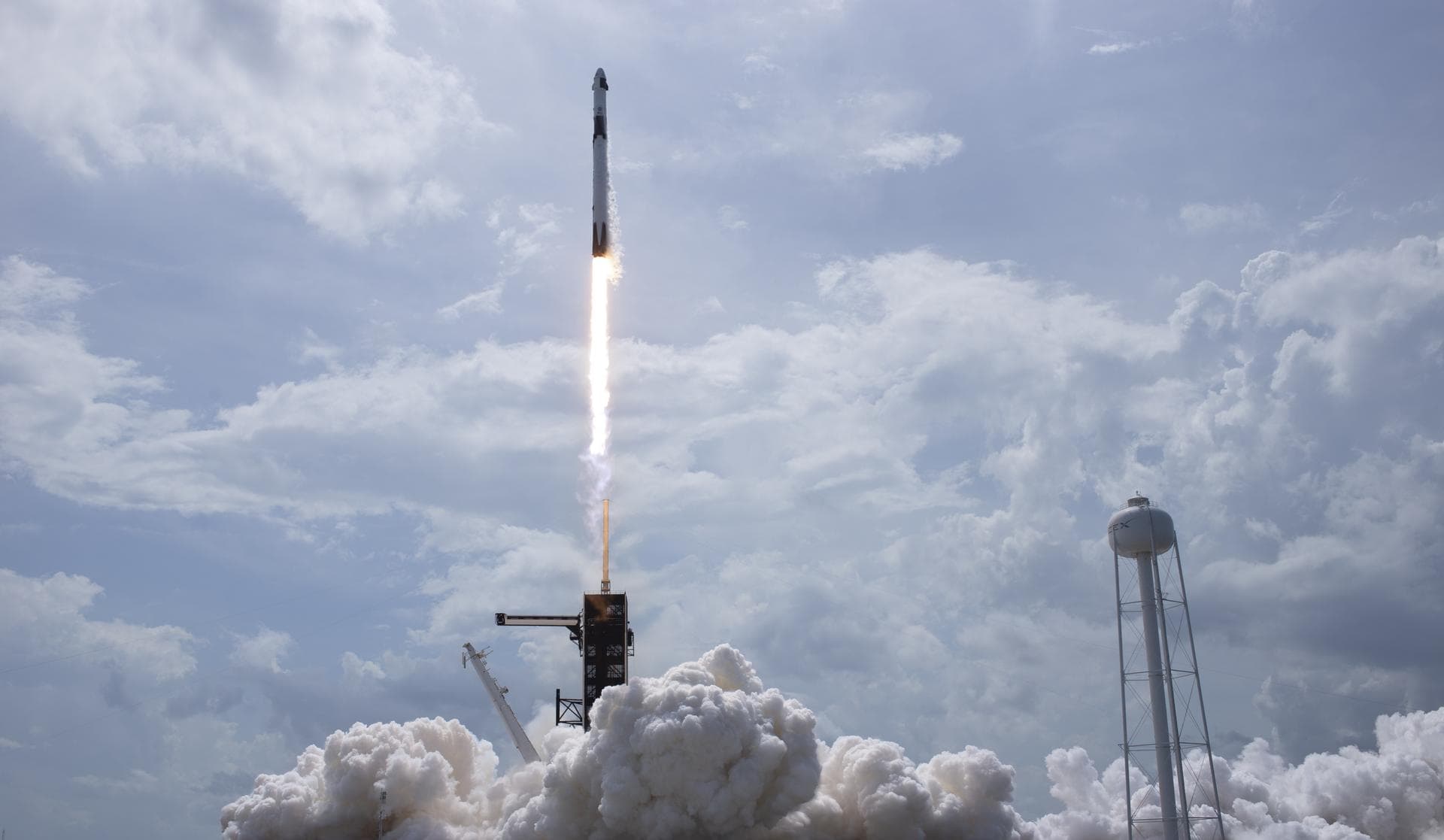
Blue Origin, LLC is a privately held American aerospace manufacturer and spaceflight services company founded by Jeff Bezos in September 2000 and based in Kent, Washington. Its portfolio spans reusable launch vehicles, rocket engines, lunar landers, in-space mobility systems, communications infrastructure, and a commercial space-station concept. Amazon's 2026 proxy statement identifies Blue Origin as a company owned by Bezos, rather than an Amazon business.[1] Dave Limp has served as chief executive since December 4, 2023.[2]
Status as of August 2026
As of August 13, neither Blue Origin launch vehicle was flying. New Shepard last flew on January 22, 2026, before entering a company-planned pause of no less than two years.[5] New Glenn had completed three launches, and the Federal Aviation Administration (FAA) had closed its NG-3 flight investigation, but a May 28 static-fire explosion destroyed a booster and damaged equipment at Launch Complex 36.[6][7] Blue Origin identified an engine oxygen-valve failure and retained a target of returning before the end of 2026, while work began on a second pad.[7][8] The first Blue Moon MK1 lander had completed thermal-vacuum testing, but reporting after the pad accident moved its launch target to the first quarter of 2027.[9][10] Blue Ring's first integrated mission had not been announced as launched, Orbital Reef remained in design development, and the TeraWave and Project Sunrise constellations were regulatory proposals rather than licensed operating systems.[11][12][13][14][15] Quartz was the one new network element already deployed, with three ground stations installed and tested.[16]
Ownership and organization
Bezos owns Blue Origin directly. Amazon discloses Blue Origin as a related-party supplier because Bezos has ownership interests in both companies.[1] Blue Origin is therefore separate from Amazon, even when Amazon buys launches from it.
The company's public site groups its work into launch, lunar systems, in-space systems, engines, motion control, and low Earth orbit destinations.[39] New Shepard and New Glenn provide transportation; Blue Moon extends the portfolio to the lunar surface; Blue Ring, TeraWave, and Quartz address operations and communications beyond launch; and Orbital Reef is the company's crewed destination concept.
Blue Origin also owns Honeybee Robotics. The acquisition was announced in January 2022 as a wholly owned subsidiary, and a March 2025 Blue Origin release described Honeybee as part of the company's In-Space Systems unit.[3][4] Honeybee contributes robotic systems, mechanisms, and planetary-surface technology.
Program portfolio
| Program | Role | Verified public status on August 13, 2026 |
|---|---|---|
| New Shepard | Reusable suborbital research and human-flight system | 38 flights; paused for no less than two years after January 2026.[5] |
| New Glenn | Reusable-booster orbital launch vehicle | Three launches; LC-36 recovery and vehicle changes followed the May 2026 static-fire accident.[6][7][8] |
| Blue Moon | MK1 cargo and MK2 crewed lunar landers | Endurance completed environmental testing; its launch was reported for the first quarter of 2027. MK2 remained under NASA's Human Landing System contract.[9][10][28] |
| Blue Ring | In-space hosting, transport, and maneuvering vehicle | A pathfinder flew on NG-1; the first fully integrated mission announced for spring 2026 had not received a later public launch confirmation.[11][23][32] |
| Orbital Reef | Proposed commercial low Earth orbit station | NASA-supported design and human-in-the-loop work continued; no fixed deployment date was published.[12][35] |
| TeraWave and Project Sunrise | Proposed communications and orbital data center constellations | Applications were accepted for FCC filing, which is not the same as authorization.[13][14][15] |
| Quartz | Commercial ground-station network | First three stations installed and tested; Blue Origin targeted nine sites by the end of 2026.[16] |
New Shepard
New Shepard is named for Mercury astronaut Alan Shepard. It combines a reusable, vertical-landing booster with an autonomous six-seat capsule. A typical flight lasts about 11 minutes and crosses the 100-kilometer Karman line before the capsule returns by parachute and the BE-3PM-powered booster lands vertically.[17] The system has carried people, research payloads, and technology demonstrations, but it does not enter orbit.
The booster first crossed the Karman line and landed on November 23, 2015. Blue Origin flew its first human mission on July 20, 2021, carrying Jeff Bezos, Mark Bezos, Wally Funk, and Oliver Daemen.[19][20] During the uncrewed NS-23 mission on September 12, 2022, the capsule's abort system separated it safely while the booster was lost. The FAA found that higher-than-expected engine operating temperatures caused the nozzle's structural failure and required 21 corrective actions before closing its investigation in September 2023.[21]
NS-38 on January 22, 2026, was the program's 38th mission. By then New Shepard had made 98 passenger trips above the Karman line for 92 distinct individuals, because several people flew more than once, and had carried more than 200 research payloads.[5][18] On January 30, Blue Origin said it would stop flying New Shepard for no less than two years and move resources toward lunar human flight. The announcement described a minimum pause, not a retirement date or a firm return schedule.[5] Until the pause ends, Blue Origin is not offering an active space tourism flight service.
New Glenn
New Glenn is Blue Origin's orbital launch vehicle and the transportation link for several other company programs. The current 7x2 version is more than 98 meters tall, with seven methane-and-oxygen BE-4 engines on a reusable first stage and two hydrogen-and-oxygen BE-3U engines on an expendable upper stage. Blue Origin rates it for more than 45 metric tons to low Earth orbit and 13 metric tons to geostationary transfer orbit. The manufacturer says the first stage is designed for at least 25 flights.[22]
The rocket reached its intended orbit on its first launch on January 16, 2025, though the booster was not recovered.[23] Its second flight on November 13, 2025, deployed NASA's twin ESCAPADE spacecraft and achieved New Glenn's first booster landing.[24] NG-3, its third flight, launched on April 19, 2026. A cryogenic leak on the upper stage froze a hydraulic line and produced a thrust anomaly during an engine burn. The FAA accepted nine corrective actions and authorized a return to flight on May 22, subject to the remaining licensing requirements.[6]
Six days later, the first stage designated GS1-3 was destroyed during a static-fire test at LC-36. No one was injured. Blue Origin's August 5 update traced the event to the main oxygen valve on one BE-4 engine and said retrofit hardware was expected by the end of August. The company continued to target another launch before the end of 2026, but that remained a company target rather than a confirmed launch date.[7] Construction began on LC-36B on August 12 to support the future nine-engine New Glenn configuration, while LC-36A was being rebuilt around revised integration equipment.[8] The rocket's full design, flight record, customers, and accident chronology are covered in the dedicated New Glenn article.
Blue Moon lunar systems
Blue Moon is a family of hydrogen-and-oxygen lunar landers. Blue Origin presents MK1 as an uncrewed cargo lander capable of delivering up to 3 metric tons to the lunar surface, while the larger MK2 is intended to carry cargo and astronauts between lunar orbit and the surface.[25] Both use the throttleable BE-7 engine, and both depend on New Glenn launches.
The first MK1 flight article is named Endurance. It completed thermal-vacuum testing in NASA Johnson Space Center's Chamber A in May 2026. NASA describes the Blue Origin-funded flight as a commercial demonstration of precision landing, cryogenic propulsion, and autonomous guidance. Endurance also carries NASA's SCALPSS cameras and a laser retroreflector under the Commercial Lunar Payload Services initiative.[9] NASA had described a 2026 lunar south-pole mission before the New Glenn pad accident; subsequent reporting placed the new launch target in the first quarter of 2027.[10]
NASA selected another MK1 for the VIPER lunar rover in September 2025, but the agreement is conditional. Its base phase funds payload accommodation and offloading work. NASA may exercise a later option to launch and deliver VIPER in late 2027 only after reviewing that work and the outcome of the first MK1 mission.[26] In May 2026, NASA also awarded Blue Origin task orders to deliver Astrolab and Lunar Outpost terrain vehicles to the Moon in 2028.[27]
MK2 is Blue Origin's crewed Human Landing System. NASA selected the design in May 2023 under a firm-fixed-price award valued at $3.4 billion, with an uncrewed demonstration followed by a crewed Artemis V demonstration in the original contract plan.[28] NASA's revised June 2026 architecture calls for an uncrewed Blue Origin lander pathfinder to dock with an Orion crew during the 2027 Artemis III mission in low Earth orbit.[29] NASA lists Artemis IV in 2028 as the first planned lunar landing in the revised sequence, but its announcement did not reassign Blue Moon MK2 from the original Artemis V crewed demonstration to the Artemis IV surface mission.[29] A March 2026 NASA inspector general audit found that both Human Landing System providers faced schedule and technical maturation challenges, while NASA had generally controlled contract costs through its milestone structure.[30]
In-space systems and networks
Blue Ring
Blue Ring is a spacecraft platform for hosting payloads, moving them between orbits, and providing power, communications, and mission services. Blue Origin's current product page describes hybrid solar-electric and chemical propulsion, as many as 13 payload ports, and capacity for more than 4,000 kilograms depending on mission configuration. Those figures are manufacturer specifications, not results from a complete operational mission.[31]
A Blue Ring pathfinder flew attached to New Glenn's upper stage on NG-1 in January 2025. Its purpose was to test communications, flight computing, telemetry, and ground tracking rather than perform the full transport mission.[23][32] In July 2025 Blue Origin announced a first integrated Blue Ring mission with a Scout Space sensor and gave spring 2026 as the launch period.[11] By August 13, 2026, the company had not published a launch announcement or a replacement date for that mission. The pathfinder therefore demonstrated selected subsystems, but the complete Blue Ring vehicle had not yet established an operational flight record.
Satellite and ground networks
TeraWave is a proposed multi-orbit communications network. Blue Origin announced an architecture of 5,280 satellites in low Earth orbit and 128 in medium Earth orbit, with deployment targeted to start in the fourth quarter of 2027.[13] In February 2026 the FCC accepted Blue Origin's license application for filing. The notice means the application passed an initial filing review; it does not grant authority to deploy or operate the constellation.[14]
Project Sunrise is a separate proposal for computing infrastructure in orbit. An April 2026 FCC notice says Blue Origin requested authority for as many as 51,600 data-center satellites in sun-synchronous orbits from 500 to 1,800 kilometers.[15] It, too, was only an accepted application as of August 13, with no public authorization or launch schedule.
Quartz is Blue Origin's ground counterpart to these in-space proposals. On August 13 the company said its first three ground stations, in Bermuda, New Zealand, and Australia, had been installed and tested. The initial network uses S-band and X-band links for low Earth orbit spacecraft. Blue Origin set a goal of nine sites by the end of 2026, so three tested sites were the verified deployment state on the article date.[16]
Orbital Reef
Orbital Reef is Blue Origin's proposed mixed-use commercial station in low Earth orbit, developed with Sierra Space and partners including Boeing, Redwire, Genesis Engineering, and Arizona State University. NASA selected the team in December 2021 for a funded Space Act Agreement under the Commercial Low Earth Orbit Destinations program, initially awarding $130 million for design work.[34] NASA added $42 million in 2024, bringing the agreement total to $172 million and adding milestones for life-support, power, and other station systems.[33]
The project remained in NASA's first commercial-destination development phase in August 2026. Blue Origin had completed human-in-the-loop evaluations with full-scale floor mockups of its habitable module, and NASA reported progress on life-support and structural design milestones.[12] These agreements fund design maturation and risk reduction; they are not a NASA purchase of an operating station. Blue Origin's current destination page continued to present Orbital Reef as a future business park about 250 miles above Earth but did not give a fixed launch or occupancy date.[35] It therefore remains a development program rather than an available successor to the International Space Station.
Engines and motion control
Blue Origin builds engines for its own vehicles and for United Launch Alliance's Vulcan Centaur. The ratings below are the manufacturer's current values for individual engines, not the combined thrust of a full stage.[36]
| Engine | Propellants | Rated thrust | Main application |
|---|---|---|---|
| BE-3PM | Liquid oxygen and liquid hydrogen | 110,000 pounds-force, throttleable to 20,000 | New Shepard booster |
| BE-3U | Liquid oxygen and liquid hydrogen | 200,000 pounds-force in vacuum, throttleable to 100,000 | New Glenn upper stage |
| BE-4 | Liquid oxygen and liquefied natural gas | 640,000 pounds-force, throttleable to 220,000 | New Glenn first stage and Vulcan first stage |
| BE-7 | Liquid oxygen and liquid hydrogen | 10,000 pounds-force, throttleable to 2,000 | Blue Moon landers |
The BE-4 is the portfolio's main outside product: seven power New Glenn and two power each Vulcan first stage. Blue Origin also markets Blue Thrusters, a family of reaction-control products produced in Huntsville, Alabama.[36] Honeybee Robotics broadens this systems business beyond propulsion with mechanisms and planetary robotics.[4]
Major facilities
| Location | Main publicly identified work |
|---|---|
| Kent, Washington | Headquarters; New Shepard and engine production, plus engineering and support functions.[37] |
| Launch Site One, West Texas | New Shepard flight operations and BE-3 and BE-4 testing.[37] |
| Exploration Park and LC-36, Florida | New Glenn manufacturing, integration, launch, landing-stage refurbishment, LC-36A recovery, and construction of LC-36B.[8][22][37] |
| Huntsville, Alabama | BE-series engine manufacturing and testing, Blue Thrusters production, and Test Stand 4670.[36][37] |
| NASA Stennis Space Center, Mississippi | Planned New Glenn upper-stage hot-fire work at the B-2 test stand under a reimbursable NASA agreement, targeted for fall 2026.[38] |
These sites tie the portfolio together: engines built in Washington and Alabama feed launch operations in Texas and Florida, while New Glenn is the intended carrier for Blue Moon and many customer missions. The May 2026 accident delayed Endurance and left LC-36A under repair as New Glenn's only completed launch pad. LC-36B and the Stennis test agreement are intended to add capacity, but neither was operational launch infrastructure on August 13, 2026.[8][10][38]
References
- Amazon 2026 Proxy Statement - Amazon.com, Inc.
- Blue Origin de Bezos nomeia ex-executivo da Amazon como CEO - Reuters.
- Honeybee Robotics to Join Blue Origin - Blue Origin.
- Firefly Aerospace Selects Blue Origin's Honeybee Robotics to Provide Rover for Lunar Mission - Blue Origin.
- Blue Origin to Pause New Shepard Flights for No Less Than Two Years - Blue Origin.
- FAA General Statements: FAA Closes Blue Origin NG-3 Mishap Investigation - Federal Aviation Administration.
- GS1-3 Hotfire Updates - Blue Origin.
- Returning Launch Complex 36 to Two Pads: Blue Origin Begins Construction of LC-36B - Blue Origin.
- Blue Origin Moon Lander Completes Testing at NASA Vacuum Chamber - NASA.
- Blue Origin Outlines Return to Flight Logistics for Its New Glenn Rockets - Spaceflight Now.
- First Blue Ring Mission to Demonstrate Space Domain Awareness With Scout Space Sensor - Blue Origin.
- NASA Sees Progress on Blue Origin's Orbital Reef Design, Development - NASA.
- Blue Origin Introduces TeraWave Space-Based Network for Global Connectivity - Blue Origin.
- Applications Accepted for Filing, Report No. SAT-01978 - Federal Communications Commission.
- Applications Accepted for Filing, Report No. SAT-01992 - Federal Communications Commission.
- Blue Origin Begins Global Rollout of Quartz Ground Station Network - Blue Origin.
- New Shepard - Blue Origin.
- New Shepard NS-38 Mission - Blue Origin.
- Safety: New Shepard Development Flight Test Program - Blue Origin.
- Blue Origin Safely Launches Four Commercial Astronauts to Space and Back - Blue Origin.
- FAA Closes Blue Origin Mishap Investigation - Federal Aviation Administration.
- New Glenn - Blue Origin.
- New Glenn NG-1 Mission - Blue Origin.
- New Glenn Launches NASA's ESCAPADE, Lands Fully Reusable Booster - Blue Origin.
- Blue Moon - Blue Origin.
- NASA Selects Blue Origin to Deliver VIPER Rover to Moon's South Pole - NASA.
- NASA Provides Update on Moon Base Rovers, Landers, Missions - NASA.
- NASA Selects Blue Origin as Second Artemis Lunar Lander Provider - NASA.
- NASA Marches Toward Artemis III Mission in 2027, Names Crew Members - NASA.
- NASA's Management of the Human Landing System Contracts - NASA Office of Inspector General.
- Blue Ring - Blue Origin.
- Blue Ring Pathfinder Payload - Blue Origin.
- NASA Adjusts Agreements to Benefit Commercial Station Development - NASA.
- NASA Selects Companies to Develop Commercial Destinations in Space - NASA.
- Destinations - Blue Origin.
- Engines - Blue Origin.
- Blue Origin Careers and Locations - Blue Origin.
- NASA to Support Blue Origin New Glenn Rocket Testing, Advance Artemis - NASA.
- About Blue Origin - Blue Origin.