Yuri Alekseyevich Gagarin (1934-1968) was a Soviet air force pilot and cosmonaut who became the first human being in space. On April 12, 1961, he completed a single orbit of Earth aboard the Vostok 1 spacecraft in a flight lasting 108 minutes, a milestone of the Space Race that made the 27-year-old farm worker's son one of the most famous people on the planet.[1][2]
Gagarin never flew in space again. The Soviet leadership, protective of its most valuable propaganda asset, kept him grounded for most of the decade while he toured the world and helped train other cosmonauts. He died in 1968, at age 34, when the MiG-15 trainer he was flying crashed during a routine sortie.[2][4]
Much of the Vostok 1 mission was secret at the time, and some of it stayed secret for thirty years. Gagarin's own debriefing to the State Commission was classified top secret and unavailable to researchers until 1991, and the Soviet Union did not acknowledge that he had left the descent module partway down and landed under his own parachute, because the rules then governing world records required a pilot to come down inside the craft.[1][6]
The anniversary of his flight is observed in Russia as Cosmonautics Day and, since a 2011 United Nations resolution, worldwide as the International Day of Human Space Flight. The Baikonur launch pad from which he departed is still known as Gagarin's Start.[15][18][22]
Klushino and the occupation
Gagarin was born on March 9, 1934, in the village of Klushino, west of Moscow, the third of four children of a carpenter and a dairy farmer on a collective farm.[2][10] German troops took the village in October 1941 during the advance on Moscow, and the occupation lasted about 21 months. An officer requisitioned the family house, and the Gagarins spent that period in a mud hut beside it. Two of his elder siblings were deported for forced labor in 1943 and did not come home until 1945.[11][21]
The family moved to the nearby town of Gzhatsk in 1946, where Gagarin returned to secondary school and concentrated on mathematics and physics. He finished six grades there before leaving for trade school.[10][11]
From foundry to fighter cockpit
In 1950, aged 16, Gagarin began an apprenticeship as a foundryman at a steel plant in Lyubertsy, near Moscow, and in 1951 moved to an industrial technical school in Saratov to train as a foundry worker. There he joined the local aeroclub, flying a Yak-18 trainer on weekends, and discovered that he wanted to fly more than he wanted to cast metal. He made his first solo flight in 1955.[2][10]
That year he entered the First Chkalov Air Force Pilot's School at Orenburg, graduating as a fighter pilot in 1957. He was commissioned as a lieutenant on November 5, 1957, married Valentina Goryacheva the same year, and was posted to Luostari airbase in Murmansk Oblast, north of the Arctic Circle near the Norwegian border, where he flew MiG-15s and was promoted to senior lieutenant in November 1959.[1][2]
Selection as a cosmonaut
Screening for the Soviet Union's first cosmonaut group began in October 1959 and put 206 air force pilots through months of medical and psychological testing before the field was cut to twenty. Twelve of them, Gagarin among them, formally joined the team on March 7, 1960, and the rest followed by that June, under orders signed by the air force commander in chief, Marshal Konstantin Vershinin.[1][9] Sergei Korolev, the chief designer, had set the specification: men aged 25 to 30, no taller than about 1.70 to 1.75 meters and weighing no more than 70 to 72 kilograms, so that they would fit the cramped 3KA capsule. Gagarin stood about 1.57 meters.[1][2][11]
Six were then put on an accelerated track for the first flight: Gagarin, Gherman Titov, Grigori Nelyubov, Andriyan Nikolayev, Pavel Popovich and Valery Bykovsky.[1][9] They sat final examinations on January 17 and 18, 1961, and the reviewing commission recommended assigning them to flights in that order, with Gagarin first.[1] An anonymous poll of the candidates themselves had also put him at the top.[2]
The choice between Gagarin and Titov was closer than the later mythology suggests, and it was not settled until days before launch. Nikolai Kamanin, the air force general in charge of the cosmonaut team, wrote in his diary on April 5 that opinion around him was moving toward Titov and that his own confidence in Titov was growing; what held him back was the need to keep the stronger man for the planned day-long second mission. Photographs and biographies of both men went up the party apparatus as far as Khrushchev, who was reported to have answered that both were excellent and that the specialists should decide. The aerospace historian Yaroslav Golovanov argued that the exercise existed mainly so officials could say the decision had been taken at the highest level. At its meeting on April 8, the State Commission accepted Kamanin's formal nomination of Gagarin as pilot and Titov as backup with little discussion, fixed the launch for April 11 or 12, and moved on to other business. Kamanin told the two men privately the following day.[1]
Vostok 1
At 9:07 a.m. Moscow time on April 12, 1961, Vostok 1 lifted off with Gagarin aboard from Site No. 1 at the Baikonur Cosmodrome in Kazakhstan atop an 8K72K rocket derived from the R-7 missile. As the engines lit, Gagarin called out "Poyekhali!" ("Let's go!"). The third stage shut down and the spacecraft reached orbit 676 seconds after liftoff.[1][3]
The orbit was higher than intended. The State Commission had planned roughly 180 by 230 kilometers. Sources drawn from Soviet records disagree on what was achieved: the NASA history of the Soviet program gives 175 by 302 kilometers at an inclination of 65.07 degrees, while the preliminary Soviet launch report gives 181 by 372 kilometers at 64.57 degrees with a period of 89.44 minutes. Either figure overshoots the plan by a wide margin, which mattered because the spacecraft carried only about ten days of contingency supplies for a failure of the braking engine, and a higher orbit would take longer to decay.[1][8]
| Source | Orbit (perigee by apogee) | Inclination | Period |
|---|---|---|---|
| Planned before launch[1][8] | About 180 by 230 kilometers | - | - |
| NASA history (Siddiqi)[1] | 175 by 302 kilometers | 65.07 degrees | - |
| Preliminary Soviet launch report[8] | 181 by 372 kilometers | 64.57 degrees | 89.44 minutes |
The flight was almost fully automatic. Korolev insisted that Gagarin confine himself to inspecting the equipment rather than touching the controls, and Khrushchev had raised the question of the cosmonaut's psychological stability in orbit at a Presidium meeting on April 3. To keep a disoriented pilot from damaging the mission, engineers locked the manual orientation system behind a numeric code and sealed the code in an envelope stowed on board, to be opened only if the automatic system or the ground link failed. Historians of the program note that at least two people told Gagarin the combination before launch so that he would not waste time on the envelope in a real emergency.[1][5] He was given work to occupy him instead: checking instruments, entering observations in the on-board journal, and reporting by radio and telegraph key.[1][5]
Gagarin ate, drank and wrote in the journal in his pressure-suit gloves, losing his pencil when it floated free. Approaching orbital sunrise he watched a bright orange arc light up the horizon and run through the colors of the spectrum before the sky went black.[1][8] The Soviet news agency TASS did not announce the launch until about 55 minutes after liftoff, and the communique already gave his rank as major, a promotion from senior lieutenant that he learned about only after he was back on the ground.[1]
The braking engine fired at 10:25 Moscow time over West Africa for about 40 seconds. A valve failed to close fully, fuel leaked, and the engine cut out roughly a second early, delivering 132 meters per second of braking instead of the programmed 136.[7] The descent module should then have separated from the instrument module within 10 to 12 seconds. It did not. The four metal straps of the separation mechanism released, but a bundle of cables still held the two sections together, and the joined spacecraft began to tumble at around 30 degrees per second; Gagarin later described rotating "head, then feet, head, then feet" with Africa, the horizon and the sky sweeping past the porthole. He worked out that he would come down inside Soviet territory in any case, decided not to declare an emergency, and keyed the signal meaning all was well. The sections finally parted around 10:35, some ten minutes late, when the cables burned through during reentry.[1][3][7][20] Deceleration peaked near 10 g and his vision grayed out for two or three seconds before he recovered.[1]
As the Vostok design required, Gagarin did not ride the capsule to the ground. At about 7 kilometers the descent module's parachutes opened, hatch number one blew off, and he was ejected in his seat two seconds later, separating from it and descending on his own canopy.[1][3] He landed near the village of Smelovka, 26 kilometers southwest of the town of Engels in the Saratov region, close to the ground where the cosmonaut candidates had done their parachute training the year before. It took him about six minutes to work open the air valve of his pressure suit. He then walked toward a woman and a girl he had spotted in the field to ask where he could find a telephone; they backed away from the orange-suited figure until he shouted that he was Soviet.[1]
Accounts of the exact landing time differ. Siddiqi's NASA history puts it at 10:55 Moscow time, one hour and forty-eight minutes after liftoff, which is the 108-minute figure the Soviet Union announced and that NASA and ESA still use. Anatoly Zak's reconstruction from Soviet documents gives 10:53 and 106 minutes, with the empty capsule down at 10:48 about 1.5 kilometers away. The pilot and his spacecraft landed separately, so the two figures are not measuring quite the same thing.[1][3][7]
Flight summary
| Mission | Date | Spacecraft | Duration | Result |
|---|---|---|---|---|
| Vostok 1 | April 12, 1961 | Vostok 3KA No. 3 | 108 minutes, 1 orbit | First human spaceflight |
Flight timeline
All times are Moscow time on April 12, 1961, the day of Gagarin's Vostok 1 flight.
| Time | Event |
|---|---|
| 9:07 a.m. | Liftoff from Site No. 1, Baikonur Cosmodrome[1] |
| 9:18 a.m. | Third stage shuts down 676 seconds after liftoff; orbital insertion[1][3] |
| About 10:02 a.m. | TASS announces the flight, some 55 minutes after liftoff[1] |
| 10:25 a.m. | Braking engine fires over West Africa[3][7] |
| 10:35 a.m. | Descent module separates from the instrument module, about ten minutes late[1][3] |
| About 10:42 a.m. | Gagarin ejects at roughly 7 kilometers altitude[3][7] |
| 10:48 a.m. | Empty descent module touches down near Smelovka[7] |
| 10:53 to 10:55 a.m. | Gagarin lands about 1.5 kilometers from the capsule[1][7] |
The record and the concealed ejection
Gagarin's claim to a world record ran into a rule of the Fédération Aéronautique Internationale (FAI), the body that certifies aviation and spaceflight records, which had carried one requirement over from aviation when it wrote its spaceflight guidelines: the pilot had to land inside the craft for the record to count. In aviation the rule made sense, because nobody wanted to encourage pilots to abandon aircraft in pursuit of a mark.[6]
Vostok could not satisfy it. The spherical descent module came down on a ballistic trajectory, and Soviet engineers had no braking system that would slow it enough for a person to survive the impact, so ejecting the cosmonaut was the plan from the start rather than a contingency. They did not raise the problem with the Soviet delegates to the FAI beforehand.[6] The State Commission had decided on April 8 to file for a world record with international bodies while withholding the launch site and the type of launch vehicle.[1] The paperwork that reached the FAI left the ejection out, which left everyone to assume Gagarin had landed inside Vostok 1.[6]
The account held for four months. After Vostok 2 in August 1961, Titov admitted that he had ejected too, and the FAI delegates called a special meeting to re-examine his records. They concluded that what deserved recognition was the launch, the orbiting and the safe return of a human being rather than the manner of the landing, and both men kept their records. The FAI later created a Gagarin Medal, awarded annually for the outstanding aviation or space achievement of the year.[6]
Ejection remained standard for the rest of the program. Valentina Tereshkova left her capsule at about 6.5 kilometers on Vostok 6 in June 1963, and Bykovsky's instrument compartment failed to separate on time on Vostok 5, the same fault that Gagarin and Titov had hit.[1]
Global celebrity
Gagarin returned to Moscow on April 14, 1961, to a reception at Vnukovo Airport and a motorcade to Red Square, the largest public celebration since the end of the Second World War, and Nikita Khrushchev made him Hero of the Soviet Union.[1][10] Goodwill tours followed almost immediately; the Russian state news agency TASS puts the total at about 30 countries over the next three years, among them Czechoslovakia, Finland, Britain, Cuba, Brazil, Canada, India, Egypt and Japan.[26]
The British leg is the best documented. He arrived on July 11, 1961 at the invitation of the Amalgamated Union of Foundry Workers, which had asked the former foundry apprentice to visit the Metropolitan-Vickers engineering plant at Trafford Park in Manchester. He went there on July 12 in heavy rain, took a civic reception at the town hall, and in London met Prime Minister Harold Macmillan at Admiralty House and Queen Elizabeth II at Buckingham Palace. A trip planned for two or three days ran to five.[12]
His open smile became a Soviet emblem as recognizable as any flag, and the tours doubled as Cold War diplomacy for a country eager to advertise the achievement over the United States, which did not put an astronaut in orbit until John Glenn flew Friendship 7 on February 20, 1962, ten months after Vostok 1.[10][27]
At home Gagarin was elected a deputy of the Supreme Soviet in 1962, promoted to lieutenant colonel that June and to colonel in November 1963, and appointed to senior roles at the cosmonaut training center outside Moscow (today the Gagarin Cosmonaut Training Center in Star City), where he became deputy director of training.[2][4]
Grounded
Gagarin pushed to return to flight status and served as backup pilot for Soyuz 1 in April 1967. Vladimir Komarov flew the mission alone, and on April 24 the spacecraft's parachute system failed during descent and he was killed. Officials, unwilling to risk their national hero, barred Gagarin from further spaceflight assignments and at first from flying aircraft at all.[4][11]
He turned to his studies instead, defending a thesis on the design of a winged spacecraft at the Zhukovsky Air Force Engineering Academy in February 1968. He was then allowed back into the air, but only under the supervision of a flight instructor.[4]
Death
On March 27, 1968, Gagarin took off on a routine training flight in a two-seat MiG-15UTI with instructor Vladimir Seryogin, part of his requalification for solo fighter flying. The aircraft crashed near the town of Kirzhach in Vladimir Oblast, killing both men. Gagarin was 34. He received a state funeral, and his ashes were interred in the Kremlin Wall Necropolis on Red Square.[2][4]
The 1968 state commission concluded that a sudden maneuver had put the jet into a spin in poor weather, but it never established what prompted the maneuver. Its findings ran to 29 volumes, none of which has been published in full, and competing explanations have accumulated ever since. None has been settled by a released document.[14]
| Explanation | Where it comes from | Standing |
|---|---|---|
| A sharp maneuver to avoid a weather balloon, after which the crew lost control | Excerpt released by Russian authorities in 2011 | The nearest thing to an official cause; the historian Alexander Glushko called the wording vague and noted that no complete document was published[14] |
| Controllers passed weather data that put the cloud base higher than it was, leaving too little altitude to recover from the spin | KGB material declassified in 2003 | Reported, never adopted as a formal finding[11][13] |
| A cabin air vent left open by an earlier crew starved the two men of oxygen at altitude | A retired Soviet air force colonel | Unconfirmed[13] |
| An unauthorized Su-15 passed within 10 to 15 meters in cloud while in afterburner, flying at 450 to 500 meters instead of its assigned 10,000, and its wake threw the trainer into a spiral | Alexei Leonov, who sat on the 1968 commission, in interviews in 2013 and 2017 | Leonov said a declassified report confirmed the encounter and that he was asked not to name the other pilot; Glushko treats the account as a hypothesis until the documents are published[13][14] |
Russian authorities have not formally reopened the case.[13][14]
Commemoration
April 12, the date of Gagarin's flight, has been marked as Cosmonautics Day since 1962, first in the Soviet Union and later in Russia and other post-Soviet states.[22] On April 7, 2011, five days before the fiftieth anniversary of the flight, the United Nations General Assembly adopted resolution 65/271 declaring April 12 the International Day of Human Space Flight.[15] Enthusiasts mark the date with Yuri's Night events, begun in 2001 by Loretta Hidalgo Whitesides and George Whitesides; the 2026 edition fell on the 65th anniversary of Vostok 1 and the 25th Yuri's Night.[23]
The town of Gzhatsk, where his family settled after the war, now carries his name, and dozens of streets and towns elsewhere do too.[11][25] A crater 265 kilometers across on the far side of the Moon was named Gagarin by the International Astronomical Union in 1970.[17] The Apollo 11 crew left a package of commemorative items on the lunar surface in 1969 that included two Soviet medals honoring Gagarin and Komarov, alongside an Apollo 1 patch and a silicon disc carrying goodwill messages from 73 world leaders.[16]
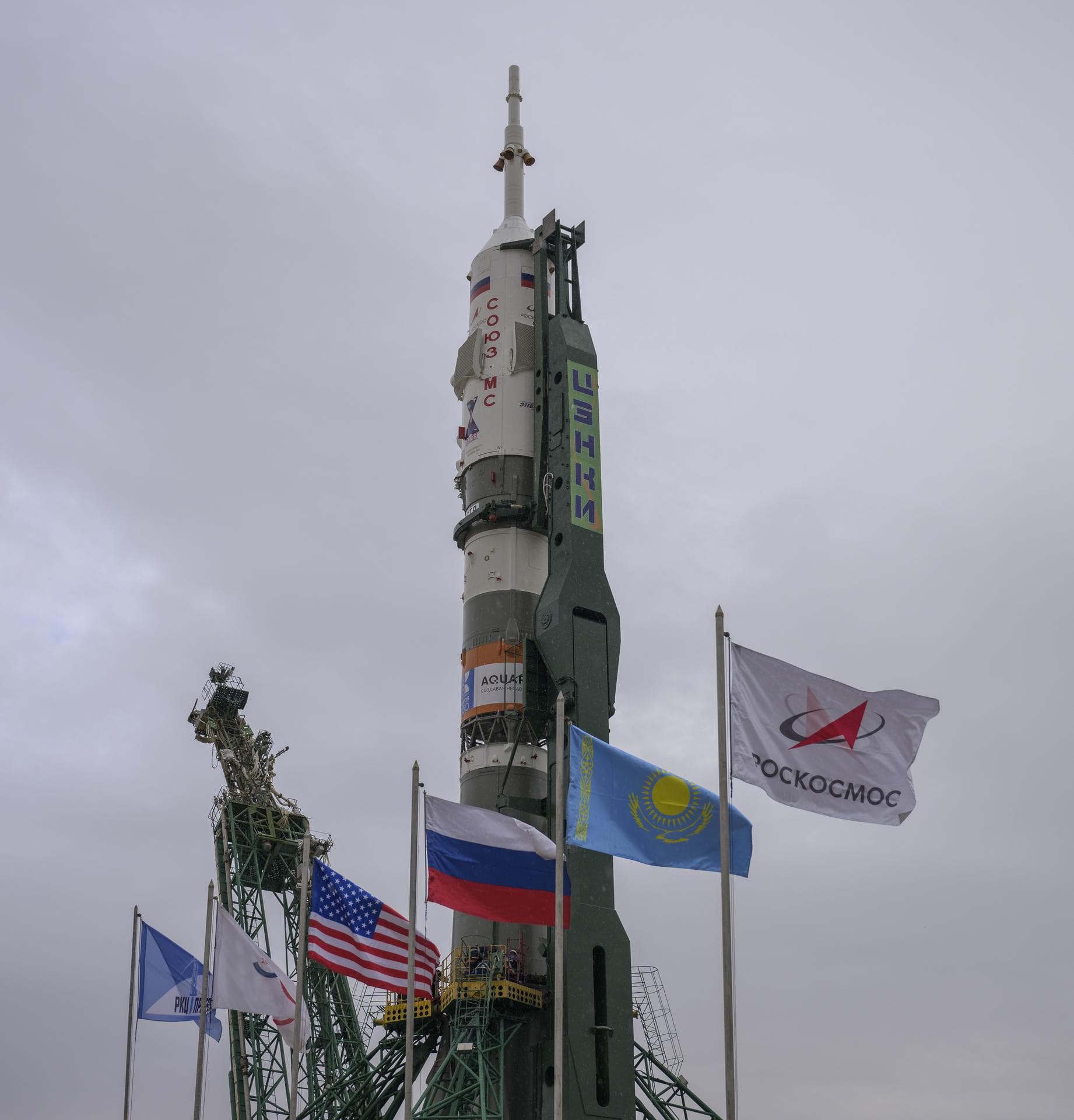
Launch Site No. 1 at Baikonur, in use since 1957 and known as Gagarin's Start, hosted its final launch, Soyuz MS-15, on September 25, 2019, and passed to Kazakh ownership on June 1, 2025 as part of a broader handover of leased facilities.[18] Kazakhstan and Roscosmos have agreed to turn the pad into a museum complex and to seek UNESCO World Heritage listing for it.[18][19] Crews launching to the International Space Station from Baikonur still keep preflight rituals traced to Gagarin: a haircut two days before launch, a screening of the film "White Sun of the Desert" the night before, a glass of champagne and a signature on the door of their quarters on launch morning, and a stop at the left rear wheel of the bus on the way to the pad.[24]
References
- Challenge to Apollo: The Soviet Union and the Space Race, 1945-1974 - Asif A. Siddiqi, NASA History Series SP-2000-4408, part 1 (chapter 7, "Gagarin").
- Yuri Gagarin - European Space Agency.
- The flight of Vostok 1 - European Space Agency.
- Remembering Yuri Gagarin 50 Years Later - NASA.
- Critical Issues in the History of Spaceflight - Slava Gerovitch, "Human-Machine Issues in the Soviet Space Program," chapter 4 in Steven J. Dick and Roger D. Launius, eds., NASA SP-2006-4702 (2006).
- Why Yuri Gagarin Remains the First Man in Space, Even Though He Did Not Land Inside His Spacecraft - Cathleen Lewis, Smithsonian National Air and Space Museum, April 12, 2010.
- Landing of the Vostok spacecraft - Anatoly Zak, RussianSpaceWeb.
- Orbital flight of the Vostok spacecraft - Anatoly Zak, RussianSpaceWeb.
- Declassified Sources on Gagarin - Asif Siddiqi, Wilson Center, April 12, 2021.
- Yuri A. Gagarin - New Mexico Museum of Space History.
- Yuri Gagarin: Facts about the first human in space - Rebecca Sohn, Space.com.
- When Yuri Gagarin visited Great Britain - Richard Evans, BBC Sky at Night Magazine, March 4, 2021.
- Details in Death of Yuri Gagarin, 1st Man in Space, Revealed 45 Years Later - Robert Z. Pearlman, collectSPACE for Space.com, June 2013.
- Fifty years on, Yuri Gagarin's death still shrouded in mystery - Marina Lapenkova, Phys.org, March 27, 2018.
- International Day of Human Space Flight - United Nations (General Assembly resolution A/RES/65/271, adopted April 7, 2011).
- 50 Years Ago: One Small Step, One Giant Leap - NASA.
- Gagarin crater - International Astronomical Union.
- Gagarin's pad (Site 1) in Baikonur - Anatoly Zak, RussianSpaceWeb.
- Kazakhstan to regain legendary Soviet space launch site, 'Gagarin's start' - Euronews, May 9, 2025.
- Yuri Gagarin and Vostok 1, the First Human Spaceflight - The Planetary Society.
- Who Was The First Man To Go Into Space? - Universe Today.
- Yuri Gagarin and Vostok 1 Photo Album - Universe Today.
- Yuri's Night 2026: Celebrating 65 years of human spaceflight - The Planetary Society, April 29, 2026.
- Gagarin's traditions - European Space Agency.
- Yuri Gagarin: the first human in space - Ezzy Pearson, BBC Sky at Night Magazine, March 25, 2021.
- FACTBOX: Cosmonautics Day - TASS (Russian state news agency; cited here for the tour figure as the agency's own account).
- 60 Years Ago: John Glenn, the First American to Orbit the Earth aboard Friendship 7 - NASA.