The James Webb Space Telescope (JWST) is the largest telescope ever placed in space, a 6.5-meter infrared observatory operated by NASA with the European Space Agency and the Canadian Space Agency. Launched on December 25, 2021, it detects galaxies from the universe's first few hundred million years and measures the chemistry of exoplanet atmospheres from a halo orbit around the Sun-Earth L2 point, about 1.5 million kilometers beyond Earth.[1][3]
Webb was built as the scientific successor to the Hubble Space Telescope and launched on an Ariane 5 rocket from Kourou, French Guiana.[1][3] Its segmented mirror gathers about six times as much light as Hubble's, and its infrared instruments peer through dust clouds that block visible light. Demand for observing time keeps rising: its fifth observing cycle, which began on July 1, 2026, was selected from a record 2,930 proposals.[9]
Development and launch
The Webb project began in 1996 as the Next Generation Space Telescope and survived redesigns, schedule slips, and a near-cancellation by Congress in 2011 before launch.[3] NASA rebaselined it that year at a life-cycle cost of 8.8 billion dollars with launch readiness set for October 2018. Further technical problems pushed the estimate to 9.7 billion dollars by 2021, roughly double the 2009 baseline.[4] ESA contributed the launch and instrument hardware, and Canada the guidance sensor.[1][3]
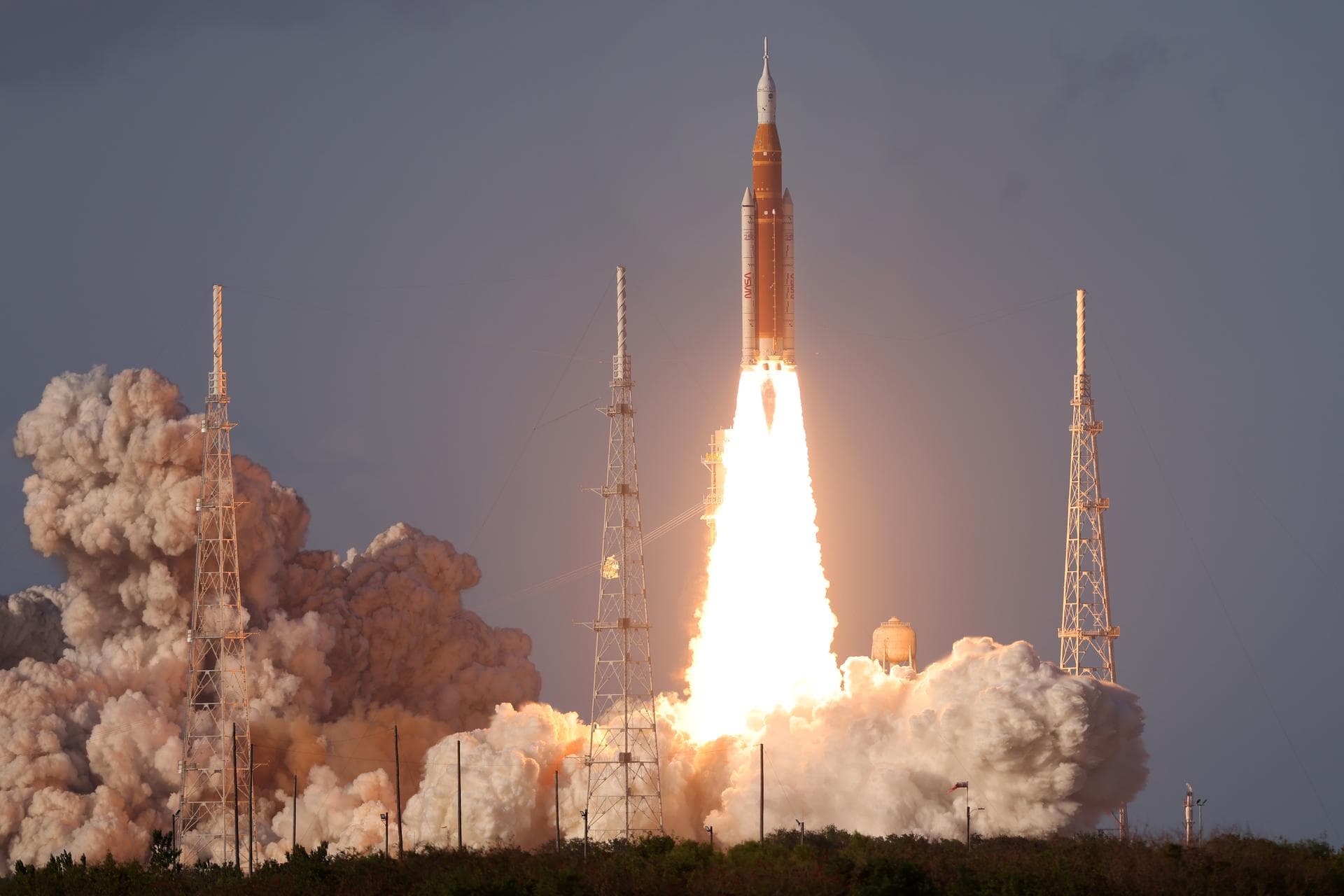
Webb launched folded inside its Ariane 5 payload fairing and completed hundreds of deployment steps in its first two weeks, unfurling the sunshield and latching the mirror wings into place. The Ariane 5 flew accurately enough, and the first mid-course correction was small enough, that Webb arrived at L2 holding far more station-keeping propellant than the mission required.[6] It entered its halo orbit on January 24, 2022.[1] President Joe Biden unveiled the first science image, a deep field of the galaxy cluster SMACS 0723, on July 11, 2022, and the rest of the first release followed a day later.[5]
Observatory design
Webb's primary mirror combines 18 gold-coated hexagonal beryllium segments, each adjustable to fractions of a wavelength, into a 6.5-meter surface with about six times Hubble's collecting area. A five-layer sunshield measuring 21.2 by 14.2 meters, about the size of a tennis court, keeps the telescope side below 50 kelvins so that its own heat does not swamp faint infrared signals; the mid-infrared instrument is chilled further, to about 7 kelvins, by a cryocooler.[1][3] Commissioning ended in July 2022 with all 17 science instrument modes checked out and image quality and sensitivity better than the requirements.[2]
The observatory has absorbed occasional micrometeoroid strikes. One in late May 2022 hit mirror segment C3 hard enough to leave a permanent deformation, raising that segment's wavefront error to 258 nanometers; engineers recovered most of the loss by repositioning segments, bringing the figure back to 178 nanometers.[2]
| Instrument | Wavelength range | Contributed by | Role |
|---|---|---|---|
| NIRCam | 0.6-5 microns | University of Arizona | Primary near-infrared camera and coronagraph |
| NIRSpec | 0.6-5.3 microns | ESA | Spectrograph observing up to about 100 objects at once |
| MIRI | 5-28 microns | ESA consortium and NASA JPL | Mid-infrared imaging and spectroscopy |
| FGS/NIRISS | 0.8-5 microns | Canadian Space Agency | Fine guidance and slitless spectroscopy |
Instrument performance
All four of Webb's instruments were working in mid-2026, but two problems with MIRI have shaped how it is used. On August 24, 2022, a grating wheel in the mid-infrared medium-resolution spectrometer showed increased friction, and observations in that mode were paused. Engineers traced the behavior to contact forces inside the wheel's central bearing assembly, tested revised operating parameters on November 2, 2022, and returned the mode to science.[7]
Routine calibration in April 2023 then showed that throughput at MIRI's longest wavelengths had dropped since commissioning, by 1 to 10 percent in spectrometer channel 3 and by 15 to 50 percent in channel 4. The Space Telescope Science Institute added a wavelength- and time-dependent flux correction to the calibration pipeline that summer; the root cause was still under investigation when the update was published.[8]
The early universe
Webb's deep surveys have pushed the galaxy distance record far beyond Hubble's reach. NIRSpec confirmed JADES-GS-z14-0 in 2024 at a redshift of about 14, less than 300 million years after the Big Bang, and it was already more than 1,600 light-years across and hundreds of millions of solar masses.[11] The record now belongs to MoM-z14, confirmed at redshift 14.44 and seen roughly 280 million years after the Big Bang.[12] Early galaxies proved more numerous and more luminous than most models predicted.[11]
The telescope also revealed a puzzling population of compact, faint crimson objects nicknamed "little red dots," and their nature is still disputed. Spectra published in Nature in January 2026 argue that their broad emission lines are widened by electron scattering in dense ionized gas rather than by orbital motion, which puts the central black holes at roughly 100,000 to 10 million solar masses, about a hundred times lighter than earlier estimates, and wraps them in gas cocoons; the authors describe the result as a "black hole star."[13] A 30-hour spectrum of the gravitationally lensed dot GLIMPSE-17775, released in June 2026, added more than 40 emission lines and an X-ray faintness consistent with that picture.[14] A competing model published in August 2026 instead casts at least some little red dots as supermassive stars of around 100,000 solar masses, pulsating and shedding shells of gas shortly before collapsing into black hole seeds.[15]
Webb has separately confirmed supermassive black holes feeding very early. CANUCS-LRD-z8.6 hosts one growing faster than models allow just 570 million years after the Big Bang.[16] In Abell2744-QSO1, seen about 700 million years after the Big Bang, the central black hole holds roughly 50 million solar masses, around two thirds of the galaxy's mass, thousands of times the ratio typical of nearby galaxies.[17]
Exoplanets
In 2022 Webb made the first clear detection of carbon dioxide in an exoplanet atmosphere, at the hot gas giant WASP-39 b.[18]
Rocky planets have been harder. Transit spectra of TRAPPIST-1 d reported in August 2025 rule out an Earth-like atmosphere containing water, methane, or carbon dioxide, leaving a thin Mars-like atmosphere, high Venus-like cloud, or no atmosphere at all.[19] Four transits of TRAPPIST-1 e, reported the following month, rule out a thick hydrogen-rich envelope but cannot yet separate a secondary atmosphere from bare rock. Contamination from the star's own spotted surface is the limiting problem, and further observations are underway.[20]
The most publicized exoplanet claim of the Webb era has not held up. A 2025 report of dimethyl sulfide, a gas produced on Earth by marine life, in the atmosphere of the sub-Neptune K2-18 b drew wide coverage, but reanalyses found the absorption features are not uniquely identifiable and that other molecules fit the data as well. A 2025 paper accepted by The Astronomical Journal concluded that the observations do not meet the standards of evidence for life and attributed the mid-infrared features to instrument noise.[21] The claim is contested, not established.
Direct imaging has produced results of its own. In June 2025 Webb captured evidence of a Saturn-mass planet orbiting the young star TWA 7, which would be its first direct-image planet discovery and the lightest planet yet imaged if confirmed.[22] In September 2025 it measured a carbon-rich, potentially moon-forming disk around the planetary-mass companion CT Cha b, finding seven carbon-bearing molecules that are absent from the disk around the host star.[23] MIRI coronagraphy in August 2024 turned up a candidate gas giant in the habitable zone of Alpha Centauri A, but attempts to recover it in February and April 2025 failed, and the object remains unconfirmed.[24]
Two 2026 results probed atmospheres in unusual places. In May astronomers reported that the giant planet WASP-94A b cycles daily between cloudy mornings and clear evenings, with clouds made of rock-forming minerals that condense and evaporate each day.[25] In July, Webb detected hydrocarbons, most likely methane, along with small cloud particles around WD 1856 b, the first atmosphere measured for a planet orbiting a white dwarf. The planet is four to eleven Jupiter masses and warmer than light from the dying star alone can explain.[26]
Solar system and interstellar visitors
Within the solar system, Webb has tracked storms on the giant planets and, working with the Keck II telescope, provided the first evidence of convective methane clouds in the northern hemisphere of Saturn's moon Titan, over the region that holds most of its lakes and seas.[27] A Webb survey of the Uranian system found the planet's 29th moon, S/2025 U1, in NIRCam images taken on February 2, 2025. The object is about 10 kilometers across and orbits roughly 56,000 kilometers from the planet's center, small enough to have escaped Voyager 2 in 1986.[28]
Its most watched target of 2025-2026 was 3I/ATLAS, the third known interstellar object, discovered on July 1, 2025. Webb's NIRSpec observations that August, taken while the comet was still 3.32 astronomical units from the Sun, revealed a coma dominated by carbon dioxide, with a CO2-to-water ratio of about 7.6, among the highest ever measured in any comet.[29] Webb observed it again as it moved back out from the Sun in December 2025 and measured a deuterium-to-hydrogen ratio about 30 times that of solar system comets, together with a shortage of carbon-13. NASA reported in June 2026 that both point to formation in a very cold environment early in the galaxy's history, possibly 10 to 12 billion years ago, long before the Sun existed.[30]
Operations status
The Webb observatory and all four of its instruments remained fully operational in mid-2026, four years into science operations. Webb was built to carry propellant for a 10.5-year mission; NASA said after launch that the surplus should support significantly more than a 10-year science lifetime, and the commissioning assessment put the reserve at more than 20 years.[6][2]
Interest from researchers keeps climbing. The Cycle 5 call drew 2,930 proposals, a record for any observatory and up from 2,377 for Cycle 4. Reviewers approved 254 programs out of 2,855 compliant submissions, among them 227 General Observer programs, and allocated 8,009 prime hours from the 99,782 requested, an oversubscription of about twelve to one. Cycle 5 runs from July 1, 2026 to June 30, 2027.[9][10]
To mark four years of science, NASA and ESA released near- and mid-infrared images of Centaurus A on July 6, 2026, resolving individual stars through the dust lanes that hide the galaxy's center in visible light.[31]
Funding pressure
Webb's operating budget has been under strain since 2025. In January 2025 the head of the Webb mission office at STScI said the mission was preparing for a cut of roughly 20 percent, one that would reach across observing efficiency, anomaly response, calibration, and the number of instrument modes offered to astronomers.[32] The fiscal 2026 budget request proposed reducing Webb's line from 187 million to 140 million dollars, and STScI told astronomers in June 2025 that science operations might have to shrink by 25 to 35 percent.[33] Congress rejected the reduction. The fiscal 2026 appropriations passed in January 2026 funded NASA science at 7.25 billion dollars and Webb at 208 million.[34]
Mission timeline
| Date | Event |
|---|---|
| 1996 | Project begins as the Next Generation Space Telescope[3] |
| 2011 | Near-cancellation in Congress; rebaselined at 8.8 billion dollars for an October 2018 launch[4] |
| December 25, 2021 | Launch on an Ariane 5 ECA from Kourou[1] |
| January 24, 2022 | Arrival in halo orbit around Sun-Earth L2[1] |
| July 11-12, 2022 | First science images and spectra released[5] |
| August 2022 | First clear detection of carbon dioxide in an exoplanet atmosphere[18] |
| May 2024 | JADES-GS-z14-0 confirmed at a redshift of about 14[11] |
| August 2025 | Uranus's 29th moon announced; candidate planet reported at Alpha Centauri A[28][24] |
| November 2025 | Feeding supermassive black hole confirmed 570 million years after the Big Bang[16] |
| June 2026 | Isotopes date interstellar comet 3I/ATLAS to the early galaxy[30] |
| July 1, 2026 | Cycle 5 observations begin[9] |
References
- James Webb Space Telescope - NASA.
- The Science Performance of JWST as Characterized in Commissioning - Rigby et al., arXiv preprint, published in Publications of the Astronomical Society of the Pacific 135, 048001 (2023).
- The James Webb Space Telescope Mission - Gardner et al., arXiv preprint, published in Publications of the Astronomical Society of the Pacific 135, 068001 (2023).
- James Webb Space Telescope: Project Nearing Completion, but Work to Resolve Challenges Continues - U.S. Government Accountability Office, GAO-21-406, May 2021.
- President Biden Reveals First Image from NASA's Webb Telescope - NASA, July 11, 2022.
- NASA Says Webb's Excess Fuel Likely to Extend Its Lifetime Expectations - NASA, December 29, 2021.
- MIRI Medium Resolution Spectroscopy Is Returning to Science Observations - Space Telescope Science Institute, November 2022.
- MIRI MRS Reduced Count Rate Update - Space Telescope Science Institute, May 2023.
- JWST Cycle 5 Proposal Selection - Space Telescope Science Institute.
- STScI Announces the JWST Cycle 4 General Observer Program - Space Telescope Science Institute, March 2025.
- NASA's James Webb Space Telescope Finds Most Distant Known Galaxy - NASA, May 30, 2024.
- A Cosmic Miracle: A Remarkably Luminous Galaxy at z=14.44 Confirmed with JWST - Naidu et al., arXiv preprint.
- Little red dots as young supermassive black holes in dense ionized cocoons - Rusakov et al., Nature 649, 574-579 (2026).
- Webb finds strongest evidence yet for "black hole stars" - ESA/Webb, June 10, 2026.
- "Little red dots" may be pulsating monster stars that created early-universe black holes - Phys.org, August 2026.
- Webb witnesses a feasting supermassive black hole in the early Universe - ESA/Webb, November 19, 2025.
- Webb reveals black hole that formed before its galaxy - ESA/Webb, May 27, 2026.
- NASA's Webb Detects Carbon Dioxide in Exoplanet Atmosphere - NASA Jet Propulsion Laboratory, August 2022.
- Webb narrows atmospheric possibilities for Earth-sized exoplanet TRAPPIST-1 d - ESA/Webb, August 2025.
- NASA Webb Looks at Earth-Sized, Habitable-Zone Exoplanet TRAPPIST-1 e - Space Telescope Science Institute, September 8, 2025.
- K2-18b Does Not Meet the Standards of Evidence for Life - Stevenson et al., arXiv preprint, accepted by The Astronomical Journal.
- Webb captures evidence of a lightweight planet around TWA 7 - ESA/Webb, June 25, 2025.
- Webb studies moon-forming disc around massive planet - ESA/Webb, September 2025.
- NASA's Webb Finds New Evidence for Planet Around Closest Solar Twin - NASA Jet Propulsion Laboratory, August 7, 2025.
- NASA's Webb telescope discovers a planet where rock clouds vanish every night - ScienceDaily.
- NASA's Webb Studies How Planet Survived Death of its Star - NASA, July 1, 2026.
- Webb's Titan Forecast: Partly Cloudy With Occasional Methane Showers - NASA, May 2025.
- SwRI-led Webb Telescope survey discovers new moon orbiting Uranus - Southwest Research Institute, August 2025.
- JWST detection of a carbon dioxide dominated gas coma surrounding interstellar object 3I/ATLAS - Cordiner et al., arXiv preprint, accepted by The Astrophysical Journal Letters.
- NASA's Webb Finds Clues to Ancient, Distant Origin of Comet 3I/ATLAS - NASA, June 2026.
- Webb uncovers unusual galaxy shaped by cosmic collision - ESA/Webb, July 6, 2026.
- JWST facing potential cuts to its operational budget - SpaceNews, January 25, 2025.
- James Webb, Hubble space telescopes face reduction in operations - Astronomy, June 2025.
- You just saved NASA's budget - The Planetary Society, January 2026.