Apollo 11 was the first crewed mission to land on the Moon. NASA astronauts Neil Armstrong and Buzz Aldrin landed the lunar module Eagle in the Sea of Tranquility on July 20, 1969, while Michael Collins orbited above in the command module Columbia.[1][2] The two moonwalkers spent 21 hours 36 minutes on the surface[2][3] and brought home 21.6 kilograms of lunar rock and soil.[10]
Launched by NASA on July 16, 1969, the mission carried commander Armstrong, command module pilot Collins, and lunar module pilot Aldrin; Armstrong stepped onto the surface about six and a half hours after touchdown.[1][2] The flight lasted 195 hours 18 minutes 35 seconds from liftoff to splashdown,[2] and it was the first of the Apollo program's six landings. The landing fulfilled President John F. Kennedy's 1961 goal of reaching the Moon before the end of the decade and effectively decided the Space Race. NASA estimates that 650 million people watched the first steps on live television, the largest broadcast audience to that date.[2]
Crew
| Role | Astronaut | Prior spaceflight |
|---|---|---|
| Commander | Neil Armstrong | Gemini 8 |
| Command module pilot | Michael Collins | Gemini 10 |
| Lunar module pilot | Buzz Aldrin | Gemini 12 |
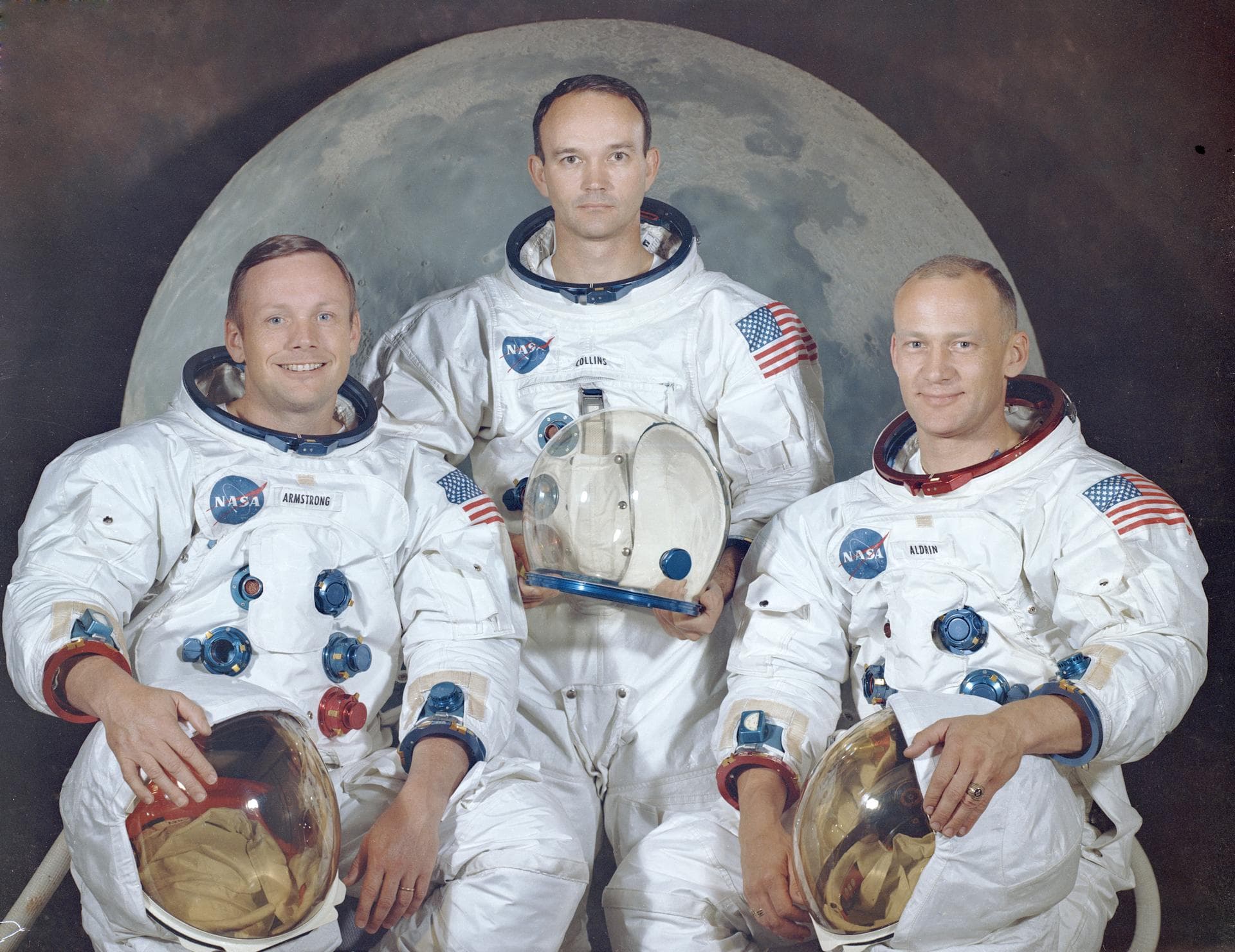
Apollo 11's three astronauts were all born in 1930, and each had flown once during the Gemini program. Armstrong, a civilian former test pilot, had salvaged Gemini 8 after a stuck thruster sent it tumbling in 1966, and Aldrin had written a doctoral thesis on orbital rendezvous. NASA named the crew on January 9, 1969, with James Lovell, William Anders, and Fred Haise as backups; Collins had been assigned to Apollo 8 but was moved off after surgery on a bone spur in his spine, and rejoined the rotation on Apollo 11.[4] Collins would keep Columbia running alone in lunar orbit, out of contact with Earth during each pass behind the Moon.[2]
Mission timeline
Ground elapsed time on Apollo 11 was measured from liftoff, which is why the clock and the calendar diverge over the eight days of the flight.
| Event | Ground elapsed time | Date and time (UTC) |
|---|---|---|
| Liftoff from Launch Complex 39A | 000:00:00 | July 16, 13:32:00 |
| Translunar injection | 002:44 | July 16, 16:16 |
| Lunar orbit insertion | 075:50 | July 19, 17:22 |
| Eagle undocks from Columbia | 100:12 | July 20, 17:44 |
| Powered descent begins | 102:33 | July 20, 20:05 |
| Touchdown at Tranquility Base | 102:45:40 | July 20, 20:17:40 |
| Armstrong steps onto the surface | 109:24:15 | July 21, 02:56:15 |
| Moonwalk ends, hatch closed | 111:39 | July 21, 05:11 |
| Ascent stage lifts off | 124:22 | July 21, 17:54 |
| Trans-Earth injection | 135:23:42 | July 22, 04:55:42 |
| Splashdown in the Pacific | 195:18:35 | July 24, 16:50:35 |
Sources: NASA's mission overview, the Apollo Lunar Surface Journal, and the Apollo Flight Journal.[2][3][5][8][22]
Launch and outbound journey
Apollo 11 lifted off atop a Saturn V rocket, vehicle SA-506, from Launch Complex 39A at the Kennedy Space Center at 13:32 UTC on July 16, 1969, before an estimated one million spectators on the surrounding beaches and causeways.[2] The vehicle put the spacecraft into a parking orbit of about 114 by 116 miles, and after one and a half revolutions the S-IVB third stage reignited for a burn of 5 minutes 48 seconds that sent it toward the Moon. Columbia then turned around, docked with Eagle, and pulled the lander free of the spent stage.[2]
The spacecraft reached the Moon after a three-day cruise. On July 19, behind the Moon and out of radio contact, the service propulsion engine fired retrograde for 357.5 seconds to drop into an elliptical orbit of 69 by 190 miles; a second 17-second burn circularized it to roughly 62 by 70.5 miles.[2]
Landing at Tranquility Base
The lunar module Eagle undocked from the command module Columbia on July 20, 1969, and began its powered descent with Armstrong and Aldrin standing at its controls, the engine running for about 12 and a half minutes from an altitude of 50,000 feet.[2] Five computer program alarms sounded during the descent, two 1202 alarms during the braking phase, then a 1201 and two more 1202s during the approach.[7] Both codes signaled that the guidance computer had run out of scheduling memory: 1202 meant no free core sets, 1201 no free vector accumulator areas.[6] The cause was traced to the rendezvous radar, which had been left in a mode where its reference signal and the computer's were locked in frequency but not in phase, so the coupling data units incremented the computer's counters almost continuously and stole roughly 13 percent of its processing time.[7] The software's restart protection flushed the incomplete work and reinstated the tasks that mattered, and flight controllers in Houston judged that the landing could continue.[5][6]
Nearing the surface, Armstrong saw the autopilot steering toward a boulder field, later identified as ejecta from West Crater, took semi-manual control, and flew the module several hundred meters farther downrange to a clear spot.[5] Eagle touched down at 20:17:40 UTC on July 20, farther west than the aim point, at 0.67409 degrees north and 23.47298 degrees east in Mare Tranquillitatis.[3][5]
How much propellant was left at touchdown is often misstated. The "60 seconds" and "30 seconds" calls that capsule communicator Charlie Duke read up during the final approach counted down to a land-or-abort decision, not to an empty tank, and the descent quantity light had latched with 5.6 percent of the original load showing.[5] Post-flight analysis put about 770 pounds of propellant in the tanks at touchdown, of which roughly 100 pounds was unusable. The Apollo 11 Mission Report figured the remainder at about 45 more seconds of flying, including some 20 seconds held back for an abort. Sloshing in the tanks while Armstrong pitched the vehicle over to fly past the crater had made the gauges read low, so the situation in the cockpit looked tighter than it was.[5] Armstrong then radioed, "Houston, Tranquility Base here. The Eagle has landed."[1]
One small step
Neil Armstrong descended Eagle's ladder and set foot on the Moon at 02:56:15 UTC on July 21, 1969, saying, "That's one small step for man, one giant leap for mankind."[8] He maintained afterward that he had said, or at least intended to say, "one small step for a man." The word is not audible in the transmission, and its fate remains disputed: a 2006 audio analysis claimed to detect a compressed "a," while later acoustic and linguistic studies concluded the recording is ambiguous and that speakers from Armstrong's part of Ohio often blend "for a" into a single sound. NASA transcripts render the line with the "a" in parentheses.[8]
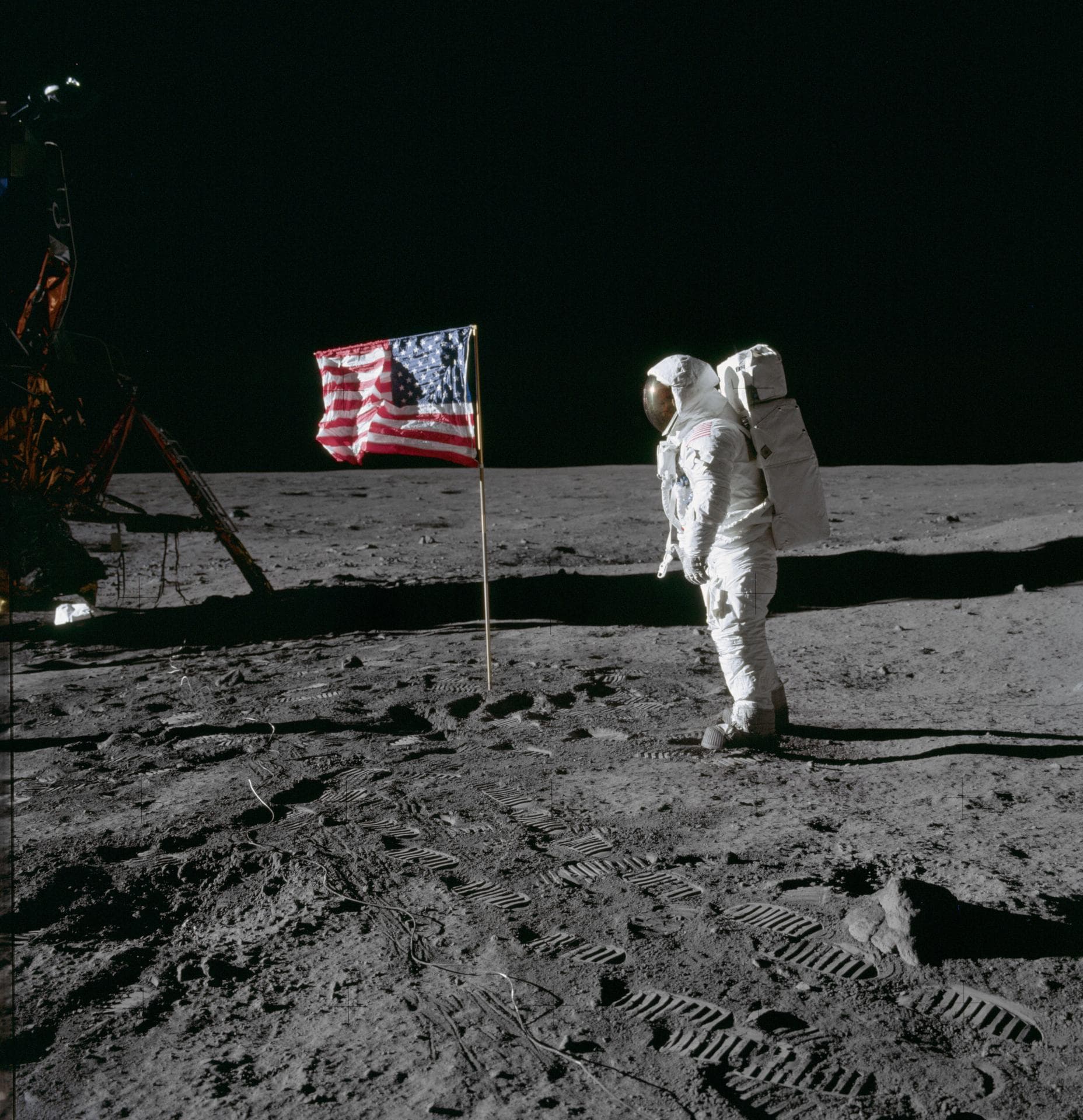
His first task was a contingency sample, a scoop of soil pocketed early so that something would come home even if the moonwalk had to be cut short. Aldrin joined him 19 minutes later and described the scene as "magnificent desolation."[8] During a single moonwalk of 2 hours 31 minutes, the two men collected samples, photographed the terrain, planted a United States flag, took a phone call from President Richard Nixon, and unveiled a plaque bolted to the ladder strut of the descent stage.[1][3] NASA renders its text as "Here men from the planet Earth first set foot upon the moon, July 1969 A.D. We came in peace for all mankind," under the signatures of the three astronauts and the president.[9] They ventured no farther than about 60 meters from the lander; Armstrong made an unscheduled walk that far east to photograph Little West crater, the 30-meter pit Eagle had flown over on the way in.[19]
Science on the surface
Apollo 11 carried the Early Apollo Scientific Experiments Package (EASEP), a simplified forerunner of the nuclear-powered stations left by later crews. Its seismometer ran on two panels of solar cells and carried four sensors for moonquakes and meteoroid strikes; it returned a useful first look at lunar seismology before it stopped answering commands at 04:00 UTC on August 25, 1969, most likely from overheating in the midday Sun.[12] The package's Laser Ranging Retroreflector, an array of 100 fused silica corner cubes, is still used by observatories in New Mexico, France, Italy, and Germany to time laser pulses off the Moon. The technique fixes the Earth-Moon distance to within a few millimeters and shows the Moon receding by about 3.8 centimeters a year.[13]
Aldrin also deployed a solar wind composition experiment, a sheet of aluminum foil 1.4 by 0.3 meters hung on a pole facing the Sun. It was the only non-American experiment flown on an Apollo landing, built at the University of Bern under Johannes Geiss, who persuaded NASA to put it out before the flag so that it would catch as much solar wind as possible. The foil was exposed for 77 minutes, then rolled up and brought home, giving the first direct measurements of noble gases in the solar wind.[11]
The crew brought back 21.6 kilograms of material, including about 50 rocks, bagged regolith, and two core tubes that reached some 13 centimeters below the surface.[10] The rocks are basalts unusually rich in titanium, dated to roughly 3.6 to 3.9 billion years, the first direct evidence of the Moon's volcanic history and great age. Three minerals unknown on Earth were identified in them: armalcolite, named for Armstrong, Aldrin, and Collins, along with pyroxferroite and tranquillityite.[10][14]
Leaving the Moon
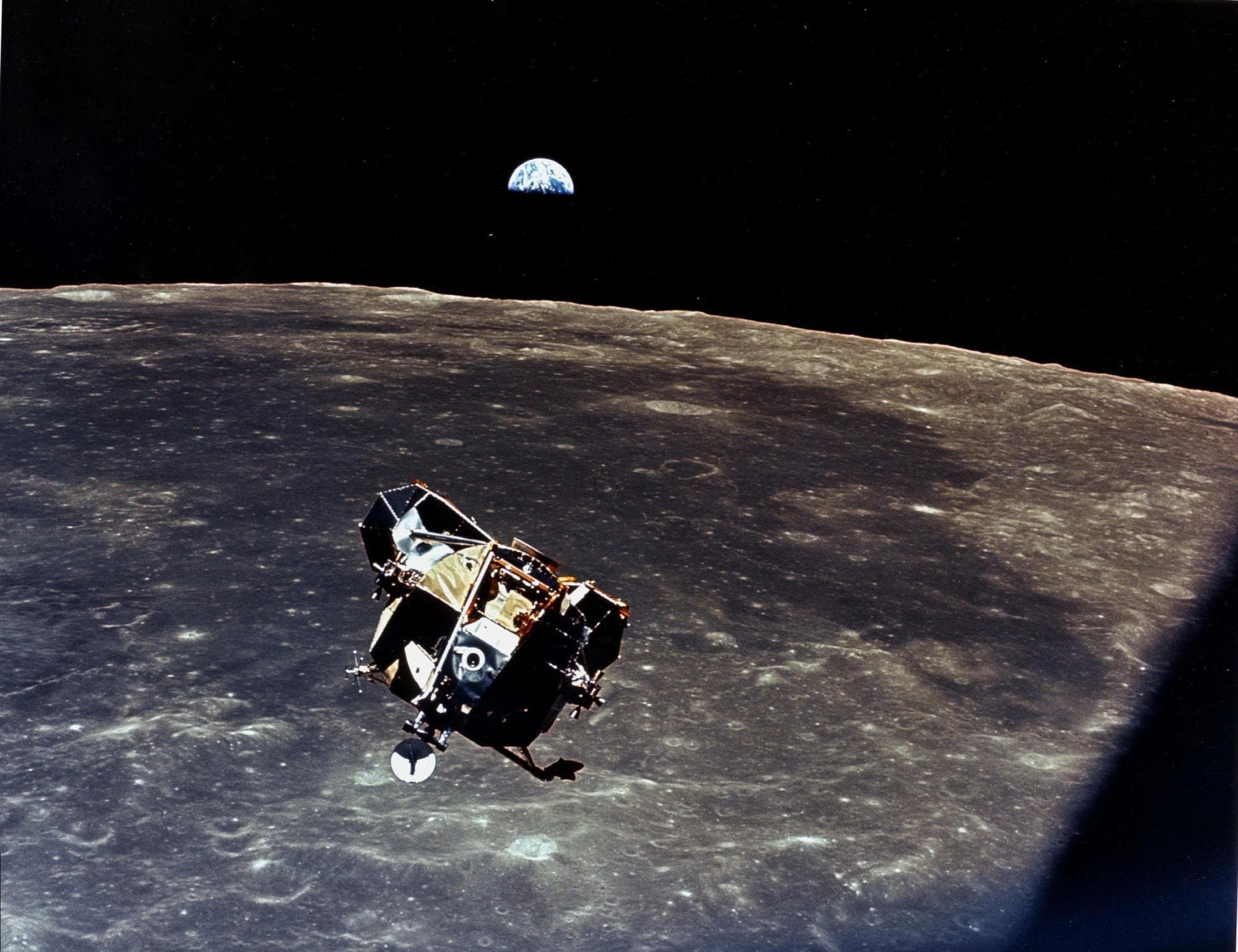
After 21 hours 36 minutes on the lunar surface, the ascent stage of the lunar module Eagle lifted off at 17:54 UTC on July 21, 1969.[2][3] Aldrin, looking out as the engine fired, saw the flag blown over by its exhaust; Lunar Reconnaissance Orbiter images taken decades later show flags still standing at every Apollo landing site except this one.[23] The ascent stage rendezvoused and docked with Columbia later that day, the crew transferred the samples, film, and themselves across, and the lander was cast off into lunar orbit.[1] Columbia spent about 59.5 hours in lunar orbit across 30 revolutions in all,[3] and left for home with a 2 minute 28 second service propulsion burn at 04:55:42 UTC on July 22.[22]
Eagle's ascent stage was never tracked to an impact and its fate is not recorded. A 2021 orbital study by James Meador, submitted to Planetary and Space Science, simulated the abandoned stage forward from its last known orbit and found that variations in eccentricity and the precession of the orbit's apsidal line can offset each other, leaving open the possibility that it is still circling the Moon.[15]
Return and quarantine
The command module Columbia splashed down in the Pacific Ocean at 16:50:35 UTC on July 24, 1969, about 1,500 kilometers southwest of Hawaii and 13 miles (21 kilometers) from the recovery carrier USS Hornet.[2] Because scientists could not yet rule out lunar microorganisms, the astronauts donned biological isolation garments in the water, entered a sealed trailer aboard the carrier, and were greeted by President Nixon through its window. They finished a 21-day quarantine at the Lunar Receiving Laboratory in Houston and were released on August 10, 1969, after no sign of contamination appeared. The quarantine protocol was dropped after Apollo 14.[1]
The speech that was never given
Two days before Apollo 11's landing, on July 18, 1969, White House speechwriter Bill Safire sent chief of staff H. R. Haldeman a memo headed "IN EVENT OF MOON DISASTER," in case Armstrong and Aldrin reached the surface and could not leave it. The statement drafted for Nixon opens, "Fate has ordained that the men who went to the moon to explore in peace will stay on the moon to rest in peace," and closes on the thought that anyone looking up at the Moon afterwards would know "there is some corner of another world that is forever mankind." The memo adds that the president should telephone each of the widows-to-be first, and that once NASA ended communications a clergyman should follow the procedure for burial at sea. It was never used, and the typescript survives in the Nixon papers at the National Archives.[16]
Artifacts and legacy
The Apollo 11 command module Columbia is displayed at the Smithsonian's National Air and Space Museum in Washington, which also conserved and re-displayed Armstrong's spacesuit for the landing's 50th anniversary in 2019.[17] Left at Tranquility Base are the descent stage, the two EASEP instruments, the flag, and the plaque, together with a shoulder patch from Apollo 1, whose crew died in a fire during a launch rehearsal, and medals for two Soviet cosmonauts killed in their country's space program.[24] The crew also left a small silicon disc carrying statements by Presidents Eisenhower, Kennedy, Johnson, and Nixon and goodwill messages from the leaders of 73 countries.[25] The site gained legal protection under the One Small Step to Protect Human Heritage in Space Act, Public Law 116-275, signed on December 31, 2020, which requires companies working with NASA on lunar missions to abide by the agency's guidance on keeping clear of United States landing sites and artifacts.[20]
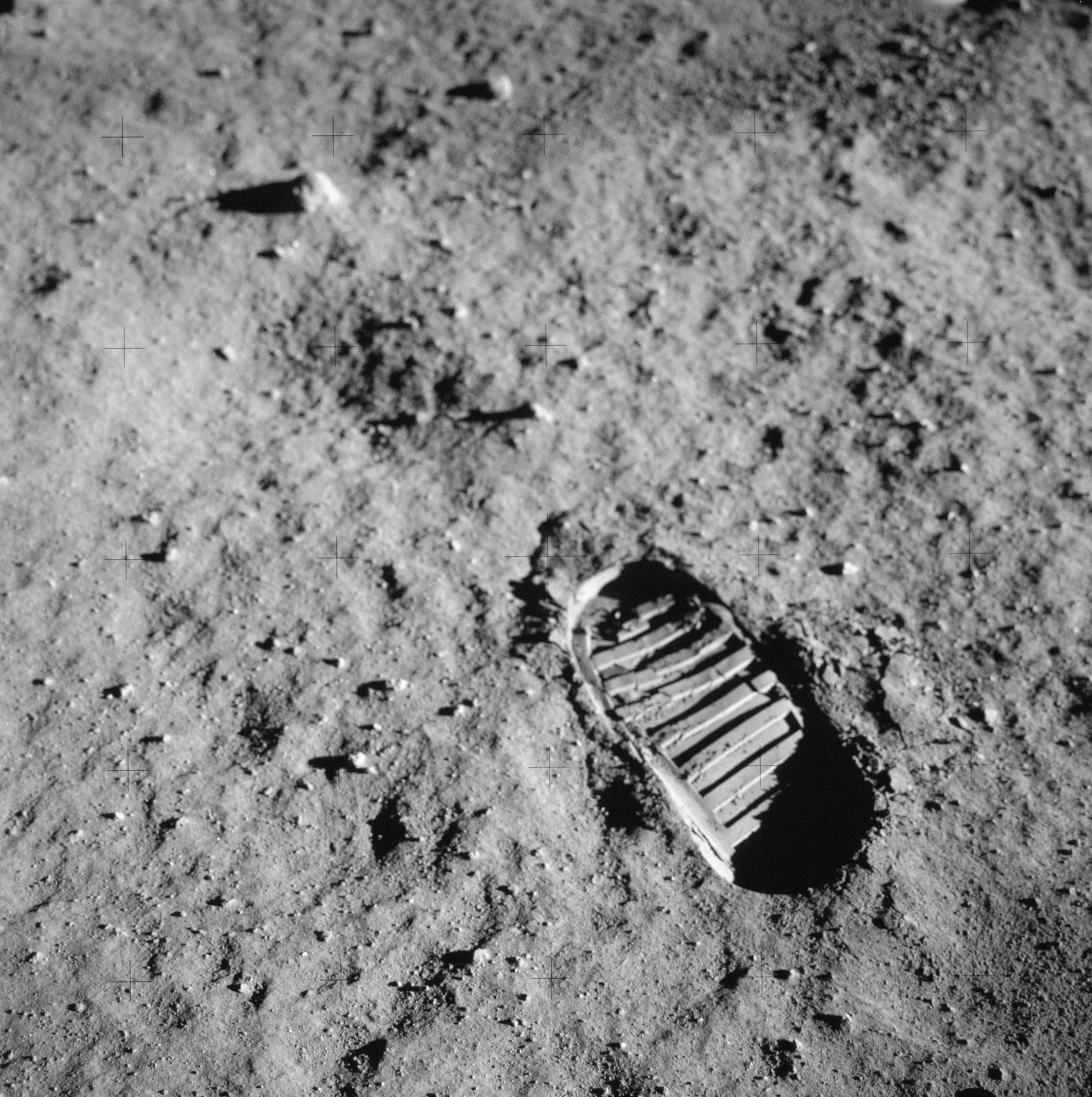
NASA's Lunar Reconnaissance Orbiter first photographed the site in July 2009, catching the descent stage as the largest object left behind.[18] Sharper passes since then resolve the retroreflector and the seismometer as separate objects and show the crew's tracks as dark scuffs in the regolith, including the path out to Little West crater and back.[19]
Armstrong died in 2012 and Collins in 2021, leaving Aldrin, who turned 96 in January 2026, as the last surviving crew member and the oldest living astronaut.[26] NASA's return to crewed lunar flight, the Artemis program, sent the Artemis II crew around the Moon on April 1-10, 2026, the first astronauts to leave low Earth orbit since Apollo 17 in 1972.[21] The Apollo 11 sample collection remains under active study more than five decades after its return.[10]
References
- Apollo 11 - NASA.
- Apollo 11 Mission Overview - NASA.
- Apollo 11 Lunar Surface Journal: Mission Overview - NASA History Office.
- 50 Years Ago: NASA Names Apollo 11 Crew - NASA, January 2019.
- The First Lunar Landing - Apollo 11 Lunar Surface Journal, edited by Eric M. Jones and Ken Glover.
- Apollo 11 Program Alarms - Apollo 11 Lunar Surface Journal, NASA.
- Don Eyles, Tales from the Lunar Module Guidance Computer - paper AAS 04-064, 27th Annual Guidance and Control Conference, 2004.
- One Small Step - Apollo 11 Lunar Surface Journal.
- Apollo 11 Plaque - NASA Science.
- Apollo 11 Mission - Lunar and Planetary Institute.
- Europeans in Apollo: First flag on the Moon? - European Space Agency.
- Apollo 11 Seismic Experiment - NASA Science.
- The Apollo Experiment That Keeps on Giving - NASA Jet Propulsion Laboratory.
- Armalcolite: A New Mineral from the Apollo 11 Samples - Apollo 11 Lunar Science Conference, 1970, NASA Technical Reports Server.
- Is the Apollo 11 Lunar Module Ascent Stage Still in Lunar Orbit? - SpaceNews, 2021.
- In Event of Moon Disaster - memorandum from Bill Safire to H. R. Haldeman, July 18, 1969, National Archives.
- Command Module, Apollo 11 - Smithsonian National Air and Space Museum.
- Apollo 11 Landing Site - NASA Earth Observatory.
- Apollo 11 Little West Crater Panorama - The Planetary Society.
- One Small Step to Protect Human Heritage in Space Act, Public Law 116-275 - Congress.gov.
- Artemis II - NASA.
- Day 6, part 4: Trans-Earth Injection - Apollo 11 Flight Journal.
- Question Answered! - Lunar Reconnaissance Orbiter Camera, Arizona State University.
- Apollo 11: Did You Know? - NASA StarChild, Goddard Space Flight Center.
- Apollo 11 Goodwill Messages - NASA news release 69-83F, July 13, 1969.
- Oldest Astronaut Buzz Aldrin Turns 96 as New Moon Astronauts Share Apollo Inspirations - Phys.org, January 2026.