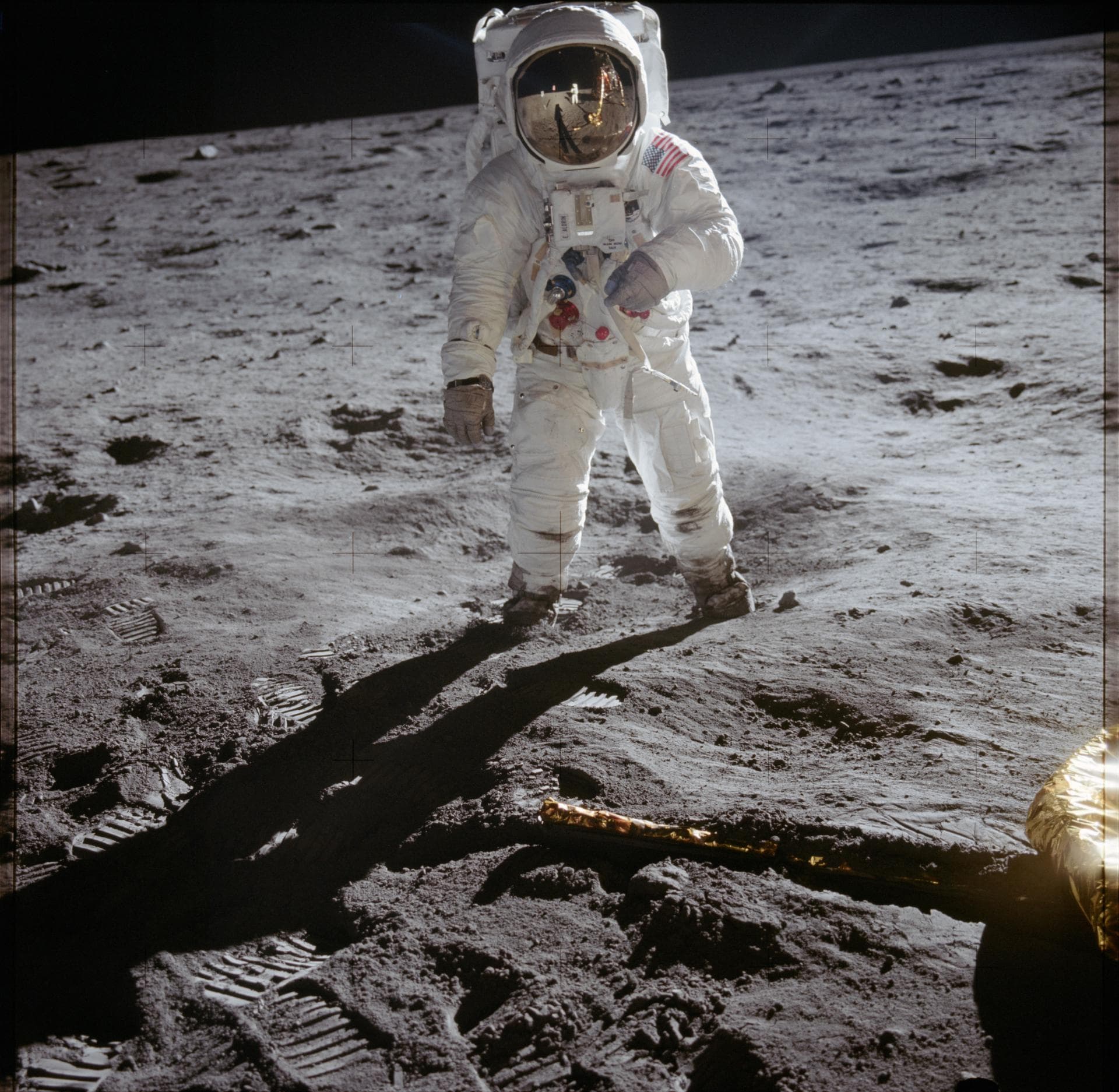
The Apollo program was the United States human spaceflight effort that carried the first people to the Moon. Run by NASA from 1961 to 1972, it flew 11 crewed missions and put 12 astronauts on the lunar surface across six landings between July 1969 and December 1972.[2][4] Nine of those missions traveled to the Moon and back, carrying 24 different astronauts; Jim Lovell, John Young, and Eugene Cernan each made the trip twice.[2]
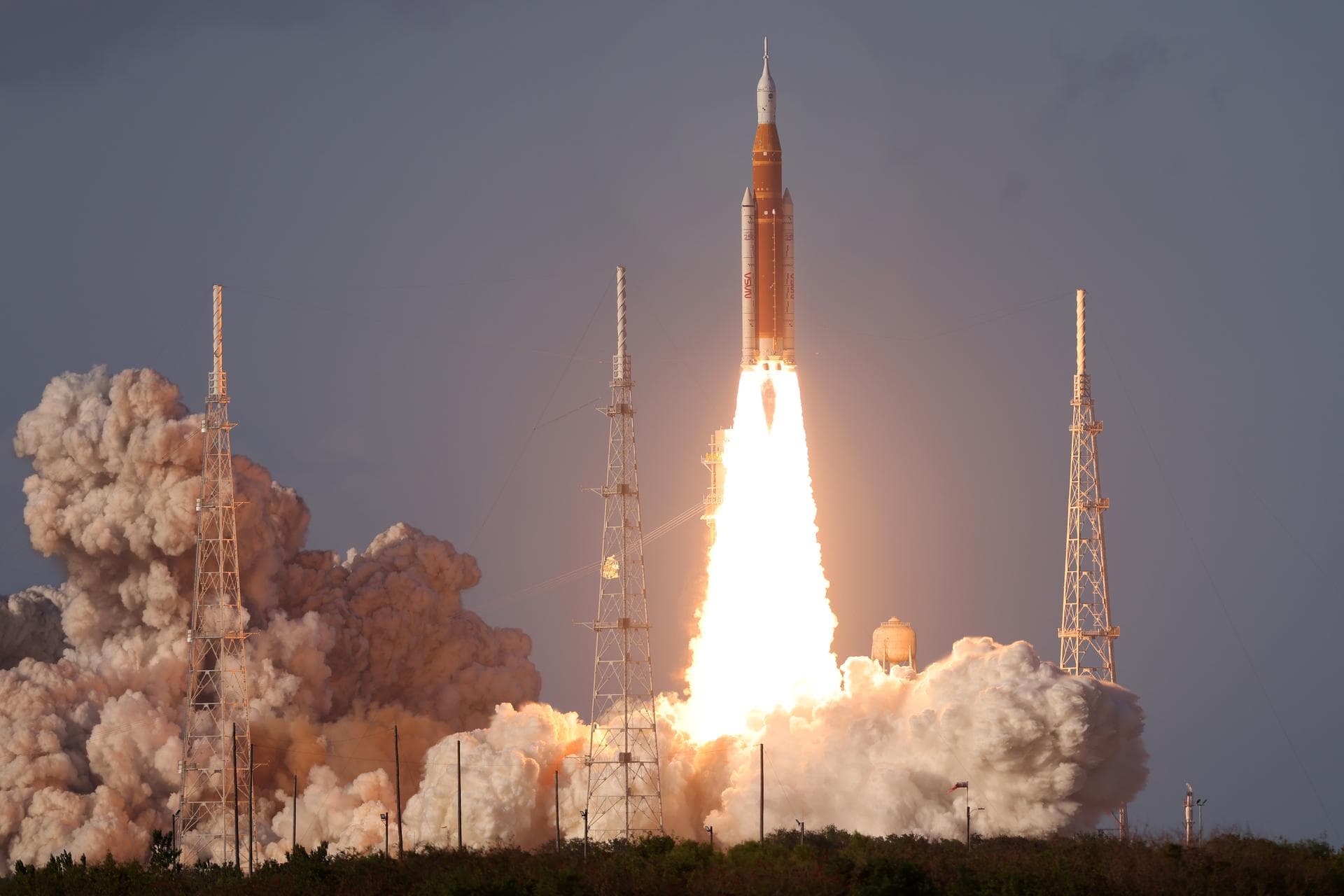
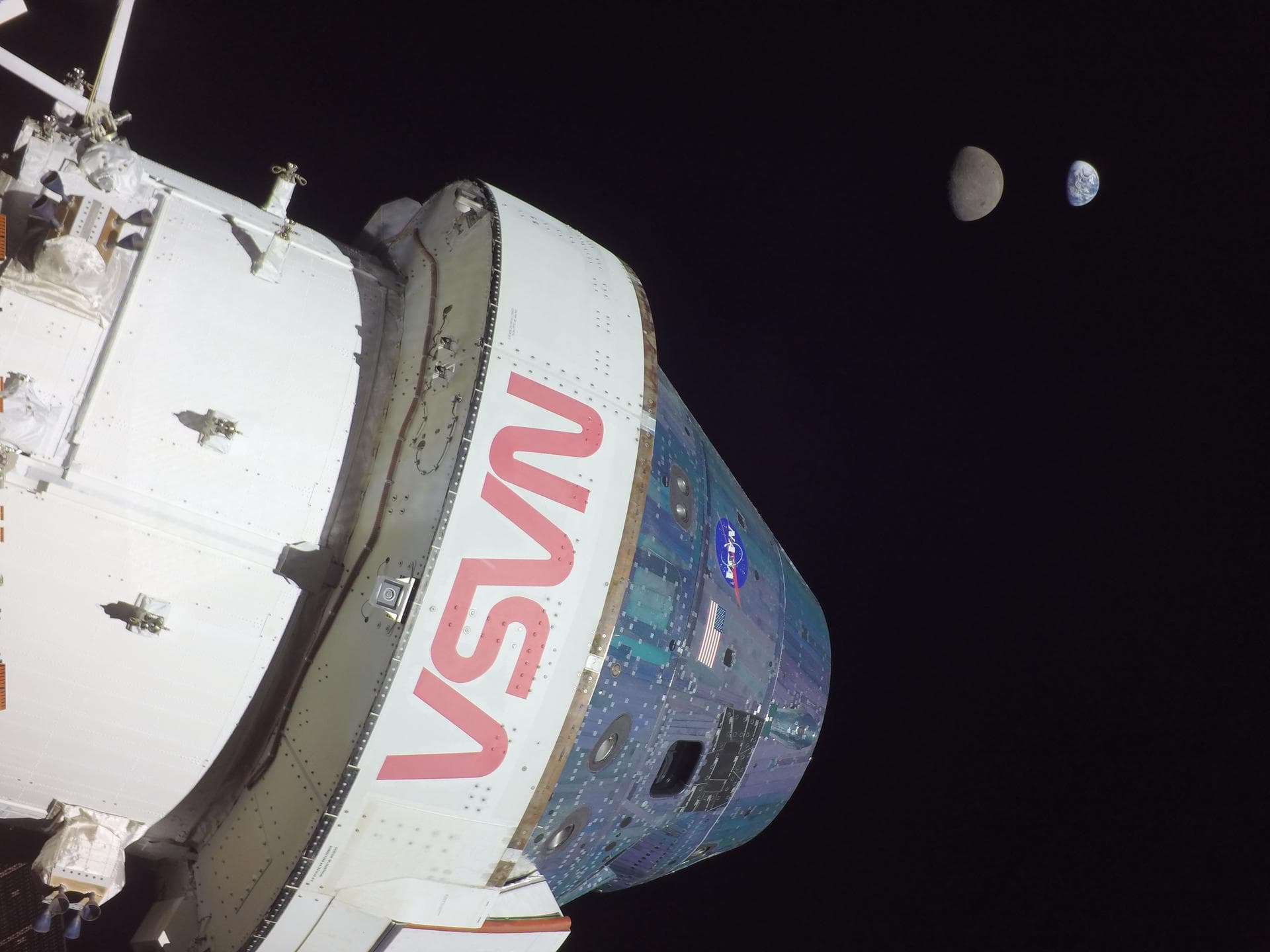
Apollo grew directly out of the Space Race with the Soviet Union. The program cost 25.8 billion dollars between 1960 and 1973, roughly 309 billion in 2025 dollars, and employed about 400,000 Americans at its peak.[1][9] Its landing crews returned 382 kilograms of rock and soil that remain central to lunar science more than 50 years later.[5] After Apollo 17 in December 1972, no human traveled beyond low Earth orbit until the Artemis program flew a crew around the Moon in April 2026.[7][24]
Origins and Kennedy's commitment
Apollo predates the commitment to land on the Moon: NASA was already sketching a crewed spacecraft to follow Mercury before any lunar landing was authorized. At a program plans conference in Washington in July 1960, the agency introduced a then unnamed circumlunar project, and Abe Silverstein, its director of space flight development, proposed calling it Apollo after the Greek god.[26]
The political trigger came in the spring of 1961. Soviet cosmonaut Yuri Gagarin orbited Earth on April 12, and Alan Shepard's 15-minute suborbital flight on May 5 was the entire American response. On May 25, 1961, President John F. Kennedy asked a joint session of Congress to commit the nation "to achieving the goal, before this decade is out, of landing a man on the moon and returning him safely to the earth."[3]
Congress funded the goal on a scale no science project had seen. NASA's budget climbed to about 4.4 percent of all federal spending in 1966, and the agency and its contractors eventually employed some 400,000 engineers, technicians, and support staff at roughly 20,000 companies and universities.[1][9] Apollo also crowded out the rest of the agency: its share of NASA's own appropriations rose from a tenth in 1962 to about 70 percent in 1967.[2]
Choosing the mission mode
Before Apollo hardware could be frozen, NASA had to decide how a crew would actually reach the lunar surface and get home. Three approaches competed. Direct ascent would land a single fueled spacecraft on the Moon and needed the Nova rocket, roughly twice the size of anything then planned. Earth orbit rendezvous would assemble or refuel the lunar spacecraft in Earth orbit, avoiding a giant booster at the cost of orbital operations nobody had attempted. Lunar orbit rendezvous (LOR) would send one Saturn V, park a command and service module (CSM) in lunar orbit, and land only a small, lightweight lunar module (LM) that would return to orbit and rendezvous before the trip home.[8]
| Mode | What goes to the Moon | Rockets required | Main drawback |
|---|---|---|---|
| Direct ascent | One spacecraft that lands whole, fully fueled | Nova, with nearly twice the Saturn V's thrust | Development too slow for Kennedy's deadline |
| Earth orbit rendezvous | A lunar spacecraft assembled or refueled in Earth orbit | Multiple Saturn launches | Untried orbital assembly; a single failed launch endangered the mission |
| Lunar orbit rendezvous | A command and service module to lunar orbit; only the lightweight lunar module lands | One Saturn V | Crewed rendezvous far from Earth |
Direct ascent's Nova would have needed about 12 million pounds of liftoff thrust, nearly twice the Saturn V's capacity, and most engineers doubted it could fly before the end of the decade.[8] The price of LOR was that a failed rendezvous in lunar orbit would strand a crew 240,000 miles from home with no possible rescue.[8]
LOR started as the least popular option. Langley engineer John Houbolt had worked on it since 1959 and eventually wrote directly to NASA's associate administrator over the heads of his management chain to argue for it.[8][9] The mass advantage proved decisive: landing only the LM cut what had to be decelerated to the surface and hauled back off it, so one rocket in the Saturn class could fly the whole mission. Wernher von Braun, who had favored Earth orbit rendezvous, came around in the spring of 1962. NASA management settled on LOR on June 22, 1962, and Administrator James E. Webb announced the decision publicly on July 11, 1962, calling it the most desirable choice on time, cost, and mission accomplishment.[8]
The choice fixed the shape of the hardware: two crewed spacecraft that separated in lunar orbit, and a lander built only for vacuum and one-sixth gravity rather than for launch loads and reentry.[8]
Gemini and the Saturn V
Apollo's lunar orbit rendezvous plan demanded techniques nobody had performed in space. The two-person Gemini program supplied them, flying ten crewed missions in 1965 and 1966 that demonstrated orbital rendezvous, docking, spacewalks, and flights lasting up to 14 days.[4] Langley also built a Lunar Landing Research Facility that suspended a training vehicle from an overhead gantry to simulate one-sixth gravity; 24 astronauts flew it, including Neil Armstrong and Buzz Aldrin.[9]
The launch vehicle came from the Saturn family developed under von Braun at the Marshall Space Flight Center. The three-stage Saturn V stood 110.6 meters (363 feet) tall and produced about 33.8 meganewtons (7.6 million pounds) of thrust at liftoff.[27] The spacecraft stack it sent toward the Moon grew from 45.7 tonnes on Apollo 11 to 48.6 tonnes on the last three missions.[2] Twelve Saturn V rockets flew Apollo missions between 1967 and 1972, and a thirteenth launched the Skylab station in 1973, without a lost crew or payload.[2][22]
The Apollo 1 fire
On January 27, 1967, a fire swept through the Apollo 1 command module during a plugs-out launch rehearsal at Launch Complex 34, Cape Kennedy, killing astronauts Gus Grissom, Ed White, and Roger Chaffee. The spacecraft, designated AS-204, was sealed and pressurized with pure oxygen at 16.7 pounds per square inch, slightly above outside air pressure, for a mission then scheduled to launch on February 21. The fire started at 6:31 p.m. Eastern time and ruptured the cabin within seconds; the crew died of asphyxia from carbon monoxide and toxic gases before the burns could kill them.[6][10]
The Apollo 204 Review Board released a report running to some 3,000 pages on April 9, 1967. It could not identify a single ignition source but found arcing in wiring beneath Grissom's couch near the environmental control system, and it blamed the speed of the fire on the pure-oxygen atmosphere, the quantity of combustible material in the cabin, and a three-piece inward-opening hatch that could not be released in time.[6]
Crewed flights stopped for more than 20 months while the command module was rebuilt. The hatch was replaced with a single unit that could be opened in about three seconds from inside or outside, flammable materials were sharply restricted, fire-resistant suits were developed, and the same changes were applied to the lunar module. All later crews flew the improved Block II spacecraft, and NASA set up an independent safety and quality assurance office along with the Aerospace Safety Advisory Panel, which still operates.[6] On March 14, 1968, acting on a flammability review board chaired by Robert Gilruth, NASA also changed the launch-pad atmosphere to 60 percent oxygen and 40 percent nitrogen at 16 pounds per square inch, with the cabin bleeding down to pure oxygen at 5 pounds per square inch once in orbit.[11]
Test flights
Apollo hardware was proved out on six uncrewed flights before any crew boarded it. Three Saturn IB launches carried Block I command and service modules in 1966: AS-201 on February 26 tested the spacecraft and the new booster, AS-203 on July 5 studied liquid hydrogen behavior in the S-IVB stage, and AS-202 on August 25 flew a suborbital profile that exercised the fuel cells, the restartable service propulsion engine, and the heat shield.[12]
| Flight | Date | Vehicle | Purpose and result |
|---|---|---|---|
| AS-201 | February 26, 1966 | Saturn IB | First flight of the Block I CSM and the Saturn IB |
| AS-203 | July 5, 1966 | Saturn IB | Cryogenic propellant behavior in the S-IVB stage |
| AS-202 | August 25, 1966 | Saturn IB | Fuel cells, service propulsion restarts, heat shield |
| Apollo 4 | November 9, 1967 | Saturn V | First flight of the Saturn V, all three stages live |
| Apollo 5 | January 22, 1968 | Saturn IB | First flight of the lunar module; descent and ascent engines fired |
| Apollo 6 | April 4, 1968 | Saturn V | Pogo oscillation and engine failures; Saturn V still cleared for crews |
Apollo 4 on November 9, 1967 was the first Saturn V launch and used George Mueller's all-up approach, flying every stage live on the first attempt rather than proving them one at a time.[4] Apollo 5 followed on January 22, 1968 with the first lunar module in space, firing both the descent and the ascent engines, the latter in the "fire in the hole" mode that ignites the ascent stage while it is still attached to the descent stage. NASA judged the abort capability demonstrated and the flight a complete success.[13]
Apollo 6, on April 4, 1968, was the roughest flight of the program. Pogo oscillation shook the vehicle for about 30 seconds during first-stage flight and ruptured igniter fuel lines in the J-2 engines; two second-stage engines shut down early and the third stage would not restart in orbit. The remaining engines compensated and the flight still reached orbit, and the fixes it produced were enough for NASA to commit the Saturn V to crewed flight.[14]
Flights to the Moon
Apollo 7 returned the Apollo program to flight on October 11, 1968, testing the redesigned Block II command module in Earth orbit for 10 days and 20 hours. It was the first crewed Apollo mission and the only one launched from Launch Complex 34, the pad where the Apollo 1 crew had died.[2][6] Two months later Apollo 8 became the first crewed spacecraft to leave Earth orbit. Frank Borman, Jim Lovell, and William Anders launched on the first crewed Saturn V on December 21, 1968, circled the Moon ten times over December 24 and 25, read from the Book of Genesis in a Christmas Eve television broadcast, photographed the "Earthrise" view of Earth above the lunar horizon, and splashed down on December 27.[2][15]
Apollo 9 rehearsed the full spacecraft in Earth orbit from March 3, 1969, including the first crewed flight of the lunar module and a spacewalk in which Russell Schweickart worked outside the lander for 47 minutes while David Scott stood in the open command module hatch.[2] Apollo 10 repeated the profile in lunar orbit in May, taking the lunar module Snoopy down to 14.4 kilometers (47,400 feet) above the surface without landing.[2] On July 20, 1969, Apollo 11 landed Armstrong and Aldrin at Tranquility Base, meeting Kennedy's deadline with five months to spare.[4]
| Mission | Launch | Crew | Duration | Result |
|---|---|---|---|---|
| Apollo 7 | October 11, 1968 | Schirra, Eisele, Cunningham | 10 d 20 h | First crewed Apollo flight; CSM test in Earth orbit |
| Apollo 8 | December 21, 1968 | Borman, Lovell, Anders | 6 d 3 h | First crewed lunar orbit; ten revolutions |
| Apollo 9 | March 3, 1969 | McDivitt, Scott, Schweickart | 10 d 1 h | Lunar module test in Earth orbit |
| Apollo 10 | May 18, 1969 | Stafford, Young, Cernan | 8 d 0 h | Landing rehearsal in lunar orbit |
| Apollo 11 | July 16, 1969 | Armstrong, Collins, Aldrin | 8 d 3 h | First crewed lunar landing |
| Apollo 12 | November 14, 1969 | Conrad, Gordon, Bean | 10 d 4 h | Precision landing beside Surveyor 3 |
| Apollo 13 | April 11, 1970 | Lovell, Swigert, Haise | 5 d 22 h | Landing aborted after oxygen tank failure |
| Apollo 14 | January 31, 1971 | Shepard, Roosa, Mitchell | 9 d 0 h | Landing at Fra Mauro |
| Apollo 15 | July 26, 1971 | Scott, Worden, Irwin | 12 d 7 h | First mission with the Lunar Roving Vehicle |
| Apollo 16 | April 16, 1972 | Young, Mattingly, Duke | 11 d 1 h | First landing in the lunar highlands |
| Apollo 17 | December 7, 1972 | Cernan, Evans, Schmitt | 12 d 13 h | Final landing; first scientist on the Moon |
Durations in the table run from liftoff to splashdown.[2]
Apollo 12 followed in November 1969 and showed that Apollo could land where it aimed. The vehicle triggered lightning twice during ascent, at 36.5 and 52 seconds after liftoff, disconnecting the fuel cells and knocking out spacecraft power long enough to light most of the caution panel, but the launch proceeded as planned. Pete Conrad and Alan Bean then set down 163 meters from the Surveyor 3 probe that had soft-landed in the Ocean of Storms in April 1967. They cut pieces off it, including the television camera, and brought them home for study of how hardware ages on the Moon.[2][4]
Apollo 13
Apollo 13 was the closest call of the Apollo program. Oxygen tank 2 in the service module failed at 55 hours 54 minutes 53 seconds into the flight on April 13, 1970, about 200,000 miles from Earth, moments after the crew stirred the cryogenic tanks on a routine request.[2][16] The postflight investigation traced it to a chain of ground errors: thermostatic switches in the tank's heater assembly could not handle the 65-volt supply at the launch site, an improvised detanking procedure ran the heaters long enough to damage the Teflon insulation on the fan motor wiring, and nearly 56 hours into the mission that wiring shorted and ignited inside the tank.[2]
The crew shut down the command module, moved into the lunar module Aquarius, and used it as a lifeboat for systems it was never designed to support. Controllers put the spacecraft back on a free-return trajectory with a burn of the lunar module descent engine at 61 hours 30 minutes, and the crew looped around the Moon. On April 15 they reached 400,171 kilometers (248,655 miles) from Earth, the farthest humans had ever traveled, a distance record that stood until Artemis II passed it in April 2026.[24] Apollo 13 splashed down safely on April 17, 1970 after 142 hours 55 minutes.[2][16]
The J missions and the lunar rover
Apollo 14 in February 1971 recovered the Fra Mauro site that Apollo 13 had lost, and Alan Shepard and Edgar Mitchell covered 4 kilometers on foot across two moonwalks totaling 9 hours 23 minutes, pulling a two-wheeled Modular Equipment Transporter loaded with tools and samples.[2] The last three flights, classed as J missions, were a different kind of expedition: three-day stays, three moonwalks each, upgraded lunar modules and backpacks, and a battery-powered Lunar Roving Vehicle folded into a bay of the descent stage.[2]
The rover extended each crew's reach from a few hundred meters to several kilometers. Apollo 15 drove 27.9 kilometers at Hadley-Apennine, Apollo 16 drove 26.9 kilometers on the Descartes plains, and Apollo 17 drove 35.7 kilometers at Taurus-Littrow, a combined 90.5 kilometers of driving.[2] The command and service modules carried a scientific instrument module bay with mapping cameras, spectrometers, and a laser altimeter, and Apollo 15 and 16 each released a small subsatellite into lunar orbit to measure plasma and particle fields.[2] Retrieving the film cassettes meant a spacewalk on the way home: Alfred Worden, Ken Mattingly, and Ronald Evans each made one in deep space, of 39 minutes, 1 hour 24 minutes, and 1 hour 6 minutes.[2]
| Mission | Landing site | Landing (UTC) | Surface stay | EVAs | EVA time | Traverse | Samples |
|---|---|---|---|---|---|---|---|
| Apollo 11 | Sea of Tranquility | July 20, 1969 | 21 h 36 m | 1 | 2 h 32 m | 0.9 km on foot | 21.55 kg |
| Apollo 12 | Ocean of Storms | November 19, 1969 | 31 h 31 m | 2 | 7 h 45 m | 2.3 km on foot | 34.35 kg |
| Apollo 14 | Fra Mauro | February 5, 1971 | 33 h 31 m | 2 | 9 h 23 m | 4.0 km on foot | 42.28 kg |
| Apollo 15 | Hadley-Apennine | July 30, 1971 | 66 h 55 m | 3 | 18 h 35 m | 27.9 km by rover | 77.31 kg |
| Apollo 16 | Descartes | April 21, 1972 | 71 h 02 m | 3 | 20 h 14 m | 26.9 km by rover | 95.71 kg |
| Apollo 17 | Taurus-Littrow | December 11, 1972 | 74 h 59 m | 3 | 22 h 04 m | 35.7 km by rover | 110.52 kg |
Sample masses are the official totals weighed at the Lunar Receiving Laboratory in Houston.[2] Across the six landings, crews spent about 299 hours on the surface and 80 hours 32 minutes outside their spacecraft.[2]
Apollo 17 launched at 05:33 UTC on December 7, 1972, the only night launch of a Saturn V, and carried geologist Harrison Schmitt, the first professional scientist to reach the Moon.[2] Its crew made the longest surface stay of the program, found orange soil of volcanic origin at the rim of Shorty crater, and returned 110.52 kilograms of samples, the largest haul of any mission.[2]
The canceled missions
Three planned Apollo landings never flew. NASA canceled Apollo 20 in January 1970 so that its Saturn V could launch the Skylab station instead. On September 2, 1970, under budget pressure, Administrator Thomas O. Paine canceled two more lunar flights, and the remaining missions were renumbered as Apollo 14 through 17. The flight numbers 18, 19, and 20 were never used.[17]
Science and samples
Apollo's six landing crews collected about 2,200 documented samples totaling 382 kilograms from six geologically distinct sites, since subdivided many times over for research and still issued to laboratories at a rate of roughly 400 allocations a year.[5] The rocks showed that the Moon is ancient, that its early crust formed when light anorthosite floated to the top of a global magma ocean hundreds to thousands of kilometers deep, and that its composition resembles Earth's mantle closely enough to support the giant-impact origin in which a Mars-sized body struck the young Earth.[19] Sample dating placed the Moon's formation roughly 60 million years after the solar system began to form, with the oldest highland crust near 4.4 billion years.[19]
Each landing crew after Apollo 11 deployed an Apollo Lunar Surface Experiments Package (ALSEP), a geophysical station powered by a SNAP-27 radioisotope generator supplying about 70 watts. Instruments varied by site and included passive and active seismometers, magnetometers, solar wind spectrometers, ion and cold cathode gauges, heat flow probes, and dust detectors; Apollo 17's package added a gravimeter, a mass spectrometer, and a meteoroid detector.[2][18] Apollo 11 had left a simpler solar-powered set, the Early Apollo Scientific Experiments Package, designed to last 14 days rather than a year.[2] The seismic network recorded roughly 10,000 moonquakes and 2,000 meteoroid impacts over eight years and found that the dry, fractured lunar crust rings for far longer than terrestrial rock, vibrating for more than 55 minutes after the Apollo 12 lunar module was crashed into it.[18] The Apollo 14 station failed in January 1976; the other four were commanded off on September 30, 1977, mostly for budget reasons.[2][18]
Three arrays of laser retroreflectors, left by Apollo 11 and 14 with 100 corner cubes each and by Apollo 15 with 300, need no power and are still in use.[2][20] Observatories bounce laser pulses off them to fix the Earth-Moon distance to within a few centimeters, which is how the Moon's recession of about 3.8 centimeters a year is measured.[20]
The collection keeps producing results. NASA deliberately held back some material for instruments that did not yet exist, and in March 2022 curators at Johnson Space Center opened sample 73001, the lower half of a drive tube that Cernan and Schmitt had sealed under vacuum on the Moon in December 1972, as part of the Apollo Next Generation Sample Analysis program.[21]
Cost
The Apollo program cost 25.8 billion dollars between 1960 and 1973, equal to about 309 billion in 2025 terms when adjusted with NASA's New Start inflation index.[1] How much the total covers depends on where the accounting boundary is drawn. NASA's own appropriations tables record 19.4 billion dollars charged directly to Apollo program lines between 1960 and 1973, of which the Saturn V alone took 6.4 billion.[2] The Planetary Society's 25.8 billion reconstruction, built from NASA budget documents, also counts the ground facilities, salaries, and overhead attributed to the program. Adding Gemini and the robotic Ranger, Surveyor, and Lunar Orbiter precursors raises the total to 28 billion dollars, about 338 billion adjusted.[1]
Spending peaked in 1966, three years before the first landing, and Apollo's share of the federal budget declined steadily afterward.[1] Within NASA the peak came in 1967, when Apollo absorbed about 70 percent of the agency's appropriations; by 1972 it was down to a quarter.[2]
Legacy
Apollo hardware outlived the lunar flights. The last Saturn V launched the Skylab space station on May 14, 1973, and three crews occupied it between May 1973 and February 1974 for 28, 59, and 84 days, logging 171 days in orbit and 270 investigations.[22] The final Apollo command and service module docked with a Soviet Soyuz on July 17, 1975 during the Apollo-Soyuz Test Project, two days after launch, the first international crewed space mission; Thomas Stafford, Vance Brand, and Deke Slayton flew with Alexei Leonov and Valery Kubasov.[23]
The program's appetite for compact, reliable electronics pulled the young integrated-circuit industry forward. The Apollo Guidance Computer, designed at the MIT Instrumentation Laboratory, was the largest single consumer of integrated circuits in the mid-1960s, taking roughly 60 percent of United States production in 1963 and hundreds of thousands of units in total, at a moment when the parts were new and expensive.[25]
The sample collection remains under active study more than 50 years after it was returned.[5][21] Apollo 8's "Earthrise" and the Apollo 17 "Blue Marble" photographs reshaped how the public saw Earth. Apollo also set the terms for NASA's return: Artemis II carried Reid Wiseman, Victor Glover, Christina Koch, and Jeremy Hansen around the Moon on April 1-10, 2026, the first crew beyond low Earth orbit since Apollo 17, splashing down off San Diego after reaching 252,756 miles from Earth at the farthest point.[7][24]
References
- How much did the Apollo program cost? - The Planetary Society.
- Apollo by the Numbers: A Statistical Reference (NASA SP-2000-4029) - Richard W. Orloff, NASA History Division.
- Address to Joint Session of Congress, May 25, 1961 - JFK Presidential Library and Museum.
- The Apollo Program - NASA.
- Lunar Rocks and Soils from Apollo Missions - NASA Johnson Space Center, Astromaterials Acquisition and Curation.
- 55 Years Ago: The Apollo 1 Fire and its Aftermath - NASA.
- Artemis II - NASA.
- 60 Years Ago: NASA Decides on Lunar Orbit Rendezvous for Moon Landing - NASA.
- The First Step: Langley's Contributions to Apollo - NASA.
- Apollo 1 - NASA.
- 50th Anniversary of NASA Deciding on a Mixed-Gas Atmosphere for Apollo - NASA.
- 55 Years Ago: Apollo AS-202, Final Test Flight Before Planned First Crew Mission - NASA.
- 50 Years Ago: First Test of the Apollo Lunar Module - NASA.
- 55 Years Ago: The Flight of Apollo 6 - NASA.
- Apollo 8 - NASA.
- Apollo 13 - NASA.
- 50 Years Ago: Preparations for Apollo 14, 15, and 16 - NASA.
- Apollo Lunar Surface Experiments Package - Apollo Lunar Surface Journal, NASA.
- Moon Formation - NASA Science.
- Measuring the Moon's Distance - NASA Goddard Space Flight Center.
- Fifty Years Later, Curators Unveil One of Last Sealed Apollo Samples - NASA.
- 50 Years Ago: The Launch of Skylab, America's First Space Station - NASA.
- 45 Years Ago: Historic Handshake in Space - NASA.
- NASA Welcomes Record-Setting Artemis II Moonfarers Back to Earth - NASA.
- Silicon Chips Take Man to the Moon - Computer History Museum.
- Silverstein on Apollo Naming (1962) - NASA, from The Apollo Spacecraft: A Chronology, Volume I.
- What Was the Saturn V? - NASA.