Katherine Johnson (1918-2020) was an American mathematician whose orbital calculations at NASA underpinned the first American human spaceflights. Working as one of the agency's "human computers" at Langley Research Center in Virginia, she computed the trajectory for Alan Shepard's 1961 suborbital flight, hand-verified the computer-generated orbit for John Glenn's 1962 mission at Glenn's request, and contributed to the Apollo 11 lunar landing and the Apollo 13 rescue.[1][2]
Johnson did this work as a Black woman in the segregated Virginia of the 1950s, beginning in a separate computing pool for African American women before her skill in analytical geometry moved her into the previously all-male, all-white Flight Research Division. In 1960 she became the first woman in that division credited as an author on a research report, a technical note setting out how to place a satellite over a chosen point on Earth.[1][7] Her contributions went largely unrecognized outside NASA until late in her life, when the 2016 book and film "Hidden Figures" made her the best-known of the agency's early Black mathematicians. President Barack Obama awarded her the Presidential Medal of Freedom in 2015.[5][16]
She retired from NASA in 1986 after 33 years and died in 2020 at age 101.[1][5]
Early life and education
Katherine Johnson was born Katherine Coleman on August 26, 1918, in White Sulphur Springs, West Virginia, the youngest of four children. Her mother, Joylette, was a schoolteacher; her father, Joshua, worked as a lumberman, handyman and farmer, and also took work at the Greenbrier Hotel.[28] Her aptitude showed early. She recalled counting everything, "the steps to the road, the steps up to church, the number of dishes and silverware I washed," and she was a high school freshman by the age of 10.[4][5]
Her county offered no public schooling for Black children past the eighth grade, so her father drove the family 120 miles to Institute, West Virginia, where the children could attend the high school on the campus of West Virginia State College. He found his wife work there and returned to White Sulphur Springs to earn a living, making the trip each school year.[3][4]
Johnson skipped grades, graduating from high school at 14 and entering the college itself at 15. She finished summa cum laude in 1937, at 18, with degrees in mathematics and French.[4][6][28] Mathematician W. W. Schieffelin Claytor, the third African American to earn a Ph.D. in mathematics, built advanced courses around her, including a class in analytic geometry. "You'd make a good research mathematician and I'm going to see that you're prepared," she remembered him saying. When she asked where she would find such a job, he told her that would be her problem.[3][6] She took a teaching post at a Black public school in Virginia.[1]
In 1939 West Virginia moved to integrate its graduate schools quietly, and West Virginia State's president, John W. Davis, selected Johnson and two men as the first Black students offered places at the state's flagship campus, West Virginia University. West Virginia University's own library records date her arrival in Morgantown to 1940 and note that she left after a semester of classes; she left to start a family with her first husband, James Goble, and returned to teaching once her three daughters were older.[1][10]
Human computer at Langley
Katherine Johnson entered Langley through its computing pools, the first of which was formed in 1935, when "computer" was a job title rather than a machine and the work of reading, calculating and plotting test data was done almost entirely by women.[13] The laboratory began hiring Black women as computers in 1943, two years after Executive Order 8802 barred racial discrimination in the defense industry, and Virginia's segregation laws kept them in a separate West Area Computing unit. Dorothy Vaughan led that unit from 1949 until 1958.[12]
The segregation was structural, not incidental. The floor plan of the original West Area cafeteria laid out separate dining areas for "white" and "colored" around a shared kitchen, along with separate restrooms.[11] Margot Lee Shetterly, whose research became "Hidden Figures," described the first five West Computers taking their seats in 1943 "in a segregated office with a 'colored girls' bathroom and a table for the 'colored' computers."[15] The segregated facilities, West Computing among them, were abolished in 1958 when the NACA became NASA.[12]
Johnson heard about the openings in 1952, while on vacation from a teaching job that paid $100 a month. "I heard that Langley was looking for Black women computers," she said.[3][5] She and her husband moved the family to Newport News, and she began work in June 1953 in the West Area Computing unit.[1][2]
She lasted two weeks in the pool. Vaughan assigned her to a project in the Maneuver Loads Branch of the Flight Research Division, and the temporary detail became permanent. Johnson spent the next four years analyzing flight test data on a mechanical Frieden calculator and worked on the investigation of a plane crash caused by wake turbulence. She asked to sit in on the editorial meetings where the division reviewed its research reports, which no woman had done.[1][2] Her first husband died of cancer in December 1956; she married James A. Johnson, an Army officer, in 1959.[2]
The launch of Sputnik in October 1957 turned the division toward spaceflight and opened the Space Race. Johnson supplied some of the material for "Notes on Space Technology," a 1958 compendium of lectures given by engineers of the Flight Research Division and the Pilotless Aircraft Research Division. Those engineers formed the core of the Space Task Group, and Johnson, who had worked alongside them for years, "came along with the program" as the NACA became NASA later that year.[1][2] Her command of analytic geometry made her central to the new problems of orbital mechanics. "We wrote our own textbook, because there was no other text about space," she said. "We just started from what we knew. We had to go back to geometry and figure all of this stuff out."[3]
In September 1960 she and engineer Ted Skopinski published NASA Technical Note D-233, "Determination of Azimuth Angle at Burnout for Placing a Satellite Over a Selected Earth Position," which set out the equations for an orbital flight whose landing position is specified in advance. It was the first time a woman in the Flight Research Division received credit as an author on a research report.[1][7]
Mercury: Shepard and Glenn
Katherine Johnson calculated the trajectory for Freedom 7, the May 5, 1961, flight that made Alan Shepard the first American in space. The mission was suborbital, a 15-minute arc into the Atlantic, and Johnson's analysis tied the launch conditions to the splashdown point. "You tell me when you want it and where you want it to land, and I'll do it backwards and tell you when to take off," she recalled telling the engineers. "That was my forte."[3][5]
Her most repeated story came with John Glenn's orbital flight on February 20, 1962. Mercury-Atlas 6 needed a worldwide tracking network feeding IBM computers in Washington, at Cape Canaveral and in Bermuda, and the astronauts were wary of machines that were prone to hiccups and blackouts. As part of the preflight checklist, Glenn asked engineers to "get the girl" to run the same equations by hand on her desktop calculating machine. "If she says they're good," Johnson recalled him saying, "then I'm ready to go." The numbers matched, and Friendship 7's three orbits made Glenn the first American to circle the Earth.[1][2]
The documented circumstances are narrower than the film version. Johnson, then 44, rechecked the trajectory produced by room-sized IBM 7090 computers at Goddard Space Flight Center in Maryland. She was at Langley in Virginia rather than in the control room at Cape Canaveral, and Shetterly's book puts the work at a day and a half rather than the minutes shown on screen. "Those calculations for John Glenn took three days," the film's director, Theodore Melfi, said of the compression. "So yes, it took her 25 seconds in the film." Shetterly searched Project Mercury reports and computer printouts without finding a document that dates the request. Johnson placed it "weeks before" the launch, but her account, given more than fifty years later, moved across interviews, and Glenn's flight had itself slipped from a December 1961 target through scrubs on January 27 and February 1, 14 and 16, which leaves the exact timing open.[14]
| Detail | Film version | Documented record |
|---|---|---|
| When Glenn asked | During the countdown, with Glenn waiting on the pad[14] | Undated in Mercury records; Johnson placed it "weeks before" the February 20, 1962, launch[14] |
| Time the check took | About 25 seconds on screen[14] | A day and a half in Shetterly's book; "three days" in the director's telling[14] |
| Where Johnson worked | At the launch site, running her results to Mission Control[14] | At Langley in Virginia, while the flight controllers were at Cape Canaveral[14] |
Apollo 11 and Apollo 13
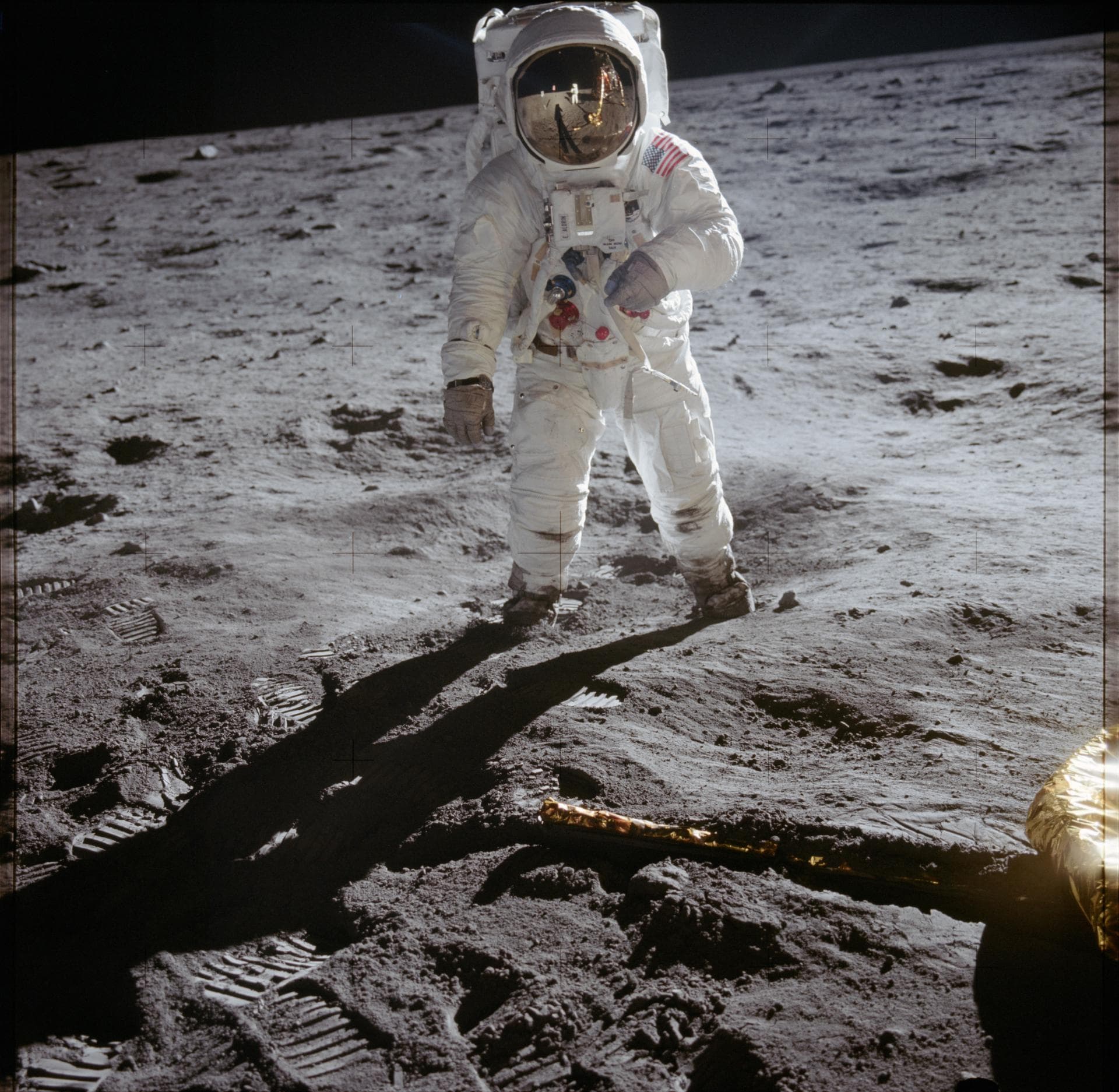
After Mercury, Katherine Johnson joined the Space Mechanics Division and turned to the Apollo program. She calculated trajectory work for the 1969 Apollo 11 flight and computed backup navigational charts that would let a crew fix its position from a star sighting if the onboard electronics failed.[2] Asked to name her greatest contribution to space exploration, she pointed to the calculations that synchronized the lunar module with the command and service module orbiting the Moon, the rendezvous that brought Neil Armstrong and Buzz Aldrin back from the surface in July 1969.[1][2]
She watched the landing on a small television at a sorority meeting in the Pocono Mountains. "I had done the calculations and knew they were correct," she said, "but ... anything could happen. I didn't want anything to happen and it didn't."[3]
When an oxygen tank ruptured aboard Apollo 13 in April 1970, the aborted mission drew on that earlier work. NASA credits her backup parameters and charts with helping set the path that returned the crew to Earth four days later.[2]
Later Langley work and technical reports
In her later years at Langley, Katherine Johnson worked in the Flight Dynamics and Control Division on the Space Shuttle program, on the Earth Resources Technology Satellite (later renamed Landsat), and on planning for a mission to Mars. Her final projects before retirement dealt with the guidance and control of large flexible structures.[2] She retired in 1986 after 33 years at Langley. "I went to work every day for 33 years happy," she said. "Never did I get up and say I don't want to go to work."[3]
NASA's Langley biography credits her with authoring or coauthoring 26 research reports; a separate NASA profile page puts the figure at 13.[1][2] Three appear in NASA's Technical Reports Server, with Johnson as first author on two of them.
| Report | Date | Authors |
|---|---|---|
| NASA TN D-233, "Determination of Azimuth Angle at Burnout for Placing a Satellite Over a Selected Earth Position" | September 1960 | T. H. Skopinski, Katherine G. Johnson |
| NASA TN D-1366, "The Orbital Behavior of the Echo I Satellite and Its Rocket Casing During the First 500 Days" | June 1962 | Katherine G. Johnson, Gertrude C. Westrick |
| NASA TN D-2379, "Approximate Solutions for Flight-Path Angle of a Reentry Vehicle in the Upper Atmosphere" | July 1964 | Katherine G. Johnson, Jack A. White |
The 1962 study covered Echo 1, a 100-foot inflatable balloon that served as the first passive communications satellite and the first whose orbit was measurably disturbed by solar radiation pressure.[2][8] The 1964 note worked out approximations for the flight-path angle of a vehicle reentering the upper atmosphere.[9]
Key contributions
Katherine Johnson's documented NASA work runs from the 1960 satellite-placement report through Space Shuttle and Landsat analysis in the years before her 1986 retirement.[1][2]
| Year | Mission or program | Contribution |
|---|---|---|
| 1960 | Satellite orbital placement | Coauthored NASA TN D-233, the Flight Research Division's first report credited to a woman |
| 1961 | Mercury-Redstone 3 (Shepard) | Trajectory analysis for first American spaceflight |
| 1962 | Mercury-Atlas 6 (Glenn) | Hand verification of computer-generated orbital trajectory |
| 1962 | Echo 1 | Coauthored a study of the satellite's orbit over its first 500 days |
| 1967 | Lunar Orbiter | Shared the Lunar Orbiter Spacecraft and Operations team award for navigation work on the five Moon-mapping probes |
| 1969 | Apollo 11 | Trajectory work, lunar-orbit rendezvous calculations, and backup navigational charts |
| 1970 | Apollo 13 | Backup parameters and charts used on the return trajectory |
| 1970s-1986 | Space Shuttle, Landsat | Analysis and planning work until retirement |
Recognition and Hidden Figures
For most of her career Katherine Johnson's name was known mainly inside NASA. That changed in her nineties. On November 24, 2015, President Obama presented her with the Presidential Medal of Freedom, the highest U.S. civilian honor.[4] The citation credited her computations with influencing "every major space program from Mercury through the Shuttle program," and singled out the 1961 Shepard trajectory, the 1962 verification of Glenn's orbit, and the 1969 Apollo 11 trajectory.[16] The following year Margot Lee Shetterly's book "Hidden Figures" and its film adaptation, in which Taraji P. Henson played Johnson, told the story of the Black women mathematicians of Langley. The film was nominated for the Academy Award for best picture and took more than $200 million worldwide; Johnson, then 98, was brought on stage at the 2017 ceremony to a long ovation.[25]
The film is a dramatization, and several of its best-known scenes compress or relocate events, including the Glenn verification. Johnson's own telling of her working life was consistently plain. "I didn't have time for that," she said of feeling unequal. "My dad taught us 'you are as good as anybody in this town, but you're no better.' I don't have a feeling of inferiority. Never had."[3] Shetterly found that when Johnson was asked how it felt to be a trailblazer, she would as often say she was just doing her job.[15]
Honors and memorials
NASA named the Katherine G. Johnson Computational Research Facility at Langley on May 5, 2016, the 55th anniversary of Shepard's flight, and gave her a Silver Snoopy award at the same ceremony; the $30 million, 40,000-square-foot building opened on September 22, 2017.[19][20] In February 2019 the agency redesignated its Independent Verification and Validation Facility in Fairmont, West Virginia, as the Katherine Johnson IV&V Facility, and that June the street in front of NASA Headquarters in Washington became Hidden Figures Way, honoring Johnson, Vaughan and Mary Jackson.[21][22] Congress authorized Gold Medals for the four women of "Hidden Figures" and for the NACA and NASA computers as a group in a law signed on November 8, 2019; the medals were presented to their families in Emancipation Hall at the U.S. Capitol on September 18, 2024.[17][18] A Northrop Grumman cargo spacecraft flown to the International Space Station was christened S.S. Katherine Johnson and launched on February 20, 2021, the 59th anniversary of Glenn's flight.[23]
| Year | Honor |
|---|---|
| 2015 | Presidential Medal of Freedom, presented November 24[16] |
| 2016 | Computational Research Facility named at Langley on May 5; NASA Silver Snoopy award[19] |
| 2017 | Katherine G. Johnson Computational Research Facility opened September 22[20] |
| 2018 | West Virginia State University dedicated a bronze statue and an endowed STEM scholarship on August 25[27] |
| 2019 | NASA IV&V Facility in Fairmont, West Virginia, redesignated February 22[21] |
| 2019 | Hidden Figures Way street sign unveiled outside NASA Headquarters June 12[22] |
| 2019 | Hidden Figures Congressional Gold Medal Act signed November 8; IEEE President's Award[17][24] |
| 2021 | Cygnus spacecraft S.S. Katherine Johnson launched February 20[23] |
| 2024 | Congressional Gold Medal presented September 18; enshrined in the National Aviation Hall of Fame[18][26] |
Death and legacy
Katherine Johnson died on February 24, 2020, at her home in Newport News, Virginia, at 101.[5] NASA Administrator Jim Bridenstine said the agency was "sad to learn the news that Katherine Johnson passed away this morning at 101 years old. She was an American hero and her pioneering legacy will never be forgotten."[1] The agency's own summary of her work is more specific: her calculations of orbital mechanics were critical to the success of the first and subsequent American crewed spaceflights, achieved despite the barriers of race and gender.[2][18]
Her story is now widely used to draw young people toward science, technology, engineering and mathematics, which is how NASA frames the legacy itself.[2] Johnson put the advice more briefly: "Do your best. But like it! Like what you do; then you will do your best."[5]
References
- Katherine Johnson Biography - NASA Langley Research Center, biography by Margot Lee Shetterly, November 22, 2016.
- Katherine G. Johnson - NASA, People of NASA profile, May 25, 2017.
- She Was a Computer When Computers Wore Skirts - NASA Langley Research Center, August 26, 2008.
- Katherine Johnson: The Girl Who Loved to Count - NASA, November 24, 2015.
- Katherine Johnson (1918-2020) - NASA Science.
- Katherine Johnson: A Lifetime of STEM - NASA.
- Determination of Azimuth Angle at Burnout for Placing a Satellite Over a Selected Earth Position - T. H. Skopinski and Katherine G. Johnson, NASA Technical Note D-233, September 1960, NASA Technical Reports Server.
- The Orbital Behavior of the Echo I Satellite and Its Rocket Casing During the First 500 Days - Katherine G. Johnson and Gertrude C. Westrick, NASA Technical Note D-1366, June 1962, NASA Technical Reports Server.
- Approximate Solutions for Flight-Path Angle of a Reentry Vehicle in the Upper Atmosphere - Katherine G. Johnson and Jack A. White, NASA Technical Note D-2379, July 1964, NASA Technical Reports Server.
- Preserving the History of WVU's First African-American Graduates - West Virginia University Libraries, November 13, 2017.
- Cafeteria (Building 1213) - NASA Langley Research Center historic preservation.
- Dorothy Vaughan - NASA, biography by Margot Lee Shetterly.
- When the Computer Wore a Skirt: Langley's Computers, 1935-1970 - NASA History, from NASA History News and Notes, Vol. 29, No. 1.
- Hidden Figures: When Did John Glenn Ask for "the Girl" to Check the Numbers? - Robert Z. Pearlman, collectSPACE via Space.com, January 5, 2017.
- Hidden Figures: How Black Women Did the Math That Put Men on the Moon - NPR interview with Margot Lee Shetterly, September 25, 2016.
- President Obama Names Recipients of the Presidential Medal of Freedom - The White House, November 16, 2015 (Obama White House archive).
- Public Law 116-68, Hidden Figures Congressional Gold Medal Act - United States Congress, November 8, 2019.
- NASA's Hidden Figures Honored with Congressional Gold Medals - NASA Langley Research Center, September 2024.
- Computational Facility Named After Langley "Human Computer" Katherine Johnson - NASA, May 6, 2016.
- NASA Langley's Katherine Johnson Computational Research Facility Officially Opens - NASA, September 2017.
- NASA Renames Facility in Honor of "Hidden Figure" Katherine Johnson - NASA, February 22, 2019.
- Sign of Progress: Street Renaming Puts NASA Headquarters on Hidden Figures Way - NASA, June 2019.
- NASA Science, Cargo Launches on 15th Northrop Grumman Resupply Mission to Space Station - NASA, February 20, 2021.
- Katherine Johnson, the Hidden Figures Mathematician Who Got Astronaut John Glenn Into Space - IEEE Spectrum.
- NASA Mathematician Katherine Johnson, Celebrated in "Hidden Figures," Dies at Age 101 - PBS NewsHour, February 24, 2020.
- Katherine Johnson - National Aviation Hall of Fame, 2024 enshrinee.
- West Virginia State University Dedicates Statue, Scholarship to Katherine Johnson - West Virginia State University, August 2018.
- Katherine Johnson's Continuing Legacy at IV&V, Beyond - NASA, August 25, 2023.