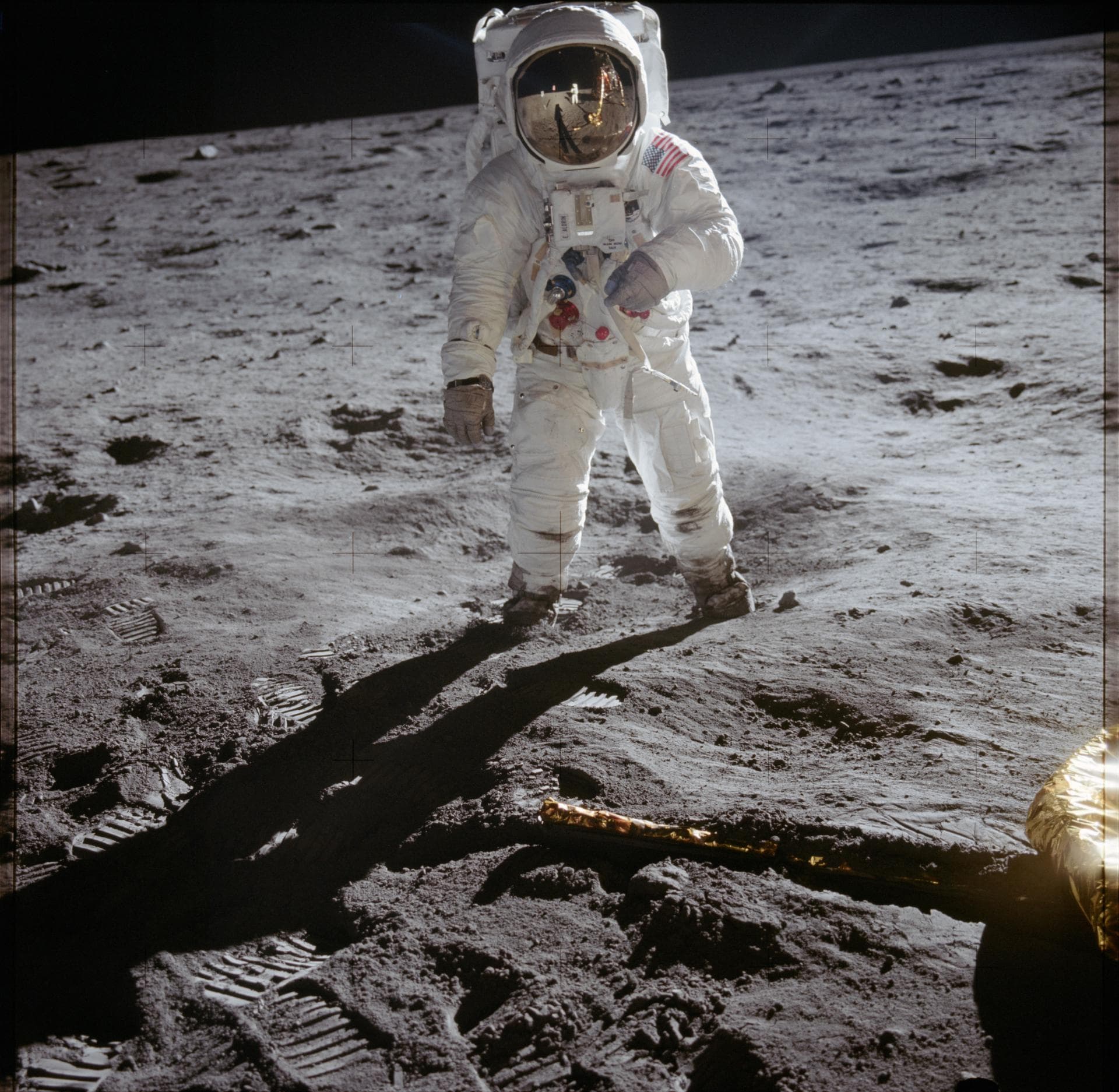
Neil Alden Armstrong (1930-2012) was an American naval aviator, test pilot, and NASA astronaut who, on July 20, 1969, became the first person to walk on the Moon. As commander of Apollo 11, he piloted the lunar module Eagle to a landing in the Sea of Tranquility and stepped onto the surface with the words "That's one small step for man, one giant leap for mankind."[1][12][13]
Before joining the astronaut corps, Armstrong flew 78 combat missions in the Korean War and spent seven years as a civilian research pilot, taking the X-15 rocket plane to the edge of space. His first spaceflight, Gemini 8 in 1966, achieved the first docking of two vehicles in orbit and then survived the first life-threatening emergency of the American space program.[1][2][9]
After leaving NASA in 1971 he taught aerospace engineering at the University of Cincinnati and avoided public life almost entirely, declining most interviews for the rest of his life. He died in 2012 at age 82.[1][15][17]
Early life and flying in Ohio
Armstrong was born on August 5, 1930, on his grandfather's farm near Wapakoneta, Ohio, the eldest child of Stephen Armstrong, a state auditor, and Viola Engel. His father's job moved the family repeatedly around Ohio during his childhood.[4]
He took his first airplane ride at about age six, in a Ford Trimotor, and afterwards built model aircraft obsessively, along with a crude wind tunnel at home. He began flying lessons at fifteen in an Aeronca Champion, paying for them with odd jobs around town, and earned his student pilot certificate on his sixteenth birthday, before he had a driver's license. He was an Eagle Scout and graduated from Blume High School in 1947.[4][5]
Purdue and naval service
Armstrong entered Purdue University in 1947 to study aeronautical engineering on a Navy scholarship under the Holloway Plan, which paid for two years of study, then required active service, then returned the student to campus for the final two years.[4]
The Navy called him up in 1949 and sent him to Pensacola for flight training; he was designated a naval aviator in 1950, one of the "flying midshipmen" of that era. Assigned to Fighter Squadron 51, he flew the Grumman F9F Panther from the carrier USS Essex off Korea and completed 78 combat missions, the youngest pilot in the squadron.[1][4]
On September 3, 1951, on a low, fast run over a valley, his Panther hit a cable strung across the terrain, which sheared several feet off the starboard wing. He nursed the crippled aircraft back over friendly territory and ejected safely, and was flying combat again two days later. He received the Air Medal and two Gold Stars for his Korean service.[2][4]
Armstrong left active duty in 1952 and completed his aeronautical engineering degree at Purdue in January 1955. He met Janet Shearon there and married her in January 1956.[4][6][7]
Test pilot
Armstrong joined the National Advisory Committee for Aeronautics (NACA), NASA's predecessor, as a research pilot in 1955. His first assignment was the Lewis Flight Propulsion Laboratory in Cleveland, but after about five months he transferred to the High-Speed Flight Station at Edwards Air Force Base in California, the home of the X-plane programs. He stayed there until he became an astronaut in 1962. Over that period he flew more than 200 different models of aircraft, from gliders and helicopters to rocket planes, and left with more than 2,450 flying hours.[1][2][6]
He began part-time graduate study toward a master's degree at the University of Southern California in September 1955, chose aerodynamic entry energy management as his thesis area, and never finished the thesis; his appointment as senior NASA member of the Dyna-Soar pilot consultant group left no time for it. The degree stayed unfinished for a decade.[6]
His early rocket flying was in the Bell X-1B, including three flights in November 1957 that validated its reaction control system, the kind of thruster attitude control later used on spacecraft.[3]
His most demanding assignment was the North American X-15, a hypersonic research aircraft dropped from a B-52 carrier plane. Armstrong flew it seven times between December 1960 and July 1962, reaching a peak altitude of 207,500 feet in the X-15-3 and a speed of 3,989 mph, or Mach 5.74, in the X-15-1. He flew the first X-15 flight with a new airflow direction sensor in the nose, and the first with a self-adaptive flight control system. On April 20, 1962, he flew the longest X-15 flight of the program at 12 minutes 28 seconds, after the aircraft ballooned back out of the atmosphere and overshot the landing area.[2][3]
In January 1962, while he was still at Edwards, his two-year-old daughter Karen died of a brain tumor.[4]
Selection as an astronaut
NASA selected Armstrong in its second group of astronauts, announced on September 17, 1962: nine men chosen from 253 applicants, four Air Force pilots, three Navy pilots, and, for the first time, two civilians. Armstrong was one of the civilians, and his application had arrived after the deadline; NASA managers decided to accept it anyway.[8]
He was assigned to monitor the development of mission simulators, served as backup command pilot for Gemini 5, and was backup commander for Apollo 8, the first crewed flight to lunar orbit, in December 1968. That rotation put him in line to command the first landing attempt of the Apollo program.[8][11]
Gemini 8: first docking, first emergency
Gemini 8 lifted off on March 16, 1966, at 11:41:02 a.m. EST with Armstrong as command pilot and David Scott as pilot. On the fifth orbit, at 5:14 p.m. EST, the crew docked with an uncrewed Agena target vehicle already in orbit, the first docking of two spacecraft.[9]
About 27 minutes later the joined vehicles began to yaw and tumble. The crew undocked, assuming the fault lay with the Agena, but the spin worsened until the Gemini approached one revolution per second, near the limit at which the crew would have lost consciousness or their vision. The cause was roll thruster number 8 on the Gemini's own orbital attitude and maneuvering system, which had short-circuited and stuck open. Armstrong shut that system down and used all sixteen reentry control thrusters to damp the roll, stabilizing the spacecraft at 6:06:30 p.m. at the cost of 75 percent of the reentry control propellant.[9]
Mission rules required an immediate return once the reentry system had been used, so Scott's planned spacewalk and the rest of the flight plan were cancelled. The capsule splashed down in the western Pacific at 10:22:28 p.m. EST, after 10 hours 41 minutes 26 seconds, and the crew was picked up by the destroyer USS Leonard F. Mason.[9]
Training for the lunar landing
Apollo commanders practiced the final descent to the lunar surface in the Lunar Landing Research Vehicle, an open-frame machine with a downward-pointing jet engine that cancelled five-sixths of its weight so that thrusters could fly it like a lunar module. On May 6, 1968, at Ellington Air Force Base near Houston, Armstrong was about five minutes into his twenty-second flight in LLRV-1 when it went out of control. He ejected at roughly 200 feet, parachuted down without injury, and was back at his desk the same day. The vehicle burned on impact.[10]
The accident board found that a loss of helium pressure had starved the reserve attitude thrusters of hydrogen peroxide, and that the instrumentation gave the pilot no adequate warning. Flights resumed in October 1968 with a revised version, the Lunar Landing Training Vehicle. Armstrong logged 21 flights in the LLRV and 6 in the LLTV, and afterwards credited that training with preparing him for the trajectory he actually flew to the lunar surface.[10]
Apollo 11
NASA named the Apollo 11 crew on January 9, 1969: Armstrong as commander, Buzz Aldrin as lunar module pilot, and Michael Collins as command module pilot. A Saturn V launched them from Kennedy Space Center on July 16, 1969, at the peak of the Space Race with the Soviet Union.[11]
On July 20, Armstrong and Aldrin undocked the lunar module Eagle and began the descent. With the onboard computer raising alarms and steering them toward boulder-covered ground, Armstrong took semi-manual control and flew past it, setting Eagle down in the Sea of Tranquility with the descent propellant running critically low, 102 hours 45 minutes into the mission. His first words after engine shutdown were "Houston, Tranquility Base here. The Eagle has landed."[4][12]
At 10:56 p.m. Eastern time, watched by an estimated 650 million people, Armstrong climbed down the ladder and stepped onto the lunar surface. He and Aldrin spent more than two and a half hours outside, collecting samples, deploying experiments, and photographing the site, and 21 hours 36 minutes on the Moon in total. The crew returned to Earth on July 24 and went into quarantine before a world tour.[12]
The first words on the Moon
Armstrong said he intended his first sentence on the lunar surface to be "one small step for a man, one giant leap for mankind," which is what makes it read as a contrast rather than a tautology. The article "a" is not audible in the transmission, and after listening to the recording repeatedly he accepted that he might have dropped it, though for years he attributed the loss to the communications link.[13]
In 2006 the computer programmer Peter Shann Ford analyzed the recording with software written for assistive communication and reported a brief acoustic trace of the missing "a" masked by static. Armstrong found the work persuasive, but other analysts examining the same waveform found no vowel in the gap, and Ford's conclusion is not settled. The quote is therefore often written with the article in brackets.[13]
Missions
Armstrong flew two spaceflights, Gemini 8 in 1966 and Apollo 11 in 1969, and logged a total of 8 days and 14 hours in space.[2]
| Mission | Dates | Role | Crew | Notes |
|---|---|---|---|---|
| Gemini 8 | March 16-17, 1966 | Command pilot | Neil Armstrong, David Scott | First orbital docking; flight cut short after a stuck thruster |
| Apollo 11 | July 16-24, 1969 | Commander | Neil Armstrong, Buzz Aldrin, Michael Collins | First crewed lunar landing; first steps on the Moon |
After NASA
Armstrong served as Deputy Associate Administrator for Aeronautics at NASA Headquarters, coordinating the agency's aeronautics research and technology work, and pushed early research into digital fly-by-wire flight control. He resigned from NASA in 1971.[1][4]
He joined the University of Cincinnati in August 1971 as University Professor of Aerospace Engineering and taught there until 1979, insisting on being treated as an ordinary member of the faculty. He also finally collected his master's degree: on January 22, 1970, he delivered a one-hour seminar at the University of Southern California titled "Apollo 11 Lunar Landing Mission. Lunar Landing Techniques," which the School of Engineering accepted in place of the unfinished thesis, and the MS in aerospace engineering was conferred on him that afternoon.[6][15]
Armstrong took part in two major accident investigations. He was a member of the Apollo 13 Review Board, established on April 17, 1970 under Langley director Edgar M. Cortright, which reported on June 15, 1970 that the accident "was not the result of a chance malfunction in a statistical sense but, rather, it was the result of an unusual combination of mistakes coupled with a somewhat deficient and unforgiving design." In 1986 he served as vice chairman of the Presidential Commission on the Space Shuttle Challenger Accident, the Rogers Commission, where he concentrated on the technical side of the inquiry.[1][4][14]
His other public appointments included chairman of the Presidential Advisory Committee for the Peace Corps from 1971 to 1973 and membership of the National Commission on Space in 1985 and 1986. In business he sat on the boards of United Airlines, Morton Thiokol, and Eaton, among others, and was chairman of Computing Technologies for Aviation, Inc. of Charlottesville, Virginia, from 1982 to 1992.[1][4]
He returned to public argument late in life. Testifying before the Senate Commerce, Science and Transportation Committee on May 12, 2010, he opposed the cancellation of the Constellation Moon program, said he had "yet to find a person in NASA, the Defense Department, the Air Force, the National Academies, industry, or academia that had any knowledge of the plan prior to its announcement," and warned that "other nations will surely step in where we have faltered."[16]
Public life and privacy
Armstrong was reticent about the Moon landing to a degree that became part of his reputation. He gave few interviews, deflected credit toward the roughly 400,000 people employed at the peak of Apollo, and stopped signing autographs in 1994 after learning that his signature was selling for large sums and that forgeries were circulating.[17][26]
He agreed to his first authorized television profile only in November 2005, talking to Ed Bradley of CBS's 60 Minutes around the publication of his biography. Asked about the discomfort of being famous for a single event, he said, "I guess we all like to be recognized not for one piece of fireworks, but for the ledger of our daily work," and added of the assignment itself, "I wasn't chosen to be first. I was just chosen to command that flight."[17]
That biography, "First Man: The Life of Neil A. Armstrong" by the historian James R. Hansen, appeared in 2005 as the authorized account, written with Armstrong's cooperation. A film adaptation directed by Damien Chazelle, with Ryan Gosling as Armstrong, opened in October 2018.[17][18]
He identified as an engineer rather than an explorer. Speaking at a National Press Club luncheon on February 22, 2000, where he announced the National Academy of Engineering's list of the twentieth century's twenty greatest engineering achievements, he summed up the distinction as "Science is about what is; engineering is about what can be."[4][19]
Honors and memberships
NASA records that Armstrong was decorated by 17 countries. His awards included the Presidential Medal of Freedom, the Congressional Gold Medal, the Congressional Space Medal of Honor, the NASA Distinguished Service Medal, the Robert J. Collier Trophy, the Robert H. Goddard Memorial Trophy, the Harmon International Aviation Trophy, the Explorers Club Medal, the Gold Medal of the Royal Geographical Society, and the Gold Space Medal of the Federation Aeronautique Internationale.[1]
He was a Fellow of the Society of Experimental Test Pilots and the Royal Aeronautical Society, an Honorary Fellow of the American Institute of Aeronautics and Astronautics and the International Astronautical Federation, and a member of the National Academy of Engineering and the Academy of the Kingdom of Morocco. He was inducted into the International Space Hall of Fame in 1976 and enshrined in the National Aviation Hall of Fame in 1979.[1][5][28]
Death and legacy
Armstrong underwent cardiovascular bypass surgery in August 2012 and died of complications on August 25, 2012, in Cincinnati, at age 82. A national memorial service was held at Washington National Cathedral on September 13, and the following morning his cremated remains were buried at sea in the Atlantic from the cruiser USS Philippine Sea, an honor reflecting his naval service.[2][4][21]
In July 2019 The New York Times reported, on the basis of court documents it authenticated through Ohio probate records, that Mercy Health had paid Armstrong's family a confidential $6 million settlement in 2014. His sons had argued that the post-surgical care at Mercy Health Fairfield Hospital, in particular internal bleeding caused when temporary pacemaker wires were removed, had cost him his life. The money went to ten family members; his widow Carol received none of it, and the hospital's caregivers stood by their treatment while agreeing to settle.[20]
His name is attached to a good deal of American aerospace infrastructure. NASA's Dryden Flight Research Center, where he had flown the X-15, was redesignated the Neil A. Armstrong Flight Research Center on March 1, 2014, under legislation signed on January 16 that year.[22] The Armstrong Air and Space Museum opened in Wapakoneta on July 20, 1972, three years to the day after the landing, with Armstrong and his family present.[23] At Purdue, the School of Aeronautics and Astronautics has been housed in the Neil Armstrong Hall of Engineering since October 27, 2007, when Armstrong attended the dedication with fourteen other Purdue astronauts.[7] Purdue's archives hold the Neil A. Armstrong papers, 221.7 cubic feet in 466 boxes, donated by Carol Armstrong beginning in 2012 and covering his childhood, military service, flight test work, spaceflights, teaching, and business career.[24] The International Astronomical Union approved the name Armstrong in 1970 for a 4.21 km crater in Mare Tranquillitatis, near the landing site; it approved craters named Aldrin and Collins, and the name Statio Tranquillitatis for the landing point itself, in the same year.[29] His Apollo 11 spacesuit, conserved and digitized after years in storage, was unveiled at the National Air and Space Museum on July 16, 2019, the fiftieth anniversary of the launch.[25]
Colleagues consistently described a quiet, private engineer who preferred technical work to celebrity. No one has landed on the Moon since Apollo 17 in 1972, although Artemis II carried four astronauts around the Moon and back in April 2026, the first crewed lunar flight in more than fifty years.[4][27]
References
- Neil A. Armstrong, NASA Astronaut (Deceased), Biographical Data - NASA Lyndon B. Johnson Space Center, August 2012.
- Neil A. Armstrong - NASA.
- Former Astronaut Neil A. Armstrong - NASA.
- Neil A. Armstrong - National Academy of Engineering, Memorial Tributes, Volume 17.
- Neil Alden Armstrong - National Aviation Hall of Fame.
- Neil Armstrong: From Lunar Landing to Master of Science Degree - Mike Gruntman, IAC-24-E4.IP.9, 75th International Astronautical Congress, Milan, 2024.
- Neil Armstrong BSAE'55, DEA'67, HDR'70, OAE'99, 1930-2012 - Purdue University School of Aeronautics and Astronautics.
- 60 Years Ago: NASA Selects a Second Group of Astronauts - NASA.
- Gemini VIII - NASA.
- 55 Years Ago: Astronaut Armstrong Survives LLRV Crash - NASA.
- 50 Years Ago: NASA Names Apollo 11 Crew - NASA.
- Apollo 11 Mission Overview - NASA.
- One small step for man... What did Neil Armstrong really say? - BBC Sky at Night Magazine.
- 50 Years Ago: Apollo 13 Review Board Report - NASA.
- Armstrong, the Man - University of Cincinnati Libraries.
- Neil Armstrong says Obama 'poorly advised' on space - Phys.org, May 12, 2010.
- Being the First Man on the Moon - CBS News, 60 Minutes, November 6, 2005.
- Chazelle's 'First Man' Chronicles Personal Losses Behind Armstrong's 'Giant Leap' - NPR, October 10, 2018.
- Neil Armstrong: Why the World Needs 'Nerdy Engineers' - Universe Today.
- Neil Armstrong died of post-surgical complications; Ohio hospital paid $6 million to family, court documents show - CBS News, July 2019.
- Armstrong Burial at Sea - NASA.
- NASA Armstrong Center Renaming Ceremony Set for May 13 - NASA, March 2014.
- Our Organization History - Armstrong Air and Space Museum.
- What's in a Box? Processing the Neil A. Armstrong papers - Purdue University Libraries, Archives and Special Collections, April 29, 2020.
- Unveiling Neil Armstrong's Apollo 11 Spacesuit - NASA.
- The First Step: Langley's Contributions to Apollo - NASA.
- NASA Welcomes Record-Setting Artemis II Moonfarers Back to Earth - NASA, April 2026.
- Neil A. Armstrong - New Mexico Museum of Space History.
- Armstrong (lunar crater) - Gazetteer of Planetary Nomenclature, IAU Working Group for Planetary System Nomenclature and USGS Astrogeology Science Center.