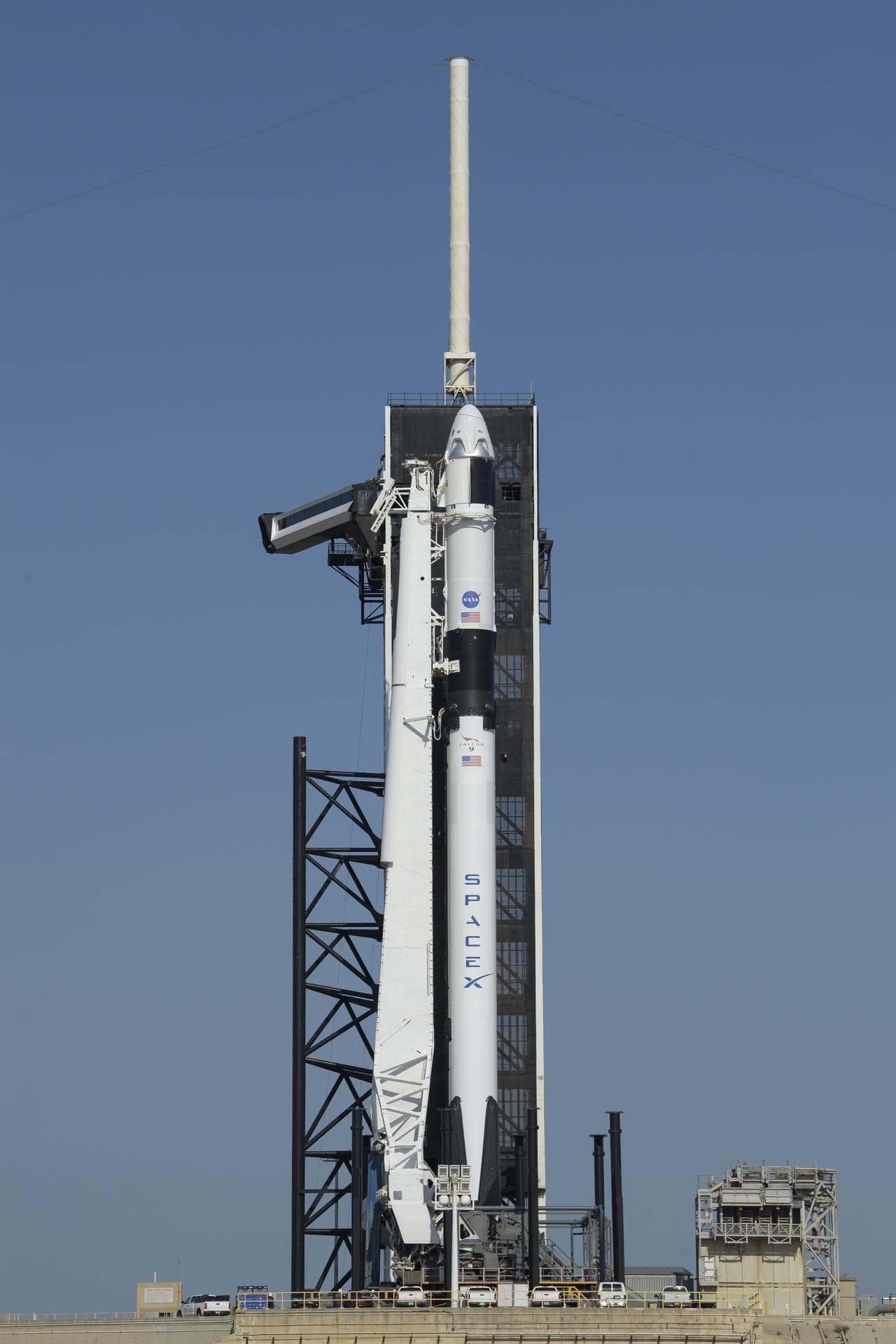
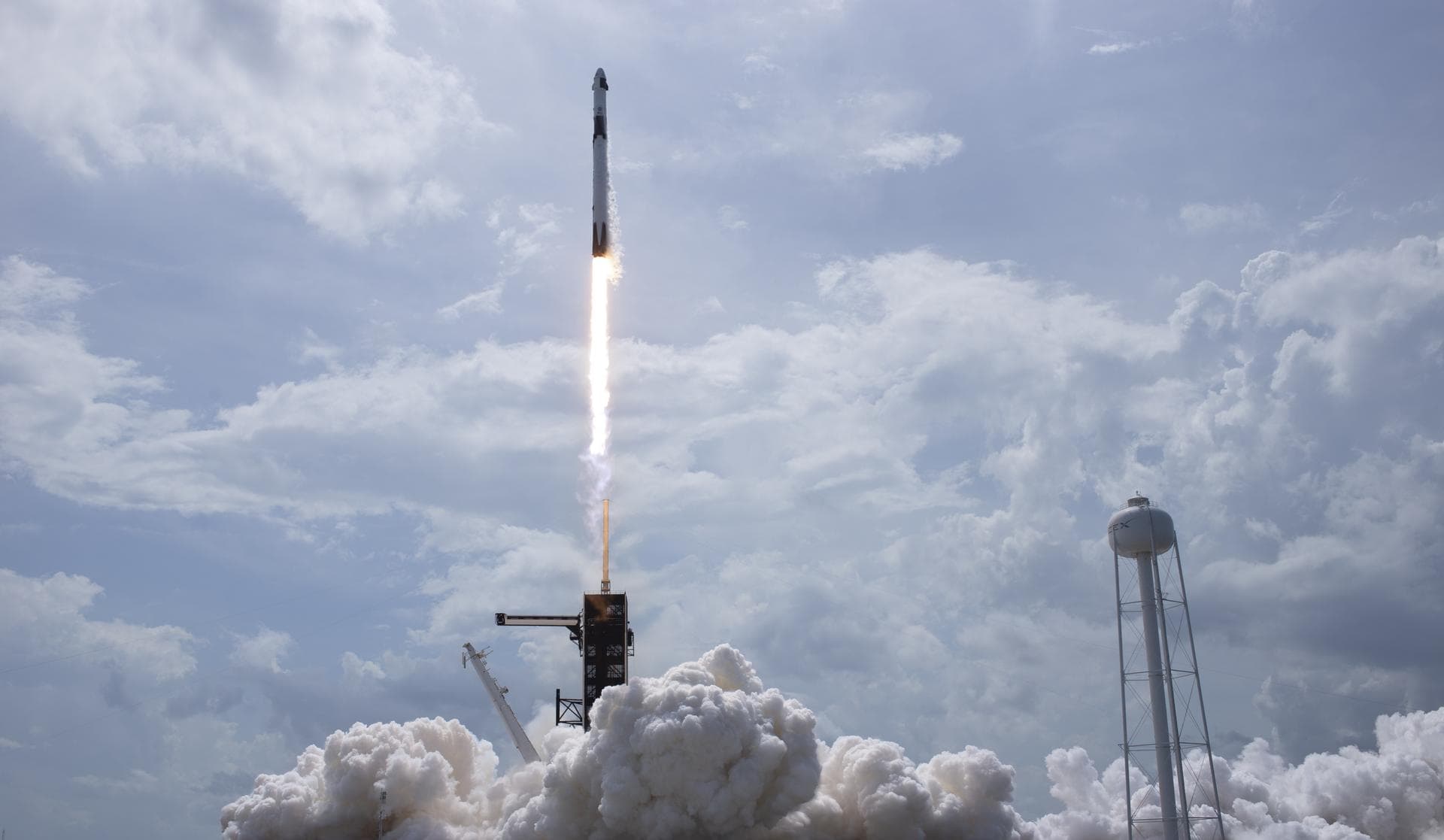
Falcon Heavy is a heavy-lift launch vehicle built by SpaceX from three modified Falcon 9 first stages strapped together beneath a single upper stage. Its 27 Merlin engines produce about 5 million pounds of thrust at liftoff, and when it debuted in 2018 it was the most powerful operational rocket in the world, a title it held until NASA's Space Launch System flew in November 2022.[1][2]
The rocket has flown 12 times as of August 2026, all successfully.[3] It launches rarely, roughly once or twice per year, because upgrades to Falcon 9 allowed the smaller rocket to capture most of the missions Falcon Heavy was designed for. The vehicle instead serves a niche of very heavy communications satellites, direct-to-geostationary military payloads, and NASA planetary missions such as Psyche and Europa Clipper.[3] Its next flight, carrying NASA's Nancy Grace Roman Space Telescope, is scheduled for August 30, 2026.[4]
Development and first flight
SpaceX announced Falcon Heavy in April 2011 with a first flight promised for 2013, but the program proved harder than expected. Elon Musk later said the company tried to cancel it three times, since the loads and vibration environment of a three-core vehicle could not simply be extrapolated from Falcon 9 experience. The center core required substantial structural redesign, the grid fins had to be reworked for the changed aerodynamics, and Musk put total development spending at more than half a billion dollars.[5]
The demonstration flight lifted off from Launch Complex 39A at Kennedy Space Center on February 6, 2018. As a test payload Musk supplied his own Tesla Roadster with a spacesuited mannequin, "Starman," in the driver's seat; the upper stage placed the car into a heliocentric orbit crossing that of Mars. The two side boosters, both previously flown Falcon 9 stages, landed simultaneously at Cape Canaveral in one of the most widely shared images of the decade, while the center core missed the drone ship and hit the ocean at about 300 mph after only one of the three engines needed for its landing burn relit.[5]
Design
Falcon Heavy is 70 meters tall and 12.2 meters wide across its three cores, with a liftoff mass of 1,420,788 kilograms. Flown fully expendable, it can lift 63,800 kilograms to low Earth orbit or 26,700 kilograms to geostationary transfer orbit.[1]
Falcon Heavy's side boosters are close derivatives of the Falcon 9 Block 5 first stage, fitted with nose cones instead of interstages. The strengthened center core throttles down after liftoff so the side boosters expend their propellant first, separate, and fly back for landing; the center core then throttles up and burns longer. The second stage and payload fairing are identical to Falcon 9's.[1]
| Parameter | Falcon Heavy |
|---|---|
| Height | 70 m |
| Width | 12.2 m |
| Liftoff mass | 1,420,788 kg |
| First stage engines | 27 Merlin 1D (kerosene/liquid oxygen) |
| Liftoff thrust | About 22,800 kN (5.1 million lbf) |
| Payload to low Earth orbit | 63,800 kg (fully expendable) |
| Payload to geostationary transfer orbit | 26,700 kg (fully expendable) |
| Payload to Mars | 16,800 kg |
Full Falcon Heavy performance requires expending all three cores. Most missions recover the side boosters, which trims capacity but saves hardware; center core recovery has proven difficult and SpaceX has not attempted it since 2019, expending the center core even when the side boosters land.[1][3]
Launch history
Falcon Heavy has flown 12 missions between February 2018 and April 2026, all successful.[3]
| Flight | Date | Payload | Outcome | Booster recovery |
|---|---|---|---|---|
| 1 | February 6, 2018 | Tesla Roadster (demo) | Success | Side boosters landed; center core missed drone ship |
| 2 | April 11, 2019 | Arabsat-6A | Success | All three cores landed; center core later lost at sea |
| 3 | June 25, 2019 | STP-2 (24 satellites) | Success | Side boosters landed; center core missed drone ship |
| 4 | November 1, 2022 | USSF-44 | Success | Side boosters landed; center core expended |
| 5 | January 15, 2023 | USSF-67 | Success | Side boosters landed; center core expended |
| 6 | April 30, 2023 | ViaSat-3 F1 | Success | Fully expendable |
| 7 | July 29, 2023 | Jupiter 3 (EchoStar 24) | Success | Side boosters landed; center core expended |
| 8 | October 13, 2023 | Psyche | Success | Side boosters landed; center core expended |
| 9 | December 28, 2023 | USSF-52 (X-37B) | Success | Side boosters landed; center core expended |
| 10 | June 25, 2024 | GOES-U | Success | Side boosters landed; center core expended |
| 11 | October 14, 2024 | Europa Clipper | Success | Fully expendable |
| 12 | April 29, 2026 | ViaSat-3 F3 | Success | Side boosters landed; center core expended |
Arabsat-6A in April 2019 was Falcon Heavy's first commercial mission and achieved the first center core landing, though the booster toppled in heavy seas days later; the robotic clamp SpaceX uses to secure Falcon 9 stages to the drone ship deck did not fit the center core's different hold-down interface.[6] USSF-44 in November 2022 demonstrated a direct injection to geosynchronous orbit, with the upper stage coasting for about six hours through the radiation belts before a final burn, a capability the US Space Force requires.[7] Jupiter 3, launched in July 2023, was the heaviest commercial communications satellite ever built at 9.2 metric tons.[8]
Falcon Heavy's side boosters have proven far easier to recover than the center core: 20 landings in 20 attempts across the ten flights that tried to bring them back, against a single center core recovery, and that booster never reached port.[3][6]
Notable science missions
NASA turned to Falcon Heavy for several flagship missions. Psyche, which departed on October 13, 2023 toward a metal-rich asteroid in the asteroid belt, was the rocket's first interplanetary launch and its first NASA payload; it also carried the agency's Deep Space Optical Communications laser experiment.[9] The spacecraft flew 4,609 kilometers above Mars on May 15, 2026, using the planet's gravity to bend its path toward an asteroid arrival in the summer of 2029 and testing its science instruments along the way.[10] GOES-U, the last of NOAA's current generation of weather satellites, went to geostationary transfer orbit on June 25, 2024, with both side boosters returning to Cape Canaveral.[11]
Europa Clipper, launched October 14, 2024 on a fully expendable Falcon Heavy, is the largest spacecraft NASA has ever built for a planetary mission and is en route to Europa, due to enter orbit around Jupiter in April 2030.[12] The mission had originally been assigned by law to the Space Launch System, but NASA moved it to Falcon Heavy in 2021 under a launch contract of about 178 million dollars.[13] The agency's budget request argued the switch would save more than 1.5 billion dollars; its inspector general had put the likely difference far lower.[14]
After a gap of no flights in 2025, Falcon Heavy returned on April 29, 2026, sending the 6-metric-ton ViaSat-3 F3 broadband satellite toward geostationary orbit from LC-39A.[15] The side boosters landed back at Cape Canaveral about eight minutes after liftoff, one at Landing Zone 2 and the other on the new landing pad at Space Launch Complex 40, a first for Falcon Heavy.[16]
Upcoming missions
Falcon Heavy's next flight is NASA's Nancy Grace Roman Space Telescope, an infrared survey observatory with a field of view at least 100 times larger than the Hubble Space Telescope's, set for August 30, 2026 at 7:26 a.m. Eastern from LC-39A.[4] NASA fixed the date in June 2026 with the project running ahead of schedule and under its cost commitment, and moved the target forward from an early September estimate.[17]
Astrobotic's Griffin-1 lander is booked on Falcon Heavy for a delivery to Nobile Crater near the south pole of the Moon, carrying Astrolab's 500-kilogram FLIP rover and smaller payloads from six countries.[18] Griffin was originally contracted to deliver NASA's VIPER ice-hunting rover, but NASA cancelled VIPER's flight in July 2024 over cost growth and delays, converting the mission into a demonstration of the lander itself.[19] The launch, once planned for 2025, slipped to July 2026 while Astrobotic qualified the lander's engines, and is now targeted for the fourth quarter of 2026.[20][18]
In April 2026 NASA selected Falcon Heavy to launch ESA's Rosalind Franklin rover, the renamed ExoMars rover, from LC-39A no earlier than late 2028 as part of NASA's contribution to the rebuilt European Space Agency mission.[21] It would be the first SpaceX launch to send a payload to Mars.[22]
One long-planned mission has left the manifest. NASA contracted Falcon Heavy in February 2021, for about 331.8 million dollars, to launch the first two elements of the lunar Gateway station together as part of the Artemis program.[23] In March 2026 the agency paused Gateway in favor of a planned lunar surface base and began repurposing the hardware, leaving that launch shelved.[24]
Why demand for Falcon Heavy stayed modest
When Falcon Heavy was conceived, Falcon 9 could lift about 10 metric tons to low Earth orbit. By 2018 continuous upgrades had more than doubled that, and an expendable Falcon 9 could deliver most large communications satellites to geostationary transfer orbit on its own.[25] Customers rarely need the extra performance, and each Falcon Heavy mission requires converting LC-39A, its only launch pad, away from crewed and Starlink use for weeks.[15]
SpaceX's published figures show the difference in scale between the two rockets.
| Measure | Falcon 9 | Falcon Heavy |
|---|---|---|
| First-stage engines | 9 Merlin 1D[25] | 27 Merlin 1D[1] |
| Payload to low Earth orbit, fully expendable | 22,000 kg[27] | 63,800 kg[1] |
| Payload to geostationary transfer orbit, fully expendable | 8,300 kg[27] | 26,700 kg[1] |
| Payload to Mars | 4,020 kg[27] | 16,800 kg[1] |
| Published price | 74 million dollars through 2026[27] | 97 million dollars, 2022 list[26] |
SpaceX's list price for Falcon Heavy, raised from 90 to 97 million dollars in a 2022 inflation adjustment, still made it far cheaper than the Delta IV Heavy it displaced, which a former Pentagon acquisition official at its debut put at four to ten times the price.[26][5] The company's current published price sheet quotes only Falcon 9, at 74 million dollars through 2026; Falcon Heavy missions are negotiated case by case, and government awards that bundle mission-specific services run higher, from 178 million dollars for Europa Clipper to 331.8 million for the shelved Gateway launch.[27][13][23] The vehicle remains certified for the most demanding US national security orbits, including the direct-to-geosynchronous profile it flew on USSF-44.[7] SpaceX expects Starship to eventually take over its heavy-lift work; company president Gwynne Shotwell has said Falcon launches will tail off as Starship comes online.[28]
References
- Falcon Heavy - SpaceX.
- Artemis 1 launch success makes NASA's SLS the most powerful rocket ever to fly - Space.com, November 16, 2022.
- List of Falcon 9 and Falcon Heavy launches - Wikipedia.
- Nancy Grace Roman Space Telescope - NASA Science.
- SpaceX successfully launches Falcon Heavy - SpaceNews, February 6, 2018.
- Falcon Heavy center core toppled after landing - SpaceNews, April 2019.
- Falcon Heavy 'simply outstanding' on SpaceX's first launch to geosynchronous orbit - Spaceflight Now, November 1, 2022.
- SpaceX Falcon Heavy lifts off with heaviest commercial communications satellite ever - Spaceflight Now, July 2023.
- Liftoff of NASA's Psyche and DSOC Experiment - NASA Science, October 13, 2023.
- NASA's Psyche Mission Delivers Mars Flyby Data, Time-lapse Video - NASA Science, July 17, 2026.
- Falcon Heavy Side Boosters Stick the Landing - NASA Science, June 25, 2024.
- Liftoff! NASA's Europa Clipper Sails Toward Ocean Moon of Jupiter - NASA JPL, October 14, 2024.
- NASA Awards Launch Services Contract for Europa Clipper Mission - NASA, July 23, 2021.
- Falcon Heavy to launch Europa Clipper - SpaceNews, July 2021.
- SpaceX Falcon Heavy rocket lifts off on 1st launch in 18 months - Space.com, April 2026.
- SpaceX launches 6-ton ViaSat-3 F3 satellite on Falcon Heavy rocket - Spaceflight Now, April 29, 2026.
- NASA Sets Launch Date for Roman Space Telescope - SpacePolicyOnline, June 2, 2026.
- Astrobotic Unveils Griffin "Moon Base II" Lander - SpacePolicyOnline, June 15, 2026.
- NASA Ends VIPER Project, Continues Moon Exploration - NASA, July 17, 2024.
- Astrobotic delays Griffin-1 Moon mission to NET July 2026 - Spaceflight Now, October 28, 2025.
- NASA Begins Implementation for ESA's Rosalind Franklin Mission to Mars - NASA Science, April 16, 2026.
- This life-hunting rover may be SpaceX's 1st-ever Mars launch - Space.com, April 2026.
- NASA Awards Contract to Launch Initial Elements for Lunar Outpost - NASA, February 9, 2021.
- NASA halts work on Gateway to develop a lunar base - SpaceNews, March 2026.
- Falcon-9 - Gunter's Space Page.
- Blaming inflation, SpaceX raises Starlink and launch prices - SpaceNews, March 2022.
- Capabilities & Services - SpaceX.
- Read TIME's Full Interview with SpaceX's Gwynne Shotwell - TIME, March 26, 2026.