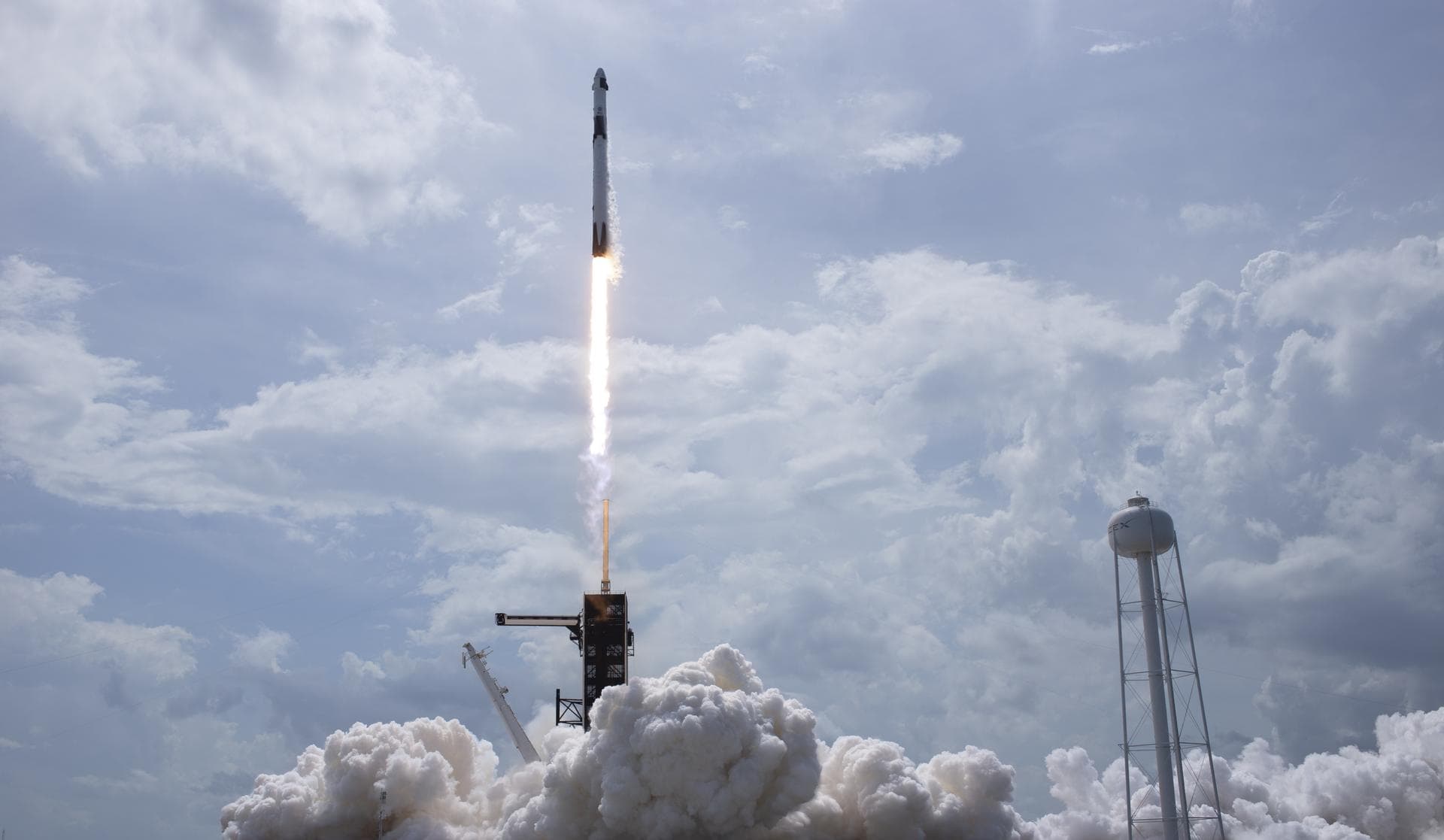
Reusable rockets are launch vehicles designed to recover some or all of their stages after flight and fly them again, spreading hardware costs across many launches instead of discarding a rocket after every flight, which is how spaceflight worked for its first six decades. SpaceX landed the first orbital-class booster on December 21, 2015,[13] and one Falcon 9 booster has since flown 36 missions, a record for any orbital rocket stage.[15]
Throwing a rocket away after one flight is the economic equivalent of scrapping an airliner after one trip, yet reuse was tried, promised, and repeatedly found wanting before SpaceX made it routine in the late 2010s. By mid-2026 the field had shifted from argument to competition. Blue Origin landed its New Glenn booster on the vehicle's second flight in November 2025[2] and flew the same stage again the following April.[28] On July 10, 2026 a Chinese Long March 10B caught its first stage in a net aboard a recovery ship, making China the second country to bring an orbital-class booster back intact,[22] and on August 19 LandSpace's Zhuque-3 landed its first stage on legs at a pad in Gansu province,[31] the first orbital-class booster recovered by a Chinese commercial company.[32] SpaceX's Starship is chasing full reuse of both stages. The unresolved questions are no longer whether boosters can be landed, but how cheaply they can be turned around and how many customers the resulting capacity can find.
The Space Shuttle's partial reuse
NASA's Space Shuttle, flown 135 times between April 1981 and July 2011, was the first partially reusable orbital system. The winged orbiter returned to a runway and flew again (Discovery logged 39 missions, the most of any orbiter), and the twin solid rocket boosters were fished out of the Atlantic and refilled, but the large external tank burned up on every flight.[8][10]
The program demonstrated reuse without delivering its promised economics. When the shuttle was approved in 1972, NASA described flights as often as once a week costing as little as 20 million dollars each. In practice the fleet never exceeded nine flights in a year, and each orbiter required months of inspection and refurbishment between missions, including tile-by-tile checks of its fragile thermal protection system. NASA's own accounting put the program's lifetime cost near 209 billion dollars in 2010 terms, close to 1.6 billion dollars a flight.[9] Two vehicles, Challenger in 1986 and Columbia in 2003, were destroyed in accidents that killed 14 astronauts.[8][9] The shuttle's lesson shaped everything after it: reuse only pays if refurbishment is cheap and the flight rate is high.
DC-X and other early attempts
The Delta Clipper Experimental (DC-X), a one-third-scale demonstrator built by McDonnell Douglas for the Pentagon's Strategic Defense Initiative Organization and later flown by NASA in an upgraded form as the DC-XA, flew 12 low-altitude hops at White Sands, New Mexico between 1993 and 1996. It took off and landed vertically on rocket thrust, was operated by a small ground crew, and proved that a rocket could fly, land, and fly again within days. The program ended when a landing strut failed to extend and the vehicle tipped over and burned.[11] Its vertical-landing concept resurfaced two decades later: DC-X opened a wave of reusable launch vehicle work that ran through NASA's X-33 and X-34 programs and, by way of Masten Space Systems, into the landing programs at SpaceX, Blue Origin, Rocket Lab, and Stoke Space.[12]
The Soviet Union's Buran shuttle, in principle reusable, flew once uncrewed in 1988 and never again. SpaceX initially fitted early Falcon boosters with parachutes; none survived reentry, and the company switched to propulsive landing.
Falcon 9's breakthrough
SpaceX approached Falcon 9 booster landing iteratively. The Grasshopper testbed flew short hops in Texas in 2012 and 2013, then flown boosters attempted soft "landings" on the open ocean, then on an autonomous drone ship, with a series of instructive crashes through 2015. On December 21, 2015, a Falcon 9 first stage returned to a landing pad at Cape Canaveral after releasing 11 Orbcomm satellites, the first orbital-class booster ever recovered intact.[13] The first drone-ship landing followed on April 8, 2016 during a space station cargo run, and on March 30, 2017 that booster launched the SES-10 communications satellite, the first orbital rocket stage to fly a second mission.[14]
Falcon 9 boosters land two ways: flying back to pads near the launch site when performance allows, or touching down on drone ships stationed hundreds of kilometers downrange for heavier missions. Grid fins steer the descent, a subset of the nine engines relights for braking, and four legs deploy at touchdown. Holding propellant back for the return costs payload, which is why SpaceX's published figure of 22,000 kilograms to low Earth orbit applies only to a fully expendable Falcon 9.[19]
The Block 5 version introduced in 2018 was designed for rapid reuse, and the fleet's statistics have grown steadily. Booster B1067 flew a record 35th mission in June 2026 and extended the mark to 36 on July 9, more flights than any orbital booster in history and within three of Discovery's shuttle record.[15][10] SpaceX has said it is working toward certifying boosters for up to 40 missions apiece.[1] Turnaround has compressed alongside flight count: booster B1088 flew twice in nine days in March 2025, beating a previous best of 13.5 days.[17] Landings are now routine: SpaceX logged its 644th booster landing on August 4, 2026, on the 90th Falcon 9 launch of the year, the large majority of them on flight-proven stages.[16]
Fairings were the next target after boosters. Each half carries avionics, thrusters, and a steerable parachute, and recovery ships collect the halves from the sea; Elon Musk has put the cost of a fairing at roughly 6 million dollars. Recovered halves flew again for the first time on a Starlink mission in November 2019, using hardware from a Falcon Heavy launch earlier that year.[18][14]
New Shepard and New Glenn
Blue Origin landed a rocket before SpaceX did, though in an easier regime. Its suborbital New Shepard booster touched down in West Texas on November 23, 2015, the first rocket to land vertically after crossing the 100-kilometer line, and reused boosters have since carried most of the company's space tourism flights. The most-flown New Shepard propulsion module has logged 17 flights, the last of them on January 22, 2026.[30] Eight days later Blue Origin paused the program for at least two years, after 38 missions since 2015, to concentrate on its lunar landers.[29]
The orbital New Glenn is built around a first stage rated for 25 flights. On the rocket's debut in January 2025 the booster was lost during descent, but on the second flight, November 13, 2025, the stage nicknamed "Never Tell Me the Odds" landed on the ship Jacklyn in the Atlantic while the upper stage sent NASA's twin ESCAPADE probes toward Mars. That made Blue Origin the second organization to land an orbital-class booster.[2] The same stage flew again on April 19, 2026 and landed on Jacklyn a second time, the first reuse of a New Glenn booster, although that flight's upper stage underperformed and left its satellite in an unusable orbit.[28] On May 28 a New Glenn booster being prepared for an Amazon Leo satellite launch exploded during a static-fire test, destroying the vehicle and heavily damaging the pad at Launch Complex 36. No one was injured.[3] In early August 2026 Blue Origin traced the explosion to the main oxygen valve on one of the booster's BE-4 engines and said modified valve hardware was in production, holding to a goal of returning to flight before the end of the year.[27]
Starship and full reuse
Every rocket that has recovered a booster to date still throws away at least its upper stage. Starship, the two-stage vehicle SpaceX is testing from South Texas, is designed to discard nothing: the Super Heavy booster returns to the launch tower, where mechanical arms catch it by its forward fins, and the Starship upper stage is meant to be caught the same way after reentering behind a heat shield. Catching eliminates landing legs and puts the booster back on its mount, an approach aimed at aircraft-like turnaround.
The tower caught a returning booster for the first time on Flight 5, on October 13, 2024, and again on Flights 7 and 8 in early 2025. On Flight 9, in May 2025, a previously flown Super Heavy launched again with 29 of its 33 engines unchanged, the first reflight in the program, though it was expended in a deliberately aggressive landing experiment.[4] Thirteen integrated flights had been conducted by early August 2026, including the May 22, 2026 debut of the larger Version 3 vehicle. Flight 13, on July 24, 2026, released 20 working Starlink satellites on a suborbital arc, the program's first satellite deployment, and the ship survived reentry and settled onto the Indian Ocean without breaking up, which SpaceX said it had never achieved before. The booster fared worse: not all of the engines needed for the landing burn relit, and it struck the Gulf of Mexico faster than planned, the second consecutive flight without a controlled booster splashdown.[23] Full reuse remains unproven. No Starship upper stage has been recovered, SpaceX has said Flight 14 could be the vehicle's first orbital mission, and the economics depend on flight rates far beyond anything demonstrated.[23] The design's ambitions extend to the Artemis program lunar lander and SpaceX's Mars plans, both of which assume routine reuse and orbital refueling.
Electron and small-rocket recovery
Propulsive landing costs propellant that small rockets cannot spare, so Rocket Lab tried another route with its Electron: the booster reenters behind a heat shield, deploys parachutes, and is retrieved. In May 2022 a helicopter briefly snagged a descending stage in midair before releasing it, and the company subsequently settled on fishing boosters from the sea, which it says suits more missions and costs less than helicopter operations. Recovered stages and engines have been returned to the factory, refurbished, and test-fired.[7]
The clearer payoff is Neutron, Rocket Lab's medium-lift rocket, whose first stage carries nine Archimedes engines and is meant to land propulsively. Its debut is targeted for no earlier than the fourth quarter of 2026 and will not attempt a recovery: the plan is to glide the stage down and relight its engines for a soft splashdown, with a converted barge named Return On Investment stationed downrange for later flights. Neutron's fairing is hinged rather than jettisoned, so it returns with the stage.[24]
Other approaches
Not every rocket reuse plan brings a whole stage home. United Launch Alliance's SMART concept would detach the Vulcan Centaur booster's aft thrust structure, the section holding the engines, avionics, and fluid systems, and return it under an inflatable hypersonic decelerator and parachutes for recovery at sea. Because the engines carry most of the stage's cost and the method reserves no landing propellant, ULA's analysis concluded it could pay for itself in roughly two flights, against about ten for recovering a complete booster. The company planned to begin flying SMART-related experiments in 2026 and has said that over time almost the only part of the booster core discarded would be the fuel tank.[21]
Stoke Space is building Nova, a two-stage vehicle intended to recover both halves of the rocket: the booster flies back to a landing pad, and the upper stage reenters behind an actively cooled metallic heat shield and lands on its own legs. The company has raised about 1.34 billion dollars, including an 860 million dollar Series D round, and is preparing a first launch from Launch Complex 14 at Cape Canaveral.[25]
Europe's entry is Themis, a full-scale reusable first stage demonstrator built by ArianeGroup and funded through ESA and the EU-backed SALTO project. Standing at Esrange Space Center in northern Sweden, it completed a cryogenic launch rehearsal on July 23, 2026 ahead of a first hop test, which would be Europe's first flight test with recovery. No date for the hop had been set.[26]
Chinese reusable programs
China recovered an orbital-class booster for the first time on July 10, 2026, when the state-owned China Aerospace Science and Technology Corporation flew the Long March 10B, a single-core commercial variant of its lunar rocket, from the Hainan Commercial Space Launch Site. Instead of landing on legs, the stage deployed four hooks and was caught by a net strung across the deck of the recovery ship Linghang Zhe, minutes after separation. That made China the second country to bring an orbital-class booster back intact, after the United States, and CASC said it intended to refly the same stage before the end of the year.[22]
China's most prominent commercial effort is LandSpace's Zhuque-3, a stainless-steel methalox rocket in the Falcon 9 class. Its first flight, on December 3, 2025, reached orbit, but the booster was destroyed when combustion turned unstable during the final landing burn. The earlier stages of the return, including high-altitude gliding, grid fin deployment, and the reentry burn, ran as planned, and the stage came down about 40 meters off the aim point.[5] The second vehicle completed a static-fire test on June 29, 2026 and flew on August 19, lifting off at 07:35 Beijing time from the Dongfeng Commercial Space Innovation Pilot Zone at Jiuquan. The second stage placed the Honghu 03 satellite in orbit, and this time the booster came all the way down, touching down vertically on its legs at the company's dedicated landing zone in Minqin County, Gansu province, roughly 390 kilometers downrange.[31] LandSpace said it had cut the number of engines used in the landing burn, added a predicted landing point to the onboard safety system, and strengthened the stage's thermal protection after the first attempt. The landing made it the first Chinese commercial company to recover an orbital-class booster, the first in China to do so on land and on legs, and the third organization worldwide, after SpaceX and Blue Origin, to land an orbital booster on legs.[31][32] Video clips shared after touchdown showed a fire around the stage's aft section.[32] LandSpace had targeted reflying a recovered booster in the fourth quarter of 2026;[5] after the flight it said Zhuque-3 was moving from recovery verification to engineering-scale reuse verification,[31] and two days later a company representative said the recovered stage should fly again within six months.[33] Several other Chinese companies, including Space Pioneer with Tianlong-3 and iSpace with Hyperbola-3, are developing reusable medium-lift rockets, and state-owned launchers have flown vertical-landing hop tests. Chinese officials frame booster recovery as essential to launching the country's planned communications megaconstellations.[6]
Orbital-class boosters recovered to date
Five orbital-class rockets have had boosters recovered intact as of August 2026: SpaceX's Falcon 9 and Super Heavy, Blue Origin's New Glenn, China's Long March 10B, and LandSpace's Zhuque-3.[13][4][2][22][31] Only Falcon 9 has reflown a booster more than once.
| Vehicle | Operator | First recovery | Method | Reuse status |
|---|---|---|---|---|
| Falcon 9 | SpaceX | December 21, 2015 | Propulsive landing on pad or drone ship | Routine; fleet leader at 36 flights[15] |
| Super Heavy | SpaceX | October 13, 2024 | Caught by the launch tower's arms | One reflight, May 2025[4] |
| New Glenn | Blue Origin | November 13, 2025 | Propulsive landing on a ship at sea | One reflight, April 2026[28] |
| Long March 10B | CASC | July 10, 2026 | Net capture aboard a ship at sea | Reflight planned for 2026[22] |
| Zhuque-3 | LandSpace | August 19, 2026 | Propulsive landing on legs at a downrange pad | Not yet reflown[31] |
Economics and the skeptics
The case for rocket reuse is straightforward: the first stage represents most of a rocket's hardware cost, while propellant is only a small share of a launch price (see how rockets work), so flying the same stage dozens of times should collapse costs. SpaceX's experience supports much of the claim. Reuse enabled a launch cadence, 90 Falcon 9 flights by early August 2026, that would be impossible if every booster were built new, and company officials attribute Starlink's viability to it.[16][1]
How much reuse actually saves is harder to pin down, because nearly all the figures come from the companies doing it. After the first Falcon 9 reflight in 2017, SpaceX president Gwynne Shotwell said refurbishing that booster had cost "substantially less than half" the price of a new stage, while noting it had absorbed work that would not be repeated on later vehicles. Musk said at the same time that SpaceX had spent at least 1 billion dollars developing reuse, and that price cuts could not match cost cuts because the development bill had to be repaid.[14] The year before, Shotwell had put the expected saving from first stage reuse at about 30 percent; analysts calculated that passing half of that to customers would trim the list price from 61.2 million dollars to roughly 48 million.[20]
Recovery also costs performance, and the penalty depends on how far the stage has to fly back. LandSpace publishes the whole tradeoff for Zhuque-3: 21,300 kilograms to low Earth orbit when the booster is expended, 18,300 kilograms with a downrange landing, and 12,500 kilograms when it returns to the launch site.[5]
Skeptics have always pointed at the fine print, and some of it still applies. Refurbishment and drone-ship fleets carry standing costs, and the shuttle showed that reuse at a low flight rate can cost more than throwing rockets away. Arianespace executives argued in 2016 that the business case needed 35 to 40 launches a year, well beyond what Europe's forecast demand could support.[20] ULA reached a similar conclusion from another direction, calculating that recovering an entire booster takes roughly ten flights to break even while recovering the engine section alone takes about two.[21] Falcon 9's list price, meanwhile, has not fallen in nominal terms at all: SpaceX advertised 61.2 million dollars in 2016 and quotes 74 million dollars through 2026, which critics read as evidence that reuse's savings accrue to the provider rather than the customer in a market with limited competition.[19][20]
What has changed is the default assumption. Operators that dismissed booster landings in the mid-2010s now fund reusable designs of their own: ULA plans SMART reuse experiments, ArianeGroup is preparing Themis for its first hop, and China is running two recovery programs at once. Europe's operational rocket, Ariane 6, remains fully expendable.[21][26][22]
References
- SpaceX launches Falcon 9 rocket booster on record-breaking 35th flight - Spaceflight Now, June 7, 2026.
- Blue Origin launches twin Mars probes for NASA as New Glenn makes first landing - Spaceflight Now, November 13, 2025.
- Blue Origin's New Glenn rocket explodes during prelaunch testing at Cape Canaveral - Spaceflight Now, May 29, 2026.
- SpaceX launches first flight-proven Super Heavy booster, loses control of Starship mid-flight - Spaceflight Now, May 28, 2025.
- Landspace targets Q2 for next Zhuque-3 orbital launch and recovery attempt - SpaceNews, February 18, 2026.
- China's LandSpace plans more recovery test launches of its Zhuque-3 reusable rocket in Q2 of 2026 - Global Times.
- Reusable Rockets - Rocket Lab.
- Space Shuttle - NASA.
- NASA's Shuttle Program Cost $209 Billion, Was it Worth It? - SpaceNews, July 11, 2011.
- 40 Years Ago: STS-41D, First Flight of Space Shuttle Discovery - NASA.
- Experimental Delta Clipper - New Mexico Museum of Space History.
- Foust Forward | Launch, land, repeat: the legacy of DC-X after 30 years - SpaceNews, October 3, 2023.
- Falcon 9 Launches Orbcomm Satellites, Lands First Stage - SpaceNews, December 22, 2015.
- SpaceX gaining substantial cost savings from reused Falcon 9 - SpaceNews, April 5, 2017.
- SpaceX launches Falcon 9 rocket on record-breaking 36th flight - Spaceflight Now, July 9, 2026.
- SpaceX launches 24 Starlink satellites on Falcon 9 rocket from Vandenberg SFB - Spaceflight Now, August 4, 2026.
- SpaceX launches 450th Falcon 9 rocket, breaks booster turnaround record on NRO mission - Spaceflight Now, March 20, 2025.
- SpaceX to reuse payload fairing for first time on Nov. 11 launch - Spaceflight Now, November 5, 2019.
- Capabilities and Services - SpaceX.
- SpaceX's reusable Falcon 9: What are the real cost savings for customers? - SpaceNews, April 25, 2016.
- ULA making new efforts on Vulcan reusability - SpaceNews, August 21, 2025.
- China becomes second country to recover orbital booster with Long March 10B - SpaceNews, July 10, 2026.
- SpaceX conducts 13th Starship test flight - SpaceNews, July 2026.
- Rocket Lab's next step - Aerospace America, AIAA, March 30, 2026.
- Stoke Space adds $350M to funding round as it gets ready for the first launch of its reusable rocket - GeekWire, February 10, 2026.
- SALTO test campaign: Themis reusable launcher first stage prototype conducts a flight chronology rehearsal - ArianeGroup, July 2026.
- Blue Origin identifies engine issue behind New Glenn explosion - Spaceflight Now, August 6, 2026.
- Blue Origin launches third New Glenn rocket, but payload ends up in wrong orbit - Spaceflight Now, April 20, 2026.
- Blue Origin halts New Shepard flights - SpaceNews, January 30, 2026.
- New Shepard - Gunter's Space Page.
- China's Landspace recovers booster with second orbital launch of Zhuque-3 rocket - SpaceNews, August 18, 2026.
- LandSpace becomes first commercial Chinese company to land an orbital-class booster - Spaceflight Now, August 19, 2026.
- Landspace aims to refly recovered Zhuque-3 booster within six months - SpaceNews, August 21, 2026.