Saturn V was the American super-heavy-lift rocket that carried the Apollo program astronauts to the Moon and launched the Skylab space station. It stood 110.6 meters (363 feet) tall,[5] could place about 118,000 kilograms into low Earth orbit,[1] and flew 13 times between November 1967 and May 1973 without ever losing a crew or a payload.[1][2]
Developed under the direction of Wernher von Braun at NASA's Marshall Space Flight Center,[2] the vehicle weighed about 2,822 to 2,965 metric tons at ignition, or 6,221,823 to 6,537,238 pounds, the lightest being Apollo 8 and the heaviest Apollo 16.[5] Its five first-stage engines developed 34,096,110 newtons (7,665,111 pounds) of thrust as Apollo 17 left the pad.[4] Twenty-six astronauts rode a Saturn V,[14] and 24 of them traveled to the Moon.[19]
Several of Saturn V's headline numbers circulate in more than one version, because NASA quoted design capability, per-mission actuals, and rounded figures in different documents. NASA's public summary credits the Saturn V with about 118,000 kilograms to Earth orbit and 43,500 kilograms to the Moon.[1] The vehicle actually placed 139,158 kilograms into a 173 kilometer parking orbit on Apollo 17, but that total counts the spent third stage and the instrument unit as well as the spacecraft.[4] Half a century later SpaceX's Starship stands taller and produces roughly twice the liftoff thrust, although through its thirteenth test flight in July 2026 the upper stage had flown only suborbital profiles.[17]
Development and von Braun
Saturn V grew out of work by von Braun's team of engineers at the Army Ballistic Missile Agency in Huntsville, Alabama. A presidential executive order of March 15, 1960 turned their part of Redstone Arsenal into the George C. Marshall Space Flight Center, and the Army formally transferred missions, people, and facilities to von Braun as center director on July 1, 1960.[2]
The team's first launcher established the design habits that Saturn V inherited. The Saturn I clustered eight H-1 engines under a tank assembly built from Redstone and Jupiter missile tooling, and its first vehicle, SA-1, lifted off from Cape Canaveral on October 27, 1961, reaching 137 kilometers and falling into the Atlantic 344 kilometers downrange. Ten Saturn I vehicles flew in all.[2] The interim Saturn IB, first launched on February 26, 1966, kept a clustered first stage but added the hydrogen-fueled S-IVB that would later become the Saturn V third stage, so the upper stage, instrument unit, and translunar sequence could be rehearsed before the big rocket existed.[2]
After President Kennedy committed the United States to a lunar landing in May 1961, NASA studied a range of vehicles in the Saturn and Nova families. Marshall's designers settled on the three-stage Saturn C-5 late in 1961, and NASA Headquarters gave formal approval for its development on January 25, 1962. The configuration was already the one that flew: five F-1 engines in the first stage, five J-2 engines in the second, one J-2 in the third, sized for roughly 113,000 kilograms into low Earth orbit or 41,000 kilograms on a lunar mission. NASA confirmed the lunar orbit rendezvous mission mode on July 11, 1962, which meant a single vehicle of that size could fly each mission without assembling anything in Earth orbit. Early in 1963 the C designations were dropped and the C-5 became the Saturn V.[2]
Development was distributed among the era's largest aerospace firms: Boeing built the S-IC first stage at the Michoud Assembly Facility in New Orleans, North American Aviation (by 1969 North American Rockwell) the S-II second stage at Seal Beach, California, and Douglas (later McDonnell Douglas) the S-IVB third stage at Huntington Beach, with IBM responsible for the instrument unit and von Braun's Marshall center integrating the vehicle.[3]
To save time, George Mueller, who became director of NASA's Office of Manned Space Flight on September 3, 1963, imposed "all-up" testing, flying all three live stages together on the very first launch rather than proving each stage separately. The plan he inherited would have needed four separate flights, roughly a year of extra preparation and analysis, and hundreds of millions of dollars. Mueller sent the teletype revising the schedule on November 1, 1963, less than a month into the job; Marshall's initial consensus was against it. The gamble worked. Apollo 4 flew a nearly flawless uncrewed mission on November 9, 1967, after a 363-foot stack rolled out to Launch Pad 39A on August 26 of that year at less than one mile per hour.[2][11]
Cost
NASA's own accounting put the average production cost of one Saturn V at 113.1 million dollars, split roughly as 21.3 million for the S-IC, 26.2 million for the S-II, 17.3 million for the S-IVB, 13.7 million for the instrument unit, 23.1 million for engines, and 11.5 million for ground support equipment. That unit figure covers basic hardware, modifications, spares, and associated ground support equipment for Marshall-responsible hardware only, from the first stage through the instrument unit. It deliberately excludes development, sustaining engineering, transportation, propellants, storage, and everything else needed to actually launch, so it is not the price of a mission.[2]
Program-level spending is the larger number. The Planetary Society's reconstruction from NASA budget documents puts Saturn V spending between 1960 and 1973 at 6.6 billion dollars in then-year money, part of 9.4 billion for the whole Saturn family including the Saturn I, the Saturn IB, and engine development. Converted with NASA's New Start Index, which tracks aerospace procurement rather than household prices, the Saturn V line is worth about 80 billion dollars in 2025 terms.[12] Spread across the 13 vehicles that flew, that is roughly 500 million then-year dollars, or about 6 billion 2025 dollars, for each launch, with development costs averaged in.
Design
Saturn V was a three-stage vehicle: a kerosene-burning S-IC first stage with five F-1 engines, a hydrogen-burning S-II second stage with five J-2 engines, and a restartable S-IVB third stage with a single J-2, topped by the instrument unit that steered the whole stack.[2][3]
| Parameter | Saturn V (Apollo configuration) |
|---|---|
| Height | 110.6 m (363 ft) |
| Diameter | 10.1 m (33 ft) |
| Mass at ignition | 2,822,000 to 2,965,000 kg |
| Liftoff thrust | 34,096,110 N (7,665,111 lbf) on Apollo 17 |
| First stage (S-IC) | 5 F-1 engines, RP-1 kerosene and liquid oxygen |
| Second stage (S-II) | 5 J-2 engines, liquid hydrogen and liquid oxygen |
| Third stage (S-IVB) | 1 restartable J-2 engine, liquid hydrogen and liquid oxygen |
| Guidance | Instrument unit, IBM prime contractor |
| Payload to low Earth orbit | About 118,000 kg (139,158 kg in orbit on Apollo 17 including the spent third stage) |
| Payload to trans-lunar injection | Spacecraft only: 45,700 kg (Apollo 11) to 48,600 kg (Apollo 15 to 17) |
The propellants changed between stages, and the change was deliberate. The first stage burned refined kerosene, which is dense and easy to handle, because near the ground raw thrust matters more than efficiency. The two upper stages burned liquid hydrogen, far bulkier but worth much more velocity per kilogram of propellant, which is what the vehicle needs once it is above the thick atmosphere.[4] The same tradeoff between density and efficiency still governs how rockets work today.
The stack tapered as it rose. The 10.1 meter first and second stages carried the 6.6 meter third stage and instrument unit, with a conical interstage between them.
| Element | Height | Diameter | Mass fueled | Dry mass | Engines |
|---|---|---|---|---|---|
| S-IC first stage | 42.1 m | 10.1 m | 2,246,540 kg | 130,441 kg | 5 F-1 |
| S-II second stage | 24.8 m | 10.1 m | 493,318 kg | 36,478 kg | 5 J-2 |
| S-IVB third stage | 18.1 m | 6.6 m | 121,000 kg | 11,300 kg | 1 J-2 |
| Instrument unit | 0.9 m | 6.6 m | 2,040 kg | n/a | none |
Figures above are the nominal Apollo 17 vehicle; individual missions varied by a few percent.[4]
The vehicle carried far more rocket motors than its eleven main engines suggest. The Apollo 11 stack had 41 rocket engines with thrust ratings from 72 pounds to more than 1.5 million pounds, including eight solid retrorockets on the first stage at 87,900 pounds each for 0.6 seconds and four 21,000 pound ullage motors on the S-IC to S-II interstage.[3] Later vehicles were simplified: Apollo 17 flew with 31 propulsive units.[4]
F-1 engine
The F-1 predates the Saturn program. Rocketdyne began work under an Air Force study in 1955, the project passed to NASA in 1958 as part of the Air Force legacy, and Rocketdyne received a follow-on contract in 1959 to press ahead even though no vehicle or mission then existed for an engine that size.[2] A 2002 NASA Marshall review called it the largest and most powerful liquid rocket engine ever built.[7]
Each engine was a bell-shaped chamber cooled regeneratively by its own fuel, with a detachable conical nozzle extension cooled by gas generator exhaust that raised the expansion ratio from 10 to 1 up to 16 to 1. A single turbopump fed both propellants.[7] Normal thrust was 6,670,000 newtons (1,500,000 pounds), close to the thrust of the entire first stage of a Saturn IB.[2] Four engines were gimbaled on a ring for steering; the fifth was mounted rigidly on the centerline.[3] Each engine weighed almost nine metric tons, stood more than 5.5 meters tall, and had a nozzle exit nearly 4.6 meters across.[4] On Apollo 11 each F-1 produced about 1,530,771 pounds of thrust at liftoff, and the cluster rose from 7,653,854 pounds at liftoff to 9,088,419 pounds just before center engine cutoff as the vehicle climbed out of the atmosphere.[3]
Combustion instability nearly stopped the program. Pressure oscillations inside the chamber could burn through the thrust chamber wall in milliseconds, and on June 28, 1962 an instability destroyed an F-1 outright; two more engines were lost in tests soon afterward. Marshall set up an ad hoc combustion stability committee under Jerry Thomson, and Rocketdyne assigned Paul Castenholz and Dan Klute to the problem full time. Von Braun warned NASA Headquarters in November 1962 that nobody yet understood the process well enough to design an injector that avoided it, so the industry was working almost entirely empirically. Engineers deliberately set off small bombs inside running engines to trigger instability and see whether the chamber recovered. The eventual fix combined redesigned injector orifices for the oxygen and fuel with copper baffles across the injector face, dividing the chamber into smaller compartments. The final design damped a deliberately triggered instability in under 100 milliseconds, and the flight-rated injector was approved by Marshall in January 1965 after roughly 18 months of proving out. All 65 F-1 engines that flew on the 13 Saturn Vs ran without a combustion instability incident.[2][6]
J-2 engine and the restartable third stage
The J-2 that powered the two upper stages burned liquid hydrogen, which is lighter and more efficient than kerosene but has to be kept at about 423 degrees below zero Fahrenheit. On the S-IVB an insulated common bulkhead separated the hydrogen tank from the liquid oxygen tank, because liquid oxygen at about 293 degrees below zero Fahrenheit is warm enough, relatively speaking, to boil the hydrogen next to it.[3] Each S-II engine delivered a mean thrust above 227,000 pounds, giving that stage more than 1.135 million pounds in total; the single S-IVB engine was rated at a maximum 230,000 pounds.[3]
The S-IVB's restart capability is what made lunar orbit rendezvous work with one launch. The stage fired once to reach a parking orbit, coasted while the crew and the ground checked the spacecraft, then relit for trans-lunar injection. On Apollo 11 the first burn ended 11 minutes 40 seconds after liftoff, the engine reignited at 2 hours 44 minutes, and the second burn ran until 2 hours 50 minutes, accelerating the stack from 25,568 to 35,563 feet per second before trans-lunar injection ten seconds later.[3] Apollo 17 followed the same profile with a longer parking orbit coast, reigniting at 3 hours 21 minutes.[4]
Instrument unit
The instrument unit was a ring 3 feet high and 21 feet 8 inches in diameter mounted on top of the third stage, weighing 4,306 pounds on Apollo 11. IBM was the prime contractor and supplied the launch vehicle digital computer and data adapter; Bendix built the ST-124M inertial platform at its heart. The unit handled navigation, guidance and control, vehicle measurements and telemetry, tracking, checkout, stage sequencing, emergency detection, and its own power and cooling, the last through cold plates that dumped heat by evaporating water into vacuum.[3]
Guidance was path-adaptive rather than fixed. The first stage flew a preprogrammed trajectory with active guidance held off until the vehicle was out of the thick atmosphere, so it would not tear itself apart trying to fight wind shear and gusts. From second stage ignition onward the unit recomputed an optimum trajectory about once a second, and if its platform failed the Apollo spacecraft could take over, or the commander could steer manually.[3][4]
Ascent profile
A Saturn V ascent went from first motion to Earth orbit in under 12 minutes, and Apollo 11's numbers are typical. Maximum dynamic pressure came 81 seconds after first motion at 43,365 feet. The center F-1 shut down at 2 minutes 15 seconds to limit acceleration, and the four outboard engines cut off at 2 minutes 40.8 seconds at 217,655 feet (about 66 kilometers) and 9,030.6 feet per second, roughly 9,900 kilometers per hour, having burned some 2,100 metric tons of propellant in under three minutes. The second stage separated at 9 minutes 12 seconds at 609,982 feet and 22,757 feet per second, and the third stage put the spacecraft into a parking orbit 11 minutes 50 seconds after liftoff.[3]
Launch history
The 13 Saturn V flights ran from the uncrewed Apollo 4 all-up test in November 1967 to the two-stage Skylab launch in May 1973, and every one of them reached orbit.[2][5]
| Flight | Date | Mission | Outcome |
|---|---|---|---|
| SA-501 | November 9, 1967 | Apollo 4 | First flight, uncrewed all-up test; success |
| SA-502 | April 4, 1968 | Apollo 6 | Uncrewed; pogo, two S-II engine shutdowns, no S-IVB restart |
| SA-503 | December 21, 1968 | Apollo 8 | First crewed flight, first humans to lunar orbit |
| SA-504 | March 3, 1969 | Apollo 9 | Lunar module test in Earth orbit |
| SA-505 | May 18, 1969 | Apollo 10 | Lunar landing dress rehearsal |
| SA-506 | July 16, 1969 | Apollo 11 | First crewed lunar landing |
| SA-507 | November 14, 1969 | Apollo 12 | Struck by lightning twice during ascent; reached orbit |
| SA-508 | April 11, 1970 | Apollo 13 | S-II center engine shut down 132 seconds early; orbit achieved |
| SA-509 | January 31, 1971 | Apollo 14 | Third landing |
| SA-510 | July 26, 1971 | Apollo 15 | First lunar rover mission |
| SA-511 | April 16, 1972 | Apollo 16 | Lunar highlands landing; heaviest Saturn V at ignition |
| SA-512 | December 7, 1972 | Apollo 17 | Final Apollo lunar mission, only night launch |
| SA-513 | May 14, 1973 | Skylab 1 | Two-stage variant orbited the Skylab station |
Launch dates are range zero times in Greenwich Mean Time.[2][5]
Apollo 6 and the pogo problem
Apollo 6, the second uncrewed Saturn V flight in April 1968, was the closest the rocket came to failure. About two minutes into the flight the first stage suffered roughly 30 seconds of longitudinal oscillation, the "pogo effect" that occurs when structural vibration and propellant feed pressure reinforce one another. It shook about 27 square feet of paneling loose from the spacecraft lunar module adapter and would have been extremely rough on a crew. Two of the five second-stage engines then shut down early, and the remaining three burned longer to compensate. When the time came for the third stage to restart, it did not. Mission Control flew an alternate profile, using the service module engine for a 7 minute 21 second burn to about 14,000 miles, but that consumed too much propellant for the planned high-speed reentry, and the spacecraft came back at 22,380 miles per hour after 9 hours 57 minutes.[8]
NASA's Pogo Working Group traced the oscillation to partial vacuum reaching the engines through the propellant feed lines and fixed it by filling the prevalve cavities in the liquid oxygen lines with helium before ignition, so the gas acted as a shock absorber. Apollo Program Director Samuel C. Phillips and George Mueller signed off on the solution on July 15, 1968.[9] Rather than fly another uncrewed test, Marshall's analysis convinced senior management that the next Saturn V could carry a crew, and eight months after Apollo 6 the rocket flew Apollo 8 around the Moon.[8] Apollo 8's flight objectives included confirming that the modifications suppressed low-frequency longitudinal oscillation, and they were met.[5]
Apollo 13 and the second stage shutdown
The pogo oscillation that had shaken Apollo 6's first stage returned in a different place on Apollo 13's Saturn V in April 1970. High-amplitude oscillations in the propulsion and structural system of the second stage caused the S-II center engine to shut itself down at 5 minutes 30.64 seconds, 2 minutes 12 seconds earlier than planned. The vehicle was 10.7 nautical miles low and 5,685.3 feet per second slow at that moment.[5] The four outboard engines burned 34 seconds longer than planned and the S-IVB nine seconds longer, and the stack still reached a usable parking orbit.[20] The oscillation mechanism was the same one Marshall had already suppressed on the first stage after Apollo 6, where helium in the liquid oxygen prevalve cavities damped the feed line pressure swings.[9]
Apollo and Skylab
Saturn V launched every Apollo lunar mission, sending 24 astronauts to the vicinity of the Moon between 1968 and 1972, 12 of whom walked on the surface after Neil Armstrong took the first steps in July 1969.[19] The mass sent toward the Moon grew as the missions did. Apollo 11's spacecraft weighed about 45,700 kilograms without its launch escape system, while the heavier J-mission hardware of Apollo 15, 16, and 17, with its lunar rover and extended-stay consumables, pushed that to about 48,600 kilograms.[5]
The final flight, on May 14, 1973, used a two-stage variant to place Skylab, America's first space station, into orbit from Launch Pad 39A. The station was built inside a converted S-IVB stage and weighed about 170,000 pounds in orbit, by far the heaviest spacecraft to that date. The launch itself went wrong: about 63 seconds into flight the micrometeoroid shield deployed prematurely and tore away, taking a solar array with it and jamming another, so the first crew arrived to a station generating a fraction of its planned power and had to rig a sunshade through an airlock.[10]
Production and surviving vehicles
NASA contracted for 15 Saturn V rockets, and that number was never increased. On August 1, 1968, a year before the first landing, Administrator James E. Webb refused to fund long-lead items for any vehicle beyond the original 15, which in effect shut the assembly line down. Once the line closed there was no way to add rockets to the inventory, so when the Apollo Applications workshop that became Skylab needed a launcher, NASA took one from a lunar flight: on January 4, 1970 it announced that Apollo 20's Saturn V would launch the workshop instead. Further budget cuts in September 1970 removed two more missions, leaving Apollo 17 as the last lunar landing.[18]
Thirteen of the 15 vehicles flew. The other two were completed and never assigned a mission: after the Apollo-Soyuz Test Project in July 1975 the Saturn inventory consisted of two Saturn IB vehicles and the unassigned Saturn V vehicles SA-514 and SA-515.[2] No successor order was placed and the design was never revived, and no later launch vehicle was built to Saturn V drawings.
Three complete Saturn Vs are on public display.
| Location | Notes |
|---|---|
| Space Center Houston, Texas | At Rocket Park; the only display rocket made up entirely of flight-certified hardware |
| Apollo/Saturn V Center, Kennedy Space Center, Florida | Indoor display combining flight hardware with test components |
| U.S. Space and Rocket Center, Huntsville, Alabama | The Marshall test rocket, a National Historic Landmark since February 10, 1987 |
Space Center Houston notes that the other two displays mix flight hardware, mock-ups, and test components, while its own rocket is entirely flight certified.[14] The Huntsville vehicle was the article used at Marshall to shake a complete Saturn V under simulated launch conditions; the Saturn V Dynamic Test Stand that did the shaking is a separate National Historic Landmark, designated October 3, 1985.[13]
Parts of flown vehicles have come back as well. In 2013 Bezos Expeditions raised about 11,300 kilograms (25,000 pounds) of F-1 components from the Atlantic seabed, where the first stages had lain for more than 40 years. Metallurgists at the National Institute of Standards and Technology examined the recovered thrust chambers, nozzles, and turbine blades, made of the nickel superalloy Inconel X-750, and found that the heat of flight had already changed the alloy's structure in a way that made salt easier to draw out during conservation. The hardware is now split between the Kansas Cosmosphere, the Smithsonian's National Air and Space Museum, the Museum of Flight in Seattle, and Blue Origin's headquarters in Kent, Washington.[21] The Seattle pieces come from the Apollo 12 and Apollo 16 first stages.[22]
Legacy
Saturn V's run of 13 flights without a loss made it one of the most reliable heavy launchers in history, a record achieved during the Space Race on a schedule no later super-heavy program has matched: about six years from formal development approval on January 25, 1962 to first flight on November 9, 1967, with four launches in 1969 alone.[2]
Half a century later, Saturn V remains the yardstick for super-heavy rockets, and NASA still measures its own hardware against it.
| Vehicle | Height | Liftoff thrust | To the Moon | Status, August 2026 |
|---|---|---|---|---|
| Saturn V | 110.6 m (363 ft) | 7.67 million lbf | 45,700 to 48,600 kg | Retired 1973, 13 flights |
| Space Launch System Block 1 | 98 m (322 ft) | 8.8 million lbf | more than 27,000 kg | Flew Artemis II with crew, April 2026 |
| Starship | About 124 m (407 ft) | About 16 million lbf | Not yet demonstrated | In flight testing, 13 launches through July 2026 |
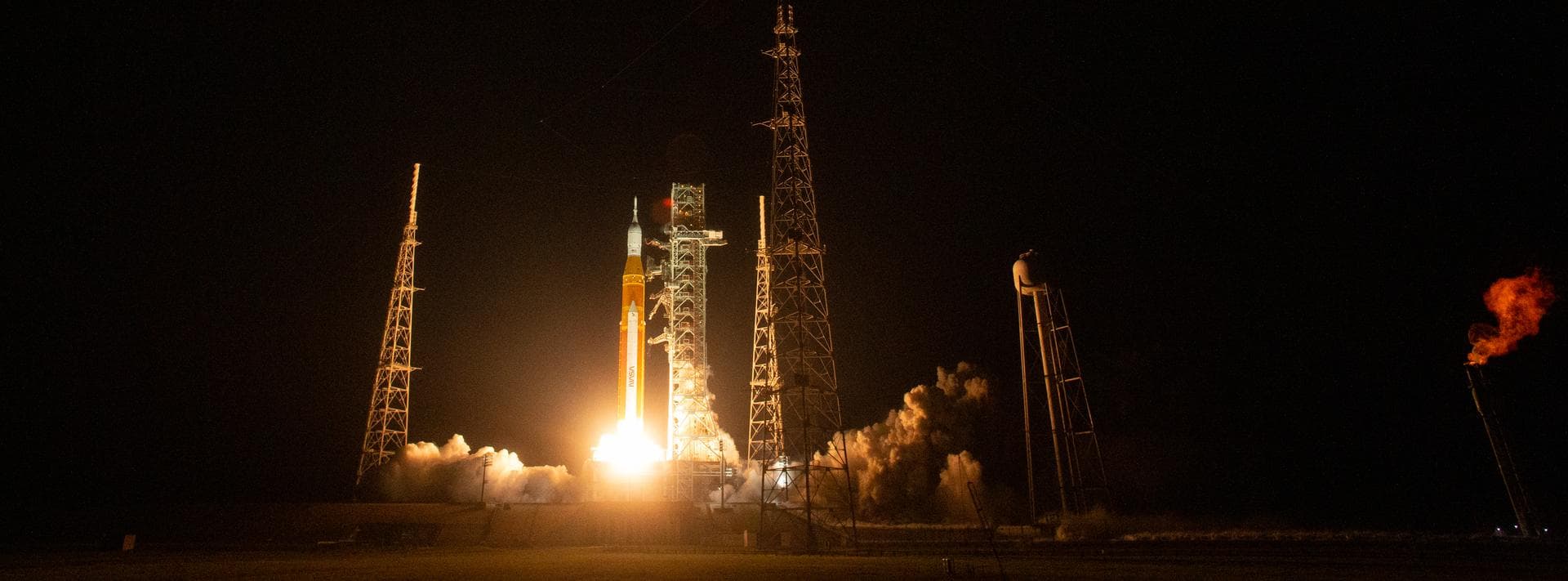
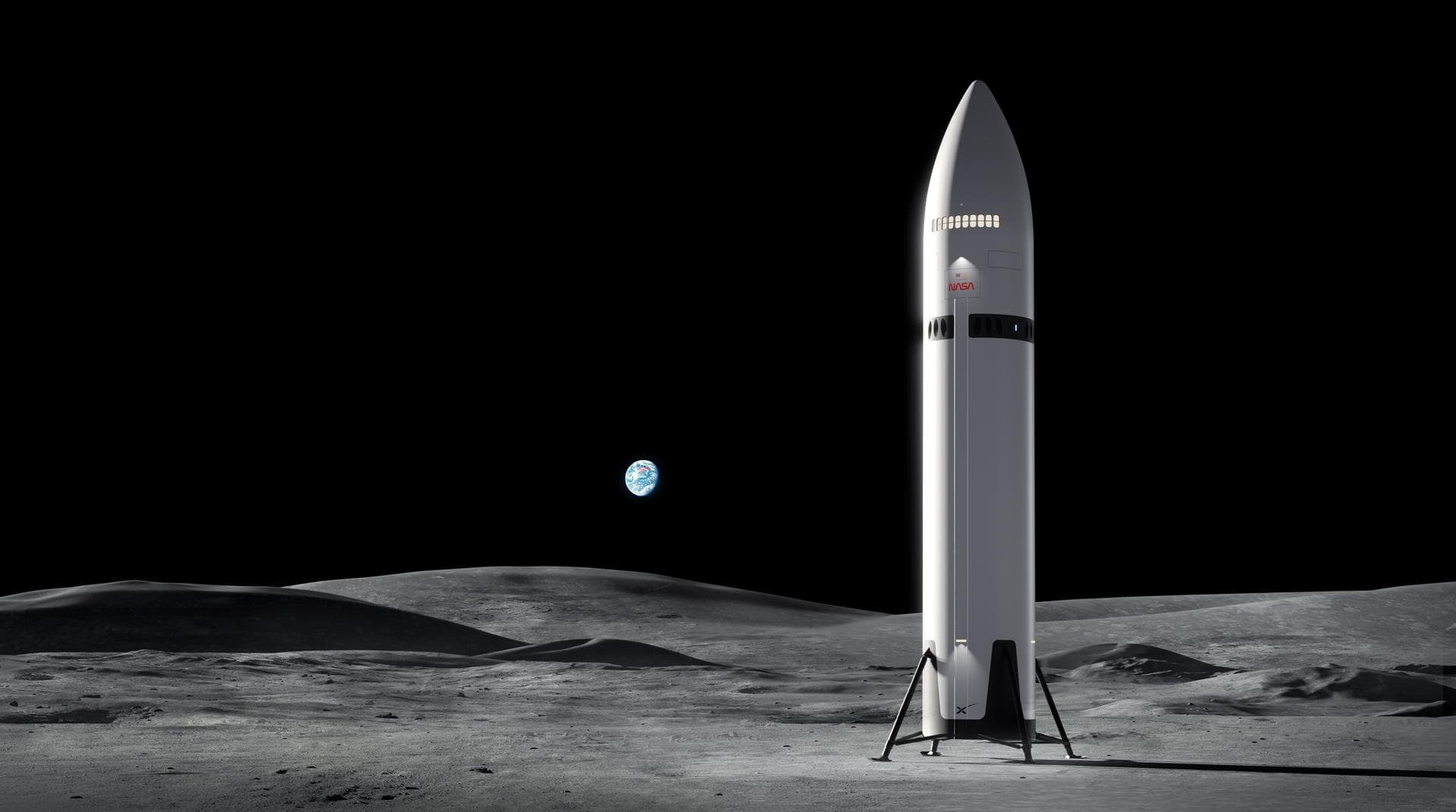
NASA's Space Launch System exceeds the Saturn V's liftoff thrust by about 15 percent but sends less mass to the Moon in its Block 1 form, which is the configuration that carried Reid Wiseman, Victor Glover, Christina Koch, and Jeremy Hansen around the Moon on Artemis II, launched April 1, 2026 from Launch Pad 39B.[15][16] SpaceX's Starship had flown 13 test flights by late July 2026, when the thirteenth deployed 20 Starlink satellites on a suborbital profile and the booster made a hard splashdown in the Gulf of Mexico; an orbital attempt was still ahead.[17] Both programs are aimed at the same destination the Saturn V reached, through the Artemis program.
References
- What Was the Saturn V? (Grades 5-8) - NASA.
- Stages to Saturn: A Technological History of the Apollo/Saturn Launch Vehicles (NASA SP-4206) - Roger E. Bilstein, NASA History Office.
- Apollo 11 Press Kit, June 26, 1969 - NASA.
- Apollo 17 Press Kit, November 1972 - NASA.
- Apollo by the Numbers: A Statistical Reference (NASA SP-2000-4029) - Richard W. Orloff, NASA History Division.
- Solving Combustion Instability and Saving America's First Trips to the Moon - NASA.
- Independent Review of the Failure Modes of F-1 Engine and Propellants System - Paul Ray, NASA Faculty Fellowship Program, Marshall Space Flight Center, 2002 (NTRS).
- 55 Years Ago: The Flight of Apollo 6 - NASA.
- 50 Years Ago: Solving the Pogo Effect - NASA.
- 50 Years Ago: The Launch of Skylab, America's First Space Station - NASA.
- First Saturn V Rollout Began an Era of Exploration - NASA.
- How much did the Apollo program cost? - The Planetary Society.
- NASA National Historic Landmarks - National Park Service.
- Saturn V at George W.S. Abbey Rocket Park - Space Center Houston.
- SLS (Space Launch System) fact sheet, October 2024 - NASA.
- Liftoff! NASA Launches Astronauts on Historic Artemis Moon Mission, April 1, 2026 - NASA.
- Super Heavy-Starship rocket chalks up mostly successful test flight, July 25, 2026 - Spaceflight Now.
- 50 Years Ago: NASA Cancels Apollo 20 Mission - NASA.
- Moon Walkers - NASA Science.
- Apollo 13: Mission Details - NASA.
- How Metallurgists Saved Apollo Rockets That Languished in the Ocean for Decades - National Institute of Standards and Technology.
- Recovered F-1 Engine Parts - The Museum of Flight, Seattle.