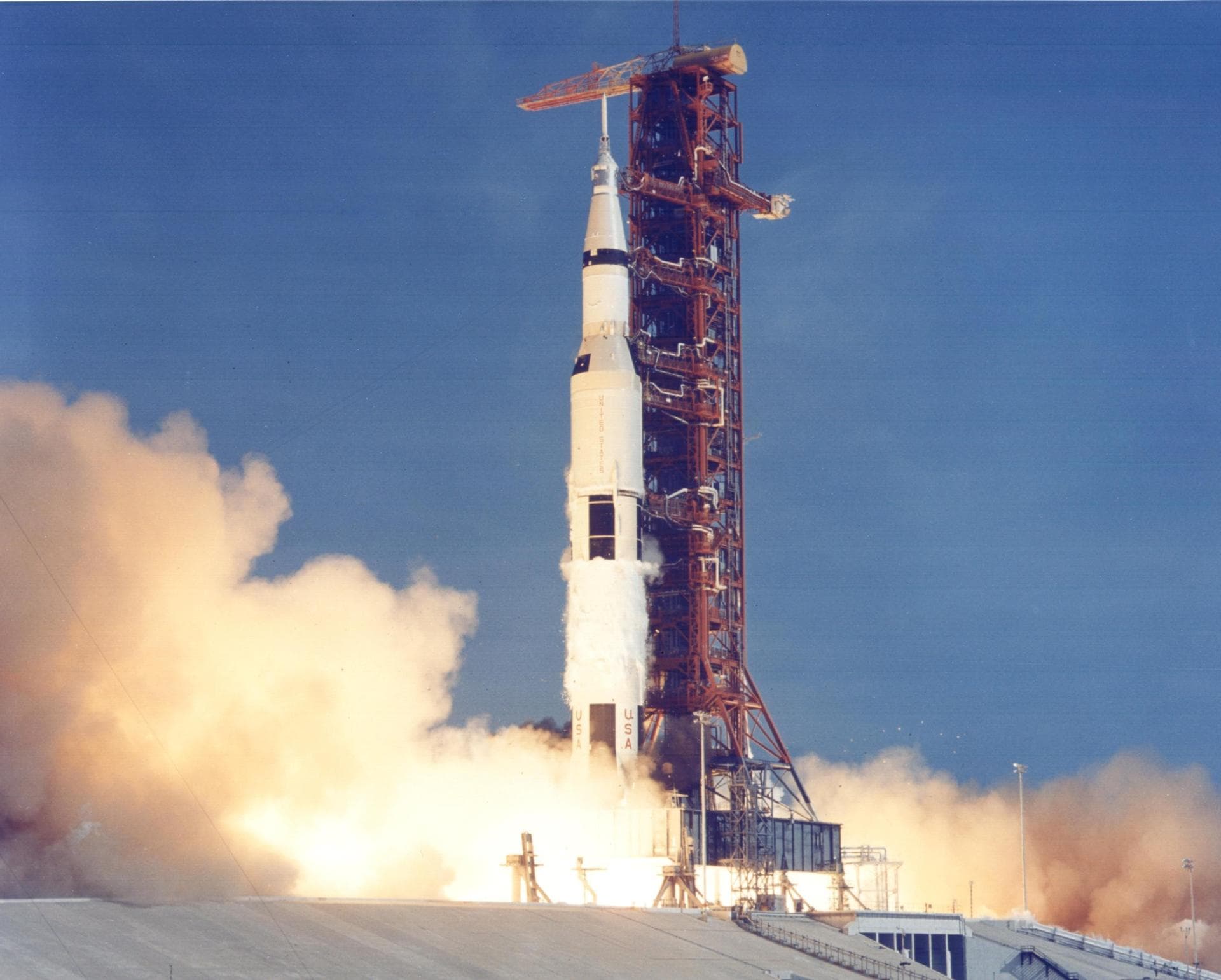
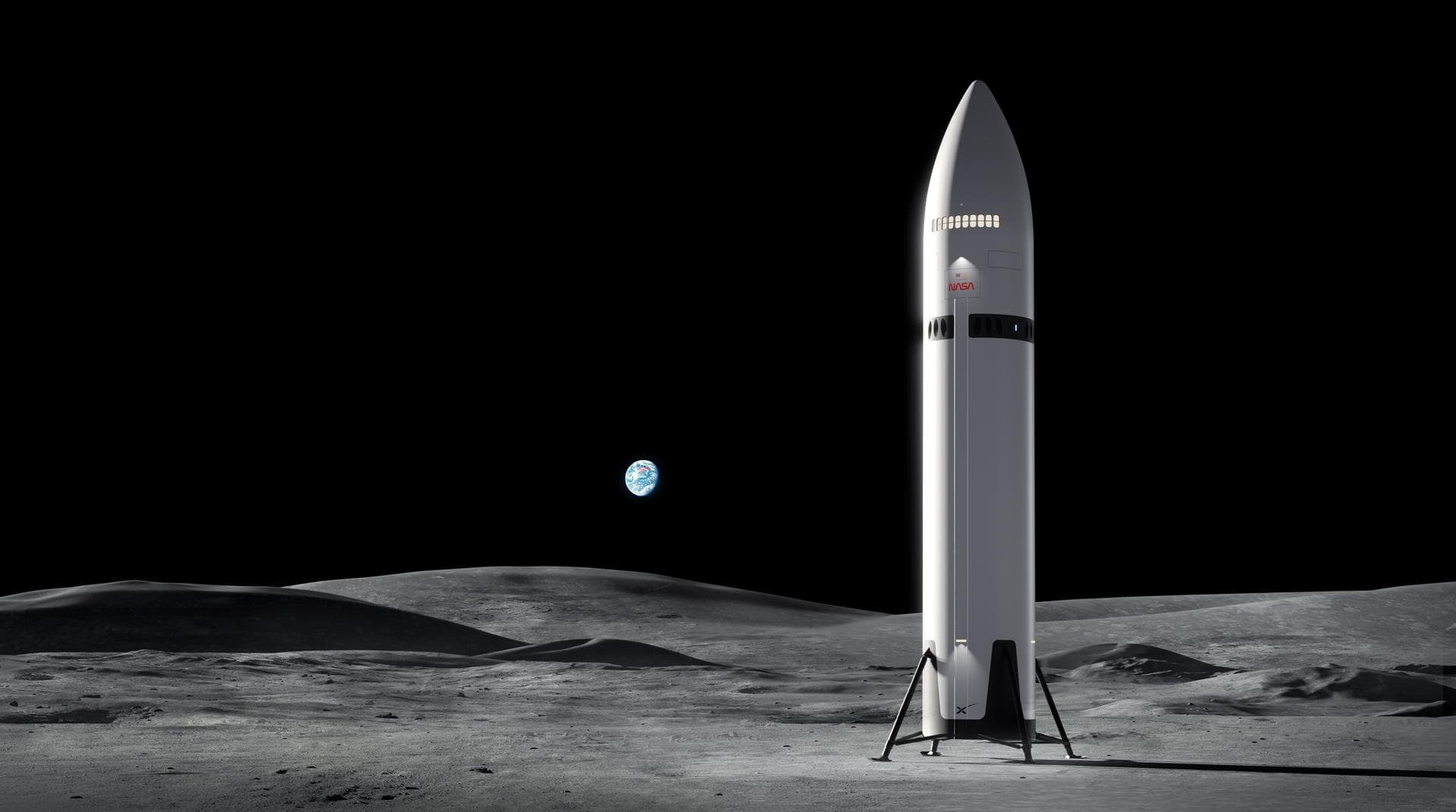
The Space Launch System (SLS) is NASA's super-heavy-lift rocket and the launch vehicle of the Artemis program. Standing 98 meters tall and producing about 8.8 million pounds of thrust at liftoff, it is the only rocket currently rated to send a crewed Orion spacecraft directly toward the Moon.[8] SLS has flown twice: the uncrewed Artemis I mission in November 2022 and the crewed Artemis II lunar flyby in April 2026.[2][9]
Built around hardware and suppliers inherited from the Space Shuttle, SLS produces 15 percent more liftoff thrust than the Saturn V, though it carries less payload.[8] The program is also among the most criticized in NASA's portfolio: each launch costs billions of dollars, the vehicle is fully expendable, and in February 2026 NASA cancelled its planned Block 1B and Block 2 upgrades to contain cost and schedule risk.[3][4]
Status as of August 2026
As of August 22, 2026, the third SLS is being assembled at Kennedy Space Center for Artemis III, a crewed Earth-orbit demonstration targeted for 2027: booster stacking on the mobile launcher began in early July, and the last of the four RS-25 engines arrived on July 21.[7][22][23] The rocket's funding held through another budget cycle. The fiscal year 2026 appropriations act, enacted in January, provides 1.308 billion dollars for SLS and rejects the administration's proposal to retire the rocket and Orion after Artemis III, directing NASA to include an SLS-based option in any future competition for Artemis launch services.[33][34] The administration's fiscal year 2027 request asks for 1.495 billion dollars, which keeps SLS flying through Artemis V while commercial replacements are developed.[21][33] The Government Accountability Office reported in July 2026 that the projects reshaped by the February replan, including the new upper-stage arrangement, were still setting revised cost and schedule baselines.[35]
Development
Congress directed NASA to build SLS in the 2010 NASA Authorization Act after the cancellation of the Constellation program, requiring reuse of Space Shuttle and Ares project contracts and hardware.[1] Boeing builds the 8.4-meter core stage, Northrop Grumman the five-segment solid rocket boosters, and Aerojet Rocketdyne (now part of L3Harris) supplies the RS-25 main engines, the same engine that powered the shuttle.[8] The first four flights draw on an inventory of 16 refurbished engines that flew shuttle missions; L3Harris has restarted the production line with a target of cutting engine cost by 30 percent, and the new-build engines it certified in early 2024 take over from Artemis V.[8] Restarting that line was expensive. A 1.16 billion dollar contract signed in 2015 covered the restart and the first six new engines, and a 1.79 billion dollar follow-on in May 2020 added 18 more, putting NASA's outlay for 24 new engines near 3.5 billion dollars, about 145 million dollars per engine.[29] The new engines run at 111 percent of the RS-25's original rated power and use modernized manufacturing, including 3D-printed components, to bring the price down.[30] L3Harris hot-fired the first new-build flight engine for a full mission duration of 500 seconds at Stennis Space Center in June 2025 and tested the second that November.[31]
The 2010 act set a goal of operational capability for the rocket's core elements by the end of 2016.[1] Delays in core stage manufacturing and the Green Run test campaign pushed the debut to November 2022, and NASA's Office of Inspector General has put SLS program costs at 23.8 billion dollars for fiscal years 2012 through 2025, about a quarter of the 93 billion dollars projected for the entire Artemis campaign over that span.[11]
Design and specifications
SLS Block 1, the configuration flown on Artemis I and II, weighs about 2,610,000 kilograms at liftoff and combines a four-engine core stage with two solid rocket boosters.[8] The boosters supply 7.2 million of the vehicle's 8.8 million pounds of liftoff thrust and burn out a little over two minutes into flight, leaving the core stage's four RS-25s to fire for roughly six more minutes.[8][25]
| Parameter | SLS Block 1 |
|---|---|
| Height | 98 m |
| Core stage diameter | 8.4 m |
| Liftoff mass | About 2,610,000 kg |
| Liftoff thrust | 39,100 kN (8.8 million lbf) |
| Core stage engines | 4 RS-25 (liquid hydrogen/liquid oxygen) |
| Boosters | 2 five-segment solids (Northrop Grumman) |
| Upper stage | Interim Cryogenic Propulsion Stage (1 RL10) |
| Payload to low Earth orbit | More than 95,000 kg |
| Payload to trans-lunar injection | More than 27,000 kg |
Block 1 pairs the core stage with the Interim Cryogenic Propulsion Stage (ICPS), a single-engine upper stage derived from the Delta IV, and can place more than 95 metric tons in low Earth orbit or send more than 27 metric tons toward the Moon.[8][24] The cancelled Block 1B would have replaced ICPS with the four-engine Exploration Upper Stage, raising trans-lunar payload to about 38-42 metric tons; a Block 2 with new boosters was to follow.[8] NASA dropped both variants, and the Exploration Upper Stage with them, in the Artemis replan announced on February 27, 2026, standardizing instead on what it calls a near Block 1 configuration.[3][4]
| Parameter | Block 1 | Block 1B (cancelled) |
|---|---|---|
| Upper stage | ICPS (1 RL10 engine) | Exploration Upper Stage (four engines) |
| Payload to trans-lunar injection | More than 27,000 kg | About 38,000-42,000 kg |
| Status | Flew Artemis I and II | Cancelled February 27, 2026 |
The SLS upper stage plan then shifted twice more. In early March 2026 NASA issued a sole-source contract to ULA for a version of the Centaur V stage flown on Vulcan Centaur, initially slated to debut on Artemis IV.[18] By May the manifest had settled: because the reshaped Artemis III mission stays in low Earth orbit, its rocket will carry an inert spacer with the same dimensions and interfaces as the ICPS, the last ICPS moves to Artemis IV, and Centaur V takes over from Artemis V.[19][20]
| Mission | Upper stage |
|---|---|
| Artemis I and II (flown) | ICPS |
| Artemis III (planned 2027) | Non-propulsive spacer |
| Artemis IV (planned 2028) | ICPS (final unit) |
| Artemis V and later (planned) | Centaur V |
Flight history
| Flight | Launch date | Upper stage | Result |
|---|---|---|---|
| Artemis I | November 16, 2022 | ICPS | Success; uncrewed Orion spent 25.5 days in space and splashed down December 11, 2022[9] |
| Artemis II | April 1, 2026 | ICPS | Success; first crewed flight, a 10-day lunar flyby ending with splashdown April 10, 2026[2] |
| Artemis III | Planned 2027 | Inert spacer | Crewed low Earth orbit demonstration with lunar lander test articles[7][19][20] |
| Artemis IV | Planned 2028 | ICPS (final unit) | Planned first crewed lunar landing of the Artemis program[4][7][19] |
Artemis I
The uncrewed Artemis I mission gave SLS its first flight on November 16, 2022, from Launch Complex 39B at Kennedy Space Center, after two scrubbed attempts and two hurricane delays.[36] The rocket performed almost exactly to prediction, sending Orion into a distant retrograde orbit of the Moon, and NASA's post-flight review concluded SLS met or exceeded expectations.[8][9] Orion spent 25.5 days in space, traveled farther from Earth than any spacecraft built for humans had before, and splashed down in the Pacific on December 11, 2022.[9]
Artemis II
Artemis II, the second SLS flight and its first with a crew, launched the first crewed Orion carrying NASA astronauts Reid Wiseman (commander), Victor Glover (pilot), and Christina Koch, along with Canadian Space Agency astronaut Jeremy Hansen.[2] The launch countdown began on March 30, 2026, and stayed clean until late on launch day, when the Eastern Range reported a communications problem with the rocket's flight termination system; engineers verified the hardware with a confidence test about an hour and 20 minutes before launch, and the count continued.[26][25] SLS lifted off from Launch Complex 39B at 6:35 p.m. EDT on April 1, 2026. The twin boosters burned out and separated 2 minutes 9 seconds into flight, and the core stage shut down its four RS-25s just past the eight-minute mark and separated, handing Orion to the ICPS.[25]
The upper stage finished the rocket's work over the next several hours. Its RL10 fired an apogee raise burn that lifted the high point of Orion's orbit, and after Orion separated, the spent stage doubled as the target for a manual piloting demonstration in which Glover flew approach and retreat maneuvers between roughly 300 and 30 feet, finishing about six minutes ahead of schedule.[27][28] The ICPS then deployed four cubesats from Argentina, Germany, Saudi Arabia, and South Korea and performed a disposal burn into the Pacific.[27] NASA's initial assessments reported that SLS placed Orion exactly where it needed to be, reaching an insertion velocity above 18,000 mph in what the agency called a precise bullseye, and that damage to the mobile launcher was far lighter than after Artemis I.[10][14] Orion's own service module engine performed the trans-lunar injection burn on April 2, a 5-minute 50-second firing that NASA called flawless.[27]
The 10-day free-return mission looped around the far side of the Moon, taking the crew farther from Earth than any humans before them and breaking the distance record held by Apollo 13 since 1970. Across the flight the crew covered 695,081 miles, photographed far-side terrain never before seen directly by human eyes, and observed a total solar eclipse. Orion splashed down off the California coast at 5:07 p.m. PDT on April 10, 2026.[2][5]
Artemis II verified Orion's life support, manual piloting modes, and communications on a lunar trajectory. It was the first crewed flight beyond low Earth orbit since Apollo 17 in December 1972.[2][5]
Cost criticism
NASA's Office of Inspector General has estimated the cost of a single Artemis launch (SLS, Orion, and ground systems together) at 4.1 billion dollars for each of the first four missions, a price tag the inspector general told Congress was unsustainable.[12] Its 2023 review examined NASA's plan to consolidate SLS production, integration, and launch under the Exploration Production and Operations Contract, a sole-source award to Deep Space Transport LLC, a joint venture Boeing and Northrop Grumman formed for the purpose, covering at least five and as many as ten flights. The audit found that a single SLS would still cost more than 2 billion dollars per flight and described NASA's goal of halving that figure as unsupported by analysis.[11] The Government Accountability Office reported the same year that senior NASA officials called the program unaffordable at current funding levels while the agency tracked costs without a per-mission baseline.[13] Because every stage is expended, none of that hardware is recovered. The White House's fiscal year 2026 budget proposal, released in May 2025, called SLS "grossly expensive," put its per-launch cost at about 4 billion dollars, described the program as 140 percent over budget, and proposed ending SLS and Orion after Artemis III in favor of commercial rockets.[3][6]
Congress pushed back. A reconciliation law signed in July 2025 appropriated 4.1 billion dollars specifically to keep building SLS vehicles for Artemis IV and Artemis V, ensuring the rocket's production line continues into the late 2020s regardless of the budget request.[15] The fiscal year 2026 appropriations act that followed in January 2026 went further: it funds SLS at 1.308 billion dollars, and its explanatory statement rejects the proposed termination outright, directs NASA to include an SLS-based option in any future competition for Artemis launch services, and bars moving money out of the Artemis transportation account until a commercial alternative demonstrates it can match SLS and Orion.[33][34]
The launch tower for Block 1B became its own overrun. NASA hired Bechtel in 2019 to build mobile launcher 2 for 383 million dollars; by August 2024 the inspector general projected the platform's cost could reach 2.7 billion dollars, roughly seven times the award value, and that it would not be ready to support a launch before spring 2029.[32] With Block 1B cancelled, NASA stopped work in late March 2026 and is salvaging parts from the unfinished tower as spares for the existing launcher.[14]
Cost pressure has already moved payloads off the rocket: the Europa Clipper mission, once assigned to SLS by law, launched on a Falcon Heavy in October 2024 under a launch contract of about 178 million dollars.[16][17]
Program future
NASA's February 2026 Artemis restructuring reshaped the SLS flight manifest. Artemis III, planned for 2027, is now an Earth-orbit mission in which an Orion crew will rendezvous and dock with pathfinders for the Starship and Blue Origin lunar landers rather than attempt a landing.[4][7][20] Artemis IV in 2028 is planned as the first crewed landing at the lunar south pole, with a possible Artemis V in late 2028 and at least one landing a year after that.[3][4][7] Both near-term missions fly the Block 1 core stage and boosters, Artemis III with the inert spacer and Artemis IV with the final ICPS, and NASA cited schedule stability and risk reduction, arguing that launching such a complex rocket only once every few years was unsustainable.[3][19]
The third SLS is taking shape for that schedule. Its core stage shipped by barge from Michoud Assembly Facility to Kennedy Space Center in April 2026, stacking of the twin solid rocket boosters on the mobile launcher began in early July, and the last of its four RS-25 engines arrived on July 21 for installation over the summer; the spacer standing in for the upper stage completed the final weld on its barrel section at Marshall Space Flight Center in early August.[22][23]
Beyond Artemis V the rocket's future is unsettled. The cancellation of the Exploration Upper Stage ended Boeing's largest planned SLS upgrade, and the administration's fiscal year 2027 budget request keeps SLS and Orion through Artemis V, asking 1.495 billion dollars for the rocket, while funding development of commercial replacements to take over afterward.[3][21][33] For now, SLS remains the only human-rated vehicle capable of dispatching Orion to the Moon in a single launch, and Boeing is building core stages for the missions beyond Artemis III at Michoud.[8]
References
- National Aeronautics and Space Administration Authorization Act of 2010 (Public Law 111-267) - U.S. Government Publishing Office, October 11, 2010.
- NASA Welcomes Record-Setting Artemis II Moonfarers Back to Earth - NASA.
- NASA revises plans for future Artemis missions, cancels upgrades to SLS - SpaceNews, February 27, 2026.
- NASA Adds Mission to Artemis Lunar Program, Updates Architecture - NASA, February 27, 2026.
- Artemis II - NASA.
- Proposed 24 percent cut to NASA budget eliminates key Artemis architecture, climate research - Spaceflight Now, May 3, 2025.
- NASA Marches Toward Artemis III Mission in 2027, Names Crew Members - NASA.
- SLS (Space Launch System) fact sheet - NASA, December 2025.
- Splashdown! NASA's Orion Returns to Earth After Historic Moon Mission - NASA, December 11, 2022.
- NASA on Track for Future Missions with Initial Artemis II Assessments - NASA, April 2026.
- NASA's Transition of the Space Launch System to a Commercial Services Contract (IG-24-001) - NASA Office of Inspector General, October 12, 2023.
- First Four Artemis Flights Will Cost $4.1 Billion Each, NASA IG Tells Congress - SpacePolicyOnline, March 1, 2022.
- Space Launch System: Cost Transparency Needed to Monitor Program Affordability (GAO-23-105609) - Government Accountability Office, September 7, 2023.
- NASA stops work on SLS Mobile Launcher 2 - SpaceNews, April 5, 2026.
- Republican-backed reconciliation bill passes, includes funding for ISS, Artemis programs, Space Shuttle relocation - Spaceflight Now, July 5, 2025.
- NASA Awards Launch Services Contract for Europa Clipper Mission - NASA, July 23, 2021.
- Liftoff! NASA's Europa Clipper Sails Toward Ocean Moon of Jupiter - NASA Jet Propulsion Laboratory, October 14, 2024.
- NASA contract confirms selection of ULA's Centaur 5 as new upper stage for the SLS rocket - Spaceflight Now, March 7, 2026.
- SLS to launch without upper stage for Artemis 3 - SpaceNews, May 13, 2026.
- NASA Outlines Preliminary Artemis III Mission Plans - NASA, May 2026.
- Trump FY2027 Budget Supports Moon Missions, But Cuts Everything Else - SpacePolicyOnline, April 3, 2026.
- NASA Rolls Out Artemis III Moon Rocket Core Stage - NASA, April 20, 2026.
- NASA Joins Artemis III Orion Modules; Rocket Hardware Update - NASA, August 5, 2026.
- The Great Escape: SLS Provides Power for Missions to the Moon - NASA.
- Artemis II Launch Day Updates - NASA, April 1, 2026.
- NASA's Artemis II Launch Mission Countdown Begins - NASA, March 30, 2026.
- Four Astronauts Headed to Moon After Successful TLI Burn - SpacePolicyOnline, April 2, 2026.
- Artemis II Flight Update: Apogee Raise Burn Complete, Crew Looks Ahead to Proximity Operations - NASA, April 1, 2026.
- Aerojet Rocketdyne defends SLS engine contract costs - SpaceNews, May 7, 2020.
- NASA Begins New RS-25 Engine Testing for Future Artemis Missions - NASA, December 13, 2022.
- L3Harris testing brand new RS-25 engines for future Artemis launches - NASASpaceflight, November 2025.
- NASA's Management of the Mobile Launcher 2 Project (IG-24-016) - NASA Office of Inspector General, August 27, 2024.
- NASA Appropriations and Authorizations: At a Glance (R43419) - Congressional Research Service, updated April 29, 2026.
- Great News for NASA in the House-Senate FY2026 Appropriations Report - SpacePolicyOnline, January 5, 2026.
- NASA: Assessments of Major Projects (GAO-26-108556) - Government Accountability Office, July 23, 2026.
- Liftoff! NASA's Artemis I Mega Rocket Launches Orion to Moon - NASA, November 16, 2022.