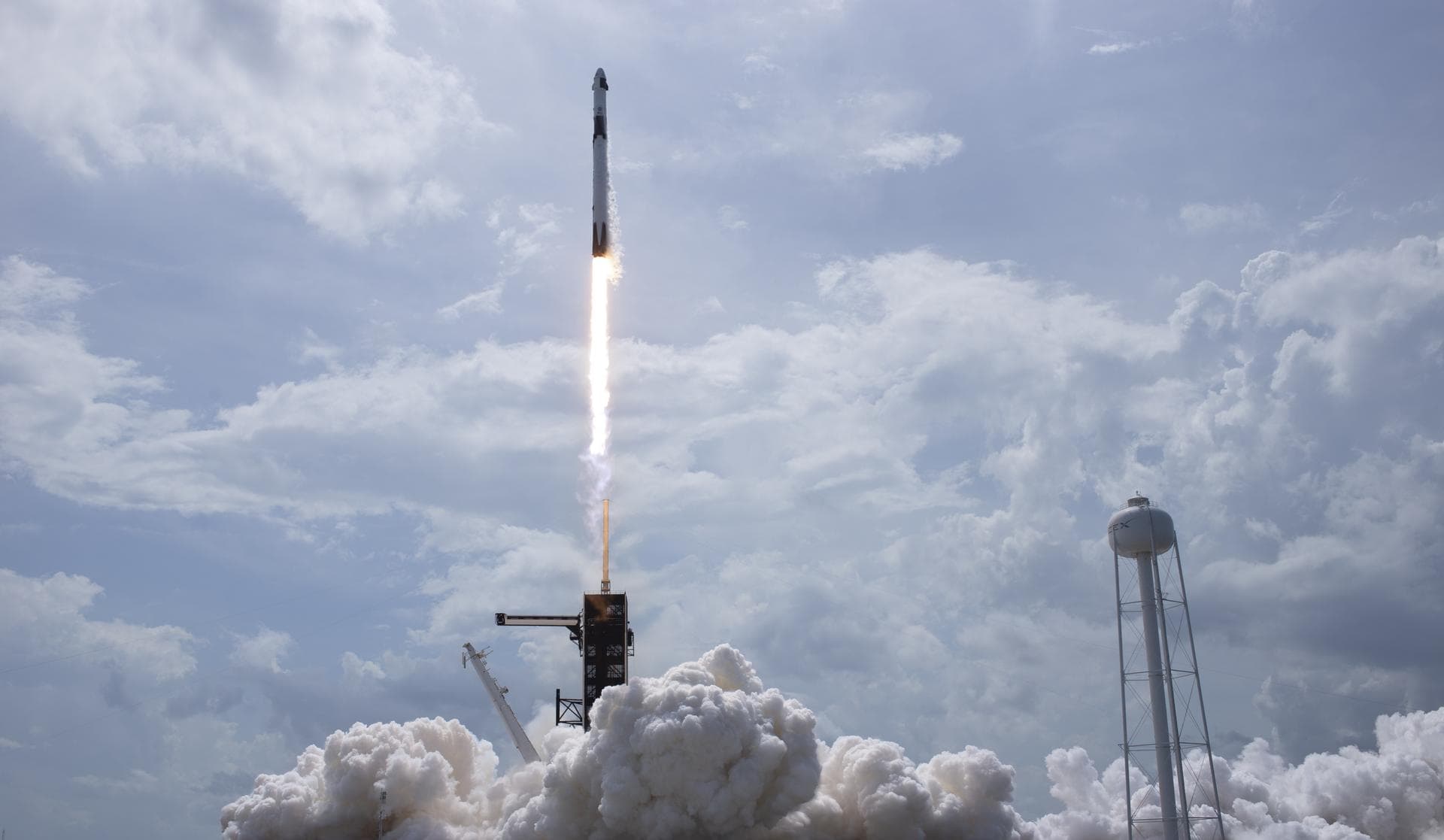
New Glenn is a reusable heavy-lift launch vehicle developed by Blue Origin. Named for astronaut John Glenn, the two-stage rocket stands 98 meters tall and is marketed to carry 45 metric tons to low Earth orbit or more than 13 metric tons to geostationary transfer orbit. Its 7-meter payload fairing has roughly twice the volume of a conventional 5-meter-class fairing. Seven BE-4 engines power a first stage designed to land on a ship and fly at least 25 times.[1]
New Glenn reached orbit on its first attempt on January 16, 2025. Its second flight, on November 13, deployed NASA's twin ESCAPADE probes and made Blue Origin the second company after SpaceX to land an orbital-class booster after a satellite launch.[2][3] The same booster flew again on April 19, 2026, after all seven engines were replaced, and landed a second time. That flight's upper stage placed AST SpaceMobile's BlueBird 7 satellite too low for it to survive, and the satellite was deorbited.[10][11][22][23]
On May 28, 2026, the vehicle prepared for New Glenn's fourth flight exploded during an integrated hotfire at Cape Canaveral's Launch Complex 36A. The rocket, a lightning tower, the transporter-erector, and hydraulic equipment were lost.[4][5] As of August 13, Blue Origin had located the anomaly's origin at a main oxygen valve on one BE-4 engine and was making retrofit modifications, but its remaining fault-tree analysis was still open. The company continues to target a return before the end of 2026.[14][15]
Status as of August 2026
As of August 13, New Glenn is operationally grounded, although the FAA's NG-3 flight investigation is closed. On May 22 the agency accepted nine corrective actions for the April upper-stage failure and authorized a return once licensing requirements are met. Six days later, the next vehicle was lost in an LC-36A hotfire, starting a separate company investigation and pad rebuild.[11][15] Blue Origin said on August 5 that the anomaly originated at one BE-4 engine's main oxygen valve, but it was still completing fault-tree analysis while manufacturing retrofit hardware due by month's end.[15] LC-36A reconstruction uses a crane-based horizontal and vertical process instead of replacing the transporter-erector. On August 12, the company also announced construction of LC-36B for the 9x4 variant.[4][24] Blue Origin still targets a flight before the end of 2026, but has announced no date or payload. NASA plans New Glenn second-stage tests at Stennis in fall 2026.[20]
Development
Blue Origin publicly introduced New Glenn in September 2016 after previously describing only an unnamed orbital launch vehicle. An FAA industry compendium published the following year listed 2020 as the planned first-launch year.[21] The design later changed substantially, including a switch from the originally proposed vacuum BE-4 upper-stage engine to two hydrogen-fueled BE-3U engines. The oxygen-rich staged-combustion BE-4 also powers the first stage of ULA's Vulcan Centaur, making Blue Origin both a launch competitor and ULA's engine supplier.[1]
The debut slipped while Blue Origin built its factory at Exploration Park, completed and qualified the engines, and rebuilt the former Atlas launch site at LC-36. Blue Origin says it invested more than $1 billion in the launch complex and located the factory, launch site, and refurbishment operations within a 14-kilometer radius.[1] The completed vehicle finally lifted off in January 2025, placing a Blue Ring Pathfinder into its intended orbit on the first attempt.[8][9]
Design and specifications
The operational model, now called New Glenn 7x2, has seven reusable BE-4 engines on its first stage and two restartable BE-3U engines on its expendable second stage. Blue Origin's current ratings give each BE-4 2,846 kilonewtons of sea-level thrust and each BE-3U 890 kilonewtons in vacuum. The advertised payload figures are 45 metric tons to low Earth orbit and more than 13 metric tons to geostationary transfer orbit.[1]
| Parameter | New Glenn 7x2 |
|---|---|
| Height | 98 m |
| Diameter | 7 m |
| Fairing | 7 m diameter, roughly twice the volume of a 5 m-class fairing |
| First-stage engines | 7 BE-4, liquefied natural gas and liquid oxygen |
| Liftoff thrust | About 19,900 kN, or 4.5 million lbf |
| Second-stage engines | 2 BE-3U, liquid hydrogen and liquid oxygen |
| Payload to low Earth orbit | 45,000 kg |
| Payload to geostationary transfer orbit | More than 13,000 kg |
| Booster recovery | Ship landing as far as 1,000 km downrange; designed for at least 25 flights |
During recovery, four fins and two large strakes steer the first stage before BE-4 engines restart for the final descent to the landing platform Jacklyn. The landing system has six legs. The fairing's volume is useful for payloads that are limited by physical size rather than mass, including large satellite batches and station modules.[1]
In November 2025, Blue Origin announced a phased upgrade program beginning with NG-3. The plan raised total first-stage thrust from 3.9 million to 4.5 million pounds-force and total upper-stage thrust from 320,000 to 400,000 pounds-force. Other planned changes include a reusable fairing, a lower-cost tank design, and reusable thermal protection on the booster.[17]
The same announcement introduced New Glenn 9x4, a larger variant with nine BE-4 engines, four BE-3U engines, and an 8.7-meter fairing. Blue Origin advertises more than 70 metric tons to low Earth orbit, more than 14 metric tons directly to geosynchronous orbit, and more than 20 metric tons to translunar injection. The company says 9x4 will operate alongside 7x2 but has not announced an entry-into-service date.[17]
| Parameter | New Glenn 7x2 | New Glenn 9x4 |
|---|---|---|
| First-stage engines | 7 BE-4 | 9 BE-4 |
| Second-stage engines | 2 BE-3U | 4 BE-3U |
| Fairing diameter | 7 m | 8.7 m |
| Payload to low Earth orbit | 45,000 kg | More than 70,000 kg |
| Payload to translunar injection | Not published | More than 20,000 kg |
Flight history
New Glenn has launched three times. NG-1 and NG-2 achieved their primary orbital objectives, while NG-3 failed to deliver its payload to a sustainable orbit. The first stage has landed on two of three attempts, and one booster has flown twice.[2][8][10][22]
| Flight | Date | Payload | Orbital result | Booster result |
|---|---|---|---|---|
| NG-1 | January 16, 2025 | Blue Ring Pathfinder | Planned orbit reached | Lost before the reentry burn |
| NG-2 | November 13, 2025 | NASA ESCAPADE and Viasat technology demo | Planned loiter orbit reached | Landed on Jacklyn |
| NG-3 | April 19, 2026 | AST SpaceMobile BlueBird 7 | Deployed too low and deorbited | Landed on Jacklyn on its first reflight |
NG-1 lifted off from LC-36 at 2:03 a.m. Eastern on January 16, 2025. Two burns by the BE-3U upper-stage engines placed the Blue Ring Pathfinder, which remained attached to the stage, into its planned orbit. The booster, "So You're Telling Me There's a Chance," was lost. The FAA later identified the proximate cause as an inability to restart the first-stage engines, which prevented the planned reentry burn, and accepted seven corrective actions before NG-2.[8][9][11]
NG-2 launched on November 13, 2025, carrying NASA's ESCAPADE spacecraft and a Viasat technology demonstration. Its first stage, "Never Tell Me the Odds," landed on Jacklyn about 600 kilometers off Florida.[2][3] The twin ESCAPADE probes are following a wide loiter trajectory around the Earth-Sun L2 region. They are scheduled to return past Earth for a gravity assist in November 2026 and arrive at Mars in September 2027, where they will study how the solar wind interacts with the planet's upper atmosphere.[12][13]
NG-3 launched on April 19, 2026, with BlueBird 7, an AST SpaceMobile direct-to-device communications satellite carrying a phased-array antenna of up to roughly 2,400 square feet. The mission reused the NG-2 booster, but Blue Origin replaced all seven of its BE-4 engines and said it planned to use the flown NG-2 engine set on later missions. The stage landed on Jacklyn again.[10][23]
The primary mission failed. The FAA found that a cryogenic leak froze a hydraulic line and caused a thrust anomaly during the second-stage burn. It closed the investigation on May 22 after accepting nine corrective actions, which it said it would verify before the next launch.[11] AST SpaceMobile reported that BlueBird 7 separated and powered on but was too low for its onboard propulsion to sustain operations. The satellite deorbited, and AST said it expected a replacement launch under its contract.[22]
2026 static-fire explosion
At about 9:00 p.m. Eastern on May 28, 2026, the booster "No, It's Necessary" exploded at the start of an integrated-vehicle hotfire at LC-36A. A fueled second stage was attached. The vehicle was being prepared for NG-4, the first New Glenn mission for Amazon Leo, with 48 satellites scheduled to launch as early as June 4. The payload had not been taken to the pad, and no one was injured.[5][25]
The explosion destroyed the vehicle and the transporter-erector and brought down a lightning tower. Blue Origin's June 30 assessment also listed the launch system's hydraulic cylinders as lost, but said the tank farm, Integration Facility, vehicle access tower, and water tower remained in good shape. Hardware recovery and debris removal were complete, pad reconstruction had begun, and the twice-flown booster plus three second stages stored in the Integration Facility were moved out safely.[4][6]
Rather than replace the transporter-erector, Blue Origin is changing LC-36A to a hybrid processing flow. The two stages are joined horizontally in the Integration Facility, rolled to the pad, turned upright and lifted onto the launch table by crane, and then mated with the payload vertically. Workers were installing new 88-foot doors on the Integration Facility by late July.[4][14][16] On August 12, the company announced that LC-36A would remain the 7x2 pad while the new LC-36B, a vertical integration building, and a payload processing facility were being developed for 9x4 and higher-cadence operations.[24]
Early analysis placed the anomaly in the aft end of the first stage. On August 5, Blue Origin said recovered hardware and inspections showed that it originated at the main oxygen valve on one BE-4 engine. Component tests and engine hotfires informed small valve changes that can be retrofitted to existing engines, with updated hardware expected by the end of August.[15] Because Blue Origin also said the remaining fault-tree analysis was still in progress, it had not issued a final public root-cause report. Its goal of flying again before the end of 2026 remains a company target rather than a scheduled launch date.[4][14][15]
Blue Moon and Artemis role
New Glenn is the launch vehicle for Blue Origin's Blue Moon lunar landers. The first robotic Mark 1 lander, Endurance, completed thermal-vacuum testing in NASA's Chamber A in May 2026. It is designed to demonstrate precision landing, cryogenic propulsion, and autonomous navigation while carrying a NASA camera package and laser retroreflector to the lunar south polar region.[18]
Blue Origin program officials said in July that the LC-36A accident moved Endurance's launch to no earlier than the first quarter of 2027, although NASA's July 24 release still described the Moon Base I mission as launching in fall 2026. Blue Origin has not announced a firm date while New Glenn remains grounded. The company has four Mark 1 landers in production, and a second is intended to deliver NASA's VIPER rover later in 2027.[7][19][20]
NASA also identifies New Glenn as a launcher for later missions that will land on the Moon. Under NASA's revised Artemis architecture, Artemis III is planned to test Orion rendezvous and docking in low Earth orbit with a pathfinder from Blue Origin, SpaceX, or both in 2027, before the first crewed south-pole landing targeted for Artemis IV in 2028.[20][29] Separately, NASA and Blue Origin plan to begin New Glenn second-stage hotfire testing at Stennis Space Center in fall 2026.[20]
Amazon Leo and national security missions
Amazon says it has 24 firm New Glenn launches for its Amazon Leo broadband constellation, formerly Project Kuiper. Initial New Glenn missions are designed to carry 48 satellites inside the 7-meter fairing. NG-4 was to be the first of those flights, but the rocket was destroyed before the encapsulated satellite stack reached the pad. Amazon and Blue Origin have not announced a replacement date.[5][25]
New Glenn is also working through a four-flight US Space Force certification plan for higher-assurance National Security Space Launch missions. The first three New Glenn flights counted toward that process, but the rocket was not yet certified for NSSL Phase 3 Lane 2 when the pad accident occurred, and Space Systems Command said the accident's effect on certification was not yet known.[28] Blue Origin nevertheless holds a Lane 2 requirements contract under which the Space Force projected seven mission awards beginning in the second order year.[27]
On the afternoon of May 28, hours before the hotfire accident, Space Systems Command also awarded Blue Origin its first firm national-security launch task order. The NRO mission is scheduled for the fourth quarter of 2027 through the first quarter of 2028 under the less restrictive NSSL Lane 1 program. The Space Force says Lane 1 does not require full launch-vehicle certification.[26]
References
- New Glenn - Blue Origin.
- New Glenn Launches NASA's ESCAPADE, Lands Fully Reusable Booster - Blue Origin.
- New Glenn launches NASA's ESCAPADE Mars mission, lands booster - SpaceNews.
- New Glenn Return to Flight - Blue Origin.
- Blue Origin's New Glenn rocket explodes during prelaunch testing at Cape Canaveral - Spaceflight Now.
- Blue Origin plans to fly New Glenn rocket again this year despite massive rocket explosion - Space.com.
- How Blue Origin's rocket explosion affects NASA's moon plans - Space.com.
- Blue Origin's New Glenn Reaches Orbit - Blue Origin.
- New Glenn reaches orbit on first launch - SpaceNews.
- Blue Origin launches third New Glenn rocket, but payload ends up in wrong orbit - Spaceflight Now.
- FAA General Statements: New Glenn mishap investigations - Federal Aviation Administration.
- ESCAPADE - NASA Science.
- Mission design - ESCAPADE, UC Berkeley Space Sciences Laboratory.
- Blue Origin identifies engine issue behind New Glenn explosion - Spaceflight Now.
- GS1-3 Hotfire Updates - Blue Origin.
- Blue Origin outlines return to flight logistics for its New Glenn rockets - Spaceflight Now.
- New Glenn Update: Upgraded Engines and Subcooled Components Drive Enhanced Performance - Blue Origin.
- Blue Origin Moon Lander Completes Testing at NASA Vacuum Chamber - NASA.
- Blue Origin continues work on lunar landers during recovery from New Glenn explosion - SpaceNews.
- NASA to Support Blue Origin New Glenn Rocket Testing, Advance Artemis - NASA.
- 2017 Commercial Space Transportation Compendium - Federal Aviation Administration.
- AST SpaceMobile Quarterly Report for the period ending March 31, 2026 - US Securities and Exchange Commission.
- Third flight of Blue Origin's New Glenn rocket to feature first reuse of booster - Spaceflight Now.
- Returning Launch Complex 36 to Two Pads - Blue Origin.
- Amazon Leo plans to double launch rate with 20+ missions in year two - Amazon.
- Space Force Awards Blue Origin Task Order to Launch National Reconnaissance Mission - Space Systems Command.
- Space Systems Command awards National Security Space Launch Phase 3 Lane 2 contracts - Space Systems Command.
- National security launch schedule not likely impacted by New Glenn disaster - Breaking Defense.
- NASA Marches Toward Artemis III Mission in 2027, Names Crew Members - NASA.