Elon Reeve Musk (born June 28, 1971) is a South African-born American entrepreneur who founded SpaceX on March 14, 2002, with roughly 100 million dollars of his own money[1][2] and serves as its chief executive officer, chief technical officer, and chairman of the board.[4] The company developed the first orbital-class reusable rockets under his direction[1][2] and had flown roughly 650 orbital launches by March 31, 2026.[4]
SpaceX under Musk also became NASA's primary crew transportation provider, built the world's largest satellite constellation, and is flight-testing Starship, the largest rocket ever flown, toward his stated goal of establishing a self-sustaining settlement on Mars.[1][2] Musk is also the chief executive of electric carmaker Tesla and controls several other companies, including the artificial intelligence firm SpaceXAI and the social platform X. His business record, political activity, and public statements have made him one of the most closely watched and most polarizing figures in technology. SpaceX's stock market listing in June 2026 pushed his paper fortune above one trillion dollars, the first time any individual fortune had been valued that highly, though the figure has since swung by hundreds of billions with the share price.[25][26] This article focuses on his role in space exploration.
Early life and first companies
Musk was born in Pretoria, South Africa, on June 28, 1971. He taught himself programming as a child and sold a video game he wrote at age 12. He left South Africa for Canada in 1989, then transferred to the University of Pennsylvania, earning bachelor's degrees in economics and physics in 1997. He enrolled in a Stanford graduate program in 1995 but left within days to start his first company.[1][2]
That company, the online city-guide firm Zip2, sold to Compaq in 1999 for about 307 million dollars. Musk then co-founded the online bank X.com, which merged into what became PayPal; eBay bought PayPal in 2002 for 1.5 billion dollars, leaving Musk, its largest shareholder, with the fortune he would soon spend on rockets.[1][2]
Founding SpaceX
Around 2001 Musk began exploring a project called Mars Oasis, a plan to land a small greenhouse on Mars to rekindle public interest in exploration. Trips to Russia to buy a refurbished missile as a launcher convinced him that launch prices, not public interest, were the limiting factor, and that a new company could build rockets far more cheaply than the incumbents. He founded Space Exploration Technologies Corp. on March 14, 2002, and invested roughly 100 million dollars of his own money.[1][2] He has said since that he expected to lose it, putting the odds that either SpaceX or Tesla would survive at around 10 percent.[32]
The gamble nearly failed. SpaceX's small Falcon 1 rocket failed on its first three flights, and by 2008 both SpaceX and Tesla were close to bankruptcy. On September 28, 2008, the fourth Falcon 1 reached orbit, making SpaceX the first private company to put a liquid-fueled rocket into Earth orbit, and in December NASA awarded SpaceX a 1.6 billion dollar cargo resupply contract that Musk has credited with saving the company.[1][2][4]
Role at SpaceX
SpaceX's IPO prospectus lists Musk as the company's founder, chief executive officer, chief technical officer, and chairman of the board, roles it says he has held since May 2002. Gwynne Shotwell is president and chief operating officer.[4] NASA identified him as SpaceX's "Chief Executive Officer and Chief Designer" at a 2012 briefing ahead of the company's first Dragon flight to the space station,[27] and a biography SpaceX supplied for a 2011 congressional hearing described his role the same way: "At SpaceX, Elon is the chief designer, overseeing development of rockets and spacecraft for missions to Earth orbit and ultimately to other planets."[35]
Colleagues and biographers describe him as directly involved in major design choices, from engine architecture to structures and materials.[1][2] The clearest documented example is the switch of Starship from carbon composite to stainless steel, which he announced and defended publicly in December 2018 on the grounds that steel is slightly better than composite in strength-to-weight terms at cryogenic temperatures, "vastly better" at high temperatures, needs much less thermal protection on reentry, and costs a fraction as much.[17]
The prospectus is also explicit about the limits of that involvement. It states that "although Mr. Musk devotes significant time to our businesses and is highly active in our management, he does not devote his full time and attention to our businesses and devotes time and attention to other significant roles", naming Tesla, Neuralink, and The Boring Company, and it lists dependence on him as a key-person risk for which SpaceX carries no insurance.[4]
His pay is tied directly to the Mars goal. On January 13, 2026, SpaceX's board granted him one billion performance-based restricted Class B shares that vest only if the company both clears 15 market-capitalization milestones and establishes "a permanent human colony on Mars with at least one million inhabitants". A separate grant of about 302 million shares depends on market-capitalization milestones plus completion of non-Earth-based data centers delivering 100 terawatts of compute a year. As of March 31, 2026, SpaceX judged both performance conditions improbable and had recorded no expense for either award.[4]
Key program decisions
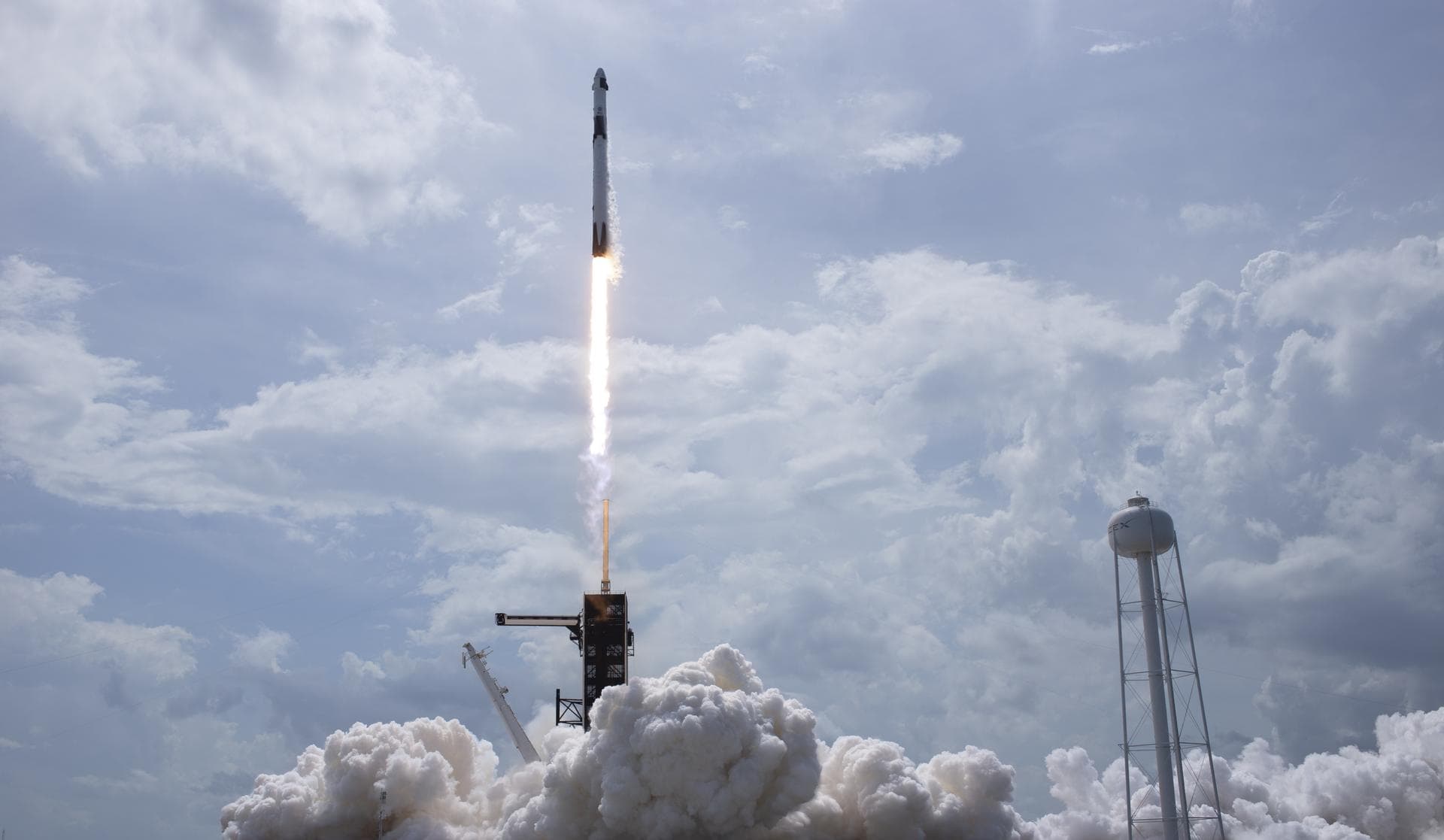
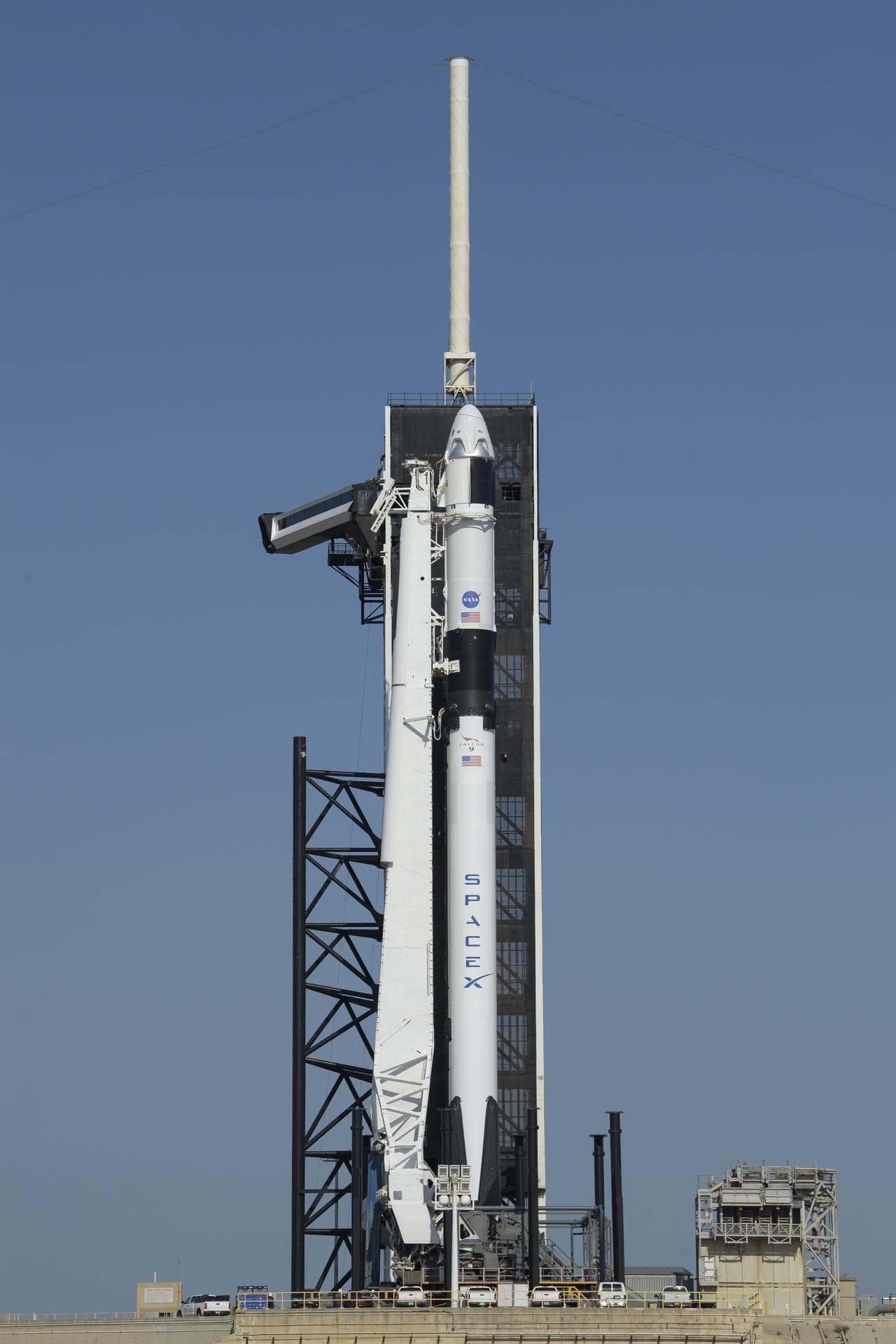
Reusability was the central program decision of Musk's tenure at SpaceX. Against prevailing industry judgment that recovering orbital boosters could not pay, he directed the company to land and refly Falcon 9 first stages. The first successful landing came on December 21, 2015, and the first reflight of a recovered booster on March 30, 2017.[20][21] By March 31, 2026, the company counted roughly 650 orbital launches, more than 540 of them flown on a previously used booster, and said Falcon rockets had carried more than 80 percent of the world's payload mass to orbit every year since 2023.[4] The fleet-leading booster made its 36th flight on July 9, 2026, and SpaceX flew 78 missions in the first half of the year.[5][22] The Dragon spacecraft that rides those boosters carried astronauts for the first time in May 2020 under NASA's Commercial Crew Program, the first crewed orbital flight by a private company, and continues to serve the International Space Station.[2]
A second decision was Starlink, approved in 2015 as a way to fund Mars development with satellite internet revenue. About 10,900 Starlink satellites were in orbit in early August 2026.[28] SpaceX reported 12.0 million subscribers at the end of the second quarter of 2026, double a year earlier, and 4.3 billion dollars of connectivity revenue for the quarter, which made Starlink both SpaceX's largest business by revenue and the only one of its three segments reporting operating income.[5]
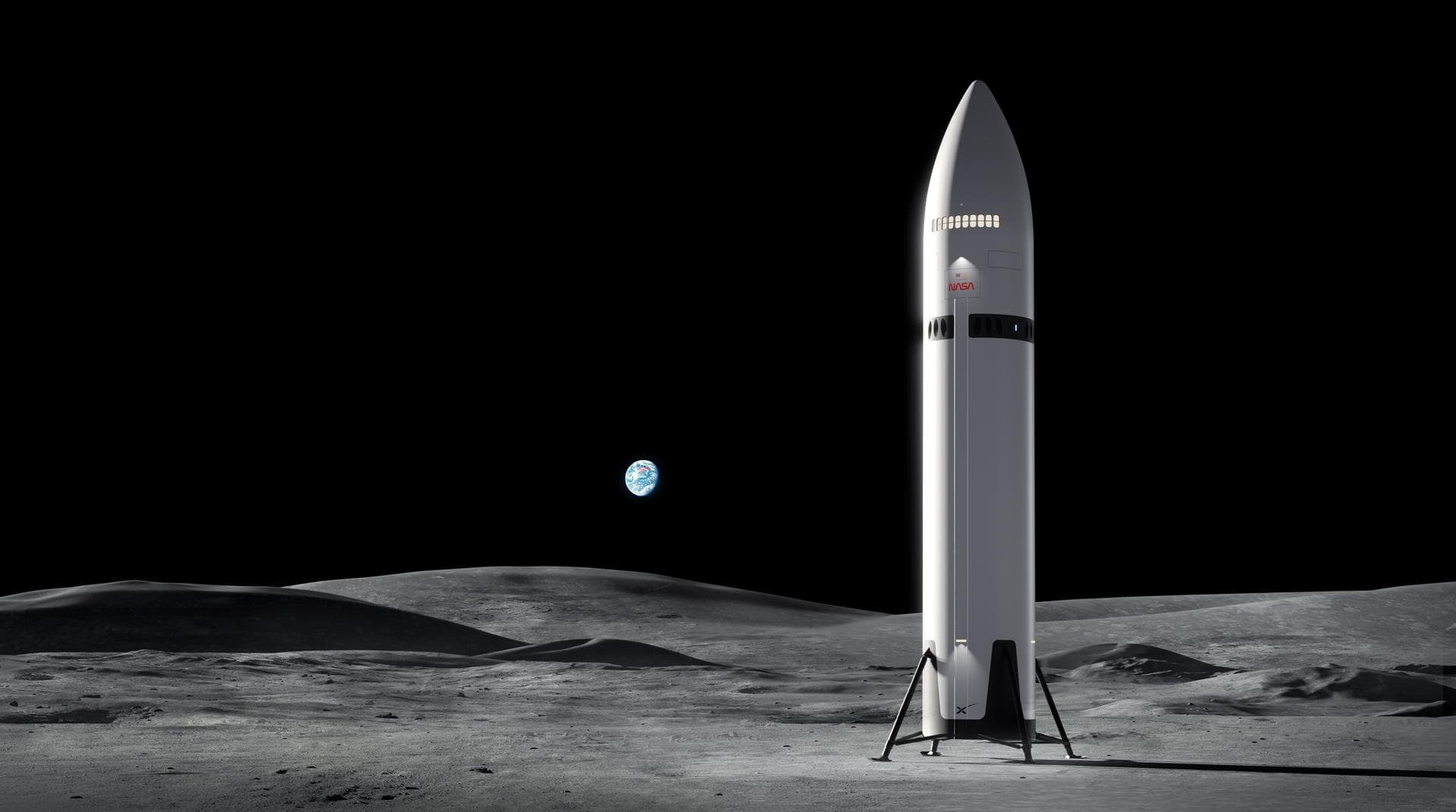
The third is Starship, a fully reusable two-stage vehicle designed to lift more than 100 tonnes. Musk pushed unconventional calls that defined the program: methane-fueled Raptor engines, stainless steel construction instead of carbon fiber, rapid build-test-fly iteration at the Starbase site in South Texas, and catching returning boosters with the launch tower. Thirteen integrated test flights have flown since April 2023. Flight 12, on May 22, 2026, introduced the larger Version 3 design,[6] and Flight 13, on July 24, 2026, released 20 Starlink satellites and ended with the ship intact and afloat after the softest splashdown of the program, though the booster was again lost.[23] NASA selected Starship in April 2021, under a 2.89 billion dollar firm-fixed-price award, as the crewed lunar lander for the Artemis program,[18] which flew astronauts around the Moon in April 2026.[19] Under lander plans revised in June 2026, Starship would dock with Orion in Earth orbit rather than lunar orbit, and the first crewed Artemis landing attempt is Artemis 4, planned for 2028.[33]
SpaceX milestones under Musk
| Year | Milestone |
|---|---|
| 2002 | Founds SpaceX with roughly 100 million dollars of his own money |
| 2008 | Falcon 1 reaches orbit; NASA cargo contract |
| 2012 | Dragon is first commercial spacecraft to berth with the ISS |
| 2015 | First landing of an orbital-class booster |
| 2017 | First reflight of a recovered orbital booster |
| 2020 | Demo-2, first private crewed orbital flight |
| 2021 | NASA selects Starship as Artemis lunar lander |
| 2023 | First integrated Starship flight test |
| 2026 | SpaceX absorbs xAI; Starship Version 3 debut and first satellite deployment; Nasdaq listing in the largest IPO on record |
Going public and Musk's control
SpaceX listed on the Nasdaq on June 12, 2026, under the ticker SPCX, selling 555.6 million shares at 135 dollars each and raising about 75 billion dollars, the largest initial public offering on record.[24] The stock closed its first day at 160.95 dollars, up 19 percent, and the paper value of Musk's stake made him the first person credited with a fortune above one trillion dollars.[25]
The listing did not loosen his grip on the company. SpaceX uses a dual-class structure in which Class B shares carry ten votes and Class A shares one. Musk held 849,494,440 Class A and 5,219,053,075 Class B shares at the offering price, about 82.4 percent of total voting power immediately after the sale, and Class B holders elect a majority of the board. The prospectus states plainly that he "will have the power to control the outcome of matters requiring shareholder approval, including election of all our directors, and to control our business and affairs".[4]
What the listing did change is that SpaceX now reports its finances quarterly and its share price moves in public. Musk's fortune peaked near 1.33 trillion dollars on June 16, 2026, then fell to about 684 billion by August 1 as SpaceX shares dropped 46 percent from their June high amid concern over the company's AI capital spending and an approaching unlock of 911.5 million restricted shares.[26]
The Mars goal
Musk has framed SpaceX's purpose since its founding as making humanity multiplanetary, arguing that a self-sustaining city on Mars is insurance against civilization-ending events on Earth. He presented an architecture for Mars settlement at the International Astronautical Congress in Guadalajara on September 27, 2016: a 122-meter methane-fueled Interplanetary Transport System of reusable boosters, ships carrying more than 100 people, and tankers to refuel them in Earth orbit, with development costed at roughly 10 billion dollars and a stated aim of a million people on Mars within 40 to 100 years.[14]
A year later, at the 2017 congress in Adelaide, he presented a smaller version: 9 meters in diameter instead of 12, 106 meters tall, 31 engines instead of 42, and intended to replace Falcon 9, Falcon Heavy, and Dragon with a single vehicle whose commercial work would pay for the Mars campaign.[15][16] The design was renamed Starship in 2018 and shifted from carbon composite to stainless steel that December.[17]
| Design detail | 2016 Guadalajara plan[14] | 2017 Adelaide revision[15][16] |
|---|---|---|
| Height | 122 meters | 106 meters |
| Diameter | 12 meters | 9 meters |
| Engines | 42 | 31 |
| Intended role | Mars transport system with ships carrying more than 100 people | Single vehicle to replace Falcon 9, Falcon Heavy, and Dragon |
The hard dependency in every version of the plan is orbital refueling. A Mars-bound Starship needs roughly 1,200 tonnes of propellant, about 933 tonnes of liquid oxygen and 267 tonnes of methane, which the consultant Donald Rapp has estimated at roughly a dozen tanker flights for every departing ship. SpaceX has transferred propellant between tanks inside a single vehicle but has not demonstrated a ship-to-ship transfer, and no Starship had reached a sustained orbit as of August 2026; the test flights that released Starlink satellites did so on suborbital trajectories.[7][23]
Stated Mars timelines
Musk's target dates have consistently run ahead of what SpaceX delivered. He has often labeled them aspirational at the time he gave them.
| Stated | Target given at the time | What followed |
|---|---|---|
| September 2016 | A robotic Dragon lander on Mars as early as 2018; crewed ships aspiring to launch in late 2024 | No Dragon Mars mission flew, and the vehicle design was replaced the next year[7][16] |
| September 2017 | Two uncrewed cargo ships in 2022, two crewed ships in 2024 | No Mars launch. Musk called the schedule "aspirational" when he presented it[15] |
| May 2025 | 50-50 odds of sending uncrewed Starships in the late 2026 transfer window | Dropped in February 2026 in favor of the Moon[13] |
| February 2026 | A lunar city in under 10 years; a Mars city started in about five to seven years | A stated intention; no mission has been scheduled[9][13] |
The shift to the Moon
On February 8, 2026, Musk wrote that "SpaceX has already shifted focus to building a self-growing city on the Moon, as we can potentially achieve that in less than 10 years, whereas Mars would take 20-plus years", adding that the company "will also strive to build a Mars city and begin doing so in about five to seven years".[13] His stated reason was iteration speed: lunar launch opportunities come roughly every 10 days with a two-day transit, while Mars windows open about every 26 months with a six-month crossing.[9][13] Reporting at the time said SpaceX had dropped the late-2026 Mars window and was aiming instead at an uncrewed lunar landing demonstration as early as March 2027.[13]
| Factor | The Moon | Mars |
|---|---|---|
| Launch opportunities | Roughly every 10 days | About every 26 months[9][13] |
| Transit time | About two days | About six months[9][13] |
| Stated city timeline | Under 10 years | 20-plus years; a start in about five to seven years[13] |
He has since sketched a larger lunar program. On SpaceX's August 2026 earnings call he described robotic satellite factories on the Moon, saying the idea "sounds like super sci-fi right now, but it's going to happen", and argued that manufacturing and generating power off Earth could eventually scale far beyond what the planet's surface allows.[29] None of it is a plan of record: no lunar or Mars landing mission has been scheduled, and the near-term program remains Starship flight testing, reuse, and refueling.[7][23]
Tesla and other ventures
Musk joined Tesla as an early investor and chairman in 2004 and became CEO in 2008; the company's Model S, Model 3, and Model Y helped move electric cars into the mainstream, and it now also builds the Optimus humanoid robot. He co-founded Neuralink (brain-computer interfaces) and The Boring Company (tunneling), bought Twitter for 44 billion dollars in 2022 and renamed it X, and founded the AI company xAI in 2023, which absorbed X in a 2025 all-stock deal.[1][2] SpaceX acquired xAI on February 2, 2026, in a stock-for-stock deal that valued the AI firm at about 250 billion dollars and the combined business at 1.25 trillion; the AI arm was renamed SpaceXAI in July 2026, while the parent kept the SpaceX name.[10][11] On SpaceX's August 2026 earnings call Musk announced Starmind, a planned constellation of AI-compute satellites developed with NVIDIA, saying SpaceX and its AI unit would rely exclusively on NVIDIA chips.[12] His compensation, workplace practices, and regulatory clashes, including a 2018 securities-fraud settlement with the SEC that cost him Tesla's chairmanship, have drawn repeated litigation and press scrutiny.[1]
Government service and politics
Musk spent heavily in support of Donald Trump's 2024 presidential campaign and, from January to May 2025, served as a special government employee leading the Department of Government Efficiency (DOGE), a cost-cutting initiative. He left the role on May 30, 2025, and had a brief, public falling-out with Trump in June 2025, for which he later expressed regret.[3][8] In July 2025 he said he had formed a new political party, the America Party;[30] as of August 2025 he had not filed the paperwork to register it with the Federal Election Commission, and no candidates had run under it.[34] He returned to running his companies full time and holds no government position, though he has kept spending on politics: by the end of June 2026 he had committed at least 90 million dollars to Republican campaigns in the midterm cycle, more than any other individual donor.[31] His political spending and statements, and content-moderation decisions at X, remain subjects of controversy in the United States and Europe; supporters credit him with reviving American launch capability, while critics fault his management style and public conduct.[1][3]
References
- Elon Musk - Wikipedia.
- Elon Musk | SpaceX, Tesla, xAI, X, & PayPal - Encyclopaedia Britannica.
- Elon Musk is leaving the federal government. What's next for DOGE? - NPR, May 30, 2025.
- Space Exploration Technologies Corp., Prospectus (Form 424B4) - U.S. Securities and Exchange Commission, June 12, 2026.
- SpaceX Reports Second Quarter 2026 Results (Form 8-K, Exhibit 99.1) - U.S. Securities and Exchange Commission, August 4, 2026.
- SpaceX launches more powerful Super Heavy-Starship rocket on test flight - CBS News, May 22, 2026.
- A Closer Look at SpaceX's Mars Plan - Aerospace America.
- Elon Musk may be gone but DOGE isn't done remaking the federal government - NPR, June 16, 2025.
- Elon Musk says SpaceX will prioritize establishing a city on the moon instead of building a Mars colony - Scientific American, February 9, 2026.
- Musk's xAI, SpaceX combo is the biggest merger of all time, valued at $1.25 trillion - CNBC, February 3, 2026.
- xAI is now officially known as SpaceXAI - Engadget, July 2026.
- Elon pledges to give Nvidia a virtual monopoly over the stars - The Register, August 5, 2026.
- Musk says SpaceX focus is on the moon rather than Mars - SpaceNews, February 9, 2026.
- SpaceX's Elon Musk announces vision for colonizing Mars - Spaceflight Now, September 27, 2016.
- SpaceX CEO Elon Musk updates Mars colonization plans - The Planetary Society, September 29, 2017.
- Musk unveils revised version of giant interplanetary launch system - SpaceNews, September 29, 2017.
- Musk teases new details about redesigned next-generation launch system - SpaceNews, December 2018.
- As Artemis Moves Forward, NASA Picks SpaceX to Land Next Americans on Moon - NASA, April 16, 2021.
- NASA Welcomes Record-Setting Artemis II Moonfarers Back to Earth - NASA, April 2026.
- Falcon 9 Launches Orbcomm Satellites, Lands First Stage - SpaceNews, December 22, 2015.
- SpaceX demonstrates rocket reusability with SES-10 launch and booster landing - SpaceNews, March 30, 2017.
- SpaceX launches Falcon 9 rocket on record-breaking 36th flight - Spaceflight Now, July 9, 2026.
- Super Heavy-Starship rocket chalks up mostly successful test flight - Spaceflight Now, July 25, 2026.
- SpaceX officially prices shares at $135 in the largest IPO ever - TechCrunch, June 11, 2026.
- SpaceX IPO closes up 19% and delivers the world's first trillionaire - TechCrunch, June 12, 2026.
- Elon Musk's fortune slumps to pre-SpaceX IPO levels after rout - Fortune, August 1, 2026.
- Elon Musk, SpaceX Chief Executive Officer and Chief Designer - NASA, April 16, 2012.
- Starlink Launch Statistics - Jonathan McDowell, Jonathan's Space Report, August 8, 2026.
- Elon Musk reveals SpaceX plans to build satellite factories on the moon - Scientific American, August 2026.
- Musk says he's formed the America Party. Here's what to know - PBS News, July 2025.
- Billionaires are flooding the midterms with cash - Fortune, July 27, 2026.
- Elon Musk thought there was a 'greater than 90% chance both SpaceX and Tesla would be worth $0' - CNBC, October 2, 2020.
- Revised Artemis lunar lander plans take shape - SpaceNews, June 2026.
- Elon Musk pushes back on report he's dropped plans for America Party - CNN Business, August 20, 2025.
- Elon Musk biography submitted to the House Committee on Science, Space, and Technology - U.S. House of Representatives, October 24, 2011.