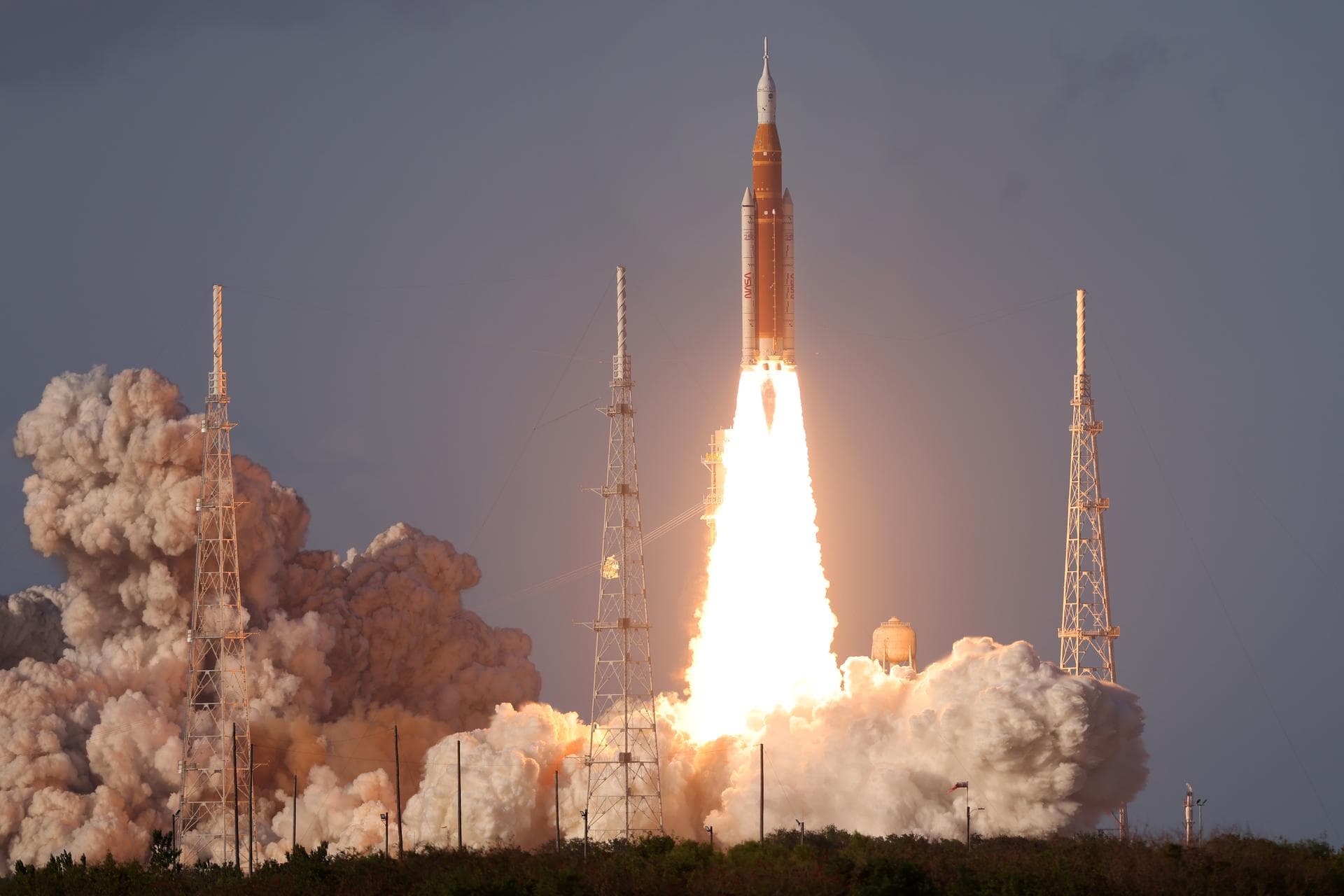
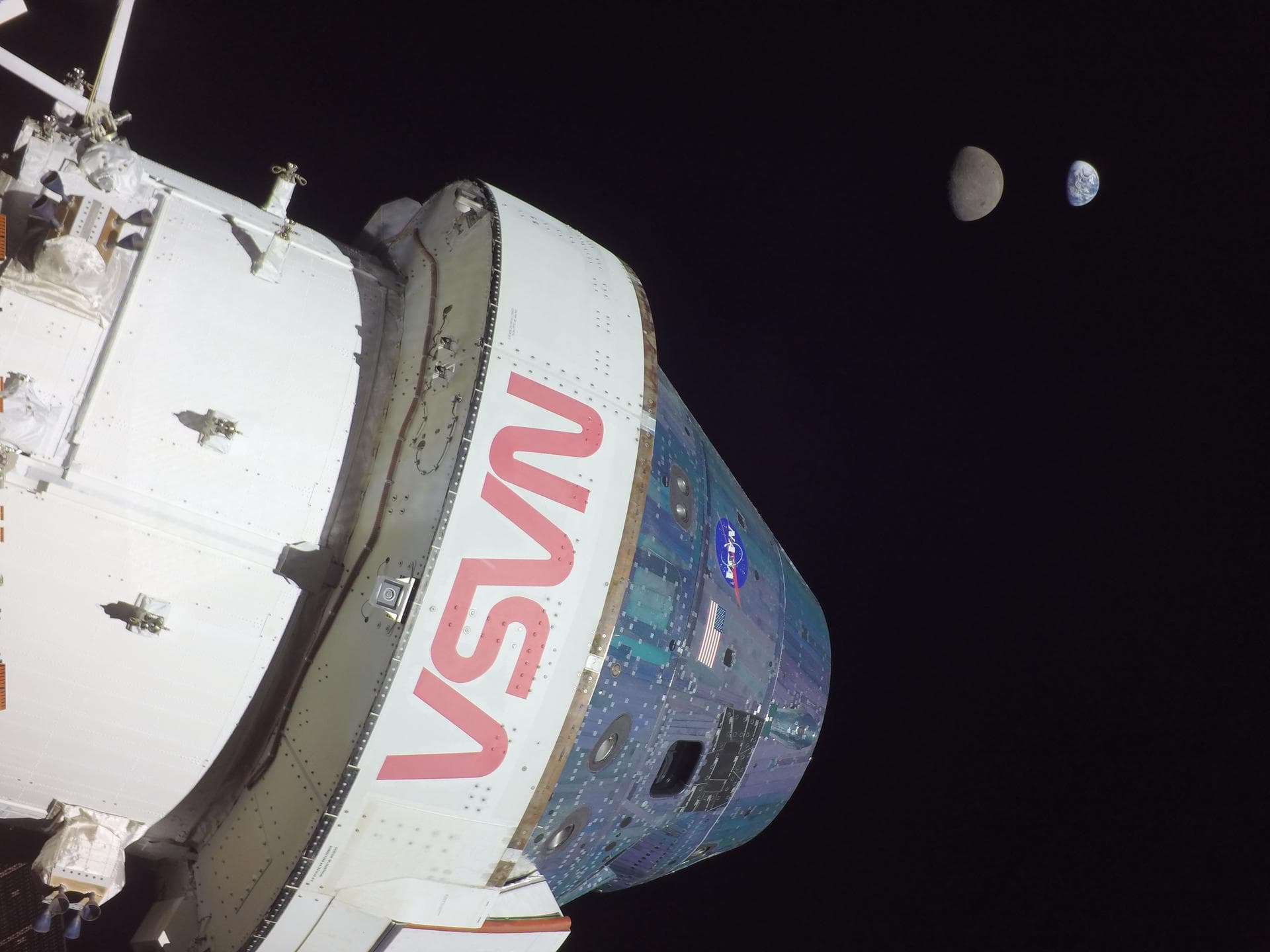
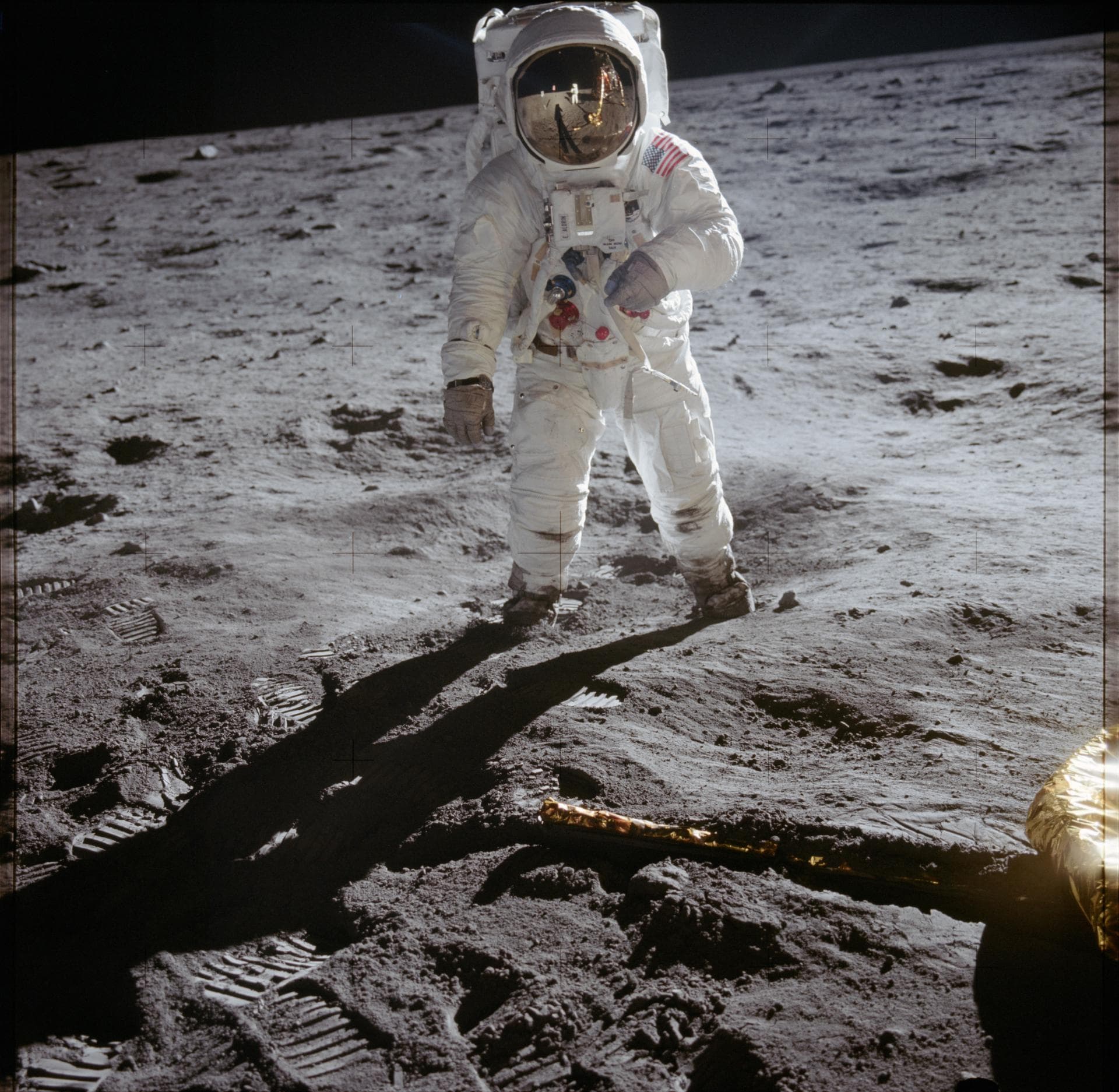
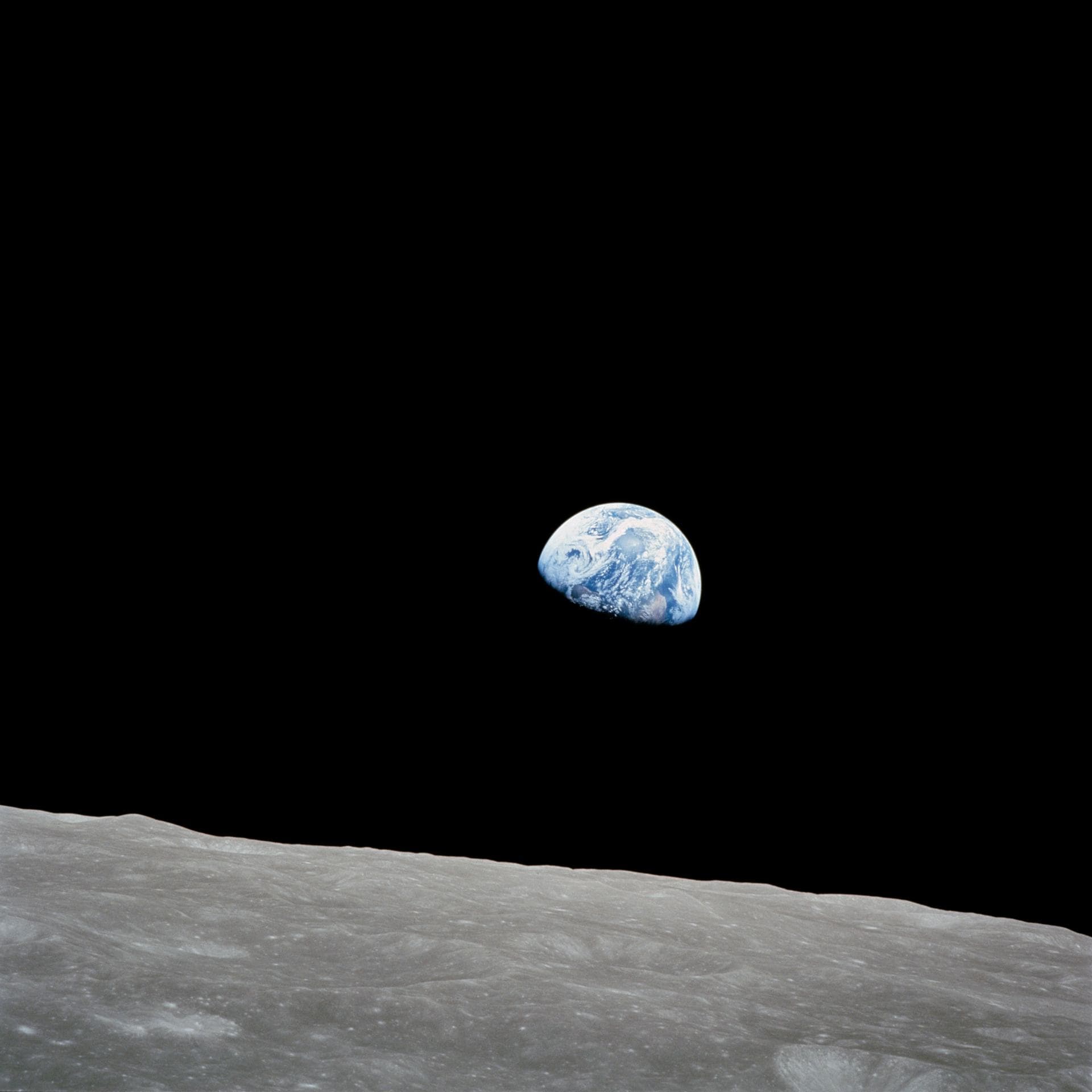
Kennedy Space Center (KSC) is NASA's launch site on Merritt Island, Florida, and the only place from which humans have left Earth orbit. Established in 1962 as the Launch Operations Center and renamed for President John F. Kennedy in November 1963,[1][2][3] the center occupies about 140,000 acres of barrier-island land and water beside Cape Canaveral.[5][6] Its Launch Complex 39 launched every crewed lunar mission of the Apollo program, from Apollo 8 in December 1968 through Apollo 17 in December 1972, all 135 Space Shuttle flights between 1981 and 2011, and the Artemis program's Artemis II lunar flyby in April 2026.[10][13][22]
The center employed 17,701 civil servants, contractors, and tenants at the end of fiscal year 2025 and had $2.65 billion in budget authority that year.[7] NASA now runs it as a multi-user spaceport: the agency launches the Space Launch System from Pad 39B, SpaceX leases Pad 39A, and Space Florida operates the former shuttle runway.[6][7][15][17] Together with the adjacent Cape Canaveral Space Force Station, a separate military installation, the spaceport hosted a record 109 orbital launches in 2025.[29]
Status as of August 2026
Kennedy's two large pads are in the middle of separate transitions. Launch Complex 39B launched the crewed Artemis II lunar flyby on April 1, 2026, and the four astronauts returned on April 10.[22][23] Solid rocket booster segments for Artemis III, a low Earth orbit docking test planned for 2027, began stacking inside the Vehicle Assembly Building in July.[24] At Launch Complex 39A, SpaceX flew its final Falcon 9 mission from the pad on December 17, 2025, removed the crew access arm in February, shifted Crew Dragon launches to Space Launch Complex 40 on the neighboring Space Force station, and is finishing a Starship pad under a January 30, 2026 FAA record of decision that permits up to 44 Starship launches a year. No Starship has flown from Florida yet.[25][26] Falcon Heavy still flies from 39A and passed its flight readiness review on August 21 to launch NASA's Roman Space Telescope on August 30.[27] The Space Coast's 109 orbital launches in 2025 set an annual record, and the range's commander expects 100 to 115 in 2026.[28][29]
History
From the Cape to Merritt Island
NASA's first Florida launch teams worked as tenants on Air Force property at Cape Canaveral, using 1950s buildings such as Hangar S for Project Mercury.[1] The Apollo commitment of 1961, made at the height of the Space Race, outgrew that arrangement almost immediately. On September 1, 1961, the agency asked for funds to buy land on Merritt Island, immediately north and west of the existing Cape pads; the first request covered a 200-square-mile area.[1] The Saturn V would need a launch complex built specifically for it.[8]
NASA established the Launch Operations Center as an independent field center on Merritt Island in 1962, created on March 7 and in place by July, with Kurt Debus as its first director.[1][2] In November 1963, in the week after President Kennedy's assassination, President Lyndon Johnson designated the center and Station No. 1 of the Atlantic Missile Range on the Cape together as the John F. Kennedy Space Center under Executive Order 11129, and NASA's part of the designation became the center's name that December.[1][2][3] The Air Force renamed its side Cape Kennedy Air Force Station, and the cape itself carried the name Cape Kennedy until public pressure in Florida returned the 400-year-old name Cape Canaveral in October 1973. The space center kept Kennedy's name.[1][4]
Building the Moonport
Construction on Merritt Island ran through the mid-1960s. Work on the Vehicle Assembly Building began in August 1963, the Operations and Checkout Building opened in the fall of 1964 to test Apollo command and lunar modules, and the center's headquarters building opened on May 26, 1965.[1][35] Launch Complex 39 was designed as a set: the assembly building, the adjacent Launch Control Center, two pads lettered A and B, and a crawlerway connecting them, so that rockets could be stacked indoors and carried upright to the pad.[1][11]
The first launch from the new spaceport was Apollo 4, the first Saturn V, which lifted off from Pad 39A on November 9, 1967.[8] Apollo 11 followed from the same pad at 9:32 a.m. EDT on July 16, 1969, carrying the first Moon landing crew.[9] Every Apollo crew that reached the Moon left from Launch Complex 39. Apollo 10, which lifted off on May 18, 1969 to rehearse the landing, was the only one to use Pad 39B; the pad later launched all three Skylab station crews in 1973 and the American crew of the Apollo-Soyuz Test Project in 1975.[12][13]
Shuttle decades
The Space Shuttle flew from the same two pads for 30 years. Pad 39A launched 82 of the 135 shuttle missions, including the first, Columbia's STS-1 in 1981, and the last, Atlantis's STS-135 in July 2011; the other 53 used Pad 39B.[10][13] By the time the shuttle retired, 39A had hosted 94 launches since 1967, counting 12 Saturn V flights.[13] A 15,000-foot runway, built in 1974 and opened for flights in 1976 as the Shuttle Landing Facility, let orbiters land back at the spaceport they left from.[17] Pad 39B also hosted the Ares I-X test flight in October 2009.[14]
Opening the spaceport to industry
The shuttle's retirement in 2011 left Kennedy with more Apollo-era infrastructure than NASA programs to fill it, and the center began signing its facilities over to commercial users. SpaceX signed a 20-year lease for Pad 39A on April 14, 2014, agreeing to operate and maintain the pad at its own cost.[15] Space Florida, the state's aerospace development agency, took over the shuttle runway under a 30-year property agreement in June 2015 and now runs it as the Launch and Landing Facility.[17][18] NASA opened the small Launch Pad 39C in July 2015 as a proving ground for small-vehicle companies.[16] By fiscal year 2025 the center described itself as "the nation's premier, multi-user spaceport," and its annual report counted hundreds of partnership agreements.[7]
Launch Complex 39 and major facilities
Launch Complex 39 remains the center's core: a vehicle assembly hall, a control center, a crawlerway, and the pads at its seaward end. NASA lists three vertical launch pads and one horizontal launch site across the property.[6]
| Facility | Origin | Current role, August 2026 |
|---|---|---|
| Launch Complex 39A | Built for the Saturn V; first used November 1967.[8] | Leased to SpaceX since 2014 for Falcon Heavy launches, with a Starship pad in final construction.[15][25] |
| Launch Complex 39B | First used by Apollo 10 in May 1969.[12] | NASA's "clean pad" for the Space Launch System; launched Artemis I and Artemis II.[12][22] |
| Launch Pad 39C | Concrete pad completed in 2015 inside the 39B perimeter area.[16] | Available for small-class vehicles with up to 200,000 pounds of thrust.[16] |
| Vehicle Assembly Building | Erected 1963-1966 for Saturn V stacking.[10][35] | Stacks SLS and Orion for Artemis; Artemis III boosters began stacking in July 2026.[10][24] |
| Launch Control Center | Built beside the VAB as part of the original LC-39 design.[1] | Countdown control for launches from the complex.[1] |
| Crawler-transporters | Two tracked carriers delivered in 1965.[11] | Crawler-transporter 2, upgraded for SLS, carries the mobile launcher to Pad 39B.[11] |
| Launch and Landing Facility | Runway built in 1974 for shuttle returns.[17] | Operated by Space Florida for aviation, testing, and spaceflight support work.[17][18] |
| Neil Armstrong Operations and Checkout Building | Opened 1964 for Apollo spacecraft checkout.[1][19] | Orion assembly in a Lockheed Martin high bay, plus the astronaut crew quarters.[19][20] |
The Vehicle Assembly Building is the complex's landmark. The 525-foot-tall, 518-foot-wide hall covers 8 acres, encloses about 130 million cubic feet, and was among the largest buildings in the world when its frame of 98,590 tons of steel was finished; its four high bays have processed 12 Apollo missions, 4 Skylab missions, the Apollo-Soyuz flight, the Ares I-X vehicle, and all 135 shuttle stacks.[10][35] High Bay 3 gained ten levels of retractable work platforms from 2014 onward to surround the SLS.[10]
Rockets reach the pads on one of two crawler-transporters, tracked machines 131 feet long and 114 feet wide that have run since 1965. Crawler-transporter 2, which weighs about 6.65 million pounds, picks up the mobile launcher with the SLS stacked on top and carries it 4.2 miles to Pad 39B at 1 mile per hour, a trip of about eight hours. Its upgraded capacity is 18 million pounds, 50 percent above the original design.[11]
Pad 39B shows how NASA rebuilt Apollo infrastructure for a multi-user era. The shuttle-era towers came down in favor of a "clean pad" with only the basics every rocket needs: power, water, a flame trench, and a safe launch area, so different vehicles can bring their own support structures and spend 10 days or less on the pad. Three 600-foot lightning masts ring the perimeter, taller than the VAB itself, and a rebuilt liquid hydrogen tank holds 1.25 million gallons.[12]
Cape Canaveral Space Force Station and shared geography
Cape Canaveral Space Force Station is a separate installation on the cape proper, across the Banana River from Merritt Island. The United States Space Force's Space Launch Delta 45 operates it along with the Eastern Range, the tracking and safety infrastructure that every launch from either site depends on; the station carried the name Cape Canaveral Air Force Station until December 2020.[28][30] Launch statistics for "the Space Coast" or "the Cape" normally combine the two installations. Of the 109 orbital launches in 2025, SpaceX flew 101, United Launch Alliance six, and Blue Origin two, most of them from Space Force pads.[29] Kennedy's own annual report counted 110 missions from the combined spaceport in fiscal year 2025, against a 2024 calendar-year record of 93.[7]
The station's pads carry most of the commercial traffic. Space Launch Complex 40 hosts SpaceX Falcon 9 launches, and since February 2026 all Dragon crew and cargo missions, with boosters returning to the adjacent Landing Zone 40.[26] United Launch Alliance flies Atlas V and Vulcan from Space Launch Complex 41, including Starliner missions for the Commercial Crew Program.[7] Blue Origin launches New Glenn from Launch Complex 36, and the Department of the Air Force approved rebuilding the former Delta IV pad at Space Launch Complex 37 for up to 76 Starship launches a year in November 2025.[21][31] Blue Origin builds New Glenn in a factory at Exploration Park, the research and manufacturing district just outside Kennedy's gates, and rolls the finished rockets to the Space Force station for launch.[6][21]
Most of Kennedy's acreage is undeveloped and managed as a wildlife refuge. The U.S. Fish and Wildlife Service established the Merritt Island National Wildlife Refuge in August 1963 as an overlay of the space center under an interagency agreement with NASA. The refuge covers more than 140,000 acres of dunes, saltwater marsh, scrub, and lagoon supporting over 1,500 species of plants and wildlife, and it manages the KSC lands not in active use for space operations. A second agreement in 1975 added Canaveral National Seashore along the coast to the north.[5] The undeveloped land doubles as a safety buffer, allowing launches over the ocean and away from populated areas, and NASA still holds about 8,000 acres available for future development.[6]
Current operations
Artemis is the largest NASA program at the center: Exploration Ground Systems drew $874 million of Kennedy's $2.65 billion in fiscal year 2025 budget authority.[7] The program stacks the SLS in the VAB, Lockheed Martin assembles each Orion crew capsule in the Neil Armstrong Operations and Checkout Building, and crews spend launch countdowns in that building's astronaut quarters before riding out to Pad 39B.[12][19][20] Artemis II followed that path on April 1, 2026, when the SLS lifted off at 6:35 p.m. EDT carrying Reid Wiseman, Victor Glover, Christina Koch, and Jeremy Hansen on the first crewed lunar flight since 1972.[22][23] Booster stacking for Artemis III began in the VAB in July 2026.[24]
SpaceX's tenancy at Pad 39A is changing shape. The pad's Falcon era began with the first Falcon Heavy launch in February 2018,[36] and Crew Dragon's Demo-2 test flight lifted off there in May 2020, restoring crewed orbital launches from the United States.[26][37] Through 2025 the pad also carried NASA science missions, among them Europa Clipper on a Falcon Heavy in October 2024 and the IMAP heliophysics observatory in September 2025.[7] After the FAA's January 2026 decision cleared up to 44 Starship launches and 88 landings a year from the pad, SpaceX moved Falcon 9 and all Dragon missions to SLC-40, kept Falcon Heavy at 39A, and continued building the Starship tower and flame trench alongside the Falcon pad.[25][26] The company hoped for a first Florida Starship flight before the end of 2026; none had occurred by August 22.[25]
Launches beyond those two programs keep the manifest full. NASA's Launch Services Program, based at Kennedy, buys rides for science missions such as the Roman Space Telescope, set for a Falcon Heavy launch from 39A on August 30, 2026, and Commercial Lunar Payload Services deliveries like Firefly's Blue Ghost, which left 39A in January 2025 and landed on the Moon that March.[7][27] Congress has backed the growing cadence with $1.3 billion through 2028 for range modernization under the Spaceport of the Future initiative.[28]
The workforce behind this activity totaled 17,701 people in 2025: 2,079 NASA civil servants, 5,868 contractor employees, 540 construction workers, and 9,214 employees of tenant organizations.[7] A fiscal year 2021 study credited the center with $5.2 billion in economic activity.[2] Brian Hughes became the center's leader in May 2026 under the new title of senior director of launch operations, a role that also oversees NASA's Wallops Flight Facility in Virginia.[34]
Visitor complex
The Kennedy Space Center Visitor Complex, just inside the main entrance, is the center's public face. Its Apollo/Saturn V Center, reached by bus tour past the LC-39 pads, displays a complete 363-foot Saturn V horizontally above visitors.[33] The Space Shuttle Atlantis exhibit, a $100 million building that opened on June 29, 2013, shows the real orbiter Atlantis tilted with its payload bay doors open, as only astronauts saw it in flight; Delaware North operates the complex.[32] Launch viewing, spacecraft artifacts, and astronaut presentations round out the site.[33]
References
- Creating NASA's Launch Operations Center - NASA History, March 29, 2023.
- Kennedy Space Center 60th Anniversary - NASA.
- Executive Order 11129: Designating certain facilities of the National Aeronautics and Space Administration and of the Department of Defense, in the State of Florida, as the John F. Kennedy Space Center - National Archives, Federal Register.
- Cape Kennedy Named - Florida Historical Society.
- Merritt Island National Wildlife Refuge: About Us - U.S. Fish and Wildlife Service.
- Optimal Location - NASA Kennedy Space Center Partnerships.
- Kennedy Space Center 2025 Annual Report - NASA, February 2026.
- Apollo 4 Was First-Ever Launch from NASA's Kennedy Space Center - NASA History.
- Apollo 11 Launch - NASA Science.
- Kennedy at 60: Vehicle Assembly Building Ready for New Era of Launch Vehicles - NASA, 2022.
- Crawler-Transporters Fact Sheet - NASA Kennedy Space Center.
- Launch Complex 39B - NASA.
- The Milestone Space Missions Launched from NASA's Historic Pad 39A - Space.com, February 2017.
- Ares I-X Launches! - NASA.
- NASA Signs Over Historic Apollo-Era Launch Pad to SpaceX - Space.com, April 2014.
- New NASA Launch Pad for Small Rockets Is Open for Business - Space.com, July 2015.
- NASA Signs Agreement with Space Florida to Operate Historic Landing Facility - NASA, June 22, 2015.
- Launch and Landing Facility - Space Florida.
- Operations and Checkout Facility, Kennedy Space Center - NASA.
- NASA's Artemis II Launch Mission Countdown Begins - NASA, March 30, 2026.
- New Glenn - Blue Origin.
- Liftoff! NASA Launches Astronauts on Historic Artemis Moon Mission - NASA, April 1, 2026.
- NASA Welcomes Record-Setting Artemis II Moonfarers Back to Earth - NASA, April 10, 2026.
- NASA's Artemis III Flight Hardware Stacks Up at Kennedy - NASA, July 13, 2026.
- FAA approves Starship launches from LC-39A - SpaceNews, February 5, 2026.
- Crew-12 launches to ISS - SpaceNews, February 13, 2026.
- Teams Complete Flight Readiness Review for NASA's Roman Telescope - NASA Science, August 21, 2026.
- Florida Space Coast tops 100 launches as Space Force pushes for range upgrades - SpaceNews, November 2025.
- SpaceX launches 2nd Space Coast mission of 2026 - Phys.org, January 2026.
- Cape Canaveral, Patrick Air Force Base renamed as Space Force bases - SpaceNews, December 9, 2020.
- SpaceX gets approval to build Starship launch complex at Cape Canaveral - SpaceNews, November 2025.
- Space Shuttle Atlantis Exhibit Launches at NASA Kennedy Space Center Visitor Complex - Space.com, June 2013.
- Apollo/Saturn V Center - Kennedy Space Center Visitor Complex.
- NASA Names Brian Hughes to Launch Operations Role - NASA, May 8, 2026.
- Vehicle Assembly Building at Kennedy Space Center - NASA.
- SpaceX successfully launches Falcon Heavy - SpaceNews, February 6, 2018.
- Commercial Crew Program Press Kit - NASA, updated February 13, 2026.